Country of origin: syria
Year of settlement: 2015
Age on arrival: 33
City: bochum
Gender: male
Language of the interview: Arabic
[i] I am happy and honored to have this meeting today, the third one, on the 15th of January, 2019. Here, in the Human Rights Association of the Middle East, in Weston Fender Strasse, in Bochum. I am [name], the president of the Human Rights Association of the Middle East, here in Bochum. The conversation is with you in the Oral History Program in Europe. Welcome, Mr. [name]. Please, introduce yourself. What brings you here today?
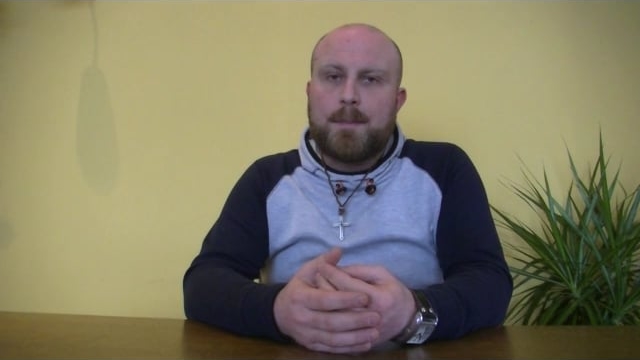
[r] I am [name], Syrian nationality. I have been married since 2006. I was born in 1982. I have three children. I have been living in Germany for three and a half years. I have a very nice memory. It was with me since I left Syria. It has accompanied me all the way. It was a memory from my father. I hope it will accompany me all the way and help us in our new life that we have chosen. It is this chain that is a symbol of our Christianity. I hope it will accompany us all our lives and help us to overcome the difficulties and problems that we may face. I believe in God that our life will be good and that it will continue in the best way.
[i] [name], what does this chain mean to you?
[r] To be honest, it means to me, from a Christian or religious point of view, that we are Orthodox Syrians, from the roots of the Aramaic language spoken by Jesus Christ, and it means a lot to me. It is a symbol of our faith and our Christianity, and our faith in Jesus Christ and the doctrine that we follow. As for the social aspect, we can say that it is a very nice and wonderful memory. It has remained in my family’s memory. As they say, it has accompanied me all the way. I hope it will satisfy my family. Thank God, we are very successful so that we can reach here safely. Thank God.
[i] How long have you been here?
[r] Since the 1st of July, 2015. On the 1st of July, 2015, I entered Germany. Mr. [name], you said that your fate is unpredictable. Did you come here with your family?
[r] To be honest, no. In those days, I separated with my wife and children in the middle of June, 2015, due to the circumstances in Syria. I went on the religious roads at the beginning of the road, and then on the non-religious roads, unfortunately. Until I entered Germany, and the necessary procedures took place until the time we stayed. Then I left my family. I came here about 10 months after I arrived in Germany.
[i] How are you today?
[r] Thank God, I am fine. But there is still something that we are living through. Thank God. We tried to integrate into the new society we entered into. I hope we are doing well. I don’t know. My children, thank God, are in schools. Everything is fine. We have done language courses here so that we can live and live our daily lives or adjust our things, as they say. We are currently looking for a job. I worked here for a very short time. I mean, not very long. But we are trying, God willing. There are certain difficulties that one can talk about more than that. But the circumstances are not helping us much right now due to language or other problems. We are trying to find a suitable job opportunity or the profession that we originally worked in in Syria. There are many difficulties in adjusting and in these problems. But, thank God, everything is going well. Our health is doing well, thank God. There is still something that always excites us. I don’t know if the foreigners in every country I mean, I expect that the longing for the child, for the country, for the family, for the relatives, for the beautiful memory, for the beautiful memory that you left in your country. I mean, this thing is always very difficult in countries of conflict, for sure.
[i] I am happy and honored to have this meeting today, the third one, on the 15th of January, 2019. Here, in the Association of Human Rights in the Middle East, in Westenfelde Strasse, in Bochum. I am [name], the president of the association, the speaker with you in the program of oral history in Europe. Welcome, Mr. [name]. Please, tell us about yourself. And tell me what brought you here today to start our conversation.
[r] Welcome, thank you very much. I am [name] from Syria, from the city of Homs, from a small village in the city of Homs called Sadat. I was born in 1982. I was born in Damascus. I have been married for about 14 years. I have three children. I have been living in Germany for about three and a half years. I have a very nice memory. I was expecting my third child since I left Syria. I don’t know…
[i] Show us on camera.
[r] Here you go. This was a memory from my father. May God prolong his life.
[i] Amen.
[r] I took it with me everywhere since I left Syria. And… And… I mean, she was… I consider that she was my support in every way. And… And we had a lot of problems, unfortunately, on the way. The more I touched her, I felt that she was very… She strengthened me. She helped me, maybe, to overcome the problem or the stage we were in. And… Thank God, in the end, everything went well and I arrived in Germany. This is from a religious point of view. Because… It means something to me that… our Christianity and our faith in Jesus Christ and that He always stands by us and is by our side in everything that we may be affected by. Badly. And from a social point of view, she is. .. I told you, I mentioned it in front of you, that she is a memory from my father. She dressed me with her before I left. And… I mean, I went on a trip. And… She keeps reminding me of my father, with a longing for the country, for the original scent of the Levant that is present in it. And, thank God, we arrived in the end safely. We started a new life. And… God willing, we will be able to talk about everything in more detail.
[i] Thank you for bringing us this beautiful and meaningful memory. Now, maybe we… If you need a week, we will put it in the exhibition. If you are ready to give it to us, we will be very grateful to you.
[r] No problem.
[i] We will return it to you, because it is very expressive and I liked the idea very much.
[r] I hope that it will be accepted by all of you. Of course, I don’t have a problem at all. But… I mean… It means a lot to me.
[i] We will return it.
[r] I hope… I hope that it will be preserved. Even if it remains with you, of course, I don’t have a problem. But I appreciate the true meaning of this story, and its meaning, and its value for all of us.
[i] Yes. Mr. [name], I remember that your father gave you this necklace. Is your father still well?
[r] No, unfortunately. My father, may he rest in peace, died when I was here in Germany, to be honest. About two years ago, he was about to die. And… This was the biggest disaster that might have happened. May God not try anyone, as they say. But… It was… It was a very big disaster in the West. I mean… In addition to the West, this death, this distance from our families, and the circumstances that might have happened to us, may be the West in itself. Not the West, which is only far away from them. After anything happens, or something difficult, and. .. You won’t be able to stand next to your family, next to your family, in your homeland. This is difficult.
[i] I didn’t ask you why you came to Germany.
[r] We came because of the recent circumstances that occurred in the country. The war, unfortunately, destroyed a lot. Not only did it destroy our hearts, but it destroyed our families, and our people. It destroyed the whole country, and the situation became very difficult. It was difficult. The living conditions were difficult. The financial situation was difficult. The social situation was difficult. The preservation of our souls, and the souls of our children, also for their future, was the main reason, of course, for the departure from the country. And… We went to Germany, and I am now settled here, in Bochum. Since I came to Germany, I have settled in the same area. It was a very difficult and difficult situation, and God willing, it will not be easy for anyone. Hopefully, one day, we will be able to… Even if we don’t continue in this country, or if we continue, we will be able to visit our country, and we will be able to go and come to Syria, because. I mean, in the end, the smell of the people in it, and the smell of the country in it, I mean, wherever a person goes, he will remain. .. His country is the most precious. we live, thank God, and we are happy, but the country, of course, we cannot get rid of it.
[i] Since you mentioned the country, the homeland, we will go back to our talk a lot, about Bochum, and we will talk in detail about Bochum, but let us go back to Syria, and the atmosphere of the country, and the atmosphere of your village. You mentioned that you are a Sadadi, from the village of Sadad. Is it a village or a city, Sadad?
[r] Sadad, is an Aramaic village, to be honest.
[i] Were you born in it?
[r] From Homs.
[i] Were you born in it?
[r] No, unfortunately, I was born in. We do not want to say unfortunately, that it is a country, and our country, and our people, but I was not born in my village, I was born in Damascus, I was born in Damascus, but I did not lose it, we never lost it, I mean, the world, the result of, as they say, the internal migration, that was taking place, most of the population, of the Syrian villages, left their villages, due to the circumstances, the living conditions, or something like that, in the country, in that period of time, and they went around the city. My father was, of course, one of those people, who went towards the city, and settled in Damascus. Sadat is a Christian Aramaic village, with a population of about 22,000 people, all of them are Christians, Syriac Orthodox, who speak the Syriac language, derived from the Aramaic language, that our Lord Jesus Christ spoke. And, there was a lot of people, in the circumstances, that took place in Syria, a lot of people came out of it, I think the population, is not more than 5,000, 8,000 people, I mean, between 5,000 and 8,000 people, approximately, currently. Although, it was even like this, when we were living in Syria, as a result of the migration, that I talked about a little while ago, the internal migration, that is in the country, in winter, I think, it is not more than 7,000 people, and in summer, about 20,000 people, who are in Sadat. Because, on a daily basis, there are occasions, there are celebrations, there are celebrations, there is a pleasant atmosphere, very nice, in the summer, the world spends, almost all of the summer, about three months in Syria, in the summer, so, it is a very nice village, and we hope to return to it, and we hope you visit us there, and the situation will be better in Syria, and the circumstances are suitable for its visit, and a long and nice stay in it.
[i] You mentioned that your mother is still in the same village of Sadat, do you have any siblings?
[r] I have two brothers, young people, one was a traveler, before he came here, in the direction of Germany, and one stayed in Syria, to be with my family, in their old age, and in the living conditions, and so, of course, you need someone from the children, to stay with the family, and I cannot say that, we preferred ourselves, than our brother, in this thing, and we got out of the circumstances, that were present, during his stay in Syria, but it was his choice, plus, it was his family’s choice, and his wife’s job, his commitment to the state, in the state’s job, it was the best choice, to stay with the family in Syria, and the other brother, is currently here, in Bochum as well.
[i] Is there any communication between you two?
[r] There is, of course, but, I can also tell you, that the current situation, in Syria, my brother, unfortunately, for about a year, although, he is the only one, who is in Syria, for my family, this is something, that we are, sorry, we are feeling sorry for him, we withdrew, to the compulsory service, in Syria, the compulsory service, of course, is to finish, the compulsory service, for more than, 15 years, maybe, but, as a result, of the war, we withdrew, to the compulsory service, in the Arab-Syrian army, and, from these circumstances, the communication, with him, started to decrease, through the internet, or by phone calls, or something like that, he doesn’t have, this service, of course, during his service period, with the parents, thank God, there is communication, also, a little bit, as a result, of the power cut, I mean, the circumstances, also, a little bit, I mean, there are many things, that distract this thing, but, I mean, thank God, we are still able, to communicate with him, to make sure of him, of his health, about, his necessities, if something is missing, and, thank God, things are fine, no problem.
[i] This is, a very, comforting thing, that there is communication from Bochum to Sadad. And, to talk to the mother, and, of course, you said, that you are a family father, and you have children, so, this thing, makes you happy, as an older woman?
[r] Of course, otherwise, I mean, maybe, even, the happy, the weeping, as they say, I mean, the means, of social communication, that, became present, that, thank God, comforted us, a lot, in the communication, with the parents, otherwise, it was, a very big problem, the weeping, is hard, if, there is no communication, with the parents, also, for the communication, with the children, with, with, their uncle, with the children, with their uncle, with their parents, with their mother, there must be, a way, to be able, to communicate, with each other, not to forget, their country, not to forget their parents, not to forget their language, to continue speaking the language they must speak.
[i] The mother tongue.
[r] The mother tongue, of course. No one can abandon their language. On the contrary, it is an honor for us to be able to speak two or three languages for our children. This is very good. In addition, I hope that the circumstances will be better in the coming days. And we will be able to go to Syria and meet them. It won’t be their first meeting. It won’t be that these people don’t know them because they are their parents. We are very comfortable with the ways of communication through communication with the parents and knowing what is happening with them, what is happening with us, how life is going on on both sides so that there is no disconnection, there is no surprise in new things happening. No one knew what was going on.
[i] Of course, due to the global disconnection and the lack of communication, I want to talk about your childhood.
[r] My childhood. It was very beautiful. Syria, in fact, from my personal point of view, was a country where there was coexistence. What I saw or what I knew at that age. We lived in a neighborhood of about 200 houses. I am talking about the initial stage of education at the age of 12. It was called Kabbas. And the neighborhood was composed of co-consistent houses. All the houses in Levant were known to be close to each other. The doors to each other, the neighbors to each other, the parents to each other. We lived in a neighborhood that was all of our brothers, of Islam. And there was only one Christian family in the neighborhood. Even the school The school I studied in, I think there was no one else, or only me and another person, but Christians But we did not feel this talk at all in the age we were in, in the childhood we lived in Until I entered more than one class, more than one lesson And I study Islamic religious education And I memorize even some of the Fatihah, some of the simple chapters of the Holy Qur’an From entering these classes and studying with my friends I can’t leave them only with the religious lessons It was a very nice life, thank God, my father’s work was good And we live, thank God, comfortably Schools are good and education is free in Syria There is no additional cost for the study of the child in school And we passed this stage I was good in school I can tell you that I was superior in this stage And the stage after that I transferred to another school This story about the house and the school is a little further away And the house was changed here We lived in another area in Damascus Until I reached the secondary school I studied at Umayyah secondary school A well-known secondary school in Damascus In the neighborhood of Al-Assa’ They call it Al-Assa’ It is a excellent secondary school But unfortunately in the middle of the secondary school Let’s say the last year of it In the baccalaureate, they call it in Syria I was subjected to a fall I mean an accident that we can call it simple at home. I fell from the terrace in the room. And I had problems in my back. I had to do a disc operation at that time. And unfortunately I did not do the examination at all. This was a very bad situation. That we did not do the exam. And I had to the next year. I returned to the baccalaureate. I submitted and succeeded. And entered the secondary school. In the middle of the secondary school the life of the baccalaureate was also very beautiful. Here one became a young man. Became friends. Young men, young women. A new society. A new area. The baccalaureate that I studied in it was very beautiful. I mean its name is the Middle Agricultural Baccalaureate. It was an area. The whole area is full of very beautiful forests. Gardens, the manholes in the institute. There were cows Cows’ barns For those who work in the animal production department from the Agricultural Institute The views were very beautiful. The atmosphere was very nice I graduated. And entered a new life which is the military and the life of work and marriage. We can also talk about them in more detail.
[i] You served in the army.
[r] I served in the army. Immediately after After I graduated from the military, from the Agricultural Institute in 2005. In May 2005 I went to the compulsory service. I entered the compulsory service. In the tenth month, after four or five months, a public letter was issued from President Bashar al-Assad. That those who have a permanent service, there is something called permanent service in Syria. Those who have a certain disease. They have a certain number of disabilities. They have health problems. And are exposed to medical committees, they say. They have the opportunity to return during the compulsory service period. Currently to another medical committee. And determine the level of the disability. And if the services are established For this person, he can pay instead of his money. So I, the situation was a bit difficult for me. Because I remember in for four or five years I was exposed. Before this time to a case of back pain and surgery. And I immediately went through the procedures. Of being exposed to a medical committee. Because my service was in a center. A bit difficult in the Syrian Arab Army. They call it the National Guard. And the service was a bit harder than others. So I immediately went through these procedures. And I expect at the end If my memory is not mistaken I expect at the end of the tenth month. Approximately 2005 I was applying for the compulsory service. And I entered immediately in the field of work this period of time.
[i] You were still young We’re talking about. How you are getting your personality as a young person. We’re talking about a nice period of your life.
[r] Sure
[i] You’re talking about a beautiful country. A developing country. You were still young.
[r] I was young here, of course. I married in 2006, I think.
[i] You went to the army and started working.
[r] After the army service. In less than a year. And this thing was good for me, because it was a bit difficult for people to find work immediately in Syria. Less than a year, in November, I remember, 29 November 2005 was the first day of work for me. I applied for a job in a company, I don’t know if it’s famous, even if it’s a global company, it was a global company, the Bel Group, which produces cheese. It’s a very famous group, and I got into the quality department. I was a laboratory technician in a quality control laboratory. Such international companies are divided into two areas. They call it quality control and quality assurance. Quality control was… the control or the inspection of production on the production line directly, and quality assurance is what evaluates and checks the work of the control department, which is responsible for the direct inspection of production. I continued in it for about two and a half years. I got better job opportunities, and in another company, I moved to it in the beginning of 2007, almost, and I continued in it until 2015, until I came to Germany. The company was the manufacturer of beauty products, skin care products, creams, shampoos, hair gel, jelly fluids. The company also had many good products, and a very respectable company. I also worked as a quality informer for the company, for about nine years.
[i] Did you ever have the idea that you would come to them?
[r] Of course not.
[i] During this period?
[r] Of course not. It was a very nice period. Even after less than a year, excuse me, the time has passed. I told you about the work immediately. But after I worked for a year, it was almost the first time I worked for them. In 2006, I was living a nice love story with my current wife, and in 2006, we got married. I left her during this period, including the work I mentioned, and we started our lives in 2006. We established a family, a house, and children. About two years later, we had our first child. And then, the period of giving birth to the children ended in 2012. About five years. And God blessed us with two children, [name], a second son and a daughter. And we are living a 100% natural life. A normal life, in other words. Honestly, no one could imagine what happened in Syria. We were really surprised about it, we were hurt a lot. We were hurt a lot afterwards. But it was never like this. And… When things got worse, the social situation got worse, the financial situation got worse, prices got very high with very little income, and we were no longer able to get our daily necessities, the income was no longer enough, of course. And we wanted to find a way to improve this in our country, before we even think about the West or emigrating from the country, but unfortunately, the situation was very bad, because the areas were very empty, the big cities that had jobs, and people wanted to improve themselves, if they wanted to move or change their jobs, they had to go to Aleppo, the Levant, the industrial areas, Homs, all of these, in the beginning of the crisis, became the biggest cities that could benefit from improving the living situation. This situation continued, and I told you that the crisis started in the third month of 2011, God has given us children in 2012, And I waited for more than two years, three years, until 2015, until it was over, and I closed it, and we had to leave the country.
[i] The decision.
[r] The decision.
[i] Who made the decision, that you put in your head that you don’t have a permanent job, that you have a family of more than three countries, that you made a decision that you had to save this family?
[r] The decision, honestly, was probably the most difficult decision I’ve ever made in my life. I can’t even say that I was alone, of course, my wife had a huge contribution to making this decision. She was the one who founded the family with me, and she was the one who supported me with all my life, with everything that passed on us, from the easy, the hard, the sadness, the joy, and so on. She was also the one who helped me make this decision, because it was a fateful, difficult, and hard decision. The most important thing, because it was a decision to save your family, your small family, which was made up of your wife and your children, was a rescue from their side, and the destruction of a large family, which is the family of your parents. When we thought about leaving Syria, and we came out of these circumstances, and the death that might have come, for the whole world, it was a very difficult decision. We left our parents in very difficult circumstances. The family, you could say, started to break apart, as they say, because my brother left, and they decided that his wife and his children would follow him. The same is true for me and my family. I only have my brother left, whom I told you about staying in Syria. So, three young men, with three families, leaving their families and going abroad, this is very difficult. And my family, I mean, has started to collapse. I think that even this thing might have had a very negative effect on the psychology of the parents who stayed in Syria, and their health.
[i] I would like to ask you, the father, in your decision, did he have a decision with you? I mean, was he with him or against him? Tell me in detail about the father, what was his position in these circumstances. Of course, he would like his children to be saved from this tragic situation in a country. ..
[r] Honestly, this is something that I always keep in mind when I talk about it. It is not something special, but something that I feel in myself. The father wanted to continue, he wanted to live, he wanted to save our children, he wanted to live a better life. Because there is something in the future of the country that is unknown. We will not say that the hope is lost, but it is unknown, and for a long time. And the children have started to grow. There is a future where families will be destroyed or they will be built, but it is unknown. He helped us in making the decision, it is a sin, I mean, he showed us that the power and the psychological strength is that I am able to continue and you do not worry about me and you do not have a problem because the father, as I sacrificed a lot of my life and my time to make you a family to be happy, you have to do the same to be next to your children in the future and your family to be going well and may God allow you to continue in this right way. This is what I am telling you that I do not like to talk about, but frankly, after less than a year, I mean, our loss to my father and his death, I mean, I give it a lot of importance the idea of leaving the country. Because, frankly, when the father, or the head of the family, as they say, and the father of the family, sees that the family is broken and the children are no longer able to be around him or take care of him in his old age or in his age, you start to feel that he no longer has, he no longer needs anything from life. I mean, he no longer demands anything. If the husband is gone, as they say, of course he will not lose them forever, but that he no longer expects in these circumstances that he can see us one day, meet us, touch us, smell his scent. I mean, this life, I expect, what happened to many families in Syria, I expect the psychological harm and death that happened to the elderly in Syria. The reason was the migration of the family or the children in this family. It had a very big role in the diseases or problems or the health condition that collapsed in the families in Syria.
[i] Did the mother agree to leave?
[r] The mother, this is a difficult decision, of course.
[i] Or was she afraid for you?
[r] She was very, very afraid. There is no mother who is more kind and kind than the mother in the world. This is known. But I will tell you again that our decision as a whole family, with my father and mother and my wife and our children and everything, it needed our relief. It needed to live or to secure a new way of living that is good, stable, safe for our children and our family. The goal is to see us happy. Of course, it was very difficult for me. To the extent that I want to tell you about this situation. We were living in the Levant, I am telling you, and I came to travel from Damascus. My trip started from Damascus. So my father was living in a village, in Sadat. The day I wanted to travel, my mother refused to come to the Levant. Honestly, this is also a very difficult situation. I always need to remind him because I left it a day before. She was in Sadat and I saw her. But it was very difficult for me to leave Syria and not see her. She refused to come because of the difficulty of the situation and the difficulty of not wanting to see anyone going in front of me.
[i] Do you feel guilty?
[r] Guilty? I don’t know how this situation is described. But I hope to see her again.
[i] God willing, you will see her again.
[r] God willing. We have a lot of hope.
[i] You are a person with a lot of hope.
[r] Of course.
[i] Mr. [name], we will continue with our talk. We talked about feelings and a difficult time when you decided to travel and you couldn’t leave your mother. Please continue with your talk. What was the most difficult thing you did while traveling? How did you deal with it?
[r] Honestly, my brother, who I just mentioned, who is in Bochum, we were told that he was called because he was committed to the military service in the Syrian Arab Army. That’s why I was I made a decision to leave Syria a little earlier. But when this request came to my brother and the situation that we can no longer wait because, honestly, we wanted him to leave the country before he was called to the military service or committed to the military service. As they say, the outside is known and the inside is unknown. I don’t know how it happened. But the situation of the army at that time was very difficult and hard. And we couldn’t let him enter this stage. My brother came out with money. We had a little bit of money with us. And we took money from my father, from relatives, from the world that was able to help us a little at that time until my brother came out and walked on the road. At the stage that I also had a lot of situation, I had to leave and go out. Although, I mean, I’m going back to Syria. Syria is a country that cannot be left. I mean, Syria is everything to us. But we had to make a decision. We took it and now we want to leave. To be honest, I had to sell a house in Damascus. The house that I used to live in. Until until there was a certain amount of money to be able to walk on this path that I decided to take. So, I sold the house. I transferred the money. And I walked on the road. I would like to tell you a little bit about the plan that happened on the road. That a lot of young people who were going out at the same time. So, we used to go out like groups from Syria. I mean, a lot of young people from our village. From the same village, almost.
[i] Did you go out alone or with your wife?
[r] I went out alone, of course.
[i] Alone?
[r] Yes. I mean, a lot of people told us about the problems that we faced. When we were moving around and traveling together. And all the shows that happened because of us. And all the fears that our parents experienced. Actually this stopped us from trying to pick up my family. We can say that maybe it took a little fewer steps than a few days uncle. or the family’s concern that if you and someone from the children reach Europe or that they are young and they might ask their mother, this might happen. So I didn’t try to take that step at all and I went alone. But I’m telling you that we went with groups, we went with six people from Syria together and we agreed to stay together to be brothers in the difficult and easy and in the joke and in everything we will be exposed to so that we will be fine and try to hurry as much as we can so that the family is behind us and we start our lives in this country.
[i] Did you decide to come to Germany directly or did you want to come to another country? Why Germany in particular?
[r] Germany in particular, my goal was Europe, of course, there is no other way, there are many people because in Syria at this stage, of course, and the huge migration that happened to all the countries of the world, of course, the world was directed towards organizations, that there is donors in Lebanon, you know the organization that is a very enquire-mongering organization that help most with the Syrian movements. in Australia, Canada… in European countries as well but I decided straight away that certainly Europe and later in the recent years before the travel, I started to make the decision that only Germany. Why? Because My brother, who arrived before me on the trip and settled in Germany, told me a lot about this country as well, that it is the best country in Europe. Of course, according to his initial information, he arrived and saw it. He didn’t have a very long period until now. Germany is a developed country, a country of science and technology. It has a great development and a future that could be better than many countries in Europe for the future of children, life and the general situation in Germany. So the decision was made in Germany. At the end of the day, I took this decision. And we walked on this road.
[i] How was the road from any country? How did you leave Syria? How many countries did you cross? Were you aware of the trip?
[r] The road was… In the beginning, when you start to go out, it was difficult for me to travel in general. But when we started the trip by means of transportation, the transportation was comfortable and clear in front of you. You can see what it is before you try it or look at it. The situation was simple. I was directed by bus from Damascus to Lebanon. Then there were tickets for ships from Lebanon to Turkey. When I arrived in Turkey, and everything was in order, there were no problems with the passports or the Syrian passports, everything was in order. We arrived in Turkey, and there was communication with the refugees or the mafia that helps you find a non-legal way to enter the European countries. Because there is no regular way. We didn’t have tickets. We went out in the conditions that we mentioned earlier. When we arrived in Turkey, we took a phone call and contacted one of the people who wanted to help us in this stage to cross Turkey. He told us that we had to go to a certain area in Turkey. This area was also in Baskil. There was a bus that was moving in it. It lasted for about 13 hours in the bus while we were sitting. We arrived and this is where the difficulties, the problems and the dangers that we were exposed to started. In Turkey, these networks, I think, took place more than two years before people fled. When we arrived in this area, we didn’t know the language. I tell you again, we left as children of one village. Our only language was Arabic. We didn’t have any other language that could help us if we entered any new country. But there was a lot of support for the Syrians in the area that we arrived in. And among them, a lot, I mean, Arabs, Arabs, we always help each other a lot. We immediately help each other. We try to save the easy ways that can help you and help you with your matters as soon as possible. We contacted these people. They took us to hotels. We slept in them. And at these times, we were in contact with the refugees who wanted to help us to get out of Turkey. We made an agreement on a date, two or three days later, I can’t remember exactly, that we have an experience to enter the Greek borders by sea, of course. They took us to a coastal area. And it was… They took us by car. They took us with them. And… We were sitting there. It was very, frankly, miserable. I mean, the people over 20, 25 people who were in one van were heading to this area. And they gathered others. There were more people, I mean, who would be with us in the same van. This is what surprised us. I told you, these are the problems we started to see, I mean, over time. When we arrived, we got off the van and went down a very steep, mountainous road until we arrived at the border, at the sea side. And… They let us here start blowing them with air until we formed this strange shape which is the first time we see it. We are ignorant of all this situation. How can we get to this? And the number we were told about the fugitive that he won’t exceed 30 people or 25, 30 people, I remember. We were surprised when we came out the number was more than 56 people in this van. Or, it’s not a wooden boat, it’s a rubber boat. When we came out, we reached a point where we thought, why? How can we get this number with this thing? It doesn’t happen. The children we had, we had six children, I remember, babies, I mean, on their mother’s hands. And two women, there are many women, I mean, and. .. The situation was unacceptable at all. But, there was no power around them. Because, there was a discussion between one of the people who were with us and the smuggler. So, they told him that either he goes down or he leaves. That there is no other way. And this will happen every time. And the money has to go to you. I mean, the money we brought is telling you that as a result of selling houses, as a result of your existing income, I mean, you left everything to yourself. You left everything behind you. And this amount has been with you until you reach it. You can’t get rid of money to go without benefiting from it. So, we are done here. We want to continue. We stayed and walked the road. There is one who is walking or driving. After less than ten minutes, we reached the sea. Of course, the prayers that we missed, the. .. the… the… the situation that we don’t know if we will reach or die at a certain moment. And unfortunately, we saw this with our own eyes. I was exposed to a situation when we were in the Balm. I mean, we, the Turkish coast guard followed us or saw that there is a Balm across the sea. And… they followed us. They followed us so they called later and we knew that they wanted to get rid of this danger which basically we are walking in. So, they started to fire not on us directly, I mean, not on the Balm or the people but, I mean, to scare the people who are there and… to make them make a decision about surrender and return to what they want in this world. Here, the people were very scared of course. They started crying they started crying telling them that we have children to take them to see them with our hands to let us continue our way. All these problems and problems that were coming to us in our country and we left them and left them is also here that we started seeing death in our eyes. This thing did not let the cave to stop at a certain place. They became stuck in the cave and started to pass towards us trying to They hit us from the side so that we would stop, so our insistence on reaching them increased our fear of death, which did not allow us to stop, until later, the last thing they took after more than 10 minutes, which was more or less an attempt to stop us, they hit us from both sides until the boat was finally pressed between the two of us until it broke. It broke, we were all in the water, in the sea, we were only wearing a rescue suit, but I personally do not know, I swam, and honestly, since the boat started to fall on us, I want to tell you something that I will never forget, it is that, imagine, the pictures of my children appear in the water when I was exposed to this situation, I mean, there was no hope for life, and we are here, I mean, my life ended here, it was the last moment, I could not do more than to hold my friend who was next to me, to hold my cross, to ask Jesus Christ to save me from death, I mean, in any way, for my children, for my family, for what I left behind. When they saw us in this situation, they saved us, they brought my eldest sister, and we went up, and we reached the top, and they brought us back to Turkey. We slept all night, I remember it was very, after our bodies became wet, and our clothes, and our situation was very bad, we slept outside, in a police cell, maybe, or something, and let us sleep outside, because there was no room for many people, and we were cold, because the clothes, the water, the air, the cold was very strong, and we stayed like this until the morning, they walked us, they told us that this is forbidden to do, that this is not allowed to repeat, and may God be with you. We walked, we returned to the subject that we wanted to continue the journey, and the agreement was made with a smuggler in a new, different way, until I decided to go out in something like a yacht, or something a little safer than the previous thing, until, of course, at new prices, and more expensive, I mean, there was the saying that the boat, for example, is expensive, the jet boat is more expensive, the yacht is more expensive, and so on. So, you want to choose something that is suitable for you, except for, I mean, as much as you have money, almost. We chose the jet boat, and thank God, we can say with all this danger, and in the end, of course, thanks to God, that it was right in the second experience, and we went out, we reached an island in Greece, they took us, of course, a little away from the shore, and we started to get water, and we reached the island. It was the beginning of dawn, I mean, we started to feel that, God willing, the light and dawn started to come out of here. We walked through a very large mountain, and we reached this Greek village, we are not even sure where it is, but we are seeing it as a new country, and we don’t know anything at all, but we started to see signs, and we started to see signs in the road, and it indicated that this was a foreign country. The families welcomed us with something that we didn’t expect. They were very nice. The families immediately started to get food from their homes, they would go to shops and buy food, and water, and drinks, and so on, so that they can feed the children, and the women, and the world that brought us from the trip. Also here, I can tell you…
[i] Was it the Greek people, or was it the Greek state?
[r] At the beginning, it was the people, until they told, they, the people, told the state, or the police, or the government, that now refugees came to us, mostly Syrians, they came by sea, and they are in this place. The police came to us. Also, with all due respect, they took us in cars and took us to a camp. They told us later that we started to understand something, because we arrived and found the Syrians before we were in the refugee centers, or in the shelters, or the camps that exist in these countries, which we still don’t know anything about. We arrived and they told us that this camp is now a gathering place, and they will keep all of you here. And tomorrow, after a day or two, they will walk you through, like a temporary residence, or something in this country, they call it a map, so that you can walk on the land of this country. Now, here, but this night, it was very difficult for two days. Of all the people in the refugee centers, honestly, we were outside, in a place on a cemetery wall. There is no place to sleep at all in the camps or the camps that are there for sleeping or living. So, the next day, for this situation, we immediately walked on the next day. And then I, on a ship from this island, after we took the food, the maps, and we walked, we headed to our home, so that we could continue our way to Europe. Also, with mafias, and smuggling, and other things, all of them either through the airport, or the land road, or the sea road, and all of it. The problem was that these things differed depending on how much money you have. The means are more than a means, but unfortunately, the means were all expensive, and there is no escape from this thing, because the way you walked, you have to continue it. We were very happy about the fact that we got rid of the danger of the sea, and the thing we faced, that one can reach here, but in a better way than the thing we passed through. Honestly, I met a smuggler, and he promised me that, after two days, there will be a flight experience, through the airport, I will give you a specific document, that you will enter the airport, and you will travel in it, with the ticket of the flight, and I will give you an all-ready day. All my friends, who were around me, and we were talking about the subject, told me that, he will not go alone to the airport, because, they had previous experiences, and the airport was very, crowded, we can say, from the German police, the European police, we can say, in general, and the investigation was very intense, because, the thing became known, about the situation of Syrian refugees in Greece. So, they didn’t expect that, that I will be able to succeed, from the first flight experience, and that, I will reach Europe. Here, I was talking to the smuggler, that I prefer, the flight path, direct to Germany, because of my brother’s presence. Indeed, this thing was done, and thank God, that, from the first time, I tried it from the Athens airport, I was lucky, we can say, and thank God, that, I reached safely, and I landed in an airport, in Germany. The thing I want to say, is the moment, when the plane took off, maybe, the joy was very big, because, I mean, you feel that, the beginning of the future, started here, with the moment, when the plane took off. Of course, the anxiety was very big, the fear was very big, no more, I mean, a stage, very big, from your age, age, I mean, we can say, you are losing, to the past, in a second, it is the second, of this launch, and hope, in the future, is very nice, coming after this moment. I was waiting, the result of the communication, surely, there was a communication, with my brother, here, and, he knows, that I, I have a possibility, of a plane, today, arriving in Germany, he was waiting for me, in the airport, and immediately, I went, to give myself, to the German government.
[i] What was your feeling, when the plane took off, and, you went to the airport, and, what was the moment, of victory, the moment, here, I mean, the moment…
[r] The moment, I don’t know, the moment, I don’t want to explain, I don’t remember, but, the great joy, it was accompanied, by fear, with joy, that I want to, I went out, from the airport door, coming from countries, I mean, from a European country, and this thing, here, in Europe, that you, surely, you know, that between European countries, there is no support for you, but, you go out, from the airport door, so, I went out, with such a great fear, that I can, I can find my brother. I mean, I am, I am delivering to a country, I don’t know the language, I don’t know, the roads, I don’t know, people, I don’t know, anything in it, only a hope that, that, to find my brother. This is the fear, that I was experiencing, and the fear, from honestly, this fact, that the police will take me before I see my family, before I see my brother, who is waiting for me, who I was dreaming to reach, to feel that I’m on the ground. So, thank God, it went well. I went outside the airport, and here I’m waiting, where can I find him? He’s the one who wants to come to me, not me. After 10 minutes of waiting, and every minute, passed like a lifetime, until I touched the front of the bus, and I saw my brother coming to me from a certain direction, so I started running to him, and it was a very wonderful feeling. Life is hard, you have to start forgetting the past, and start living a new life in a country like Germany. Germany is a wonderful country. As for Europe, I heard a lot about the rest of the world, which we kept communicating with, and the rest of Europe, which went to the Syrian refugees. The features of Germany, as my brother told me, and the reason for my decision to come here, was that I wanted to go to Germany. Indeed, it was the home of what we talked about. Germany is a very beautiful country, very advanced, civilized, a country of technology, a country of cleanliness, a country that has work, it has education, it has everything. But, this is for later, to see it or to know it. And the difficult phase started from entering the first camp that I entered.
[i] When you entered the camp, a new people, a new language, a European country, you came from a very big adventure, you walked on the road, tell us a little bit about the camp, what happened to you?
[r] In the camp, I entered a very big camp at first, my brother went to his place, he handed me over to his place, and I went out, but the problem was that I didn’t know a single word. I mean, how do we communicate? How do you understand what’s going on with me? So, they helped us. There are many people who refuse to change the language, because they also have difficulties, but we had a little English, so we communicate with them. And the camp journey started, which is your procedures before taking a residence permit. You have to move from one stage to another in certain procedures, based on a series of German state documents, so that you can get a good living, so that you can reach the level of residence. We moved to three camps, the first one was a big gathering, we stayed there for seven days, I remember, the food was clean, the treatment was good, the people were kind and helpful, loving, they helped us, and they understood our situation, the new situation we are in, which we don’t understand a word in the language, and we went to a new camp, a camp, I mean, a more stable camp, with people assigned in a specific room, and you have to wait until the court is presented, the High Court in Germany, or the Union Court, or something, to report your situation, and to do the necessary procedures, and after I took the residence, I stayed in the second camp for about a month, and then I started to hear that the courts are being delayed a lot, so I took a step to go and wait every day at the court door, hoping that I can enter, and do a quick trial, because, I mean, in no time, the idea of leaving my wife and my children in Syria, and that they have to hurry, I have to hurry so that they can be with me, until one day, after about a month and a half since I entered Germany, I was able to do the trial, and all the necessary procedures, I stayed in the camp until I got the residence permit, and based on that, after that, I received the temporary passport in Germany, and the new Ausweis, the identity card, and I could move, so I asked to move to Bochum, the city in which my brother and many others told me about, to settle there,
[i] And you came to Bochum.
[r] And I came to Bochum.
[i] We finished our talk, at the point of your arrival to Bochum, in which we will start the new talk, and we will talk about Bochum in detail. What is your opinion about Bochum?
[i] When I came to Bochum, the decision was mine, because my brother is here, and he told me a lot about the city, that my brother Bochum is very nice, and there are a lot of people, Arabs, who are helping us in living here, and the difficulties that you might face, in this period, that we are talking about, that you need someone to be next to you, and in a time when you don’t know a language at all in the country. So, I came to Bochum, and I remember that there were 3 or 4 people here at the time. As a result of our communication, as children of one village, or one city in Syria, all the youths kept communicating with each other, where did you see, where did you find, where did you sit, and so on. So, the whole world focused on Bochum, and we settled in it. The reason for the choice was because of the nice atmosphere in it. The youths who were preceding us in Bochum, told us a lot about it, about its nice atmosphere, it might not be very cold like the rest of the areas in Germany, let’s say in the East, a little bit below, or like that, very cold in the winter, and we have the atmosphere, we can say, close to the atmosphere in Bochum. In addition, and this is something we can talk about if we go deeper into the subject, when I came to Bochum, I also came as a result of Arab-Lebanese youths who were present in Germany, or even in Bochum alone, for more than 10 years, and we have an old friendship between the families in Syria. So when we came here, and they realized that we arrived in Germany, they helped us a lot to come here so that they can help us at the beginning of this phase, because you have to make the basic documents for the birth of the baby and the arrival of your family, to secure a house, to find a house to live in, and all the ways that can make you feel a little bit relaxed and hurry you in the situation that you are living in. So, we came to the area and we started to settle in it, I started with the procedures of breastfeeding, and I was in a stage that I was waiting, I met my wife at the embassy and I brought them, and the stage of breastfeeding that may be unknown from 6 months to a year, or 2 years, we don’t know, this was something we were not aware of, and we started to enter Bochum as a city, to go out, to look around, to look for houses to settle in it. At this stage, I suffered a little bit from a thing that I could not register a name or address or a title with my brother, so we resorted a lot to the associations, and to the organizations, and to the people that they could help us. In the question, or to the churches even, there are many priests here in Catholic churches or Protestant churches or something, they tried a lot to help us by registering an address with them in order to secure a house and do registration for this thing in the government here, and you get an official address and an official house in the city. I was told that I even met in the organization called Diakonie, which they call the neighborhood of the homeless, or something, so, for those who do not have a house at the moment, I met with them and the briefs or the messages that you want to get to me from the state telling you about any procedures or any details that are happening with you in the country. Germany is a country for dealing with documents, sending information through documents and signatures and so on. This thing is a bit difficult here and we suffered in dealing with this because it is not at all available to us. There are many facilities in our country that we do not deal with. You can use your phone to talk or leave a message with your neighbor, or talk with your neighbor. There are many easier ways to deal with documents and documents that exist in the country. So, here, you are forced to, before doing anything, to have an address in a certain place so that documents can reach you. Here, when we start to enter the country and meet people, you start to see the German who really wants to help you and you see the German who does not have a desire to integrate with you and to communicate with you. We met many people and there is a person whom I met by chance during the period of the revolution on houses. I talked to him through the newspaper. I saw an ad about a house and I talked to him. Of course, I was not the one who was talking to you. The world around me, the people, the organization, even I do not know if I remember at the same time or after a while, I met your group, Karima, and they offered us a lot Thank you for that. At that time, there were around me many young Arabs who are old here to help us in this. Of course, an Arab who I remember was an Iraqi who helped me a lot Bochum has a formation I have not seen in any country this organization in it. From Arabs, from Poland, from Italy, France, there are many people in Bochum. Maybe this is what we liked about it, the connection between all societies or all cultures let’s say. Many young people helped us to find a house and we started preparing to build this house. Of course, with the simple abilities that this country offers you as aids to start securing your life or to start your first step. We stayed in a small house at that time until my wife and my children came and then we were able to take a bigger house or expand the house we were happy with. The person I met was the owner of the house I lived in. She was a very good person and helped me a lot. She also tried to start with me at this stage. I had no language course and many simple words that I learned through camps. She continued with me the difficult journey that I lived in that period to complete the papers for my wife and my children from Syria. The procedures that happened and when this happened and thank God that they did not delay much. They came 11 months or less and she came with me to the airport. We brought them and the happiness was indescribable. I mean for sure the moment they arrived. I introduced them a little about the country. My wife also enjoyed When a person leaves his country and comes to a strange country and does not know anything about it and does not know its language and does not know anything about it it is very difficult. So we were proud that the gathering that was even for the family was very good. I mean it encouraged even my wife that she loves this region and my children when they saw their uncle and their uncle and their children and they will continue living with their families and with their friends people that understand them at that time because they don’t speak German and it is very difficult for them so they were very happy with it. We started to build our life in this way initially we entered language courses and the children enrolled in schools after less than a month and a half approximately they were working. Of course I would like to tell you that it is a great favor to this German lady who helped us a lot because it is very difficult to find schools to register the children especially at the end of the year it was almost at the end of the academic year let’s say we started to see Bochum and to see the beautiful country a very beautiful country the area you walk in they preserved the old things you remember your country you remember the streets of your country the civilization of your country it is an old country and very beautiful and I read something about Bochum that it was very exposed to bombing and bombing and disasters let’s say in the second world war I remember one of the notes that more than 140,000 bombings were carried by Bochum in about 24 hours and this city remained standing something we can say but there remained something before the world war this civilization and this history that you read in the walls of this city in the streets of this city it is a city you feel that you are in Al-Sham when you are between your family and let’s say in the lower part even but this is your society that you were living in this city reminded us a lot of the country never it does not destroy the country nothing destroys the country but it reminded you of the civilization Syria is the mother of civilization and history, and there is nothing more beautiful than this country. But we are very happy with Bochum. We saw the museum in it, it was very beautiful, and the things in it are very beautiful and amazing. In the Rat House area, the streets remind you of old Chamin, it reminds you of something very beautiful. But the Arabian side, when you walk in the streets of Bochum, and the Arabs that live in it, or let’s say the mix that we talked about, it doesn’t make you feel like you’re abroad. It’s a beautiful thing, it was very comfortable for us to live and be independent in this country, in this city exclusively. And we are very happy with it, honestly.
[i] [name], you feel that when you’re gone and come back home, you feel that your father is gone.
[i] You’re at home.
[r] I want to tell you about a very nice situation from a very short time. We had an occasion, even this occasion because we talk about two things at the same time. We had the occasion of Farah’s wedding to one of the relatives in Frankfurt. So when we went and stayed in it for about four days or so, the third or fourth day when the wedding started, we didn’t know how the day would end and we wanted to go back to Bochum. So even the kids said, Dad, you want to go back to our home? I mean, we miss the streets we live in, our friends around us, the world that has become a part of us. The house, the neighbors, the neighborhood you live in, there’s something you can’t get away from. You start to feel your home completely. Your country. You don’t know what the future holds for you in this country. Maybe you’re done. This house, this street, and these neighbors have become your life. So we really enjoyed it. When we came back, you go back to your home, to your city. These streets that I know, even on a level… I tell you, driving a car, you feel that you’re at ease. A country we know. Your country. Wherever you live, this is very nice. Of course. And for the wedding, I want to tell you something about the customs we have. The weddings we have in our country, or these occasions, are very big. Very nice. It takes a long time. The wedding is five days or a week or something. We saw this in Europe. Even in Germany. It’s nice. This… This is their heritage. And this is what they rely on in the wedding. And even, by the way, I attended a funeral from here. I mean, far from here, from one of the neighbors I live with. This is one of the types of… Even that we became in contact with very good families in Germany. Until we were together and we started to share with them what’s going on with them, what’s going on with us. Even the day I mentioned in the beginning of our talk about the day my father died here. Also, all the German neighbors shared with me in a very nice way. And the people we met, the people we met. They cried with me. They felt my pain. They felt the pain that we are living in, in a foreign country. And we are losing someone of our family. Because we don’t know who we are. On the other hand, I don’t want to tell you that there are no people who were hard on us in this country. We were exposed to very difficult situations. To very… If I don’t want to tell you, for example, the neighbors around us, people we face with. We didn’t meet in a good way. A country is very difficult to integrate with its people. Because they think that they are the Germans and you are the Arabs. I just want to warn you about a very important thing here. Although I don’t expect that any civilization or anything that happened in the West will not come from the East. I mean, this thing… The heavenly religions. The civilizations. The technologies. The world that now… At the level of doctors and engineers and the world that you hear about now in Europe. The more you hear about them, the more you will find them Arabs. I mean, Arabic origins. This is something they shouldn’t forget. This is something they should understand completely. And they should know that we… It doesn’t mean that we don’t have our own country. But we… Honestly, if… As far as you can go in Europe, the first and the last dream is to go back to our country. Because the best of our country is nowhere to be found. This is something we should know for sure. The proof of the situation is that I was exposed to a very difficult situation. That’s all I want to remind you of. About some people that… I feel that… Under the name of extremists or something. As far as the Germans are concerned. I parked my car at home. A German neighbor refused. One of the German neighbors. From one of the other neighbors. I got news from him. That he said… That there is no parking space for the Arab car. I mean… Even… He didn’t say that… For this person or this family. The Arab car that he has. There is no parking space for the Arab car. This is something that really upsets you. And it bothers you. The world that… Tries to reach it in a specific language. Even with a sign. Even in any way. In the old times that we started with. With the Germans. As an integration. To refuse to talk to you. Or that you don’t even try to listen to you. I’m telling you that this is… As they say. Not all your fingers are the same. There are some people that helped us a lot. And stood by us a lot. At this stage. And I thank them a lot. To all these people. And to the entire German state. That provided us with this. And tried to… To make us… A stable country. Right now. And we decide. If we can continue. Or stop at the bottom. To return to our country. And to our families. And to our lives that existed. And… I apologize to the rest of the people. Who… May have made mistakes with us. Or if I have offended anyone. With a word from me. But this is the reality. Every country has this. This thing. I hope that our lives… Will be better. We will understand them more. They will understand us more. We will integrate more. We will find a job. And… We will continue in our normal lives. As if in our country. At the fastest time. So that we can show the world. And the Germans. Or the people who live with them. Who the Arabs are. And what they can do. Good things. For us. For themselves. And for the country we live in.
[i] What did you do? To try to integrate with the Germans. To show them your culture. Your women. What was your initiative? That you wanted to contribute to?
[r] It was… Most of it… I want to tell you. We always talk about… I mean… The first way was… To sit together. And start with this… The language that we have to form. The language that we use. As a result of certain things. It was the subject of… To invite them for example… To an Arabic delicious dish. Not boring. They don’t know how to cook. And we of course… You know… The Arabs are good at… The food of kebbeh. The food of tabbouleh. Makloubeh. Things that are very delicious. And unknown to the Germans. So… We invite them… For a certain lunch. We have a very nice and pleasant time. They like the food a lot. And… They always try to find a way… That they don’t have… This… Culture. That they are… The same. I mean… It is not necessary that they invite you for lunch. Or for food. Or for something. They give us gifts. They take us to… Things… I mean… You make contact with… The world. Or they integrate us in the country. Like… On… Shops. On… Cinema. I have… A lot of hobby. I mean… I like to go to the cinema. On a show. We go out for a walk. We walk together, for example. We do a lot of nice things together. But one of them… As I told you… The food. And when they come… We talk a lot about… Our country. And their country. I mean… Culture. And how we can approach each other. What they have. Things. What we have. How we understand this subject. Or how they understand it. Until we find a language… I mean… We agree with each other. So that… No one hurts… The feelings of others. Because… Also… The differences in cultures. And… The… Traditions. They differ. From one country to another. Of course… This thing… It brings us closer together. We try to understand each other. Things… They convince us of. And things… We convince them. But… I mean… Everyone… Does it in a society. We don’t reject them. Nor do we reject them. But… One thing… I mean… Do it in your society. But you… With the German… You must do… Your needs… In a certain way. And it’s the same thing. I mean… This… The main line that we’re walking on. To be united.
[i] You and your family… How do you spend your vacations? How is your weekend? Your vacations?
[r] Honestly… It’s very nice. Weekend… I always… The holiday… Is nice. In the summer… There are… Swimming pools. It’s very nice. And… In weekends… there are swimming pools. Even closed. Winter ones. Very nice. We go to it. But… Not in the summer. Of course. And… The summer… The gardens… That are amazing. I mean… Here… I mean… You sit in the garden. You feel like… Sitting in… In a corner. I mean… Honestly… It’s very hard to see this in our country. The green areas are very nice. Big. We go for a walk. We go to a theater. We go to a cinema. We walk in the… The… The… The very nice market. For example… You go to the… We go shopping. Even to the house. We have something to do.
[i] Family visits.
[r] The family visits… Honestly… I mean… Very… Very few with the Germans. The persecution… The visits… The… The… The… The social situation is bigger… With… Our society. The Arabs. … Of course we do.
[i] For example… Why is it more valuable here… Than in our country? How much… Because we work all week.
[r] Of course.
[i] The way of life here is different.
[r] The way of life here… We have a lot of suffering here. I mean… It’s something we didn’t expect. I told you a while ago… That the paper and the bureaucracy… That exists in Germany… It’s something… I mean… It breaks the day. You wake up in the morning… You do… Accounting… I do… This and that… I go to the course… I take my son to school… I do something… You open the post… You find two… Letters… Three letters… From the state… Because you’re reviewing your son… Because you’re doing this or that… We don’t want to get into it… But it’s… A lot of things… You do it every day… You create… A new stress in you… And this is… Almost like a day… I mean… So… When something changes in your life… You have to change… In… In… Your daily schedule… Or weekly… And all these pressures… You don’t have… To say… You have… I mean… A rest… Or a break… From this… Other than the days of Saturday… And Sunday… Or let’s say… The rest of the week… The families… Honestly… I also want to… Talk to you… About this… A little… We are… Thirty… Or… Thirty-five… Families… From… Our village… From Sadat… We became in Bochum… Here… I also want to… I want to assure you about the link. Since we have been in touch with each other. We have been around each other through communication and conversation. Until we reached the point that all of us live in one place. In a place where we stay close to each other. Stay beside each other As we were in our country. With joy we find everyone around us. With sadness we find everyone around us. With problems in life that we have more problems than others. That his language has become better and can help others. That he can guide you to something better. That you can help him with something. That means that the whole world in the end gathered together. Our communication more. We return to the subject. Our communication most of the times. With the world around us From our society. From our Arab people. From the surrounding of my own country. As I mentioned And we are with them in coordination. We do activities. That also mix with the Germans. We have certain meetings. That we do. That the Germans participate in. Or they can meet with us in this. We are not separated from each other. Of course we love this. And there will be something special for us. For ourselves. Our mood. And our emotions, as I mentioned, very nice things. We do it. They don’t have it. Or they don’t keep it. But we are living this. We are very happy with it. And God willing, all the relations will remain nice and strong. And the Arab people will remain wherever they are They are united to be stronger wherever they go. And to understand the world. What is the meaning of this communication. What is the meaning of the Arabs wherever they go. Their communication is very strong with each other. They can’t be divided The foreign Or the change of place The time The religion The politics And so on They don’t divide people They don’t divide people I mean I think the Germans will miss this And they don’t have the same the intimacy for their people They don’t have the same The connection with each other I’m going back to you The German person That you got to know me very well Very well Maybe her children don’t see them Once or twice a year I mean We don’t have this kindness. The affection that we have. The tenderness Unfortunately, I didn’t notice them, I didn’t feel that they had a strong presence. But I would like to say again that everyone should respect the other community, accept them as they are. I consider myself a guest in this country. I can leave at any moment, go back to my country, live in my nature, my society, in what I love and was raised on, and I can’t get rid of it. The money of the whole world, not just Europe, makes me get rid of a very small part of my country’s soil.
[i] It’s a very nice and informative speech. I hope we will continue with you in other segments. It’s a very informative speech and information that is very good for us and the society. Do you feel that you have succeeded in a specific plan to secure your life? To secure the future of your family? What are your ambitions so that we can conclude this meeting and this nice conversation with you?
[r] Honestly, as for the plan that I made, or what I had in mind when we started to settle, if we can say so, in this country, it’s entering the children’s school. I tried to preserve, to preserve their educational status in a way that makes them move towards the best, of course. We learned the language, me and my wife, and we took this thing and did certain courses, and we reached a certain stage. I’m not telling you that we became, that we might be similar to any work that might be presented to us. There are still many difficulties because the language is difficult, the German language is difficult, and it’s hard to find a job that is a little bit higher, let’s say, a little bit higher in our simple language with this period of time that has passed and what we were able to gain until now. My ambition is that, so we can say that we are walking within the accepted plan for this situation that we are living in. My ambition is that, as soon as possible, we will improve the level of the language, of course, as much as we can, until we reach a stage where we find the appropriate work, or the same profession that we used to work in, to adjust our certificates, or to find the way that will take us to work, to be successful in it, to improve our situation in this country, until we live in a country, to live in a better way, and until we find our main goal in this country, which is our future and the future of our family in this country.


