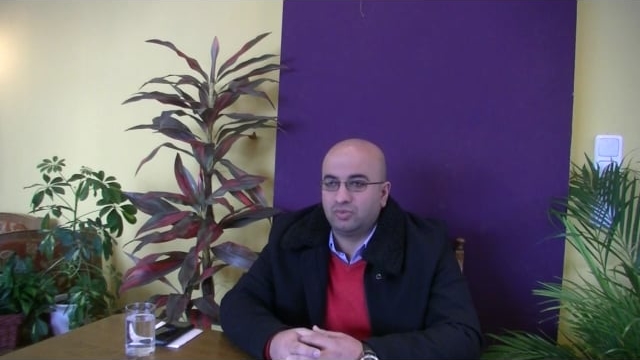
Country of origin: syria
Year of settlement: 2015
Age on arrival: 32
City: bochum
Gender: male
Language of the interview: Arabic
[i] Welcome to our program, the European History Program. I am [name], the speaker in this program. I thank you for participating in this program. Welcome again to the city of Bochum in Germany. Today we are in the Humanitarian Organization of the Middle East. Today is Sunday, November 11, 2018. We are here to meet you, your family and your history. What happened to you? What can we benefit from your experience? Please introduce yourself.
[r] First of all, I thank you and welcome you. I am [name] from Raqqa, Syria. I was born on 22-06-1993. I am married.
[i] Do you have children?
[r] I have three children. I have four children, one in Syria and three here.
[i] One in Syria. We will talk about why you have three children in Syria. How long have you been here in Bochum?
[r] Three years and a month.
[i] Thank you. Did you come here during the war?
[r] Yes, I came here in 2015. I left Syria on 31-08-2015 from Aleppo.
[i] Why did you move here? Is it because of the war?
[r] Yes, because of the war and other reasons. I had some problems. There was a threat to my family in general. The killing. My brother was kidnapped. He was kidnapped at Deir al-Zour. He was 14 years old when he was kidnapped. When we returned, it was difficult and some tribes intervened. My family went to Latakia. At some stages, of course. First of all, my father left with two of my brothers at the University of Latakia. Then, my father’s wife and two of my younger siblings left. Then, my wife and I and my sister left.
[i] We will talk about the details and the reasons why you left and how we got here. At the beginning of our conversation, I would like to ask you. Did you bring anything with you that you remember in your country? Any memories? When you decided to leave, did you want to bring something with you so you can keep thinking about it?
[r] I wanted to bring a lot of things. But you know that the way is difficult and one cannot bring everything. But I brought this bag with me. This carried me throughout the trip.
[i] Lift it to the camera a little so we can see it.
[r] This bag carried me. It had all the personal proofs that indicate that we are alive. Because we came and left our country. It had the passport of the trip. The one that proves our marriage. My son’s ID card. The money. Even if it was little. This is it. This is it.
[i] This is impressive. Mr. [name] We would like to start. First of all, we would like to talk about you.
[r] You are welcome.
[i] We would like to talk about you as a person. We would like to talk about your childhood.
[r] My childhood. I studied in the Liberty Private School. It was for Armenians.
[i] In which city?
[r] In the city of Raqqa. This was my childhood. From the kindergarten to the fourth grade.
[i] Yes.
[r] It was a school for Armenians. It was good. It had all the nationalities, personalities and sects. There were Armenians. There were Muslims. There were Christians. It was a beautiful time. Then I moved to another school. A pr[name]y school. Another stage. It is called Jamila. Then I moved to the secondary school in Sukaina. I took the secondary school from the ninth grade. Then I moved to the agricultural secondary school. To the baccalaureate. My childhood was good. I raised my father and mother. My father at that time was in charge of the state. Or the director of an institution. He was in charge of the state. My father was a political scientist. I was raised in a family that loved science. Unfortunately, I did not complete it. I was thinking that I want to work more. This is it. There is nothing else.
[i] Are you the oldest brother?
[r] No, I am the oldest brother. I have a younger brother. I have three sisters and two other brothers. From my mother. My mother died in 1999. Then my father got married. We wanted him to get married. Because the situation was difficult. He had to have a wife at home. She is a mother. A wife to my father. He got married. The first one. The marriage did not last more than a year. He divorced her. Unfortunately, she became a daughter with him. The situation was difficult. Because he was difficult between my father and the mother. Then he got married again. We became brothers and sisters. We are a group of brothers. You can say three. We are six. Nine.
[i] Mashallah.
[r] We are nine brothers. I am the oldest.
[i] How old were you at that time? When you were growing up, did the difficulties of childhood, marriage, and your mother’s death affect you? Did it affect you emotionally? Did it affect your mood in your life?
[r] There were very difficult days. Because when my mother died, I was the oldest brother. I was in the tenth grade. And my younger sister, between me and her were two years. She couldn’t. She was also a child. And my youngest brother was nine months old when my mother died. The situation was very difficult. My father was a political man. He had commitments. He took care of the house. The situation was very difficult. At first, we suffered a lot. Especially my younger brother. The situation was very difficult. Then we started to cope with the situation. The first woman came into our lives. She was the first woman in our lives. We had problems. She started to torture my younger sister. But my father was always with us. He had the most important things in his life. Then, the second wife was the mother’s role model. She helped us a lot. And we started to live our lives. I got married later. After a while, I went to the army. I finished the army. Then, I came back. My father made the brotoven for me. This was the first thing I did in my life. As a project. And I got married at that time. I was 24 years old when I got married. I marriage wasn’t succesful. There were problems. Because the wife is not from our culture or our society. She is from the Levant. And we are a group. We can say we are Arabs. We have traditions.
[i] This is very nice. We want to talk about it. Where are you from? Because the Arabic language you are speaking to me I felt that you are from Syria. But Raqqa has tribes. According to what we don’t know. So, we want to talk about this topic. Tell me about your marriage. Why did it continue with this person? So that I know the story.
[r] First of all, I am from Raqqa. We are a tribe. Our name is Hulaibin. We are a group of leaders from the family of the house. And our habits and traditions are close. As you say to the Arabs. The old tribes. The honor of the guest is a duty. The guest may come to the house. No one will find except women. The woman opens the door for him. She accepts him. This is the duty. This is the proper coffee. This is the meal. The husband may not come after hours. This is the duty. The guest may not know after a while. That the husband is not present. Our habits and traditions. In Raqqa’s province, there was no hotel. Because the guests sleep with the people of the country. I grew up. And then I was surprised by the place. It is called the tourist hotel. I didn’t know what it was. Because we didn’t have it. If the guest comes to sleep in the hotel, he is humiliated. He wants to sleep in the hotel. And if he needs something, he needs three days. He can go and travel. And we don’t ask him why he is coming.
[i] Are these traditions preserved?
[r] They are still present. And they continue. Here I tried in the simple situation. To have a coffee. Maybe my children are used to these traditions. My wife came from an environment. From the Levant.
[i] Your ex-wife? Yes, the ex-wife. The one who didn’t marry you.
[r] Yes, the ex-wife. She came from Damascus. Our family in Damascus. We don’t say that they have traditions. But it is different for us. And it is a little difficult. It is not like us. Our habit is that the woman has a role. She receives. She works. She does her duty. She likes to participate in many things. And she couldn’t. So that’s it. And then it led to separation. And I have a daughter named [name]. This is the first daughter. She was. And unfortunately, she stayed with her mother in Syria. Of course, her mother went to France for a while. Then she returned to Kurdistan. And now they live in Damascus. And I wanted her to stay with her mother. Because of course the mother will be better than everyone. Even if from the father. And when she grows up. And if she chooses to be with me. I wish. This is what.
[i] Your second wife. Was it your choice?
[r] The second marriage is a long story. It started with the end of the first marriage. My second wife. And I was hoping to be the first. But that’s fate. I mean. From my province. From a big tribe. Her parents. Her father studied in Athens. He studied in Europe. In Czechoslovakia maybe. I think. He graduated. His husband is very educated at the province level. I mean. Her father is famous. And. From my environment. From my habits. From my traditions. I liked her.
[i] It’s fate.
[r] Yes. It’s fate. Your probe was implemented. Fine. Her parents were very happy. They punished me and her family. I hate them. As a matter of fact. At first, they rejected me. I tried for two and a half years to get engaged to her, but they didn’t want me to. Because I was divorced and have a daughter. And she was a young woman. She took the Riyad Institute. My mother told me that it was forbidden to marry my daughter and then take our daughter. They were afraid that this would be a reflection of my life in the future. But in the end, I succeeded in my attempts and we got married, thank God. I now have three children. I also have [name] and [name]. [name] was born in Germany a year and a half ago. Now we are waiting for a new born. Allah willing, we will have her near us in another month.
[i] I hope that you will be able to solve all your tasks.
[r] May God help you.
[i] We talked about your mentality, your neighborhood, where you live, and the name of the place you live. Your parents house.
[r] We live by the same building, my father and my grandmother at the same time, my cousins, who are also my aunt’s children. So the atmosphere was always… We felt like siblings, we grew up like that.
[i] You are a big family?
[r] Yes. We were in the building as a group of 30 or 40 people. My house was the last floor in my family’s building. My father did it for me, of course. I got married in the first marriage. I told you about the second marriage. My wife and I shared everything. Everything was in it. Who bought it, who brought it. But unfortunately, we didn’t enjoy it. Everything was better than good. I can tell you… I built a very good or excellent building. Unfortunately, it didn’t exist. We couldn’t… We didn’t live there for a year.
[i] Because?
[r] Because of the war.
[i] Because of the war?
[r] Because at the end of the day, we didn’t sleep in the house. I used to sleep in the second house every two or three days.
[i] There was no security.
[r] They were chasing me and chasing me. The kidnapping spread at that time. My brother was the second victim. They asked me to release him. He was under a lot of pressure. So we couldn’t sleep in the house anymore. Yes.
[i] Let’s stay in the atmosphere of childhood. In the atmosphere of youth, marriage and so on. How was your childhood?
[r] I mean… In any way, how was your childhood?
[i] You were a happy child. You were young.
[r] Happy, of course.
[i] How did you spend your time? We talked about this topic. But was there a place for happiness in your life? Was there something you liked?
[r] Of course.
[i] Did you do it? Did you have fun? You told me that you are from a noble family. And that the society is very good. You talked about your life in the country. And that you consider yourself a country of the Asyai. Tell me, what was the origin of this?
[r] You see, my childhood was very happy. I mean… My father provided us with everything, from the best of what could be. I mean… Even driving a car. My fourth grade taught me how to drive a car. My childhood. This was a very beautiful thing. My father used to go to farming with him. We had agricultural projects, I used to go and see them. I enjoyed them a lot. We had a boat.
[i] Was it your hobby to ride a boat?
[r] I loved it, but the place wasn’t available because it was 100 km away from the governor’s office. So I used to go and love everything that happened to me. My father used to take me with him to fishing. I used to have a lot of fun going fishing. We would go fishing with the dogs. My friends from Lebanon and Aleppo used to come and take me with them. It was a big group. I used to enjoy it. I was a little bit older than my childhood.
[i] When you were young?
[r] Yes. I didn’t feel… My country was in a financial crisis when I was a child. I didn’t feel anything. My father used to tell me that everything was available to us. I lived my childhood in the 90s and above. I was 7 years old in the 90s. That was the beginning. Everything was good and I was happy. My school provided me with a lot of freedom. My friends used to come and take me with them. I don’t know anything about Syria. The problems and the sectarianism. I used to go to church to pray with my friends. My parents never told me why. On the contrary, I was happy. I didn’t know what the story was. I used to go and come back. I forgot. The school principal, her name was [name]. She became a family friend. She is still with my parents in Al-Lathqiya and Al-Sham. She has become our friend until now. I loved them. I used to forget. I was very happy. That’s all.
[i] You are a open family. You have been a part of the society since your childhood. This is what we talked about. How many hobbies do you have?
[r] My most important hobby is driving a car. I love driving a car. I used to love going fishing with my father. I love it a lot. When I was a child, I used to like collecting stamps. I like collecting stamps. Wherever I find a postage stamps, I collect it. I also have a bag in Syria that contains a lot of stamps. This is also one of the reasons I am relaxed because of the events.
[i] Let’s talk about you as a boy. Did the girls in your village in this society were treated the same as you? Or does it benefit you? Does it make you feel better? Since we are in an Arab society, you told me that you are from an Islamic family. But you are very open-minded. You care about the person. You don’t care about his religion. How was the girl’s treatment? Since you have siblings, we would like to know more about this.
[r] I am talking about my family at the beginning. My father didn’t have this situation. My sisters have a better role than me. Even one of my sisters today, she is younger than me, but my father advises her in many things. He even depends on her. Sometimes he tells me to talk to [name]. We are raised in this way. My sisters have the choice, as they would at any stage of life. Even academically, she is free to choose what she wants. She likes to study this field. She decides what she wants. As far as clothing is concerned, and other things. My sisters choose what they want. We don’t have this problem with anything. She is a girl. She has confidence. She acts as she likes. The most important thing is how much confidence she has. This is what we care about. In the end, she is the one who chooses her life. I will not be with her if she chooses a husband. Because she is the one who will suffer. We have the advice. If you see something bad, more than that, you will be with her. This is how I was raised. The society was not as it is now. The image is wrong. On the contrary, it was in the protection of women. On a Syrian level in general. I was raised by my family, and the society around me. We don’t have women who go to torture, or bring things. On the contrary, my husband helped her with everything. She likes to go. This is another matter. She goes to get rid of it, not more. As for the difficulties in life, for example, in terms of work, this woman did not have opportunities to work like a man, according to the society, you know, of course. For example, when I came here, this is the first time I saw a taxi driver. I have not seen it in all of Syria. But there are women, female, a bank manager, a school principal, a school teacher.
[i] The jobs of the governor.
[r] Yes, she worked in a store, worked in a restaurant, we saw all of this. This is it.
[i] The amount of information that you gave us about your country is very nice. You used to love your country. You were happy with your village. This is how we got an impression of your new passion. Then came the war. The war came, and the decision came. There was no sustainability in living in this beautiful country, in this beautiful life. You are a noble family, the happiest in your life. You have built your life. You have your home, you have your job, you have your family. You had to leave everything behind you and make a rescue operation. So, I want you to tell us about this topic.
[r] Now, I mean, when the decision came, I was happy with my country, first of all. It became very, very, very. And I was a relaxed man. I mean, one of the biggest difficulties in life today is the matter of material and work. And you come, I mean, I was very relaxed with this issue. When the danger of life happened, the material stage was over. I mean, you started looking for security, for sustainability, for you to live, to protect your children. So, I mean, at the end of the day, in Aleppo, I mean, of course, I moved to Aleppo at the end of the day. A bomb came down right next to my house. I mean, I was sitting in the living room. So, in front of the TV and there was a window. So, the bomb came down right in front of the window, completely, on a water tank. The building next to me was a water tank. Thank God, there was no explosion, I mean, nothing happened. But, the walls were damaged. And my son was with me in the room. So, I mean, I didn’t know what to do. So, I ran quickly. My wife was elsewhere. I immediately took my son and went out towards the outside of the house. There have always been bombs, but that was the first time I saw it like that. But, the first time she got down, I mean, I saw her when she got down. I saw her wounds. I mean, I don’t know how, but I held my son. I put my back on the window so that if something happened, he would come to me and not get to him. And I ran, I don’t know, like a madman. And I screamed to my wife, [name], [name], I mean, I was afraid that something happened to her. I went outside to the entrance. The entrance is in the middle of the building, so it is more of a safe place. And I took [name] in my hand and stopped a little like this. You know, the sound of the sound, the noise, the people’s crying, and the work of the ambulance. And my son is crying, he is scared. I don’t know, I mean, I mean, at this moment, I don’t know if I can get in, if the weather is good, I can get in and make it safer. I told you, I feel, I mean, the important thing is the weather is a little bit cold. So, I thought, I started to think that, I used to see people traveling. So, in my imagination, I say, these people are crazy. I mean, sorry, I say, is it possible to leave everything behind you and go? I mean, with this ease? That all your memories, your dreams, your ambitions, you are in your country, I mean, you are going to the unknown. You are a person who is going to a place where you don’t exist. No one knows you. While I was walking on the street, I used to say, hello, hello, hello, I sit at the market, I sit at the bakery, I see the second, I see the third. I can open the largest project in my country.
[i] This feeling of security.
[r] This feeling of security. This, but when I felt the danger, it became towards my family. I started to think here. I made the decision to leave, before I left, in four or five days. Suddenly, this was happening in my life. I told my wife, do you want to travel to Germany, she told me, no, if you want to go, we will stay. I told her, it is impossible, I will leave you behind me and go. I mean, this thinking is forbidden. I go, you go with me, I go. If you don’t go, it is difficult, it is impossible. I don’t know what will happen. I have to take you with me. I was afraid of the sea a lot. You know how to swim, but this is not a matter of knowing how to swim, this is the sea. Then, I was convinced, I mean, and we started to prepare ourselves. Within a week, we left.
[i] Was there anyone in your family who had a decision to participate with you, that you should travel or what was your decision? The role of the father, the role of the brother, that the decision is not easy for you to leave. Also, if you leave someone behind, you leave. You are not alone at home, you have a family, you have brothers. These are also things that play a role in our lives.
[r] What is it, Mrs. [name]? When I took the decision, I talked to my father, I mean, this was the hardest thing I did. To this day, I don’t remember how. I was afraid to tell him, I mean, I am in Aleppo, he is in Ladkiya. But we had a problem before this thing, a big problem. I have a brother from Khotaf, from Ladkiya. My brother was a student for two years in Hakouk, and he graduated with a business degree at the same time.
[i] And how old was he?
[r] His age, I mean, he was 21 years old, approximately, at that time. From Khotaf, they told us they asked us to give him 4 million Syrian pounds. I mean, at that time, it was something that might be 17 or 18 thousand euros. They told us they wanted a ransom, and my father agreed, I mean, and then the call was cut. Of course, the state and the security agencies intervened, and so on, and they determined the location of the calls, but they were moving, I mean, and my brother disappeared. To this day, the author is no longer visible. And to this day, we don’t know what will happen. I mean, he went away. He went away. with any other party. He disappeared. So, the decision was difficult. How can I tell my father my brother disappeared? And I tell him I want to travel with my son, my grandchildren, and my son, his name is [name], and I call him my father. So, he was always afraid of him, and he always told me this. When I told him a lot, he got angry. He started telling me what will happen and don’t travel and this and that. And come, stay in Balazquia. And he bought me a house in Balazquia at that time. I told him I can’t. They are afraid and threatened. And we are still threatened. I mean, when I came to Germany, my family threatened me. I mean, I told him with him, I mean, it’s not normal. We are always chasing. We always feel the danger. We want to escape. We want to pay a ransom. We want, I mean, I want to put my son in jail. I mean, I sent him. So, two days later, he disappeared. On that day, a case was filed on Rawza. I mean, it’s over. It’s over. My father got angry and I told him it’s over. I made a decision and I have to travel. And I traveled and said goodbye to the borders. I talked to him. I mean, that’s it.
[i] Was it difficult to say goodbye to you?
[r] Yes, it was. I have pictures of my son on the Syrian-Lebanese borders. This is the last picture. I told him I want to take a picture of you next to the flag. I mean, so that when you grow up, you remember that we were in this country and we went out of our way. I mean, it was very difficult that we went out of our way from you and someone comes to take everything you own in front of you but you don’t want to act. Yes, we left.
[i] Why did you choose Germany?
[r] Germany because there are several reasons. First, when you start moving from a place, I mean, you’re asking me about my age. My real age is 35 years old. My actual age is 60 years old. My social age is three years old. My three years old are in Germany. I am like the child who turned three years old in a place. I mean, three years, I don’t own anything. I don’t own a language. I don’t own… My age, like my daughter, she has nothing. Even her father has a weak language. She speaks softly. She can’t move. She needs help. She needs… So, at my age, three years old, I’m starting. So, when I came to Germany, a person who wants to come at the age of zero, he wants a place where he can find people to welcome him with a smile, nice people, a society. We saw what Rahem did before us. They welcomed him with all their heart and all their love. I mean, this country, I don’t know, Medina has a lot of things.
[i] In your country, did you know that Germany is good?
[r] Yes. Because, you know, the refugees, all these people move the news. They watch something on TV. I mean, when, we call her Mama Merkel. When Merkel came on TV and said that we welcome all Syrians. She didn’t say no supporter, no opposition, no Sunni, no Shia, no Christian, no anyone. She said we welcome them. Then this country a great country in popularity. I don’t want to need to mention any of the countries But I want to mention the whole Islamic world. The Islamic Saudi Countries, Kuwait, the whole Gulf are very good financially. No one accepted us. I tried buying accommodation but I couldn’t because it cost a lot. So we decided to come to Germany, the facilities are there and everything is there, and we entrusted it to God. I will talk again about the issue of age. I am 60 years old in terms of the problems that I experienced, and what I saw, and what happened to us, and the social and life situation. I went through them as a person who is 60 years old. I have this experience and this experience. And my real age, which is 35 years old, I lived from it for 28 or 29 years only. After that, there were all the problems and difficulties. To this day, I consider myself not comfortable in life and I do not live because I am a working person and a producer. I came to feel myself at many times high on the society. I came to feel myself at many times high on the society. I am not able to go out or do anything, or work. Because I am still, I said to myself, I am 6 years old and the language is weak. The language is the biggest obstacle. As far as I know, the state has provided us with everything for the language. But the language does not need you to just learn. The language does not need you. Relationships, friendships, contact with the Germans, this does not exist. Because it is impossible for me to go. I mean, what happened to me? Many people succeeded in friendships. I liked and wished that I had friends. But you cannot choose anyone to be a friend of the family. Because you do not know what his background is and what he is. We say to all those present in the German way. But they may not be German. I mean, they may be of other nationalities, like Ausländer. So you do not know who this person is. This is what…
[i] Mr. [name], we can talk later. We will talk about this topic. Relationships, friendships, contact with your father. But I would like, before you reach your father, and that you made the decision to reach Germany, and that the Foreign Minister welcomed all the Syrian refugees with all her love, without any discrimination. Tell me, what was the way to reach Germany? What is the way? And tell us a little about the adventure you took.
[r] The way… I will tell you from the beginning. From the beginning, when we took the decision, and we set off gradually. The beginning was from Aleppo. I took the decision. My cousin, set off from Raqqa, after he escaped from ISIS or the terrorists. He escaped with difficulty and reached Turkey. He spoke to me. His family is a little big. This is what encouraged me for one of the reasons. He helped me with my children. [Name] was four months old. Four months was a problem for me. The biggest problem, unfortunately. [Name] was able to walk. It was difficult for him to move. We worked hard. We brought with us the greatest amount of things that would serve us and help us in the way between us reaching and benefiting us in Germany. Unfortunately, I did not build anything from it. Because I considered myself the last… the most important thing in front of my wife. They are more important than me. So, I had three bags with me. I packed a lot of things, from our personal needs, from [name]’s milk. I even took milk with me from Syria. Medicines. I took first aid kits. Mobile phones. Some simple memories that I could not get rid of. There were a lot of things in the country that I had. For example, my son only wears boots. I asked him for details. Because his leg is flat. So, I brought him these with me. Even if he was small, I brought them with me. I brought a scarf from my wife. It was this one. A few days before we got married, they took it from her. So, I told her, I will not give it to anyone. So, I brought it with me. Unfortunately, they did not bring me anything. Not at all. It was just the clothes I was wearing. And a light jacket. This one. I was able to take it off. We left Aleppo on the 31st of August in a Boulmān [long distance bus], towards Lebanon. The trip was hard. Because the first time we went in a Boulmān, my son, due to the circumstances and the situation, was always at home. I mean, he would go with me, but the car, I would look for it in Aleppo. I would not buy more than that. I would buy a new one. And all those things. Until we got off to play. So, the first 30 km, he ran away. Me and the person next to me. He ran away. As a result of a new climate. He could not bear the atmosphere in a Boulmān. So, we went to rest. The problem is, I have nothing to change. I mean, I brought this one dress. I could not. I washed as much as I could. I washed as much as I could. And I took care of it. We arrived to Lebanon. The disaster was when we arrived to the Syrian-Lebanese borders.
[i] Were you alone or in a group?
[r] No, we were a group. Boulmān . Three Boulmāns. But we were a whole Boulmān. This one was moving towards Europe. I mean, in full.
[i] What does Boulmān mean?
[r] Bus. Boulmān.
[i] Ok. A group. I mean, in a bus.
[r] 45 people, you can say.
[i] Yes.
[r] So, we arrived to Lebanon. We are staying in Al-Bakhra. I stayed in Al-Bakhra on that day because the flights were complete. At that time, the border was closed towards Turkey. We were traveling in a regular way. So, I got my passports. I told my family. And I went towards the Syrian-Lebanese borders. We arrived to the borders. To Al-Bakhra, basically. We arrived in Sa’id at night. When they brought us down to the square. The square is a place that you can see it with your eyes. In the sense of speech. And we came. I, thank God, I was sitting on the street. On the street. I was rolling the materials on the street. You know, rolling like this. So, I was bored. What was I supposed to do? I did not know what to do with my wife or my father. They told me, we have to wait until dawn. From 11 in the morning to 11 in the morning. 12 hours. We have to be at this place. Which I do not know what is. I did not know what it is. Because the hall is not open to the public, so I gave it to my wife and my son, I cleaned it up a little, and I had a person with me. Meanwhile, at 4 a.m. someone saw us from the hall, we entered the hall, my wife, because my daughter is 4 months old, so this is the matter. It looked a bit like a coffin, we entered the hall, and we went to the pool, I have some pictures from the pool. We arrived in Turkey, and we went from Turkey towards Izmir, a Boulmān bus too. Unfortunately, I forgot my glasses in one of the Turkish service station. I couldn’t take my glasses off, so I went to Germany. The whole journey was full of things. We arrived in Izmir at 4 a.m. approximately. We didn’t have a mobile phone or anything. We had a mobile phone, but it didn’t work because the lines on the Turkish network didn’t work. We arrived on the basis that my cousin and his family were waiting for us in this place that they told us to come to. There was no one there. But I saw something terrible. People were sleeping on the street. So I started to feel scared. The first thing was that I didn’t know where to go with my family. I didn’t have a hotel, I didn’t know how to speak Turkish. My wife speaks a little English, which is good. We asked the Turks, but no one speaks English. At 4 a.m. what should I do? We stayed there for about half an hour or three quarters of an hour. Then my cousin came. He was late. He took us to the house. We slept in the house of the smuggler. The smuggler, according to him, is from my city. But I don’t know him personally. I don’t know who he is.
[i] How much did you pay for this trip? Did you pay him the money for the smuggler?
[r] Yes, of course. Because he is not the smuggler that we traveled with. We went through many smugglers. It was a stage of stages. The smuggler, we slept with him. In the morning we had breakfast. He came out and we sat with him. He needed $1,100 per person. For each person.
[i] That’s a lot.
[r] We talked to him. We tried. We told him that we have children. You need to help us. You need something. The important thing is that he said that he won’t take the children. But he will take the father, mother and the rest. We told him, okay. He said that he traveled today. Of course, my wife was in a difficult situation. I am afraid of the same thing. But I try to encourage her. I try to encourage her more. Because I don’t want to give her the impression that she is afraid. But I was more afraid of her. I am afraid of the children. If I die, what will they do after me? Or where will they go? And God forbid if something happens to them. How will I continue with life? I still can’t. I can’t continue without them. Even if I leave them in Syria. It is impossible for me to stay in Germany at that time. Anyway. They took us in a taxi. To the place. Which they call the point. The point of travel. We went down. They told us to run. Run. Run. We entered the forest. Of course, I am carrying [name] on my back. Or like the back of the car. I am carrying her. So that she doesn’t feel anything. We entered the forest. And we sat. We were surprised that there was a huge number of people. I mean. I don’t know the number. But it is more than 100 people. Everyone is waiting for him. We have one Turkish speaker. He is my cousin. He started speaking Turkish with them. He asks them about the time. And how we are going to go. Anyway. We know some details. We went down to the water. People came out. They were there. We were surprised that we won’t go out today. On this night. They want us to sleep in the forest. On the next day. To go out. We started screaming, we had problems, we fled and were left in the forest.
[i] Women and children with them?
[r] Women and children, a huge number. Most of them were women and children. You see, for example, two women or three women and ten children with one person. The one who died, her family, her brother and she brought her son to Islam, she came with her neighbor. The one who came with her brother. You hear all these stories on the street. Most people are like this. I became funny that I came with my family because I did a good thing. I took the right step. We went out and came back.
[i] How did you sleep in the forest?
[r] I didn’t sleep. I didn’t want to sleep. I took my cousin and we went out on the street. We went to the public street. I helped my son and we walked until we reached the public street. We went back to the city. I told him I didn’t sleep with anyone, I had to take my family to the hotel, it was hard. Even if I want to spend all the money, I won’t let them sleep with anyone. I really stayed with them in the hotel. These children want to wash up, they want to eat, they want… I locked them up in the hotel, fed them, took a shower, washed our stuff, I didn’t have this one dress, I washed it and put it on. We went out for coffee, we sat down and thought about what to do. We found another smuggler, and this was the biggest disaster. We agreed with him at the same time. He told us that at 10 pm we were going to this place. He told us to take a taxi. We took the taxi and went to the place. When I got off, you know I’m from Badia and the countryside. I have an impression of some places, some roads. I mean, it’s my life, my city, my work. When I got to the place, I felt like I was in the middle of nowhere. I felt like I was in a strange place. A place where you feel the danger.
[i] You didn’t feel comfortable.
[r] I didn’t feel comfortable. Immediately, I told them to hide in a hidden place. We stopped and I hid my wife, my son and all of them. I started trying from afar to see what was going on. I saw that the place had a public road, but there was a bridge under it. The bridge was hanging on the forest. We started telling him where we were. I told him that we had arrived. I told him not to tell my uncle. I told him that we had arrived, but we didn’t see anyone. Of course, you won’t come alone. There will be a lot of people. Why did we come alone? We came back. We told them that we wanted to come back. We turned off the phone and let them come back.
[i] You didn’t stop talking. What were you doing?
[r] I was talking. I told my uncle that we were coming back. We don’t want to travel with him anymore. We went back to Izmir. We told him that we want the money. We saw him. We were surprised. A lot of people came. Our family had already left. They didn’t take the phone. Even the Syrian police didn’t take the phone. They didn’t keep anything with them. I asked my family. They said that we had 40 families. All of them did the same thing with them. They took them and sent them away. We left, thank God. I told him that I didn’t want to travel this way anymore. I want to find a better solution. By chance, in front of the hotel, there was a person from the city of Al-Bukmal, Syria. I had worked with the people in this town, with tobacco products. In the tobacco trade. From Al-Bukmal, I met [name]. He told me that he knew Uzz Al-Ma’alif. He was a Sheikh from our tribe. I told him that he was my partner and friend. We started to remember each other. You know how memories bring people together. I came to your city. I had lunch with someone. They cooked a sheep for me. I sat with the [name]’s staff. He was surprised that I had so much knowledge in this area. Where can I do this? I told him that I was traveling. He told me that he wanted to help me. He pointed me to a person. He told me that he was 100% sure. He was the person I traveled with. But he took $1250 from me. Coincidentally, the person left my relatives. But the Turks. I have a family that is still in Turkey. I was surprised that I knew him and his family. But I didn’t know him as a person. I knew his name and his family. And I know him. My name is on one of his family members. His name is [name]. [name]. This is my cousin’s name. He wanted to help me. He helped me with a lot of things. He helped me with a lot of things. My cousin had a huge number. There were 9 people. He wanted to pay me. He wanted to help me with two things. He helped me. It was a successful trip. We went to a boat. My wife hadn’t spoken a word since we left until the end on the Greek beaches. My son came. I tried not to let him see the water. I wore a life jacket. I bought a life jacket and a suit. I did all the necessities that we can do. My son sat in my lap. I covered him so that he doesn’t see anything. We went to a boat. The number was good. It wasn’t big. The biggest problem was that they put a huge number of people. So it happened. The trip lasted about 40 minutes. Because they took us to a place very close to Greece. We went to an island. I don’t remember the name. We went there. We were happy. The place we went to was a place like what you say. We were eating in restaurants or in the water. They welcomed us. They welcomed the Greeks and we entered. They immediately took us to this place. My wife and I drank a juice. We started talking to them in English. We felt relieved. As they say, we arrived safely. There was a little danger. The water was more dangerous. The water was more dangerous. The road was more dangerous. You were going to an unknown place. You didn’t know what it was. It was more difficult to have children. We went. The biggest surprise was that we slept on the street. Because there was no place. This is the first time I have experienced such a situation. My family is with me. I don’t care about myself. My wife is with me. My son is sleeping on the street. I remember talking to my father. He told me that I have spent all my life on oil. I was comfortable. My things were good. Even after everything was gone from us. Everything was taken from us. We kept 50% of our situation. I went and tried to bring them from the kiosk. Anything they eat. I brought them things. Chips and biscuits. I took them for breakfast. We left in the morning. They took us to a different place. They gave us papers. They gave us a bus. They took us to a place where we had to book a ticket. To go to Athens. We booked a ticket. There was a doctor in Athens. He welcomed us. Whenever we passed a stage. You have a feeling that you are in danger. You took a step. You are almost safe. You are safe. I can’t describe this feeling. I felt something. It was something big. We took a train to Athens. We went to a home. We immediately went to the bathroom. We washed our clothes. We took a shower. Like a beehive, there were 15 of us. My cousin went to the mall. He bought things. My cousin cooked for them. She cooked for us. Farrouj with rice. And salad. We took pictures. I have more pictures at home. She cooked pasta with rice. My cousin doesn’t know. We ate it. We enjoyed it. We felt it was better than rice. We laughed. The problem came. We wanted to move at night. We went to the bus. We moved. After that. We wanted to start walking. It became difficult to walk. You know. Moving. Serbia. Hungary. It was all easy. I told you. We told Merkel. Because she directed the countries to allow us to pass. But we were tortured in Hungary. Because in Hungary they made a stamp. We didn’t want to stamp. To be safe. We stayed in Germany. At least. For a certain period of time. A year. Two years. Three years. Will they allow us to pass? We came. We passed. Of course. It was difficult. We walked a long distance. We were attacked by people. The same. Injuries. All the countries. These are present. They were attacked. They tried to break us. I mean. Thank God. We passed them. We took a taxi. We arrived to Bucharest. The train station. And this. I consider it here, the point it was the beginning of security. Because after that we didn’t face difficult situations. I mean, even on the train level. They said: You pay twelve euros, twelve dollars or euro. For the person. You want to pay. You don’t want to pay. If you pay. She is going. The help of the refugees. Who are coming. After you. You don’t want to pay. She is free. I mean. You are, It’s like, it’s a loan. So, at the station they made tents. Food. Milk. Children’s food. Blankets. Clothes. For those who don’t have. And many things, I mean they do. So I came I told them I want to pay. For I have seen many things in this station, and I wish that if someone comes after me, they will at least have that. And if I had more, I would have paid more, but unfortunately… A little pause… and we are back. You know, if you reach the middle of the road, how will you continue? Where will you go? We walked a little. We were looking for a taxi or bus in Namsa, and from that point, the center, when you enter Namsa, they made a center, they gathered people and then you go. Those who want to wait for the buses wait, those who do not want to wait, they look for a taxi or any other means. So I told them I will not wait. Every day they were sleeping on me, and I was on the road, I was having a problem, I was hating life, I was depressed. At that time, if I could go back in an easy way, I would go back. I am not sure if I will continue, because whenever I see my son sleeping in front of me on the ground, I have a feeling that life, why did it happen to us? What is the sin in life? What did we commit in life to happen to us?
[i] Even though you saved them from dying. Why did you have this conflict? Why did you torment yourself? You saved him from the war.
[r] I feel that I took him from death to slow death. I brought him from a place to a place that may be harder and may deprive my son, may lose him more. He may become an ineffective belief in society, a dangerous belief in society. I do not know where he went. Did he go to the streets, did he go to the ignorant? In this case, we are looking for a taxi, any other kind of taxi. We came to a person from Iraq, his mother is Turkish, he is married, maybe he is Swedish, he told me, with a van. I said I will take you, I have been in this place for 10 days, I go and come back every day from half an hour to the evening. For example, I want a van, I go and take a van and I have a visa, I decided to spend it in the service of these people. I told this person that he lost time, he lost money, he lost his visa, which he might not get every year. He wanted to come and help us. We have to offer something to these countries that are trying to offer us all this. We got off the train and took it to the train station. They welcomed us and fed us. They made several meals. Pizza, Kabsa, juice and milk for the children.
[i] In which country after you?
[r] In Nemșa [Romania].
[i] In Nemșa.
[r] From this station, they took us by train to Germany.
[i] This is the point where we arrived.
[r] We arrived in Germany and I was walking and seeing Germany. I sat here and my wife was relaxed. We started laughing at the scenery, the lands and the houses. We talked on the way that we were going to have a house. We were going to sit in this place and enjoy nature. Our children were going to study and we were going to find a job.
[i] Tell about your life.
[r] About what? We were living a very good life. Any level of life we are going to live in this country. What our role in society is going to be.
[i] You arrived in Germany.
[r] I arrived in Germany.
[i] Tell us how you arrived in Bochum and why Bochum.
[r] I arrived in Munich.
[i] Munich.
[r] Munich. I arrived in Munich at night. They took us to a prayer with thousands of people. We slept. They welcomed us. It was the best welcome. I felt very relaxed. They told us in the morning that they would like to stay here until they travel. We told them that we want to go to Detmold. A city. It is 200 km away from here. It is close to Hannover. Between Hannover and Bielefeld. Because [name]’s cousin lives in this city. He came before us.
[i] Because of the war, or did he come here to live?
[r] No. He came because of the war. But before us, in a good period of time. He came six months before us. It was a difficult way. When they came he faced many difficulties. He suffered. We went on a train. We have booked. I don’t know if I remember. It was long. But we faced a problem. A change in the trains. The train reached the point and said this is the last station, but we are like the lost ones, we listen to the German talk, but we don’t know what’s going on, what’s the story? Suddenly, we found people who came down and one of them said to us, that’s it, we are in Bielefeld, and he said no, we are not in Bielefeld, we are going to Bielefeld, because we don’t know the name of Bielefeld. So he saw the sign and at that time, I can only imagine, I remember that he said, if you speak English, say nein. Oh God. A girl came in, she was 20, I can imagine, she said to my wife that I speak English. We were happy that the news said that we had to go down and the company would pay the interest to take you to the place you want to go. You are not going to be there You are going to be there Just remember this, You go to the taxi. And he will take you to where you were You are going to be there. And she stayed with us for the last minute. She called the taxi and told them they have kids. We are used to it. We didn’t have this difficulty. You’re driving, the car seats four people. We can drive five people. We didn’t have this difficulty.
[i] Or eight is fine too, what’s the problem? I’m surprised that every child got a child seat. She sent us by taxi. She came to us, She talked to the taxi. She told him. He will give you a phone talk to someone He will tell you where to go. We took her to Bielefeld. From Bielefeld her aunt took us to the van cabin. Her German friend had a van cabin. He rented it and took us there. He picked us up at night, we went, He had someone with him, he had been singing. You can come with us, sleep here tonight. We arrived at Detmold. It was 4 a.m. On the way my wife was sleeping. She was tired. She was wearing a belt. I laughed at her how she was sleeping, We arrived at the house. He asked me what do you want to do. I told him I want to take a shower. First that and then I want to eat something because I’m so hungry. Actually, I was searching with my son. I let them all sleep, all of them. After we had showered and eaten, he gave us a room. We all went to sleep together that night, I won’t forget how much and deeply I slept. I embraced them. [name] and I often remember that. We stayed with him for 20 days until his German friend came and helped us and took us to Badhausen, 20 km away from his city. We stayed with him for 9 days. We didn’t choose Bochum. We wanted to go to Detmold, but unfortunately it didn’t work out.
[i] Unfortunately, or did it work out?
[r] Exactly. You were right. Unfortunately, it didn’t work out. That was our ambition, so we gave up. But don’t forget that [name] is in charge. He used to speak Arabic. He was a mushrif, one of the mushrifs. The first thing that happened was that my wife moved to Medina and I moved to Medina with my son. So when I went to talk to him, he said, no, we’ll arrange another one. I told him that we wanted to go to Detmold with his cousin [name]. He said, look, you’re a lucky person. I asked him why. He said, literally and in a way, he said to me, Bochum is a wonderful city. I mean, he speaks to me like this and I say, my brother, this is a comfortable life. And he says to me, I want a person to help me in life. Tell me how I want to start from here. I mean, I’m zero. I haven’t entered Germany in a long time. This is my beginning in Germany. I still don’t know. I mean, he said to me, believe me, Medina is a wonderful and beautiful city. And its people are very, very good. And tomorrow, as soon as you go here, you will discover and see. I said to him, well, that’s it. I mean, he said to me, just go and remind me. We came to Bochum by bus. They slept with my whole family. I couldn’t sleep with anyone else. The distance was about two and a half hours. I watch where he goes. I want to know where he is heading. And what will happen in front of me. We arrived in Bochum. They took us to the Post, the Rathaus There is a place under the Post. We got off at this point. I took [name]. And I took a bag on my back. And a bag in my hand. And a bag in the other hand. And [name] like this. Because my wife can’t carry her. I mean, she is a little tired and so on. So I tried to carry as much as possible. Then we entered. on the social building. We. And they put us in a place. This room below. There are tables in it and so on. Between. Completed with our papers. And they recorded us. And they took us to a camp. The camp is called Max-Greve-Straße 7
[i] You haven’t forgotten that.
[r] No, I haven’t forgotten. But the surprise was that the camp. A gym. Open. And divided. Like this. With showers. I mean. And this is the first time I’ve been in this situation. I mean. I mean. We are sleeping. And beside us. People are sleeping. We listen to them. And they listen to them. And with this. My wife used to tell me. Come on. You have to bear it. I mean. We really went. And from the first day. We went. They told us that. It won’t take long. I’m going to take you home. I mean. My goal was to go home. To continue my life. I feel. In stability. A little bit. And we went to the camp. We arrived. The camp had fifty people. All present almost. And a little bit more. The first four or five days I don’t go out. Completely. I don’t see anyone. Not at all. We are sitting to be happy. Then little by little we started going out. We started sitting outside in the sun. We started. My son goes out to play. I started going to the social welfare office. To make my son happy. To take care of the house. I started moving. Little by little. I can move. But I don’t move. I walk from the camp. To the social welfare office. And I go back. I mean. I didn’t try to move more than that. We stayed in the camp for a month. Approximately. Or less than a month. Then. We stayed at home. And a lot. They helped me with the social. I mean. A lot. A lot. They helped me. And I was. I mean. When I go. They joke with me. And so. I mean. They let me go. Relaxed. I go back. To the camp.
[i] What do you still remember from the German people?
[r] The best thing, I mean. What you saw in the circles or the institutions when you go. You are nervous and upset. I mean. In every cold. Nervous and calm. He answers you. And gives you. He absorbs your anger. You go. You feel. Then you discover. Why did you come. I’m wrong. I’m trying to help you. The last moment in any way. Even if not specialization. Even I Socialamt in the office. There was no specialization. I mean. I had all the offices. And so. And so. This is what. I mean. Until I took the house. They gave me the address. And we went home. Of course. They transferred us from the camp. They brought cars. And I and my family in a taxi. They took me home. We arrived at home. I installed the beds of course with my hand I put them. And it was the best moment that day. I mean. This day it was very nice. Because after the fatigue. I mean. We became a little independent. And we have a special place for us. I mean. Me and my family. After this period…
[i] I like to ask you.
[r] Go ahead.
[i] After this stage that you spent a month in the camp. You took home something very positive, very good. Now you are in Bochum. You are in the city of Bochum. Let’s start a new life. In the work. In the place. In the food. In the civilization. In the new culture. Tell me. Do you know, now. Now, you are in the house. Bochum. Daily life.
[r] Daily life. The first day. We spent. We went down. We brought simple things. And we came back. Of course. We did not go. We helped one of the friends. And we knew where is the train. Where we have to go. How we have to go back. The times. All you know something new. We do not know. The movement. The trains, we do not know anything. All is new. We learned on it. We started going down. We learned, We took on Bahnhof on Rathaus. These places. We have to get used to it by daily. Not. This. The case. We bought some simple details on the house. Because the house was empty with hardcore and gas. Simple things, two small pots, no utensils. We didn’t know what was going on, but we didn’t find anyone. Then we found out that this was our neighbor. This was the first neighbor who knocked on our door. And for the sake of coincidence, on that day, we also met two people on social media. They came out of the original Arabian caravan, from the Arabian Morocco. They visited us at home at night. And on the same day, our neighbor came and knocked on our door. And she said, I’m your neighbor. She’s from Iraq, from Kurdistan, but she’s been living here for a long time.
[i] So how did you feel when you met someone who speaks Arabic?
[r] Yes, it’s not easy to find someone who can help us on the first day, in this way, and speaks Arabic. And more importantly, she has experience in this country. It’s not just that you speak Arabic. When you find someone who knows where and what you want to work, he will help you. He will tell you what you have to do. The law says this. The biggest problem is that we don’t know the law. Because I want to live in a country where I know the law, so that I can move and not be a part of this country. For example, if I hear a red light, I come on the road. People are all standing. My wife was pregnant at that time. She had a miscarriage and she fell on that day. So I don’t know what to do. I became like the madman. I went down the street and came back. I don’t know where to call and what to do. Then I remembered this neighbor who knocked on the door. I went to her and knocked on the door. I said to her, what happened to us? Her son called the ambulance. The ambulance came and I was surprised by the ambulance. Because it was a team. It was the first time I saw such a scene. Because we didn’t have this. My wife was in a very bad situation. We brought her back after two days. She had a miscarriage. She went to the hospital. After a while, we were a little bit relaxed. We moved a little bit. Then we started to move. A neighbor helped us. She brought us a freezer. Then we met the neighbors in Armenia. They are also old. [name] and his wife. The neighbors started to help us.
[i] Nice. They became close. You became in contact with the neighbors. You became a little bit. Your life went back a step.
[r] Easier. The more you get to know someone.
[i] According to the Hadith, it’s faster.
[r] It’s faster. While I, for example, want to make a step. A month, I make it in one day. Because the neighbor goes with you. He knows where he has to go. You don’t know. They subscribed to the internet. We started to talk. We set up our house little by little. They help us with the floor. And that’s it. That’s how the situation came.
[i] OK. Did you like Bochum as a city? Did you reach Bochum? Did you feel comfortable here?
[r] I will tell you something about today. Today, when I traveled for a while to Frankfurt. And I came back. When I came back to Bochum. I really felt as if I returned to my country. I mean, in these moments. I tell you. When I was traveling out of my municipality. And I come back. I felt the same feeling for the first time. That I feel like this. I mean, really. I started to feel the presence of a country. I have land. And I have a place. And I have a house. I have a feeling. It’s nice. So, Bochum. I certainly love it. And I feel like it’s my city.
[i] Did you settle down? Did you settle down in Bochum? 75%. I noticed I am still… I started a new job. A little job with Amazon. So, this thing made me feel a little bit. Although it’s not a big job. But. It made me feel stable. And it made me feel stable. The thing that means more than work. I started to know all the places. All the institutions. I started to know. I go by myself. I walk the papers. Because it’s easy. You just, if you talk a little. There is no difficulty. You go to any institution. You have the law. You have the right. But if you find a problem. The only thing that I will say is. I am not a refugee. I feel civilized. Sometimes I tell them. That I am German. But without a nationality.
[i] Nice. Tell us about your daily life. As how you spend time at home. How is your contact with neighbors. Tell us about Bochum a little bit. The family. Or between you. And between the generation. Between you and the German people. Is it still strong after two or three years or is it still weak?
[r] Of course, now that I know a little more about the language, I can communicate better. It has become better and better. And the Germans are not a people that is difficult to communicate with. You just need to know the language. And you can talk to them in the morning and ask them what they want. They can help you, they can take care of you. Daily life is the biggest problem that we face. It is a big pressure in the day. It is different from our life in Syria. In Syria, a lot of people help you. The family is big and the whole family helps. Here, we don’t want to be alone. Daily life is that you wake up early in the morning, you take your child to kindergarten, you go back home, you have to go to your home to buy groceries, and your husband used to go to school. I stay with my second daughter. I have to do her homework. My wife goes back to school, I have to go home to buy groceries, to go back from shopping. If there is something to buy in the house, a doctor’s appointment, my son has a block of diabetes, three days a week, I have to take him and go back. At 4 p.m., I have to be at work. My wife is here with the children, this is her daily life.
[i] How many children do you have?
[r] It is a bit difficult to have children here because you have three children and they need full care from the age of five and a half to the age of a year. They need to be with them all day long.
[i] How is your relationship with the children of your country, with the Arab-Syrian society in Bochum? Do you have any social relationships or common friendships?
[r] My relationships are good, but I don’t have any wide relationships because I prefer to spend more time with the family, with the children. So I don’t have these relationships. I have friendships, I see them sometimes. Yesterday I saw four or five people, I sat with them for a while, for about an hour or two. Then I came back home. I have connections, I see them. I know a lot of the Syrians in Bochum or the Iraqis, but I don’t have this constant connection. I can see them, say hello to them, ask them how they are, if they finished their language or if they are working with them. That’s how it is.
[i] How is your relationship with your friends? What is your role in the integration here in the country? Do you exchange your thoughts, your experience? Or don’t you have this amount of time?
[r] I don’t have time, but I can use my phone more than I see sometimes. Because I have the same job, but I have something else. But it benefits me a lot because I can see a job, and he can see another job and talk to me about it. It could be better. It could be a bigger opportunity. Maybe the language helps me with a lot of things. Maybe he has a better understanding of the laws. Maybe he has more money than me, so it helps me. I mean, of course, it benefits this thing.
[i] Do you have, for example, we are talking about Raqqa, for example, the Syrian Raqqa, you and the Syrians became here after you considered a very small number in Bochum. Bochum has a lot of Syrians here. Do you and the Syrians, or don’t you consider with this group that you are more here?
[r] No, I don’t have any, I mean, with such a group, I mean, there is an association next to the house but it is not a Syrian organization but Arab. I mean, I don’t have that contact with those organizations. I don’t know, even if there is something like that I don’t listen to it. I don’t know if the Syrians do anything special to them.
[i] How do you relate with the family?
[r] My relationship with the family is very good. I contact them. with my father most of all. Of course, my father is also not a person who is always free. Since he was in Russia, I wanted to go see him, but I couldn’t because he was also moving. He was officially unemployed. There were elections. I wanted to go see me and my family, but we couldn’t. The ticket is expensive. I keep in touch with my sisters. I have a sister who is married in Hagen. She has been living in Germany for a long time.
[i] Did she come before the war?
[r] Before the war, but not for a while. She took residence before the war. When the war started, she settled down.
[i] Do you have a good relationship with your sister?
[r] I have a very good relationship. She has four children. I go every now and then, but not a lot. Once or twice a month. Not more than that.
[i] Your civilization, your culture, does it play a role in your daily life, in your family, in your children’s education? How do you preserve it? How do you practice it?
[r] Of course, it plays a part in our everyday lives. Because you have to… It’s nice to stick to your civilization and culture. As for me, I like to pass on to my son all the customs and traditions. Of course, the good ones that make us, at least in this country, leave a beautiful mark. Especially my son. I like to let him see all the… For example, I make coffee for them at home. If a guest comes to Germany, or sometimes someone comes.
[i] Maybe you also have Arabic furniture.
[r] I have one at home. It’s a small part.
[i] It’s very special. Exclusive.
[r] Yes, I like my son to see and know that we have the customs. So, that’s it.
[i] Do you listen to Arabic music?
[r] Almost all of it is Arabic.
[i] Do you listen to music?
[r] Yes.
[i] Are you a person who loves music?
[r] Yes, of course. Around my oldest son, [name], I feel that he wants to learn guitar. So, I gave him what I wanted. And now I bought him a guitar. But he is still five and a half years old. He still doesn’t…
[i] This is one of the types that we keep a little bit of this tradition. Music, the head, the drum. It has something of our heritage. For example, there is the Abaye and the man wears it at certain occasions. Do you have anything, for example, the husband who wears the Abaye makes the man happy that he is dressed in Abaye and doesn’t wear a suit? We have these values that we play with.
[r] Now, especially in my city, in my province, in Raqqa, women often move inside the city in Abaye. Of course, there is the normal dress. Do you see the usual dress, like here. But in the same way, there is the Abaye and the Qalabiya and the Zlima. This Abaye is called Khachiyya.
[i] Yes.
[r] Of course, this is worn by the Arabs, the sheikhs, the elders.
[i] Yes, but now the Khachiyya is modern. It is very beautiful in Badr.
[r] Yes, the people of Jordan wear it a lot. And the people of Lebanon wear it a lot. But, I mean, I told you that it is more like this.
[i] Your father wears the Abaye when he is in Badr?
[r] No, my father wears the Taqam, normal with a Qarafa. This is his dress.
[i] As for the food, how is the food in Germany?
[r] Well, the food is, I mean, a problem for us. Because we are used to a certain type of food. So, when we first came to Germany, I mean, we did not find this food. But, everything is available. Now, the German food, we do not know much about it. We do not know much about the German cuisine, the sheikhs’ food. But, we saw some of the food, and it was, I mean, not bad, delicious for us. I mean, I do not feel anything strange about it.
[i] Most of the foreigners, or any of their nationalities, have a love and passion for foreign cakes and bread.
[r] Yes. Now, I do not like sweets very much. But, my children, yes, of course. Germany has more than, I do not know, how many types of bread, I mean. Huge numbers. So, you do not know what kind of bread you want to eat. Now, even the Brötchen, or others, huge numbers. You go and look for this, this, this with saffron, this with sunflowers, I mean.
[i] Yes.
[r] Like that.
[i] Safety in your life, after three years, do you feel that there is stability?
[r] Now, since six months and so, safety. I felt a change, I felt stability, I felt that I started, I mean, a little. But, you know, we face a problem with accommodation, or we do not know that we are in a situation that we do not know if we will stay in this country, or they will leave us, or I mean, this also plays a role in stability. You feel that you are in this situation. I mean, sometimes, you are not, I’m telling them, we are neither Syrians or Germans. Neither Syrians, nor Germans. I mean, we don’t know that we are.. enough that I settled down, I became.. Brother, I can become a German, out of habit, not a condition that, a German was married and becomes German. No, because of the rest of the world. I encouraged a German more than a German, I mean. When they lost, they were upset. Not a condition that I carry the citizenship of a German and become But we are happy and we hope that one day we will be able to get our citizenship and get a permanent residence. Just so that one can feel that he has settled down and that he has a place here. And that this country is really his country, if he works, if he produces. My wish is for my son, for example, to secure their studies and their lives. That’s it.
[i] What do you think about the German language? Is it difficult?
[r] It’s difficult. It’s difficult for several reasons. First of all, those who have English are used to other languages. I don’t have English, so I only have Arabic. So when I started learning German, I faced some difficulties. Secondly, the first time I came, I was pushed to learn the language. I learned very well. But over time, I started to forget. Because it doesn’t… For example, I speak Arabic at home. All my Arab friends speak Arabic. The Syrians speak Arabic. For example, there is no one close to you who speaks German. Or you work and speak with him every day. So over time, if I learn 5,000 words for you, after a month, there won’t be a thousand left. The ones they use on a daily basis. You forget them without contact. It’s difficult.
[i] But of course, you are working now. You have a job in a global company. And this is a very positive thing. Because you are a human being. You put your feet on the ground first. As an integration. As a language. As a job. It is considered one of the successful people here in Bochum. You settled after a very short time. You got very, very positive results from these conversations. After that, you continue with your hard work. After that, you continue with your production. With your family. With your country. You have a lot of positive things. You told me about it. I saw it as something very beautiful. What is it that you wish to happen in Bochum? In a situation of stability.


