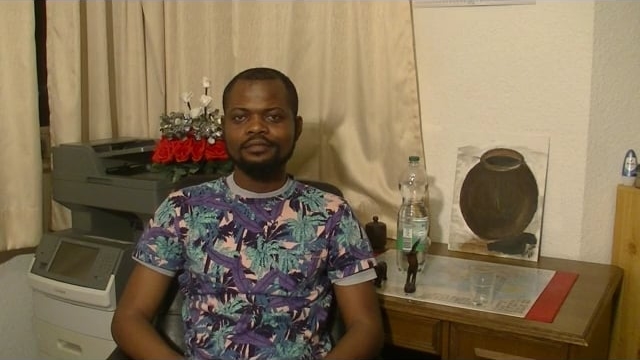
Country of origin: congo
Year of settlement: 2009
Age on arrival: 25
City: bochum
Gender: male
Language of the interview: Lingala
[i] Hello [name]. Thank you very much for your assistance to participate in our project from Hanover Museum from Bochum We are Members of the Bosangani Association from Bochum In the name of the museum That’s why we want to know before we start, that you can imagine. Do you want to do it in French? or, ok Thank you, sir [name] that you took the time to take part in our project. Project by Museum Hannover von Bochum Thank you, that you really took the time to accept our invitation to be able to comply. We would first like to ask you to introduce yourself. This lets people know who you are. My name is [name]. I come from Congo. I live here in the city of Bochum. Married, father of 3 children I have been here in Germany for 9 years.
[i] Thank you very much. Can’t we know about your childhood? That’s why we ask you if you can talk about your childhood, birth, etc. Where were you born, where did you grow up, in which community. This will be very nice
[r] I just said that I am from the Democratic Republic of Congo, although Congo Kinshasa I was born in the city of Kinshasa That was on November 25, 1984. I am the eldest child in the family Because I was born Life wasn’t easy I was born in Ngiri-Ngiri Municipality It is located in Kinshsa The road is called Ngiri-Ngiri I was born in a simple normal family My father’s name is [name], my mother [name] They brought me into the world Then when I was 8 years old I was left alone without a father. There were situations that my father himself knows about He left me to look for his life somewhere else. There the lab wasn’t easy for us. Life for us was also hard. I finished school. I first attended kindergarten, then attended primary school, and finally secondary school. I graduated despite the difficulties of the country’s life Because I I fought a lot to survive. Then life got better I came to Germany at the age of 25. I have been in Germany for 9 years. 3 years now in Bochum. I am married in Germany, I work, I am the father of 3 children. I just live normally, but it wasn’t easy my life trajectory overall I suffered a lot, like many others are suffering now Food, clothing,…, were not easy to get. Since dad didn’t work, he was a student. My mother was a housewife, she was just at home. I was born in the family home. We lived with the aunts, uncles, we all lived together. My childhood as a whole was not easy Then my father told me that he had to go look because he has to ensure our good future. He went to look for his life When I grew up, I tried to find life in my own way. That’s why I found myself here in Germany.
[i] Thank you for all the details you provided. But we would like to go back a bit. You went to school in Kinshasa. Kinshasa is a big city. In which municipality did you go to school? And in which school? did you attend primary and secondary school?
[r] I only started with kindergarten, but not directly with primary school, I started kindergarten when I was 3 years old. I stayed there until I was 6 years old. That was in “Complexe Scolaire Bonguana”, this is in Bandal [Kinshasa municipality] on Avenue Bukaka I forgot the number in the Kimbondo district I did the first through sixth grades of elementary school there I got my certificate there. After that I went to secondary school in IT Bongolo. Then I did a formation, from 3rd grade up to the 6th grade of secondary school always in ITK Bumbu as an electrician I completed and received a high school diploma in this field. I am an electrician with a degree. This is in the municipality of Bumbu
[i] Thank you very much. Do you have contacts with friends who grew up with you? Or do you no longer have any contacts?
[r] Sure there are contacts because if God…gives the opportunity I go there for vacation Since I’ve been here, I’ve gone there 2 times, I met my friends there. As I am here, they are not like that The situation in the country is not good They have a hard time coping with life We have finished all the school, but the situation is not good for them. Everyone wants to come here maybe he will find life easy, because they see that I have done something The reality of the country are not good. Special for the education and future of young people, who went to school with me is not happy. For me it is a blessing to be here in Germany because I don’t have to eat or wear anything. But sometimes they have something to eat.
[i] But they say in the media that Congo is a very rich country. And you say that people have a hard time eating. This creates a contradiction. Geography and history, as well as the media, report on the wealth of Congo. Now why are you saying that the friends and relatives who stayed there are struggling to make ends meet.
[r] Yes, Congo is a rich country, it has diamond, coltan, copper, gold. It is true that Congo is rich. We see coltan, diamond, and many other mineral resources that are needed in the world. There are people who profit from these wealth. Individual who benefits from it, but not everyone benefits from it but for his own interest For his pocket and his family If you belong to this rank (group) you will have a good life but the people outside this rank, like my friends, no one has a good life. I was worried, the last time I was there, in Kinshsa, I’m making a bracket here, I met a Freud. He told me that he had done five years without having an amount of 100 US dollars in cash. for 5 years. 100 US dollars is like 100 euros He has done 5 years without having an amount like 100 euros. You have to imagine, a person at 33 years old, what his future should be like. That’s why in Congo Such things happen what you observe there. There is constant unrest because there is no good future for young people. But practically the country is rich, this wealth goes into people’s pockets. Those in the government benefit from this.
[i] What contacts do you have with your friends now? By phone or what? Or which ones, do you still have a relationship with them like before?
[r] The relationship as we grew up together is no longer the same because I go on vacation, but sometimes I don’t visit some, I visit some, we help each other. Sometimes I avoid meeting them because sometimes they come to me, they want to get money from me. I don’t have any money to distribute. I’m on vacation. My money is well planned. Our contact is not deep, we like to greet each other, but not close contact. But I know that I went to school with him. We were in the same class. We talk about the schools time. Some say that they have children and that they don’t have a job. She told me that I was lucky because I lived in Europe. I try to motivate them to do that we have to continue to fight with life, we are the future of tomorrow. In Germany there is also suffering there is a hidden truth. In Germany if you don’t work, you can’t eat. You can’t move forward. Even though there is social assistance, you have to go to work There is the opportunity to work in Germany. There is no work there. They have the will to look for work and to work, but there is no work. To get a job you have to have a relationship, otherwise you won’t get a job. Without contact you won’t get a job. They have their suffering.
[i] Your contact with friends, you say that you were born in Ngiri Ngiri, that’s why I want to know about the family who live there, who are in Kinshasa, who did you leave there that you have contact with.
[r] Family members of my father and mother live in Kinshasa, Aunts, uncles [mother’s and father’s side] They also have children, my cousins are there too, We talk on the phone together, and when I go there, I go to them first. My aunt and my father’s siblings are there. My father and my mother don’t live together. My mother is in Luanda, my father is here and my siblings, who were born here. You are 3. You were born in the city of Essen. We live here together.
[i] The family that stayed there – they grew up together – there is concern for this separation. How do you feel about this distance between you?
[r] For me there is concern because we have the same blood, we were born in the same family. I was with them from zero to 25 years old. I know all the common sufferings. When I was there it was a little better, but now it’s gotten bad. Very bad The concern is that one day they will have a good future because if there are 100 relatives in the family, and you alone are good. And 99 are not good, don’t have a good life, this causes you to have difficulty too. Because you always have to help. You have to send the money you have for the center, for example, to them. So they can get something to eat. There’s the worry. They are missing something to eat. Sometimes I throw away the food here. But I can’t send the food there because it gets spoiled on the way. That’s why I sometimes send €100, €50 so they can get something to eat. You can’t say clothes it’s just misery. That is my concern My worry is one day Here I would like to take advantage of the opportunity that exists here. I want to learn the technique from here, so I can do something there. I can make my contribution there Maybe I can change something there with what I learned here in Germany
[i] Thank you very much. When you were in Congo, what was the political situation like? Can you please explain what you experienced in politics in Congo, in that sense of political regimes. Which regimes have you experienced and how are they governed?
[r] I can say that politics has already been destroyed from the roots. I was born in 1984. The story before I was born said because it wasn’t good before. I find politics in a catastrophic situation. in the sense that he is in the presidency, doesn’t want to go away. He doesn’t want to organize the election. He wants to stay in power. When he dies, his place will take place. If one belongs to this group of ruled politicians, he will continue to remain in this group, group of rulers. If other people want to do politics, these people will have difficulty getting into this group. As we see here, If you study politics, you can just do politics, but there is nothing like that. The political situation, as I left it there, is catastrophic. The situation has gotten worse. The man who is in power does not want to leave power. He is preparing the election, but at the same time he is preparing someone who will take his place. So that he can protect him later. Everything for your interest. They want to disrupt the country. That is our observation. Although the country is already destroyed. There is no future. The school no longer functions. If the school has already been disrupted, it is the destruction of the future of the country. When the future has been destroyed. If the school that gives people intelligence, where they are taught to learn “a”, “b”, “c” and “d” has been broken, what will the new natives learn. This bad policy brought out the phenomenon of “Kuluna”. Kuluna was created for this reason. Because if someone was in school, they can’t be a criminal. He can’t just be that criminal. Who was at school, who learned, “Kuluna” has no pity. If a “Kuluna” meets you at night, he can cut your hand just for the phone, sometimes just for 10 dollars. He can open a pregnant woman’s stomach with a machete and take the child out. Just to ask for the money. If there is no money, he will cut the woman with machete and the child will come out. Everything in front of the man. They traumatize people, they loot homes, all because the bond no longer exists. The future no longer exists.
[i] Can you perhaps explain the phenomenon of “Kuluna” for the people who will hear you.
[r] What does “Kuluna” mean? We are in the city of Bochum, Bochum has many districts, we have Bochum Hamme, Altenbochum, Bochum, .., Each district has a group of young people who form a gang. A group of young people between 18 and 20 years old. They buy machetes. They no longer go to school because their parents have no money for school fees. The parents even don’t have the money to feed the children. a resident of another district is not allowed to go to another district. For example, a resident of Altenbochum is not allowed to come to Bochum Hamme. When he comes, he is asked for telephone equipment. If he doesn’t have that, his ear will be cut. I’ve already seen someone get the baby for the ligature, he brings his wife so she can ligature her – she was pregnant. They met the “Kuluna” on the street. They [the Kuluna] asked for money. They had no money. She went to the hospital. The woman was experiencing pregnancy pains. When they attacked the “Kuluna”, the “Kuluna” took machete, they said that since he doesn’t give money, we will deliver your wife ourselves. They took her stomach and stabbed the mass, then the child came out immediately, they killed the woman and the child at the same time, that is the Kuluna phenomenon. If they meet you on the street in a car, they arrest you and they ask for money, if you don’t have it, they cut you all over with knives and then they kill you. How to say: Gang There are conflicts between districts because sometimes you have done something to someone Even if you will say that there is no more “Kuluna”, they have remained with hatred, and they have to hold accountable? Because this “Kuluna” kills someone, for example a Kuluna from another part of the city, and he remains. When he remains, the relatives of the murdered man will seek revenge. The districts are divided by quarters of “Kuluna” or of Bange(group) As we say, in reality Kuluna gangs are gangs in the district. Kulunas gang is bad because they kill people. Only sometimes because of the telephone device. Sometimes the device only costs 100 euros, you will be killed. Why is that because he doesn’t have anything to do all day. He has nothing to keep him busy. There is no future. He just wants to drink alcohol and be drunk. He is willing to harm people. His life will remain like this every day This is what “Kuluna” is like
[i] Thank you. If we now will ask, we want to know during the time you were in Congo, Congolese who fled there. Fleeed in the senses political they have problems, who will later apply for asylum, we see here in Europe many who fled here. Why are they finally fleeing? in these times?
[r] When I was there, they fled, because of their political reasons, certainly that is true. I know that I was separated from my father because of political problem, he was a member a political party, he was a combatant, he spoke for he was targeted, all young people should be caught, then he fled. It was the same with me too, it was in 2006, when the problems came. I took part in the political movement. When they notice that you are against the government and you are there. When we said: I will not remain silent for the love of my country. When we testified and we stood with placards… That was the reason I fled, because my life was in danger. We are not politicians, but we are within the political party ah in the political party we support, like all young people, who supports the development of the country. That’s why when you come, we one targeted Politics wants to disturb them, they are the opposition leaders give support. Because if we go into the street and we will be the leader behind, then they are arrested one by one. How people are fleeing now, just as I had fled, We came to Germany to apply for asylum.
[i] Now we are leaving Congo and we are in Germany when you had been fled, which route did you take? What difficulties did you have, We see people having to cross desert. It’s not easy to flee, to leave your country. With all the financial difficulties that exist there. What difficulties had you had in the way, until you can reach here?
[r] Ah, I had suffered a lot. If I have to tell this, It took me two years to get there, two years on the way, that is, is that really a story that I don’t remember many of the details. If suffering, two years. If I have to tell the story in 20 minutes, for example. But suffering, what I experienced in two years, I cannot tell in twenty minutes. It took me 2 years to get here. I had to travel on water, as you now see people doing themselves. Why this? It is because of difficulties that I should seek my future, with my own strength. I suffered, I can’t tell you about it. If I have to tell you that, it might make me worry. I was traumatized because of the experiences along the way. But to tell the truth, I suffered. I was on the way to coming to Germany for two years. footpath, Waterway, I did everything. It’s unfortunate. If I have to tell this, maybe the trauma can come back. Because I had to visit a psychiatrist here in Germany. I visited a doctor and talked to him to give me hope for life. It took me 2 years to get here. That wasn’t easy. I suffered. I suffered the worst… today I can tell you in 10 minutes, but it’s a story from 2 years ago. I can tell you this in 10 minutes, but I suffered a lot. There was a lot of suffering.
[i] Did you take something or a souvenir with you, some material from your country Congo, or a photo, or something that reminds you of the country, when you first left the country?
[r] I have no souvenir from Congo from my escape. That may be when I travel there, I see a lot of negative changes, many places are damaged. But souvenirs…If I have to think badly about something, that we bring tears to my eyes, so I really don’t have a souvenir.
[i] We are now in Germany a foreign country the climate is different here, people are different, politics is also different, the bureaucracy is also different. When you came to Germany, what was your first general impression of Germany?
[r] My first impression was the beautiful construction of this country, everything is done with order, The streets have lights on when the light is red. Garbage is not thrown on the street, but in a specific place. The people are organized, the people are integrated, that amazed me. Because I threw paper on the street in Congo. I threw the can I had been drinking water out of on the street. But here, when I drink water from a can, I throw the can in the trash. or where you have to become Teck. I can’t throw this anywhere. That was my impression. I really noticed that things are good here. I didn’t know politics because I could hear what was being said about politics. Gradually I understood politics, I knew that we have CDU, SPD, CSU, we have SPD, FDP. Then I slowly integrated, but my first impression was what I saw first. I had seen trams, subways, trains, everything is organized. That was my impression.
[i] Thank you. About the reception What general reception did you get in Germany? How did your family welcome you in Germany?
[r] Germany welcomed me. I was helped so that I could integrate. If I’m not integrated, it must be my own will. because when I came, I was sent to Bavaria in Munich. I went to school in Munich to learn the language. How to speak the language. I was received. Eh eh difficulty, statement about xenophobia, racism etc., I had no interest in it. I wasn’t interested in it because when I’m in Congo, when I see a white guy, I also say: “Look at that white guy.” That’s racism. That’s what they say too. Since we don’t understand their language, we can’t speak positively about them. Second I noticed that it is normal because I live in Congo with my relatives who live there. If he is not my relative, if he asks (offers) me something, I will be afraid because I don’t know him, I will be afraid, I don’t know all the Congolese. It is also normal that German should be afraid of you if you knock on his door to ask for water or ask him a question on the street. Because firstly, you don’t have the same skin color as him, secondly, you’re a foreigner. It doesn’t matter who I am, my color shows that I’m not with myself. I just have to obey the rules here. I can’t say they’re bad. It’s like I’m saying winter shouldn’t come, because I don’t have a jacket to wear. Further must come. When winter comes, I have to wear jacket so that I can protect myself against winter. That means that in order for me to live in Germany, I have to integrate with Germany. It could be that I won’t be accepted, or that I’ll be insulted as a black man, that I’ll be spat on, that doesn’t interest me. My interest is that I integrate myself, I speak the language, I understand people, I write the language. There are my interests. I also have to go to work like they all go to work. I have to obey the system from here. I don’t care what’s left, whether they’re racist or whatnot. That’s not in my head.
[i] Thank you very much. How you were received when you applied for asylum, were you received well? How you wanted it?
[r] Good. There was also… Despite my father living here, but I was already of age, I had to submit my own asylum application, with my own reasons. Although my father has German citizenship, it was impossible for me to get residency through him. It’s also normal because I had my own problems. I had applied for asylum. The application was also expelled. I then made a complaint and clearly stated that if I returned I would be killed because I had opposed the established regime. Although it wasn’t easy for me to be recognized. I remained undocumented for four years. I had only learned the language. I didn’t do anything for four years, I always stayed at home. I was at home, I was often sleeping, my application was rejected. After a long time it worked and then I got my paper. But I still had limitations with these papers. Restrictions mean I only have to stay in one fixed city. That was a second problem for me, which was negative for me. I was given something and told that I only had to stay in a certain place. Just have to live in a city. I wasn’t allowed to move to another city. I didn’t know these laws. I knew that you could go to any city without any problems. Second problem I had to struggle with is, I can say that it was negative until 2016. This is what I can say about the asylum application.
[i] What can you say on the positive side?
[r] On the positive side, Even though I didn’t get any paper, they gave me one Given the opportunity to attend the language school. If you know the language, you can do a lot alone. That was something positive for me that I got. Ticket free. I had gotten clothes when I asked for them. I also got pocket money, something I never got in Congo. You know that I’m human, they helped me. That is positive
[i] How you live in Germany in general are there contacts with other foreigners, if so in what form? What can you say?
[r] Contact with which foreigners? Germans or non-Germans?
[i] Non-Germans.
[r] Yes, there are contacts with non-Germans. I have from Turkey, from Arab countries, from Iran, from Iraq, from Lebanon. We talk in German, there are contacts.
[i] And do you have contacts with Germans? If so, in what form?
[r] I have contacts, especially with my work, at work I have contact with the foreman, he’s my best friend, he’s even a musician. His name is [name], he lives in Bochum Wattenscheid, I go to a concert, I integrate myself, in their German concerts. Sometimes I’m the only black person down there among the Germans, Apart from him I still have a friend [name], he is also German, he lives in Wattenscheid. Many friends are at work.
[i] You said that your father is here, and your siblings. Can you talk about contacts with the family?
[r] We are doing well with my father and my siblings, but we don’t see each other often because everyone has their own job, how the country works here. That doesn’t mean we don’t like each other, we like each other. We have the same blood. But the task and employment… We call each other and we meet too. The contact is normal.
[i] The city of Bochum, You used to be in the city of Essen, now you are in the city of Bochum.
[r] No, I used to be in the town of Milloburg on the Danube in Bavaria. That’s near Ingolstadt. I lived there for a year, then I came to Essen. I left Essen in 2016, I have been in Bochum since June 2016
[i] If you have to talk about your life in these cities, what can you say? All 3 cities Please start with the first and end with the third.
[r] First I will return, I started my life in Bavaria. I found them very racist. My first city was in Bavaria. Like I said, I wasn’t interested in that. I didn’t learn the language in Bavaria. I hadn’t done anything for a year. When I came to Essen, I can say “thank you very much” for the city of Essen. Because in the city there is food I learned the language I completed a 6-month training course in the city of Essen. I work in the city of Bochum The city of Bochum helped me. My residence status is being changed. I have a great positive condemnation for the city of Essen and Bochum. as the city of Neuburg in Bavaria. I have a bad souvenir there.
[i] You now live in the city of Bochum, What free time do you have in Bochum? In the weekends and in your free time?
[r] In the city of Bochum I often go to concerts with my colleague, My hobby is music, he plays pop and rock. I’m often with them, sometimes with children, in parks and playgrounds. But I’m often at home with my colleagues or even with children. Sometimes my colleague calls me and says that they are at Bochum Total in the city center, for example. For example, they say they have a concert in Wattenscheid, then we’ll come there. There are our jokes. Sometimes we play football as part of the company.
[i] We hear that the Germans are strong in bureaucracy, if you have to make a comparison between the bureaucracy of the city of Essen and the city of Bochum, what can you say? between the two cities?
[r] The city of Bochum receives .., I have no problem in the city of Bochum, I think people are well received. They are a little, as we say, they’re a bit… loose, in the city of Bochum they are relaxed than the city of Essen. In Essen the people are strict and tough. For me the city of Bochum is better. Life is also cheap in Bochum, the rent is cheap, Food is cheap, than in the city of Essen. I prefer to live in the city of Bochum.
[i] You came back from Congo, Congo is a big country, he also has a large community here, in Germany. I want to know if like the Congolese are organized here? Here in the city of Bochum? and in the city food?
[r] In the city of Bochum we have Mr. Massakidi, who is the chairman of the Bosangani association, he brings people together, the young people who have recently come and who have lived here for a long time. There are gatherings, we meet when there is something special, We also do projects we help each other, when there is sadness We have many projects to our club Bosangani. In the city of Essen it’s the same, but it is a little different, compared to the city of Bochum. In Essen there is a group of men who come together and meet to exchange ideas. If someone in their family has lost a member, it may be that they have no money for the funeral, the group can collect money for them, everyone can give something, for example everyone can give 10 euros, then it is sent to relatives so that they can take care of the funeral of the deceased. This is how help is provided in both cities.
[i] Let’s talk about culture. Let’s take African culture. Can you find the African culture here, what we left in our countries, can you find it here? I mean the cultural side first.
[r] The cultural area is somewhat negative. I have to be open about how I see the Jews, the Turks, they have their club. They meet there. You, Massakidi, you have a club but… I saw it negatively, perhaps because there is no support. Financial support. Things are different with the Turks, they have a lot of money. You can donate 1,000. But for us Congolese we organize a football tournament in the city of Bochum, we demand money and support. Our community does not have this support. I can say that.
[i] We know that Congolese are more believers, more believers, in Congo there are many religions, first, second, third religious communities, first are Christians then come the Muslims. There are also traditional religions. How are the Congolese religions represented here? since you also want to bed here?
[r] I notice here that Muslims go to church every Friday, yes, we also go to church every Sunday. But they have advanced a bit. They’re a little bit advanced because there are more Christians in Germany. We haven’t progressed that far because we don’t have a fixed place to sleep, where we can also get support by giving us a place to pray. We have many difficulties to gather together. You have to rent a hall with a large sum, with a lot of money This is not the case with Muslims, Furthermore, we are not firmly connected in our churches. We’re really not connected, that’s just how we are. But Congolese who are here Majority are Christian. Some don’t go to church because of personal reasons. Some don’t go because they don’t have a fixed place to pray. In Bochum a large church where many people gather is rare. I can say that.
[i] You personally can you talk about your church life, where do you go to pray, what religion do you belong to? Your family too, what are you doing on the side of religion to meet your spiritual needs here in the city of Bochum?
[r] Yes, I go to church every Sunday because I don’t have time during the week. In our church we have prayer on Tuesday and Thursday. I go to church every Sunday in the city of Wuppertal, Wuppertal Katerberg. I go to church there. If the children are there and haven’t gone to their grandparents, I’ll take them with me, also with my wife, in the city of Wuppertal, we go to hear a sermon, to pray, to praise God, then we come back home. I can say that.
[i] Which Church are represented here? Is that the Protestant church? the Catholic, the Muslim, or Congolese church?
[r] This is the free Protestant church. This is the free Protestant church, as they call it.
[i] Let us leave religion Let’s see the entertainment section on the weekend We know that Congolese are a musical people. When you were in Congo, I think you were interested in music. Since you’re here now, don’t you miss this music from Congo? The music from your homeland,
[r] Sure I miss her, because I know that in Congo we have places called bars, who are on the street, When I return from school, in the evening when I want to chat, I go to the bar to have a drink. This could be juice, beer or something else. I listen to music. But here we don’t have such a thing. They’re small, they’re like pubs. They’re not here. We really miss them. I don’t see how we can start with this. We miss them in our lives. Because we need to relieve stress after work Monday to Friday, and Saturday. We also need to go out in a unique spot. There is one in the city of Essen, there is not one in Bochum, there is not one in Bochum! For example, if I have drunk beer, I cannot drive a car to go to food. If this were in Bochum, I could walk or take a taxi. That’s how it is. We have a hard time finding each other.
[i] But with the family, let’s say the wife and children, what entertainment do you have in common?
[r] We go sometimes to cinema, Swimming pool, in playgrounds. But I didn’t grow up like that, I find that boring. Because I know when I was growing up, we did gymnastics, played football, sometimes did running sports. For those who were born here, It’s normal, but I find it boring.
[i] We hear that, we know that Exotic things are in Afroshop. Do you find things from home? here, special food? Don’t you have a home guard about the food?
[r] I’m really happy with the food by 60% There is, but not everything. But what you usually need cassava leaves, fish, sweet potato leaves, vegetables, cassava flour, different fish, you can get it here.
[i] The children were born here. you need Contacts with the family who remained in their homeland. What are you doing to get them? to enable children to have contact with family members, who stayed in their homeland?
[r] Ah, that’s very difficult, that worries me, in the sense, I can give an example I open a bracket: The Germans who work in Congo who work in the German embassy in Congo, it is the Germans who work there. Let’s assume a young German couple who have gone to work there in Congo. They had a child in Kinshasa. When the parents who are in Germany call to talk to their grandchild, I don’t think they will be able to talk to him in Lingala. Because Lingala is the language we speak in general. At school we speak French, but we usually speak Lingala to each other. What I’m talking about now. You will not speak to him in Lingala, but in German. As for me, my aunts, my children’s grandparents who are there, only speak to me when they call home. You can’t talk to my children. What languages can they communicate with? The children are not interested in learning the language. If you compare with There are many reasons, which I may talk about later. I can say that.
[i] Why don’t you encourage the children to learn their native language? What is missing?
[r] There is a lack of places where children can be taught the language, as we see the Turks and the Arabs. Sri Lankans have places where they learn the language. We don’t have anything like that.
[i] That is the question of your organization in your community. This is the city’s fault.
[r] Yes, it’s not the city’s fault, but sometimes when the community wants to do that, it might require a lot of paperwork. This can lead to you not feeling like doing it. Maybe he wants to do it on a voluntary basis, offer the courses for free, but the space will cost. The rent has to be paid.
[i] Couldn’t you talk to the children at home in your native language?
[r] It’s a bit difficult since the children were born here, Eh, eh Above all, he was born in a foreign family, like ours. I really don’t speak German well, but my wife speaks German perfectly, She speaks to the children in German. I sometimes speak in French. Sometimes I speak in Lingala. All of this makes it difficult for children to learn good German. This isn’t really easy. I’ve been thinking I thought about it, maybe it would be better like this they will go to a place to learn something. as they say in German: tutoring. She’ll get help there and it’ll be fine. This will be better than us teaching them the language at home. The one who will teach them he must have means. If he has no means, will he agree to do this? Who will pay for his time? That’s how it is. If the city will help him, it will be welcome.
[i] Are you satisfied with how the German media shows the truth of Africa? Is there agreement with the realities of what you know beautifully?
[r] There are two sides, two parts! On the one hand they do something well, on the other hand they don’t act well. According to me, they actually act well because I know the realities from there. But for my child they don’t act well in the sense that that the child has no desire to learn Lingala if As he sees in films, only bad places are shown in Congo special in Kinshasa: barracks town, bad places. Although in Kinshasa there are also beautiful places. For example, your embassy building. This is being built like the buildings here. Districts where the diplomats live are good. But it’s not shown here. They only show unpleasant places. This traumatizes the children. The children have no desire to learn the language. She say where to put it because they won’t go there. That’s the way it is. For me it is positive. But for the children it is negative.
[i] You can also do some actions to change the media? Is it possible that the community can influence the media?
[r] The media, still if we influence them… It will be difficult to achieve at first, Because to demonstrate in Germany, you have to ask for permission. It is not easy. Also, people won’t participate. Maybe this can work if we motivate through such actions. You can express them and we can also express ourselves further. It’s a bit difficult to do it in other ways.
[i] What changes do you want so that your children do not have the difficulties you have had? What wishes do you have for the authorities?
[r] To the German authorities I just demand the teachers where the children go to school, teach something about our culture. I find a lot of our stuff here. When I look at the Wuppertal Zoo, there is a race of monkeys, which are called “Bonobo”. This breed only exists in the entire world in Congo. This monkey is in Wuppertal, that means they should also help us somehow, Since we are also important and have influence over you, that’s why they picked up “Bonobo” there. I can say that.
[i] What difficulties do you have, that the children have at school? Your children are still small but you still have Brothers who are at school? What difficulties do they have as a foreigner, as people who speak many languages, or people who come from other countries?
[r] Difficulty you have with Germans or with other foreigners?
[i] Generally at school.
[i] My brothers sometimes have difficulty at school because they understand German quite well. If you call him an insult about the color of his skin, he will get angry. If he reacts, his punishment will be severe. If he reacted like that because maybe he understood what you said to him. I can react differently, react because I didn’t understand other things. But he reacted because he didn’t like the things. When he is reacted, we the punishment will be very harsh. He will even forget the one who provoked him. There are the difficulties that we are talking about. This could be because he is insulted by the color of his skin. It could be that the teacher doesn’t ask him a question because he’s black. The difficulty is what I have mentioned. I had a lot of trouble with the case where my brother wasn’t spoken to by a teacher because he was black. Everything they do is always bad. Even if he didn’t do that. It’s not good. There are the difficulties. I don’t want my children to join in. When I see it like that, it’s painful for me. I call on the authority to monitor our children’s relationships with teachers and other members of the school. About insulting black people and other things. They understand that, and that bothers them. As I accept these, I do not accept the others. Such is the difficulty. This can cause problems for them in the future. They can be denied a place at school because he or she hit someone or did something. As the law requires here. That’s what I can say about it.
[i] Can’t it be good that parents sometimes talk to the authorities when their children have these problems? Have a conversation with each other to avoid this matter coming up again in the next few years.
[r] What problem I have observed in Germany is that you can talk, but sometimes no solution is found. All they will say is that they talked about it. That’s how it is, I will have to be happy if, for example, if someone’s skin color is insulted: For example, if someone says that you are like a monkey, or you come from monkeys. That’s an insult. I demand, as is the case here, if you hit someone, you are liable for bodily harm. You should also do the same for insulting skin color. So that this doesn’t traumatize the children. Because the children make mistakes make. Sometimes when someone insults them like that, they immediately hit them. If he hits someone, he’ll get in trouble at school. That’s what I can say.
[i] Everything that happens here Do you sometimes feel homesick?
[r] Yes, there is homesickness. I say, that I came here to learn. What I will learn I will work for the development of my country. I will learn. Therefore I also have to work for the development of my country. I have taught and I usually have to study well. I will teach those who have not learned.
[i] I want to say, how sometimes one is insulted about one’s race, or our children here will have difficulties because of the color of their skin. At school notice that people are talking about things that affect their skin color. But if they had been in our countries, if it hadn’t been for this thing, because they would be in their environment. I wanted to say in this sense.
[r] Yes, I now understand your question. I’m going to call for the authority for these senses, you see, I can just understand because it doesn’t bother me. I can perhaps ask at school to teach to speak even in normal life, even in information to say that insulting skin color is not good. People should be sensitized, they should not insult other people because of their skin color. I can open a clip. I was on my way to Essen, a white man asked me whether I sell hemp. I asked him why he has all the white people walking by, but only me. He says because that’s what we blacks sell. That’s discrimination. Something about skin color an example is given. I see at work, when you see something with the color black, they will show me. If she’s a black man see, they say to me: look your relative. That’s discrimination, but I can’t angry, I understand that. But the child can’t understand it that way. The masses need to be taught. The authority should do that. Teachers need to talk about this more often in school. To offend someone about his skin color is not good.
[i] When we talk about escaping from ourselves Black people from our countries. In the last few days we have seen people Seen many Black people fleeing and coming to Europe. The difficulties that exist there, what can you say to our authorities there in Africa to make them aware?
[r] I can say that the decision comes from here in Europe, then it is sent to Africa. The problem is not attacked head on, but rather at the source. Attacking the source means that you who are here can help us so that we can get out of this trouble. Because when we get out of trouble… Imagine if I got the wages I get here in Congo! Why should I come here? Maybe I can just come on vacation like they go on vacation. then I’ll go back. But I get…, I’m in… not able to get this wage. To have a lot of money in Congo, I have to be a politician. But a politician shouldn’t have too much money. That will be theft. It’s that they’re supposed to help us. They should help us to find a better path and this coming here thing will come to an end. She should build roads for us, do things for us, help us. So that we become equal with you. Because if we are the same as you, we won’t come here. But if we suffer there, we will always come here. Because here I am protected, preserved, not killed. I’m not allowed to speak like that there, otherwise I’ll be killed.
[i] You spoke to people from here. But what do you say to our people, to black people, we Congolese who live here and also those who live in Congo. What can you say to us Congolese, both those who live here and those who live in Congo?
[r] To politicians or normal people?
[i] First about politicians.
[r] To politicians can I say that we chose you, we have always chosen them, so that they can bring our needs to Parliament. When we choose them, we don’t do it because of their bellies. We elect them for the whole people. We are like slaves. Because there is no democracy. Help us if we elected you as governor or minister, is to work for the country, but not for your family, not for your stomach, first for the country. We who are here shouldn’t give up, We should use all means and means, so that we can be heard. Because we speak for those who are there. For example, at the demonstrations, through videos for which will follow. Maybe there are people from Parliament who will listen. Our concern is that we will no longer come here. Because if they don’t help us, we will always come here.
[i] Now I want to ask this question: When you left Africa and came here in Europe, although you fled to talk for your life, But you also had some dreams, as they call it, Is these dreams realized or not?
[r] yes, for 100% it is only 5%, 95% is not realized. Because my concern is not that I grow up here. My concern is not like that. My concern is, that I help my country. Even in export, I can do something. If I hire 2 people, I will reduce the unemployment rate. Instead of giving, Is it better to do something? So that I can hire 6 people, and with that I will reduce the unemployment rate. Where can I get this intelligence, here. This is paradise for them Who goes out of the country he annoyed those who stayed. That’s my concern.
[i] What you learned in Congo did you use it here too? or do you want learn more? I want to learn more because when I went to school here, I attended a school for people who don’t have papers. That was just for the language and still small knowledge. But I want to learn more. Learn more. Because once I learn, I can help there. These people won’t come here. But if the people there have not learned, we will find ourselves here without education. How could we learn the language? In order to learn the German language, you have to have a basic knowledge. But they want to come here, they haven’t learned the language. That will cause difficulties. It’s getting better that we get more help there, Then, if things are good, we won’t be able to flee here and apply for asylum here. If you’re good, maybe he can come for a visit and then come back. You should help us.
[i] In which area do you still want to learn?
[r] For example creativity. In Congo creativity is not done much yet. Creativity means making things. You’ll be making a lot here. For example, devices and more things. They have companies. We have no means. At school you will be told something about cable without knowing it. You only explain it theoretically. When I see these things here, I can’t recognize it.
[i] Today you want to learn, what support do you expect from the German authorities or from the city of Bochum?
[r] Support from the authority or the city of Bochum is that they help the people who come and who want to learn. Even if they don’t have papers. To help someone, you have to have a base. But here to help, To attend a good school you have to have papers. This paper also has conditions. These are difficulties. This is really difficult. We need help for the school. When I came here I wanted to learn. I even wanted to study for 5 years. But I couldn’t study because my paper was that not allowed. Man couldn’t pay for college. That’s why my hope was lost, I just had to choose somehow. What I work on now is not what I learned. I work because I don’t have to just stay like that. They don’t want to give me what I’ve learned because they have no trust to my education from there. I work hidden in my training.
[i] For investing in your country, how you plan it, Are you already preparing, or is the project for the future? I’m preparing, to return to my country before I turn 50. To become an entrepreneur. To become self-employed. But there are many rules to get there. I want to lose my stay from here because my family is here. I don’t want to lose this. If I go there, you can say that since I stayed there for a long time my stay will not be made. This is going to be bad. That’s how it is.
[i] You said that you are in contact with people from your country, do they also have their wishes in certain areas that they want to work with you? Areas that the country needs. Areas that correspond to the realities of the country. The realities of our country and of Europe are different. The areas are also different. If they have already spoken to you, what areas do you like?
[r] Areas for investment in my country are for the young people to find out about. First the education, that is the basis, second, for example computer learning, third in the field of agriculture, fourth in the area livestock farming, because we have bark, instead of importing milk, we can produce on site. We have empty fields where we can plant things. It will grow well, but we don’t have the means to do it. That’s how it is. We have mineral resources, but we don’t have to transform this. I can say that you can promote coltan, and bring here to edit them. Why shouldn’t you build companies there? and work on coltan there. If they did them there, they would reduce unemployment. Instead of promoting them and bringing them here. That’s why you see the children in the mine have to work because they have nothing. They work there and support the family. But I know that the father usually feeds the children, but now the role has changed, the children feed the family. Helping us is that you bring the materials you took there, here. If you don’t want to help me as individuals, If you think I can’t put money to good use… You can help us in this sense: The things we have there you can use your devices, what you use here, also their engineer, because we will need people to show us how to use them. If you are the companies that Coltan processes that make telephones, smartphone, televisions, electric cars, if these companies wanted to move to Congo, I will be among the people who would return, to be able to work in these companies. Because my life is there is less stressful than when I’m here.
[i] Can you tell us about it? the city of Kinshasa where were you born?
[r] I already said about the city of Kinshasa when I left Kinshasa recently and came here, I have ….When I was there in months this year was August to September, What really affected me was the affair of the “Kuluna” gang. I was also disappointed with Mülle. There are places where all people throw garbage, but it is not emptied. It smells bad and people suffer from malaria. Young people are now demolishing these places because they are not emptied, there is no maintenance. The streets are not cleaned. Electricity: We have large hydroelectric power plants in Inga, in Congo, but in Kinshasa there are places where there is no electricity. Or where electricity has not yet been installed. Water: we even have the river, Congo River, it even flows to the city of Kinshasa, but are there parts of the city where there is no water. Transportation: imagine that everyone wants to buy a car, but what this car will drive on, doesn’t exist. The roads are bad, they are damaged. Some no longer exist. When it rains, it will be catastrophic. Hygiene is not good. That’s why there is typhoid, Ebola, as it is called, Malari, mosquito. Social life is not stable. If you have money, if you for example earned 500 dollars a month, you are the boss. Life in Kinshasa is inexpensive. The money I earn here, if I would earn that in Kinshasa, Will I stay here for what? There I find myself, that I am at the origin. I feel good, because I can ask something easily. To ask something here, I still have to think about it in my native language. then I will translate it, that takes time. Sometimes you speak to me without me understanding you. I say yes, so as not to be ashamed. You see, that’s how it is.
[i] As I said, normally living in Kinshasa you would be more comfortable in the sense of expressing yourself, compared to here. That is the disability. Problems in Kinshasa is that there is a lot of dirt in Kinshasa, the road is not good. The politicians do nothing at all. How big is the population of Kinshasa, can you know?
[r] About 8 million, I’m not sure, but just about. I still have to check, 8 million. In the city of Kinshasa.
[i] Congo is a big country. Which big cities still exist? The people who will follow you will maybe know something about your country?
[r] We have Kinshasa, Matadi, where there are ports, we have Lubumbashi, where there are copper works. We have Kisangani where diamond is mined, we have Mbuji Mayi where diamond is mined, we have Kananga, we also have Bukavu, Goma. We still have the city of Mbandaka… There are many cities. We have about 24 marriages… We got about, we had 11, but I heard they added some more. It’s been 26. 26 provinces. They have become 26, previously there were 11 provinces.
[i] In Germany countries are mentioned.
[r] Like we have NRW, Bavaria, like that. They turned 26.
[i] Now you personally in your life, we would like to know whether you have visited other city of Congo?
[r] Yes, I was in Mbuji Mayi, there came my grandparents, in Kasai, I was in Boma, when I left last time. Boma is a large port. When we ship things, will arrive in Boma. I was in Matadi, some things will arrive in Matadi. I was, I wanted drive in Kwango in Bandundu. There are the cities where I have already been. I’m there some big cities, where I haven’t been yet, how Lubumbashi, I haven’t been there yet, like I haven’t been yet.
[i] If you return to Congo, you will just in Kinshasa, where you were born? Or you can also live in another city?
[r] I can live in Kinshasa, but I don’t fully intend to live in Kinshsa. For example, I want live in a quiet place. Because Kinshasa is full. It’s full. I can live in the Kinshsa area. Or in the provinces. But I can’t live in my province because I don’t know the culture well. I will be in Kinshsa, but in the surroundings of Kinshasa. People just call it Kinshsa but it is a suburb of Kinshsa.
[i] You are now in Germany and have learned the language, you speak it. Are you having trouble or are you getting along well?
[r] Yes, I go to the doctor alone, I do the shopping myself, I work and speak there in German, because the language I speak now, I only speak at home, or now during the interview. But at work I speak German. But I also have problems with other words. Some words are a bit difficult to pronounce. But that takes time. I know some words Over time, I didn’t learn all of them at school.
[i] To improve your language, what do you do?
[r] I have a lot of contact with my colleagues, sometimes I read newspapers, picture newspaper, I also follow German information. So I have a lot of contacts with people who speak German. In Arabia, the people I have contacts with speak German. We only speak in German.
[r] What advice can you give to people who have recently arrived? the black, as well other foreigners, Congolese, your fellow citizens, What can you do with it? do they integrate?
[r] I can only say something, which is very important. When you come to a foreign country, you have to follow the home ice cream mixing. To make many things easier you should learn the language. Here people read the newspaper every morning, we don’t have the culture to read newspapers but we have learned that because that’s the culture from here. You should respect people. There is freedom of expression here, but you have to respect. You can’t hit someone. If you get on a tram you have to pay the ticket, in the subway too. You are not allowed to throw trash on the street. Everything counts for integration. You have to be friendly. You should greet your neighbors: Good morning, Good afternoon, Good evening Speak to your neighbors more often and neighbor to improve your language. It is like that. So you don’t be alone. If you hold back and say they are racist it won’t help, in fact it will do more harm. So you have to take it normally. If you’re called a dick, If you look at your skin color, you’re not black either. That’s just a designation, but when I look at my skin, is this skin in the normal color not black. Why should I follow her? If you call me black, Surely you said black, but my color is not black. This color is bright, as they say themselves. We have brown, we have brighter. There is also black. If you say black, I’m not black and that doesn’t stick to my body. The insult doesn’t stay firmly on me. It goes in this ear and comes out the other ear. Keep going to reach your goal. When you left your country, you did not come to other people’s lands to do nothing. You start doing shit, stealing stuff, to travel on the subway without a ticket. When the locals do that, let them do that, but you don’t do that. You have come and are trying to integrate. I would like to advise all foreigners who have come here, in my opinion let’s come here as if we came to work. We came to work. We get something so we can return home, to build something. Because we are the ones who will improve our countries. Regardless of whether you have received German citizenship, If you are a foreigner, you will remain a foreigner. That’s the advice I can give.
[i] Through the media, I see many of our countrymen who sometimes neglect to follow German information. Or follow the report. Many follow theater from their homeland. Many follow theater, it is not bad, But it may be neglected, in the sense that some broadcast may be important, it may be important message. What can you say to them?
[r] I will tell them that they are acting badly. Because if you don’t follow TVs, for example now it’s winter, how can you know the temperature so you can dress the child in weather-appropriate clothing. You can put the child in a light jacket, when he goes outside, he will freeze due to the cold. When someone is educated, information should always follow. Because when you follow German news, you learn new words. Or someone who is highly educated should know how the country runs. Who is now the minister of this ministry. One should know the government of the country. Because we are Congolese, we are foreigners, but we live in Germany. We are the same as all Germans. Before you say she belongs in a group. We are all the same. If you count the population of the city of Bochum, for example, there is no way you won’t be counted because you are black. You will say that, for example, we have 20 people who live in the city of Bochum. You will also be counted, you will be taken into account. They don’t take your skin color into account. You shouldn’t think like that, you have to integrate yourself into their cause. Thou shalt follow information to know what’s happening today, maybe you’re from work came back. I follow information every day at 8 p.m. You can know what is happening in Germany. One can know about the election. How the country runs. If you don’t know how the country works, you can go outside and find war. But if you followed the message, you won’t go outside. Outside you can meet hurricane, natural disaster strike, But if you followed information, you couldn’t go outside. I can advise you that.
[i] We had 2 years ago People their countries flee. Especially many people from Syria, they came, some people came in the next few days from Libya, many blacks. Like Angela Merkel, the current Chancellor in power as we talk, welcomed people with open hands. What feeling do you have what can you say about the politics that she applied during that time?
[r] There are reasons I don’t know why she received them. This is politics. Politics is not what is said. That’s not the truth. Politics is hidden. There are realities that made them let her come. That they make people busy so easily. I am also a foreigner, I was also welcomed. I like what they did. But after they had received them, what solution would be given to them? It’s not like you’ve received them and you’re leaving them on the street where they’re going to run around. They start smoking, causing a lot of disorder, raping. In Cologne in December we heard that they did a lot. You have to help them, orient them into a career. An orientation to work. Those who cannot help or who cannot be integrated must find a solution for them. You will be helped if you allow it. If you can’t integrate, I don’t see how you can help him. it is better that he returns. But there are some who are worried. Those who want to work, please help them. Give them a work permit, as they had done with some. And then look for another solution. To know why these people came here. Why did they leave their country? They should also help these countries. Because if they only help here, many will intend to come here in Germany to be helped. It may be that they [the population] are already many, they have their own problems that still need to be solved. That’s all I can say. I liked the feeling of welcoming people. But the result I don’t know if other people have returned, what is their future life like. We saw on the TV how they received them. But what about her future life? For me the result is negative. There are few who return. To look for how they can get back up. It’s hard because she come from another culture. You should have understanding with them. For me it is also important to take into account if someone doesn’t want to participate, should you look for another solution for his future, because there are time bombs.
[i] We have seen that many people are against the Chancellor’s decision, Are these people right or at fault?
[r] Whether they were right or not, she could be right or not. You were right, because they saw a lot of people at once, for example, they were in difficulty, they had bread, you saw a lot of people coming, they had to share this one loaf, Maybe that’s why they were annoyed. If they had had a lot of bread, they would have left it like that. Because they themselves lack it, then they take other people. They preferred other people than her. There is injustice in another sense, they were right not to be satisfied. But against that is it, Are you sure you’re not happy with it? but try to know why these people come to you. Because your leaders are responsible for bringing these people to you. They will ask me about it. They place leaders in our countries. You decide they take our wealth and bring this. For example, if they let us choose for ourselves, the man of our choice, which is not managed from outside, will we still come here? We don’t come here.
[i] As we talk, we know that Congo is in the electoral period.
[r] Hmmm
[i] What can you say to Europeans about the elections that will take place in Congo?
[r] Okay.
[i] Because we know that many choose them influence it. We know in one of the past years when there was an election, I think of Kabila in 2006, we had soldiers who went there to provide security. That is, they always have influence. What can you say, in relation to the election that will take place soon.
[r] For the elections that will soon take place in Congo, I will ask you in the love of God, since you are a Christian, I ask you with all my heart, if you want us no longer come here to stay but only as a visitor, let’s choose someone we want. I see you choosing yourself. You voted for Mrs. Merkel without fraud, there was no fraud, there was no fraud. But you elected Mrs. Merkel without any difficulty. You chose someone you wanted. I saw Macron being elected in France. I saw how the woman was elected in England, I don’t know her name. Theresa May She is elected. Let’s also choose. The Congolese have their choice. What is bad the fraud is strong in the election. We already know who will win the election. Because this system is made by you. You remain in power, give us these. We don’t want this system. If we continue with the system they bring us in Congo, we will always come here. Because if we’re going to take to the streets to protest against the politicians, we will kill ourselves. When we will flee, we will only come to their country. Then your fellow citizens will not be satisfied with the way Ms. Merkel welcomes us. Ms. Merkel can help us let’s elect our president, which we will have chosen ourselves. They will say that we don’t do the elections, but you take part. You are the one who gives materials. You participate, you donate. They give money to organize the election. Let’s make it our own to choose. That is my request.
[i] When we look back at our countries, we want to achieve positive change there. You have several criteria for the city of Kinshasa, what you saw there: dirt, the bad streets. Then what solution can you suggest for the situation in the country after living in Germany for many years? You’ve seen how things work here, What solution can you in your country, to compare with what you saw there?
[r] The solution is, that you help us. For example, I have projects. If you will maybe help me for this projects. My project maybe can 10 unemployed people to use, we see that here. Someone can have a small company, an entrepreneur, he can have 5 employees, he has reduced unemployment. The people who have projects should be helped. And there you should set up a company for us. Like I said, things you should promote, and bring here, is it better to edit there. They should set up a company there. If we work with Europeans, it’s not a problem. We also work with Europeans here. We don’t kill each other. Why this work can’t be brought from here to there. be used there, and we will get work. We will live better. We will also build roads. Because if I build a company, I will improve my place. I will build roads. I will pay into the city treasury. You should also help us, …Our leaders want the country to be viewed as a kingdom. That’s why we got independence the land belongs to everyone, Congo is our soil, We broke democracy, help us get democracy.
[i] If we look at Congolese youth, we want to give them the message that they should come to the lobby, even if they are young, 10 or 20 years old, they were supposed to come to the Congo. The message we want to convey to them is that they should come to Congo.
[r] If you give someone cash every day, the message is the same everywhere. One day they will be able to sell their house. You will be able to sell your whole life. Every time someone sells their house, it will be glory. It’s going to be so great. Our second point is that we must have hope for tomorrow. We have to think about it. We have to live with it. We have to work with it. We have to be young and work hard. We have to be prepared for it. We have to integrate and hide our weaknesses. Until we reach our goals, we have to win. Until we overtake the others, we have to score points. This is what our generation wants to do. If you are interested in sports and music, because do you know what music means to me? If you turn off the music, you are locked out. And yes, for example, work with the church, work with your friends when you have time, turn your attention to God when you have the strength. Welcome to the Tonga Museum, I am Telemi Okeluka. We are waiting for you to tell us your opinion. We are waiting for you. If you don’t want to talk, don’t come and talk to me. Don’t come and don’t talk to me. You are not a problem if you are a problem.
[i] So, [Name], that’s what we’re going to talk about today. We will talk about the word “Oyaki Sika”. This word has been used for a long time.
[i] I am surprised that there is a case where a man meets a woman of the age of This person I would like to ask Mr. Salah why you chose Kokoso as the name for your company.
[r] I will tell you the reason. Kokoso Zalini received approval from Mr. Salah. He received the right to work there after a year. He was given the right to work there like any other German citizen. If the person writes to you before entering into a contract, they will need to submit a contract to the Australian Government. The Australian government, they have to submit a contract. This is not indeterminacy, but determinacy. So the boss cannot be indeterminate. And that’s because they have a contract. And the boss cannot be vague. For example, 3 months, 6 months. That’s how long the contract lasts. So, let’s go back to the first sentence and see what we can do with it. We are back and will continue our conversation with Zila. I’ll show you where I live. I go If you think about it, that’s a good thing. I have a lot of money in my pocket so I have to be patient. I won’t say anything else. Listen, I’m telling you, even if we speak better, if we do something better than this, then that’s good. This is what I want to do. Who is the president who must assume this responsibility? Because we have been together for a long time and have talked about it. It’s a bit of a strange situation. I hope you understand this. That’s just how it is.
[i] Do you think you can come back this way?
[r] Maybe we’ll have to wait and see. Thank you for watching this video.
[i] And this is the second, and this is the third.
[r] The German authorities have said that what they mean is that Germans have the right to live, that they have the right to be able to live. I want to say that the law is good, but I’m not. But let me tell you something today. A little break… and we’re back. It’s the first time I speak in English, so the language is not the same as French. It’s the same in French. I speak French. I’m out. I speak French. I’m out. It’s the same. That’s right. If you only know our French law, the law that gives a person a legal ID, the thing that you issue or if you only give one year. It’s automatic, with your ID once you’re settled, you get it and only one year. If it runs directly, you will get approval, except for regular approval. We’re back. So we’re back at church. And we’re back in the church. The church is now declared. And the tax still applies.
[i] What are the advantages of having a house and an office in the church? Are there many advantages to having a house and an office in the church?
[r] It’s a good thing. Because if you are a member of the Mousala group and want to move out, you have to do that. They must move out, for the good of the group and for the sake of peace.
[i] This is our first foray into this bureaucracy, work-life balance. Now we are back in our room. We will talk about integration. When a foreigner enters a room, he or she is very strong. He or she is small, she is small. He or she is small. In our case we are not saying that integration should be understood in a cynical sense. That means… We say that foreigners are strong. A little break… and we’re back.
[r]Inclusion is part of the way we get clothes, not just raise your hand and bow. But think about it, there is a choice, people can think something stupid or not like what you say or say in other ways… It doesn’t matter, so it’s just something that stands out, there’s a solution to it. I was gone for a while, but now I’m back. I’m back. The yellow shirt you are wearing is red. You are wearing a white shirt.
[i] In other countries there are many clubs, football, manchafs, churches, and the church is known as the Catholic Protestant Church. We have a great responsibility towards the club and the players. The players are tired. We have a lot of work and we have to take care of it. We also need to take care of the seniors who are returning home. That is the responsibility we have. When we talk to them we have a lot of confidence.
[r] Okay, good, then let’s go back and look at the church. By the way, I’ll give you an example here 1983 01:29:48,847 –> 01:29:51,856 because we don’t have to go to church for long. We do not believe that a church is perfect. You have to make sure you go to church. If you don’t go to church, you still have the opportunity to share the gospel. When you go to church, you still have the opportunity to share the gospel. When you play football, you don’t have to worry about what the other players are going to say or what the other players are going to say. […] […] This discrimination makes us jealous, as if we were the only ones living in this house. It’s the same in France. It’s the same. I’m telling you, at the World Cup we have to break the market. We have to help our players. We need to improve our professionalism. We need a manager. So that when we start the game, we can take advantage of the players and make them stronger. We have to do that. Because if we don’t work, we contribute to taxes, that’s all. And if you don’t want to talk, then stop it. That’s it.
[i] This one… I’ll show you some forms of the word. Form of the word that is found in the Bible… I’ll show you the word for the word misalah. The word is used as a distraction. The same applies to the word that is written in the Bible: “In those days…” The main language of the Bible is… The problem is that you don’t have space on the weekend. When you’re young, you spend your weekends in discos. And you’re not in a place where you can distract yourself. Do you have a place where you can relax when you are young? Do you have a place where you can relax?
[r] I have a question because I heard this song in the village. I heard it when I went to the house. It was in German, it was in Bochum. I was wondering what kind of song that was. My colleague is a guitarist. He said it was in Kete. He said it was in a place that had a system. I asked him why. I don’t know if you can hear me or if you can hear me. Don’t look at me like that, it’s like I’m in a room. We are back at the beginning, at the beginning. This is the first time we are talking about this topic. […] We are back at the beginning of the story and the end of the story. I hope you enjoyed this video. I hope you enjoyed this video. I hope you’ll be able to, guys, if you don’t listen to me, I’m going to tell you a lot of things that I don’t want to tell you. We’ll drink this chocolate and we’ll sing. I’m telling you, I won’t… This is the fifth thing I’ll tell you about the culture in Africa, in Spain, in Asia, in the Arab world, everything is German. In the next two years everything will be German. You will be able to go abroad, you will be able to work with other people.
[i] We are talking about about 10 years here, i.e. 2029 or 2028. What changes have you seen in Germany after 10 years?
[r] After 10 years, in 2018, what changes have you seen in Germany in 2028? After 10 years…
[i] Even in 2018 I was very surprised. Very surprised. What changes have you seen in Germany?
[r] What changes have I seen? At first I was told that I would become a politician. I was told that I would help them because my goal is to achieve their goals. And secondly, I was told that I would contact them and ask them questions. I was told that I should provide them with the correct information and let them know my opinion and feelings. And thirdly… The administrative system has changed significantly… For example, one had the right to file a case without papers for four years. Especially in the 50s… And then, in the ’40s, people saw that their only option was to vote… The only option was to vote for the government to support them. You had to sign documents, like in France. For example, I have been in France for six months. I didn’t feel like going to the hospital. Four years and the time is over. You can’t know what’s going on in the world. There are so many problems. And we have to deal with it. But we have to face them with a lot of patience. But it’s still good. It’s good that you live well. It’s good that you’re able to do this. But you have to take a break. And I don’t think you need to take a break. Because it’s not the same. And the message isn’t going anywhere. The same applies to foreigners.
[i] First we would like to talk to you about your message to the people of Congo, you have young people, politicians. First, let’s talk about Congo.
[r] First, let’s talk about the Congo. We have a lot of people, I hope. But let’s talk about the politicians. Let’s talk about the politicians. The politicians are the ones who… who have the courage to guarantee for the nation. They are the role models. I want to say that we are not in the We can vote in parliament because the law doesn’t allow us to do that. But I want to say that we must respect democracy. I’m telling you that. The Democratic Republic of Congo must respect us. Democracy is free. What I say is free, but free to express my opinion. We need to reach a high population because we are a rich country. And that’s why we need to focus our attention on it. That’s because when I think about what’s going to happen next, it sounds like it’s supposed to be that way. When it comes to giving a voice, we cannot have a president who gives a voice. If this president had to give us one simple message, that’s why we want a president. He must have a simple voice. But if he doesn’t plan to hold a vote, what’s the point of that vote? He won’t give up. He won’t let us vote. He won’t let us vote for Belgium. Those who read the Bible know and have the authority to understand this. Only those who read the Gospel will be able to understand. You know that a pair of jeans is an order… If you don’t understand it, you take it and show it to that person. There is a reason why they read the Bible. […] I speak like this to tell you that Congo is my home, my hometown, and that it belongs to the Congolese. It was a generation of Congolese who needed hope, for Jesus, for his creation, for transportation, for health, for the environment. I wish you a nice day. And may God bless you! [GOD BLESS YOU!] […] […] […] […] … You need to focus on your child. If someone is unable to care for them, they can be accessed by the company. He can be trained and also become a teacher. This is important. It is very important for parents that they… have good parents, parents who are responsible for the child. You have to educate them. Because those who raise them will be the ones who will survive. That’s the most important thing.
[i] What advice would you give to the authorities in Awa and also to Africans in Awa?
[r] I think it is important for the authorities in Awa to familiarize themselves a little with the law. Because the law is a little different depending on which country you live in. Foreign law differs from German law. I would like to take this opportunity to thank the people who live in Bochum. I’m very happy to see you all here. They helped me design this place for myself. Whether they are Chinese, Arab or black. Thank you all for your consideration. And if you’re not from here, you’re open. And now I would like to say a few words about Baird and Bandaku. I hope you enjoyed this video. This is the first sentence we will learn. 2143 01:39:47,494 – -> 01:39:48,933 Discrimination. I hope you learned something from this video. I hope you enjoyed this video. I hope you are well and well.
[i] Thank you, Mr. [Name], for your time.
[r] Thank you.
[i] In any case, good luck.. .
[r] Thank you.
[i] … in Bochum and in Germany. Goodbye.
[r] Goodbye


