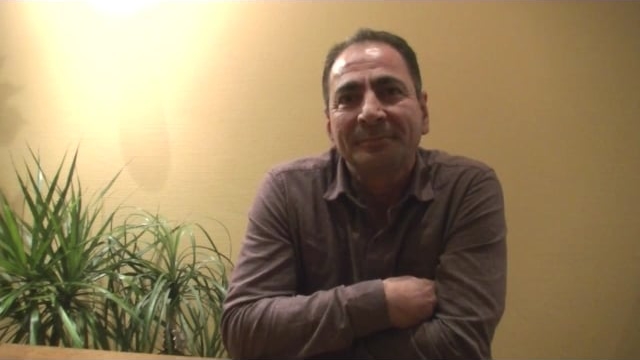
Country of origin: syria
Year of settlement: 2015
Age on arrival: 46
City: bochum
Gender: male
Language of the interview: Arabic
[i] Welcome Mr. [name], you are here today on December 12, 2019, in Bochum, and specifically in Westenfelderstraße 92. I am [name], the president of the Humanitarian Association of the Middle East, who is a speaker with you today in the Europe History Program. Please introduce yourself and what we have with you today.
[r] Welcome to you, Mrs. [name]. Thank you for your hard work. I am [name], from Syria, and I am 50 years old. I came from Syria with not much, but I have a lot of family memories and family photos, and I have my glasses, and all of this came from the country.
[i] Show me the glasses you have with you. This is for reading.
[r] Yes, I use it for reading. Unfortunately, I left my library in Syria. I don’t have many books here. I don’t have many books under me. But thanks to the technology, we can now go to the computer and mobile.
[i] Very good. If we need these glasses, can you give them to us so we can put them in the library as a memory of something you brought with you, a memory of something that is related to you?
[r] If you give me a replacement, I will be very happy. You are welcome.
[i] Thank you. What do you want to tell us about you? Tell us a little about your childhood, about your family.
[r] I was born in 1969. I was born in northern Syria. In a governorate called Idlib. My father was forced to work in 1970 in the eastern region on a project on the Furat River called Sad Al-Furat. He was supported by the Soviet Union at that time. They built a working city with about 5,000 residents. It was a Stalinist style. It was a small working street. It was used by Syrian workers. Most of them were farmers. They worked on a huge project. It was used by workers from all the Syrian provinces. Everyone was working at home, we were all working together. We were working in the fields, and I was working in the town. If I don’t have a job, I don’t even have a job. Before I had a job, I was working for a company that worked in the fields, From the school I entered in 1975 until I graduated and got my baccalaureate in 1989. Then I went to work. I couldn’t afford university education. I went to work as an employee. I worked in more than one profession. It had to do with construction and small business. Then in the same city I met a girl from a different nationality. We got married and I was employed in the same city as the Ministry of Finance. That was in 2013. I had to leave Syria because of repeated arrests by the Assad regime. I was always accused of supporting peaceful movements, such as strikes, protests, incitement to change, the demand for democracy, the demand for a civil state. In 2013 I was in a very, very scary situation. I was very afraid of my life. I was arrested four times in a row. I was arrested for two months. I had to flee. There was no light at night, as they say. I went to Turkey. In Turkey, the German government made a program to help refugees in neighboring countries. It was nominated by the Ministry of Foreign Affairs. I was granted a visa to enter Germany and serve as a refugee there. I currently live in the city of Bochum with my family. My small family consists of two children and my wife.
[i] Mr. [name], did you and your family come together? Or did you do it on your own?
[r] I came alone in the beginning. There was an administrative error. They didn’t come with me. It was a good thing. But after six months, they came with me.
[i] Did they come directly from Syria?
[r] Yes, they came directly from the German embassy in Turkey. They came by plane.
[i] Mr. [name], you told us a little bit about your life. I want to go into more detail about your childhood. Can you tell me a little bit about your childhood? About your family, your mother, your father, your children?
[r] My father, my family, my mother and I don’t know how to read or write. My father knows how to read. I mean no one knows how to write. My father wrote every word for all of us and lived in his house. My mother worked for 18 years. And I have a family of 12 children. We had an apartment, sixty square meters in size. There is no privacy for the children. There was no boys concert hall and all that else for the children. What was important and important for the family was the security. My father’s primary concern was providing food for the family. We had to take care of the clothes, and there was always a state of stress due to the density of this house. Part of our life as children was on the street. It was a natural pleasure for us. Perhaps it is the Syrian weather in all living spaces, especially during war. The street is a place for playing. I have been playing since I was 6 years old. During the summer, from 4 pm to 9 pm, I always played on the street. It was an endless game. We played games that the Syrian children invented. I played with the Syrian children. I played for 5 years. I played for violence sometimes. I played for laughter. We never looked for anything that could bring us together and let us create a chance to play. The parents were brave. The mother’s role was to go out and play on the street. The street is a part of the house. Yes? Even… In the area where we live, the street is a part of the reception of the guests. Your neighbor could come and visit you. You could stand in front of the door and put on your chairs or lay on the floor. You could make tea or coffee for them. You could meet them. You could spend an hour or two or three with them. It was fun. The summer nights and the summer days were very enjoyable. In the winter, it was difficult for us. We were stuck in the rain. We couldn’t play. But the summer nights and the spring days were very, very enjoyable. We also enjoyed the school after work. The school was our playground. During work, it was like a prison. The school was a big comfort for us because we were children. But after work, we found a playground. We play in the school and breathe. Because we go to play or sometimes we go to get revenge from the school. From destruction, breaking, breaking glass, anything that we can break. Sometimes we feel that as prisoners, we should get revenge from it, from this machine. We were in a terrible state to go to school. I was not a student, for example. As a student, I was not a student. But in the morning, when I went to school, I was always scared. I was afraid of what would happen.
[i] Why is this idea of going to school? It’s like going to something unintentionally. You are forced to go and learn. Although you have the chance in these circumstances. You have 12 siblings and you go to school.
[r] First of all, going to school was compulsory for the education system. It was compulsory for everyone. And there was a certain awareness among the Syrians, from my father’s generation, that they should be careful about educating their children. My awareness of school, I mean, at the end of elementary school, I mean, in the fifth grade and so on, was removed from the events of the 1980s in Syria. Events that were destructive to the Syrian society. Security and oppression started. It was very, very present. And the institutions of the state began to militarize. And one of the things that militarized is school. I mean, when you go to school, for example, and you are a 10-year-old student, within the organization, it is taken from the ideas of the membership system. Maybe Saeeda had these student organizations. We had to stand in line, in a military manner, we had to sing military slogans, Slogans of violence, I recall. and there are so many educational districts in Sabteleyn, Those are like some of the racks among institutions of the civil society, We didn’t feel the danger of what had happened, but at the time, it was a mix of fear and anxiety. When we went to the preparatory stage, the military started in a different way. As a student, I used to go to school in military clothes. I used to wear black boots and a military uniform. The military training started in the school. There was an attempt to make you a fighter more than a student.
[i] This is the reason why you had to go to military training? Why didn’t you go to military training?
[r] It was a fear. You were always afraid. You always felt that you couldn’t do the major national mission that you were assigned to. So, you were always left with a state of mind. The educational and study side wasn’t very important for what made you go. So, you went to school. You went to a military institution. Sometimes, you don’t feel comfortable. You don’t feel comfortable with your students, your friends, your teacher. There is always a big gap between you as a student and the teaching staff. Especially, the administrative staff of the teachers. You have the director, the instructor, and the manager. The security teachers are ordinary people. They don’t leave you with authority in the sea. You don’t learn from them. Depending on whether you are a student or not. You might be a black school student. You might be a teacher’s student. They love you. But, this wasn’t enough. Because, the system that you live in is very much like a military system. So, it was making me… Personally, I don’t know if other people play this role. But, personally, I was always afraid of this.
[i] Yes, [name]. And, this was in the initial period or the advanced period. And then, when you felt that you started to struggle. And, you became young. I mean, at this age between 16 and 18 years old. And, your personality started to develop. Tell me about this period in your life.
[r] Yes. I mean, in the period of 16 years. And, after that. I started. I said to myself. I have the issue of love of knowledge. Reading. And, I got used to the cultural center in the city. I try to get books. I read. I try to understand. What is happening around me. The main issue was the religious issues. I mean, this was. You get involved in an intellectual situation. The issue of religion. And, as a pure man. You grow up first. You like to take ideas. And, you learn from the right sources. So, I wanted to read religious books. To be more religious. To know more. This thing. Created a lot of social tension. And, people started. Surrounded by social. Relatives and family. And, started to think that [name] is reading the religion. [name] is trying. To commit more to the religion. I mean. They have made me in a more mature age than my age. This has also made me more mature and proud of myself. As a child in my family, when I entered my uncle’s house, I used to work as a child, but suddenly I became a grown-up man. I started to work as a grown-up man, and I started to follow the religion in the right way. I started to read about the future. This period did not last long. It was less than a year or a year and a half. Then I started to think about the opposition. I thought, no, no, I want to settle down. I want to see what will happen. For example, the state of social hypocrisy and religion is present. For example, religion requires you to speak quietly, but as a social state, it is not applied. It is completely opposite. I started to read. I started to read a part or more in scientific books. Then I started to read in books related to socialism, related to the left, novels, literature. I deepened my knowledge. I began to read. I have a part of my heart and knowledge of religion. I have a complete revolution of religious ideas at that time. I began to see life in a completely different way. Reading helped me in this way. The social environment, because I lived in a diverse city, with many different races, and we lived in a close-knit class. There was no class discrimination. We were all poor and poor classes. We lived together, but from different sectarian and ethnic backgrounds. From social backgrounds, in the countryside and in the city. There were children of ancient cities. There were children of the area we lived in. They call them the streets. There were many differences. I mean, these differences, they helped me to develop my personality. They made me not to be afraid of others who were strange to me mentally, or were strange to me socially, or were strange to me ethnically. With reading at that time, I feel that these two gave me a shield to be more open to the world and to my social environment. I don’t feel isolated or isolated. I don’t feel discriminated, neither religiously nor religiously.
[i] Your father played a role in establishing your personality. What was his role in your life?
[r] My father had a family of 12 people. It was his main concern that when he received his salary, he would bring a quantity of fruits or a quantity of meat. He didn’t have that time to take care of his children in an individual way, or to see their problems. He focused only on the values that were inherited by the Syrian fathers. He tried to show love, respect for the elders, and respect for the children. He focused on studying. He was very focused on learning, because studying is the only field to achieve our own goals.
[i] Was he a kind person or a hard person in his upbringing? I mean, I want to understand your connection with your mother. I mean… In your upbringing. Were there any differences in your upbringing?
[r] Yes, there were. There were differences in my upbringing. I see it now. I see it differently. They might not have seen it in this way. For example, I can’t bear my father beating his child under any circumstances. But at that time, it was normal that the child wanted to take that form. Sometimes he was harsh and he could express his care. It could be that he was crying for his child and at the same time, he could beat his child fearfully. He was for a mixture of those things. He had such pressures. He was from a family of 12 people. It was a very economical situation. He lived 50 meters from the house. He would have faced a lot of pressures. He would sometimes use force, He would beat everyone, beat everyone. But at the same time, he would sacrifice his life for these 12 children.
[i] How was the situation between you and your neighbors and your friends?
[r] The neighbors, on a family level, because in Syria and in our region, the neighbors are like your own home. This is the Syrian tradition. The neighbors cook for you, you bring it to them, they serve it to you, they go, they come. You can get anything from them, from the salt, and you go to the kitchen. If you have guests, you have a place to sleep, a place to hide, and you can get something from the neighbors. The Syrians, or the region I was in, was rural, and it remained preserved on its simple rules, and the opening to the neighbors. Your neighbor is your home. When I was in the street, I would see the neighbor’s son or the neighbor’s daughter. If he saw my brother or my son, if he needed help, or if he wanted to help him, he would help me. It was normal. And sometimes there would be feelings, and there would be fights, and there would be disputes in other occasions.
[i] Yes. At what age were you independent, and did you go on your own? Was this in marriage, or did you leave your parents’ house before?
[r] I left my parents’ house, and I was completely independent until I was 20 years old, or a little less, 19 years old. I left the city, and went back to the city of Aleppo. I rented a room, and worked more, I worked in a plastic factory, in a printing factory, in a pharmacy. I worked, I mean, anything that gave me the opportunity to work. I worked, but I didn’t have the job, or the long-term job. I couldn’t. I was also young, at the beginning of my life. The working conditions were very difficult. You could work in a nylon factory, on a machine without safety elements. For example, I worked 12 hours a day, and I paid one dollar a day. At that time, it was 50 Lira. It was enough to eat, and you could pay the rent of the room, or not pay, so we would be two or three in a room. I worked for two weeks, a month. I worked in a plastic factory, for example. In the 90s, when the Soviet Union ran away from the city of Aleppo, I lived in Syria, or in Syria, from the Armenian origins. So they used to bring Russian goods, in very cheap prices, and they would sell them in Aleppo. So we used to buy these goods from them, and we would work with them. We were the ones who made it easy on the streets. I stayed this period until I went to the army, for the compulsory service. Fortunately or unfortunately, I don’t know, but I know, I served in the internal security forces, in the forces of the struggle. I mean, in a city on the Syrian coast, in Latyeh, as a police guard, they would take us to football games, to the national football league, or if there were big meetings, or if there were protocol issues, they would take us, line us up, dress us up, and line us up in this area. I stayed there for two and a half years. I finished my military service. After that, my job opportunities were very poor in Syria, and there was nothing I could do. I didn’t do my job very well, I didn’t teach my job well. And for the academic qualification, baccalaureate, I mean, I couldn’t get a job. And I started, I mean, there was something security, as they say, opposition political means, at that time, or before that, I mean, I mean, I wasn’t involved in the Ba’ath party. And I didn’t have the means to get a job opportunity in the state. And I didn’t have a position that allowed me to open a building, or to open a small project. Like, hundreds of thousands of young Syrians, the best way was to get $20, and travel to Lebanon. And in the end, I paid the road, and went to Lebanon.
[i] During this period, did you get married? Or, in which year did you get married? You say that in 19 or 20 years, you were independent, you started the operation, and you stood on your own two feet. At that time, did you notice that you were getting married, or were you helping your family?
[r] No, there was a lot, I mean, at that time, I don’t think about early marriage, I mean, I’m telling you, that I was 23 or 24 years old, I mean, I didn’t think at all, at all, that I would get married. Especially, that I had an experience from a family of 12 people, I mean, and at that time, I didn’t think at all about getting married. But, as a relationship, I was in love, and connected, with a woman, I mean, after we got married, but after a while, I mean, I got married when I was 29 years old. But, I didn’t get connected for 4 years, and before that, I got married for 4 or 5 years, I mean, in a relationship, it came up between my wife and I, and our love, and our pressure. So, I mean, I benefited from the teaching of my parents, that early marriage is wrong, and I should have taking my chance, before I get married, I mean, in everything.
[i] Yes. After a while, we will talk about your loved ones’ story. and how they connected with your partner, and the like. But, I want to know from you, How do you feel about your country?
[r] What do you mean?
[i] In the past, what do you like about it?
[r] Syria has always been my main dream In any sense Like any citizen who lives in his country. Who loves it to the fullest. Who remembers the best. I used to dream that my country. Would be superior in everything Like any young man who wants to follow his national team in football. Who loves his country more In the scientific, economic and military competitions. Anything You love your country more. And you see it as the center of the universe. And it’s the most important thing. It doesn’t mean anything after the Syrian border So Everything to me In fact, my country is Syria. Syria in every aspect. Not Syria in the country I live in. Or my city. I lived in more than one city. From the north I lived in the east I lived in Aleppo for 3 or 4 years And I served the army in the city of Delati So I lived in the north and the south And in the capital Of course, there is no Syrian man Who didn’t cross the border And lived in it for a few months So I loved it And I feel that it’s special And the system And the media And the media intervention It also creates for you The propaganda of your country And the history And that every person Is born in a country Where he was born And his original country is Syria And the greatness of the history That exists in it. And all of this And this greatness in it And the last thing that comes to your mind Is that the father of the leader Who is present And who built the modern Syria And so on This was the beginning When you see the contradictions In the history of Syria And so on And the media intervention comes with me as a young man in that period in the 20s That he built the modern Syria What is the modern Syria? I kept responding to this saying the modern Syria is the success Of the armed movement Which is the history of the revolution Of Hafez Assad That he built the Delfurat So I thought it was a nuclear facility For example A great thing in that period The period of my awareness In the 17th or 18th year From the riots. In the 80s in Syria there was a British-American siege on Syria. So there is a crisis in the consumer goods and there is a crisis in bread. So So If You remember I will tell you I’m not sure if it is news It was drive out from East Germany I was still in East Germany Building a bread oven in Al Madini Anyway he had his construction. And the construction was different from what was normal in Syria. It was a metal cart with metal bars, with metal rods and a machine to get it. And in the end and a bread bakery with a complete production. So we used to go to the school and they would take us to see the bakery But they used to call it the cellar bakery This name, even now you will find old people saying that they got the bread from the cellar bakery because the bread technique is a nuclear bakery or something Then when we grew up we started to know why they called it the cellar bakery It is a bakery with a process of production that is natural It is not something that works on a generator But its name is the cellar bakery Even now you will find old people saying that they got the bread from the cellar bakery
[i] Thank you, [name], for this nice story. [name], now we will continue our talk in another topic but we will stop now welcome Mr. [name] We will continue our talk together We used to talk about the fact that you started in the practical battle. You are working in many jobs In many fields You stood on your feet, as they say, before your age Continue your talk Go ahead
[r] When I finished my military service When I finished my military service When I finished my military service My job opportunities were weak in the country I went and worked in Lebanon Like hundreds of thousands of Syrian youth. The field of work was in the construction sector. I worked on the roofs, on the walls of houses, on the ceilings I worked there for 3-4 years I made a lot of money I helped my family I was a taxpayer But the difference in the wages between Lebanon and Syria was negligible. In the late 98s, I was tired of my country Lebanon was not my country. I did not have a good atmosphere I wanted my family I wanted to settle down I decided to return to Syria.
[i] How long did you stay in Lebanon?
[r] I stayed there for 4 years. From 1995 to 1999. I returned to Syria I got married I had a child I started to look for a job. A chance helped me I got a job in a government office. I worked in the financial sector. On the basis of my baccalaureate. The residential area of the city. The city that the state built in the 1980s. The state decided to sell it to its friends. I had to leave the city. To settle down. I had the right to live in this house. I worked there. We left the state in Mabrouzahid My wife was also an employee in a large construction company in the same city. We had two children. We defined the family. We organized the family. As a family It was a good financial situation. My wife is an employee I am an employee. I also work as an additional outside my job. I invest in a clothing store I invest in a cafeteria. I always need to improve And improve my income My wife’s salary is enough I live. But I have the ambition to be in a better situation. In this period from 2000 to 2010. 10 years of marriage And settling in the city A lot of changes began to happen In Syria. Changes on a political, social and economic level. Hafez Assad died. His son inherited it at first, his son started To speak openly To the society To the parties To the opposition For a short time During this period In the civil society Like Syria Or what is called Arab Spring in Damascus. I was one of the activists in it. We had meetings. And political discussions In the municipalities Even in the city In which we were We had a council We met with thinkers And politicians. In the houses of the council In the rooms In a room Less than 20 meters There were 30 people. We had a lecture. We had a call from the opposition. Riyad Al-Tolok Arif Talila Abdel Razzaq Qaid Aslan Abdel Kareem Many names like Sayyida Khosama Aday. Many names who participated In Damascus We called the city In a personal way And we welcomed them in our houses. The security campaign began Security pressure troubles Questions And inquiries What do you want But there was No political parties. There were no political parties. But we kept this initiative To develop the idea I tried to found a civilized rally for the Syrians. When the Sarwa organization I asked Omar Abdelhamid, the founder of Sarwa, to take over the project. He was the founder of American support. I was very afraid of the project and refused. I tried to take it on my own. I was very pressured. I was called for security reasons. I stopped the project. But I paid a very high price. From 2003 to 2010, I was denied my job and I was very scared of my movement. I was very scared of my promotion. I was very scared of my reward. I was afraid of anything that would bother me. I was afraid of my job. I was afraid of my wife. Even socially, people started to be afraid of me. In 2011, I started to work in the Arab Spring. Just like all the Syrian people, we were hoping that the Spring would start in Syria. We weren’t very sure that the Spring would come, but we were all hoping for it. And the Spring started. Then Daraa, Banias, and the city I was in at the beginning of April. During the protest, I had a strange experience. When you see police, he comes to your office in a state of terror and terror. He comes and asks you routine questions. You are still nervous. Suddenly, you are walking around in a protest. Not normal police, but the security officers in the city are walking around you. As protesters, the number does not exceed 30 or 40 people. You are known for your residence, your job, and everything. It was a rare courage of 30 or 40 people. We were able to confront a sovereign authority and people who were afraid of us. The protest did not last more than half an hour. They were forced to leave. The protest did not fall into a system. It was a freedom protest. It lifted the siege of Daraa. Daraa was besieged. A week later, I was called on the phone for military security. I left. I could not leave for military security. I left. They argued for a long time. Then they decided to take us to the branch in Deir ez-Zor. The three of us were with them. We went to Deir ez-Zor. They took us as refugees. Nobody practices physical violence. They asked us about the protest and our demands. I had told them, I had told them about the programs that were announced about us. We had told them about the demands of the demonstration from 2005. About the freedom of a press, the freedom of the political parties, the freedom of a citizen. We did not say a word about the overthrow of the regime. We did not say any much. The situation remained for a month and we were transferred to a court and we went out. They called me again, they arrested me and kidnapped me from the streets again on the grounds that there was a call for beatings. I also stayed there for 20 days. They called me and took me to the political security department in Damascus this time. The political security department on the other hand, what happened to me was that I was in one of the departments where the head of the regime was issuing reforms against the law of the revolution and he was talking about press freedom and other things. The investigator officer was talking to me and he was asking me what my demands were and why I was going out and protesting and so on. So I was telling him that we entered into a ceiling of demands like that. The president said to me, but you have exceeded our demands a lot. We weren’t trying to demand this and that. What we wanted to do was more than what we were demanding. So why are you stopping us? He said, no, you are demanding a law in a country, we want to apply the law, you have exceeded the law, and so on and so forth. So I am telling him, even the accusation that you are stopping me from is that I was previously imprisoned in one of the military security departments and I was expelled from the judiciary and my presidency was cancelled. He told me, ok, and now it’s the same thing. You turn to the judiciary and if the judiciary discovers that you are innocent, they will release you. So he tried, even at that time, to play a game with us that these are legal procedures and as if we are actually accused as long as you go out and protest or demand to control the rights of the project and the things that exist in any other country. I replied to him and I was arrested for the fourth time. I don’t know what happened. I tried, the city had a large number of refugees that have come from other cities as a result of the regime’s coup and the eviction of the families, so I in coordination with the council of governor, there is a lady who is a member of the executive office, in coordination with the committee of the committee for the assistance of families, among the regime’s cover, I said he is not arresting us, We can’t work in politics because we can help people who come to schools, doctors, anything we can offer to the people who come. We, in the meeting, in a cultural center, in an official presence from the state agency, were arrested from the meeting. And they accused me of being a police officer or something, and this is impossible to come and claim that you are a small city, that you are a police officer and so on. When they arrested me this time, it was the most terrible time for me. First of all, I was immediately arrested, and once you are in a security department, if they want to do something to you, you don’t have to know who is doing it. And then they beat me up and something like that. In previous times, they were a little bit respectful to us, or they treated us with a little bit of respect. It wasn’t enough. But this time, they started beating me up, and I was beaten up, and they wanted to take me to Deir el-Zour. Since the city belongs to the security department, I was very scared. Very, very scared. I even heard them saying that they would take me by plane, that they would take me to and from the airport. It made me feel that they might take me by plane. I don’t know what happened outside, but there was my wife and a group of young people who were working with me in this volunteer work. They went and saw the governor. They tried to pressure him, saying that you caused [name] to do this work, and he is working with you. He is not working for anything other than helping the refugees in the city, which is the state that is recognized by them, which is the state that is supposed to provide them with aid. And they are coming to an area that is under the control of the regime. So they are worthy if you want to consider them in the political scale. They are not against the state until they come to an area. And therefore, they are not in the hands of the volunteers, because they have a duty to the state and to society. So it was as if I had put [name] in this situation. And they started beating me a lot. So they didn’t take me to Deir el-Zour. They took me to the governor’s office. And after about eight days, they arrested me. They arrested me. When I came out of the department, I wasn’t confident. They didn’t give me a headshot. And I went out of the city like this. I was in a state of panic. After seven days, I was alone. And I was very, very scared. The fourth time, I was arrested on the grounds of peaceful activity. And there was news that we were going to be fined and so on. So when I came out of the department, I remember those moments. I don’t know where I am now. The city is my city. I called my wife. She said, come and take me. I don’t know. I mean, I don’t know anything. So she told me to take a taxi. And I stopped the taxi. And I told her, I’ll take you home. I mean, there’s nothing. Anyway, I stopped the taxi. I went to the garage. And from the garage, I took a service. I was afraid to take a taxi alone from one city to another. I went to the public transport. I went. But I was in a state of relief and fear at home. As soon as I ring the bell at home, I feel afraid that someone will take me. Especially if it’s someone at night. I mean, during the day, I go and go back to my job. But it’s less stressful. But at night, in the evening, at night, I feel that anyone who rings the bell on me or the telephone, I will be in a state of terror. If the phone rings, I will be in a state of terror. If the phone rings, I will be in a state of terror. If the door rings, I will be in a state of terror. On the basis of this issue, everyone said that you have to leave and leave. And I was very, very afraid. I mean, the fear. Maybe I can’t forget the period of 15 days before I left Syria. I decided to leave Turkey. Because there is no way for me to leave, for example, to go to Lebanon. I had to cross areas with barriers far from the eastern region, towards Lebanon. The nearest place to me was Turkey. We are in the border area. It’s about 60 kilometers away. I mean, 20 kilometers. I went towards Al-Abyad. From Al-Abyad, I knocked on the door. The door was open to the Free Army. There was no order in it. And I entered the Turkish territory. A friend of mine met me there. He added me to him. After three or four days, my family came to me. My daughter and my wife. The city was under the control of the regime. There was no air strikes, no artillery attacks on the city, no clashes. They came in very difficult circumstances. I didn’t expect that I would have a dramatic change in the city so quickly. We went to Turkey. To Antep, the first shock that struck me was when I left Al-Abyad towards Urfa. I am a traveler. The only country I have traveled to, even if it is outside of Syria, is Lebanon. But I have no idea how Turkey looks like. I don’t even think that I could ever travel. No, no. When I crossed Al-Abyad, Al-Abyad was a city that had more than 150,000 inhabitants. 200,000 with me. But the city looks like a camp. A random residence. The economic value is not natural. When I came to Urfa, I noticed that the interior of the city, even the capital of Damascus, is not like this. Buildings, towers, gardens, and so on. Even when I entered Karaj, I remembered the last time I entered the airport. I was seeing the difference between the lower buildings. The first shock I had was the difference between the lower buildings. The lower buildings were in the country where I lived. And between the countries. On the border, I lived in an apartment with a house that was 200 kilometers away. It was the center of Urfa, not much. It was a very tired country. The employment there, and the services there. Where did the people live? And where did we live? I settled in Anteb. My family and I. I stayed there for 8 or 7 months. The German government had made a program for refugees from Turkey and Lebanon. Through the Ministry of Foreign Affairs to nominate some. The Samaritans were there. I had a political arrest file. On this basis, they set a date for me at the embassy.
[i] Did the Ministry of Foreign Affairs ask you to submit a request? How do they know that you are present?
[r] I think someone from Germany. The German Foreign Minister is here. They are considered politically. They are close to me. They are foreign. They were asked to nominate some. They live in Syria. So they nominated me for this job. I didn’t think about Germany. That I would come to it sooner or later. I didn’t think about it. I knew everything about Germany. I knew that it was a country of philosophy. Marx. An industrialised country. But I wasn’t attracted to it before. I didn’t think about it. I didn’t think about tourism. I didn’t think about refugees. I didn’t think about leaving Syria at all. I came to Germany. I was shocked at first.
[i] Tell me what shocked you at first. When you came to Germany.
[r] First of all, I discovered that we are victims of a misconception about the West. There is a picture of the West in our minds. This picture is not consistent with the one in our minds. Of course, I don’t have any information about the West. There is a part of cinema. Small readings. And impressions. For example, the impressions of children’s witnesses. It doesn’t reflect the real picture. Because it is necessary for the witness of the children. Or the former refugee. To have tools to dismantle the nature of society. In the right way. I mean, it talks about his impressions. His personality. But it doesn’t have to be subjective. So, there is a picture. We have a model of the West. A country of complete prosperity. A country of precision. A country of law. Yes. All these aspects didn’t shock me. Conflict is from a social point of view. You have to imagine that you will be living on the margins of society. You’re in your country. Even when you’re drifted from class. But you’re not living on the side of society. You are in your mother’s country. If your class or educational level was lower. You have your own world. And you have a social structure. Where you live with maturity. So, you don’t need to be marginalised Perhaps marginalised in all things. But in the shapes of his structure. You’re nephtpayer. So you don’t need to be marginalised. When you come here, you will suddenly discover that you will be on the edges of society. You will be very lonely and it will be difficult for you to break through this social structure. And when you question the difficulty of breaking through this social structure, they will tell you that the Germans are like that. The Germans have not broken through the social structure. The Germans live alone. You are not used to living in your country at all. You are used to being in a cell that is active, you go, you visit. When you come here, you feel that you are not only strange, if we are talking about the foreign issue, you feel that you cannot come here because of the social structure. You feel that you are in an active building in the subject. The language barrier is of course essential. Even the people who speak good and smart language come and tell you that we are also alone. We cannot protect this society. You have to come from your country with a sense of life. Your traditions, your ideas and so on. And here you have the right to live. The law allows you to live. The social situation allows you to live. And that you live here. You live here within the limits that are limited to you. To be able to protect it is difficult. For my age, my generation, it was a very big shock. I hope that my children will overcome this.
[i] The difficulty of being integrated with the Germans. The conflicts. Or the language. Or the big difference in traditions. I do not want to ask you too many questions.
[r] The language is of course very difficult. To be able to leave and go to the language. To be able to build a conversation within a sector. To serve yourself. What do you want? Where did you go? Where did you come from? To leave the language and go to the language. This is difficult. Of course. The subject is not only in the language. Even those who are leaving, I want to ask you. For example, I want to talk to my daughter. She is four years old in Germany. She knows the language very well. But when I see her friends in the class. I discover that they are only Syrians. That she is not nice. Of course she is nice. In the beginning of her life. She is a girl and so on. What prevents her? For example, in the class there are twenty students. For example, she is a friend. She is in a relationship with someone else other than a Syrian. I ask her. I try to understand what is the reason. Or why there is no. She tells me, Father Latifi, we are classmates in the class. Only in the class. Outside the class. There is a certain block. Where is the block? I can’t determine it. It has been four years. I can’t determine where the block is. Is the block from the other? Is the block from us? As a normal social pattern. I do not feel myself. My life in Germany has changed a lot. I live in Syria. People love to respect the law. They are not guilty. They forgive each other. I am not talking about myself. I am not talking about all Syrians. Of course, I can’t talk about myself. I am among the group I used to live in. It is not strange for us. I do not feel that there is a social gap between us. There is a social gap between us. Between my neighbor, for example. Or how he deals with certain issues. I get angry with him. Or I can’t do it. No. I also love the public administration. The preservation of the public administration. I do not forget the neighbors. Many Syrians get married to refugees. They do not commit to it. No. We commit to it. Not because the law is in it. Because it comes from us. We would like to be like that in our country. But there is a big gap. There is a big gap between us and them. Where is the gap? I do not know. I used to say it to myself. That I am young. The language is what I am giving. But what about the young generation? When I look at my daughter. She is 17 years old. And I say that her friends are refugees. Immigrants. Or maybe not immigrants from the Middle East. But they are not refugees. Or from the origin of immigration.
[i] Or foreigners.
[r] Foreigners. Or slanderers in the end. Why? What prevents a child or a man from making a friendship with another child from Germany?
[i] What I understand is that the problem is not only with us.
[r] Of course the problem is with us. The integration is needed.
[i] For both sides.
[r] For both sides. Of course. For example. For example. I think that. In the relationship. For example. We are from a non-religious family. We are not religiously committed. We have no problem. For example. In this typical image. That Muslims do not travel. Muslims only eat halal meat. Muslims do not drink wine. We have all these problems. We will not agree with the Germans. Because we are originally like that. It is not that the Syrian society. Is a single Islamic group. And it is isolated. And it is religious. No. There are variations in the Syrian society. In a very strange way. If I want to mention. For example. The Syrian society. A city like Aleppo. From street to street. It is very different in the traditions. For example. If you went to the city of Aleppo. You can see five weddings with different traditions. And very contradictory. Very for example weds. For example. Husbands and wives. Husbands do not mix with wives. Weds. You will find. Husbands and wives are dancing together. A wedding can be very lonely. And two parties at night. A wedding can be held in a popular square. On the street. Or out of town. Or a party. On the street. Or a mix. Here. There is no social distinction. We all see it. In front of us. Like a high wall. We are not aware of the difference. We are not familiar with this wall. We were not refugees in the first place. We didn’t come here because we were poor or needy. We are victims of fate, victims of war and oppression. All the people could have been affected by this. One day, the people of Germany were victims of war and oppression. But we weren’t victims of bread. We weren’t just here for bread. We didn’t see anything. We worked longer than the Germans. We worked harder and cooperated more. So that we could get our money. It wasn’t just the economic problem. It was what made us come here. It made the Germans think that we were refugees. And that we could sympathize with them. This way of sympathizing increases our responsibility. We don’t want to sympathize. It’s like we have a head and you’re sympathizing with me. You’re holding my hand. When a discussion with my family opens, and my daughter feels that this is not enough, and she feels that she should talk to the other person, or the German, or something like that. This kind of sympathy is used in an unnatural way. No, I’m human in the end. I have an ability. And maybe I run in terms of education, or in terms of knowledge, or in terms of sports. I can run and excel in anything. I’m no less than him in anything. Except that by chance, my daughter was a refugee.
[i] This is a very big problem in integration. It’s making a person a third person without feeling.
[r] I told you that our generation, as the first generation of refugees, this new wave in Germany, we say that we’re relieved. We don’t understand. We don’t live the way we used to live. We can’t stand living with different society or being part of this society in social terms. With the legal sense we must be committed. Restrained in having work, trained, committed to all laws. Because this law is something, we preferred it in the state. There’s the law, there’s the your respect for the law, and there’s a spirit of justice and equality. But there’s integration, The integration is not only the integration in the legal sense, the integration in the social sense, we are very far away from it. If you tell me, [name], you prefer to go to a German bar or a bar for foreigners, I will tell you, a bar for foreigners. Yes, this is a wine, and this has a drink, and this has a drink. I feel myself there as if I am blessed, I mean, I am no less than the others. When I go to a German bar, sometimes I feel like I am a migrant and I am drinking, or I don’t know what. You feel like this, maybe he doesn’t have this, but you always have this feeling.
[i] Yes, [name], continue your talk, we stopped, we were talking.
[r] We were talking about the difficulty of integration for us.
[i] Yes.
[r] And [name], we are talking that for me personally, I feel that I am living an important life, okay. Maybe I want to get along with this idea. My brother is my son. My daughters came, one of them is 12 years old, the other is 9 years old, they were in Germany. They started schools. They have a good education. I think they have a very, very difficult situation. For example, if they finish their studies here and finish their university life, they will think of going back to Syria for two days, for example. Otherwise, if I want to practice violence against them, they will force me. I don’t know, but if they go back, I think the level of education that has been provided to them, the level of promotion, the economic level that exists, the lifestyle that is comfortable, apart from the country and Syria, this is the long period that should be forgotten. My daughter [name] says, I don’t want to forget Syria, but it is going away from my mind. I don’t want it to go away from my mind, but it is going away. Her memories of Syria, nothing. Do you keep in touch with your friends and family in Syria? Yes, I keep in touch with my mother in Syria. My brothers are scattered between Turkey, between Austria, between Denmark, between Lebanon. I don’t have in Syria from 12 young people my mother and my brothers, they all emigrated. I keep in touch with my mother, they are helpless. I don’t want them to go away, I don’t want them to leave their homes, their lands, their lands and all their life. I don’t want them to leave their home and leave their country. I was talking about the idea of fear. My children want to live in Germany. For example, in Germany, what you have to pay in order to be a member of this society is very important. For example, education. In a financial situation, of course, wealth will not be accumulated with us. We live a part of our lives as helpers. Even when we work, we have to pay the minimum wage. There are no opportunities for us to accumulate wealth or live. The only thing we can do here is to help our children get a good education and good university degrees. If they achieve this, it is enough for them to be part of the German society. At a certain moment, they will feel that they are part of the German society. They are Germans of Syrian origin. They are Syrians and live in Germany. This is very different. When you ask me, I say that I am Syrian and live in Germany now. I am committed to the laws of my country where I live and I respect its laws. But at a certain point, they will feel that they are Germans of the Syrian origin. Not Syrians who live in Germany.
[i] Did you regret coming to Germany at any time?
[r] I did not regret. I don’t remember how I felt. When I see other people’s money in other countries, I think that Germany has provided on the economic level, on the legal level. It provided for the Syrians. There was a lot of government sympathy with them. It provided them with a lot of services. It provided for the economic programs regarding the rights of immigrants and housing. I think that other countries are worse than Germany. Germany is a nation, a big nation in the history and economy. I think it is better than any other country. It is a country that respects culture and art. It appreciates these things. I didn’t think about Germany when I came here. I think it was the best choice. I think I was lucky to be in Germany.
[i] Do you feel at home here? Do you feel that you have reached your home?
[r] Yes. When I first came here, I felt that I was with my family. My family is my home. I don’t have any memories of my city. I didn’t like this city. I didn’t study here. I didn’t run away from school. I didn’t play with it. I didn’t discover things for the first time. I didn’t go to the cinema for the first time. I didn’t go to the theater for the first time. I didn’t go to school for the first time. I don’t have any memories of it. I go to the government district. I go to the market. I go to the beach, for example. I go to a cafe or a bar. But I don’t feel that it is my home. I don’t know if I left it one day. The city of Bochum is kind of a second home for me, I want to find what changed there. Cities are different, but cities change. Every ten years, the city changes. If you were a resident of a city for ten years and went back, you will find new neighborhoods, there are new buildings. Here, cities are like historical monuments, nothing will change. In ten years, you will return to your hometown, You will find that the Bahnhof itself has not changed at all. You will find that the state is the same, the municipality is the same, the court is the same. Even a new residential neighborhood will not be built. A new garden will not be built. Purchasing will not change. You will feel that your city has been completed. It is complete and complete. Nothing will change in it. You may pass by a place that used to be sold by LBC and now it is sold by me. Or maybe a place that used to be sold by a mobile phone store has been transformed into another place. You may find a change. But a change in the world is impossible to find. Now it remains that I should love the city. I tried to love it. I mean, to build a relationship with the street, with the traffic, to walk in it. I tried to discover such a thing. But love comes from within. It comes from within. In general, the city has not done anything bad to me before. It is a forgiving city in general. For example, I have been here for four years. I did not experience any direct racism. Or I did not feel that someone was dealing with me in a racist way. Neither in the neighborhood, nor in the neighborhood. I did not experience it. Only with people of my age. I did not experience any racism. The city has cultural activities. One must be free 24 hours a day to follow the activities that exist in it. I know that it is a small city. And it is located in larger cities. I tried to follow it. But the German is very hard on me. There are other activities. Maybe a cultural center in my neighborhood. In Langendreer. There are activities that I sometimes attend. Maybe I sometimes attend a musical event. I attend carnivals. But as a spectator. I am not a part of the carnival. Or a part of the celebration. You are not watching the festival. As they say. We were in carnivals or events. And in the squares. When there is a festival, we are part of it. Here you go and feel that you are watching. There is a screen in front of you. And you are watching. More than being a part of it. No one is holding your hand. And telling you to be a part of it. No. They are among each other. I will say something. For example. In the building, there are residential buildings. I do not know anyone from the building. Among us, only the morning greeting. Or a hello. And nothing else. Instead of smiles. No one rings a bell from them. I do not know their names. I do not know their jobs. I do not know their country. Not at all. It is not only related to it. They are also among each other. They do not know each other. Because I did not notice anyone. For example, he is standing and talking to someone. And any person. Also, each one of them enters his house. On this subject. In the residential building. Below me. A man. A man. I can’t tell how old he is. She is 90 years old. He is older. I watch her. She will play with the mouse. Or sometimes. I see him get on the bike. Once, I asked him for help. He was angry with me. He was sleeping. And he was nervous. He stretched his head. He was driving. After the second or third step. I could not. I returned back. It means. I helped him a lot I took the cup and put it in front of his house I remember that the man disappeared we didn’t see him After a while, my wife asks someone First, she is surprised by the question why is she asking me? Then she tells him that he died He lives in the apartment under me. He has been with us for 2 weeks. We couldn’t know. There are no signs.
[i] You feel that the difference in our culture and environment is huge. This is a journey In our country, no idea is acceptable
[r] Of course For example In the apartment under me There is someone who died For 2 weeks We couldn’t know There is no sound There is no noise There is no noise. It was the ambulance. The moment I arrived. I heard the noise. From the neighbors. It was like nothing. The man disappeared. I remember that it was very simple. He refused me to help him. When my wife or my daughters see him. They say hello to him. And he disappeared. We didn’t know. He might have disappeared. After a year. We didn’t dare to ask him. When my wife tried to ask First, she was embarrassed She was embarrassed I don’t know why I told her that he died. So I told her. She apologized. That we didn’t know. I told her that it’s normal. It’s not normal for us. No, never You feel. .. You can’t fall You know You become more Even if there are qualifications Even if everything is You let people be intimate with each other owning another You know There’s something weird I didn’t understand It’s like that There’s so much You’re stupid The one who made you know There is nothing else. You don’t know, for example, if you have to go to a mourning ceremony, or if you are allowed to go, or how to go to a mourning ceremony, according to your situation. Your neighbor passed away. What do you want from yourself? As a humanitarian situation here. In my country, I know what I want. I want to help. I mean, I want to be a part of this disaster and to alleviate this disaster around me. I don’t know about my children, or about my relatives, but I want to be a part of it. I can be isolated because I am his neighbor, for example, in Syria. But here, I don’t know. I don’t even know what I should do.
[i] Let’s go back to the issue of the exchange of relations between the country and Syria. Because here, the number of people is very large. And in Germany, it is still very far from the point where it should be. I mean, the German should treat the Syrian in a different way. Explain a little about this issue. What do you expect from Germany? Or you, as [name].
[r] What do we expect from Germany? First of all, there is something. I mean, I have NATO. It should meet a little with the extremist right, or with the German right. There is sometimes an argument with respect for our privacy. Although some of the privacy is isolated and has been eaten up for a long time. Even in Syria, it is isolated. I mean, there are customs. For example, I can’t think that a 10-year-old girl is wearing a hijab. She is not wearing a hijab. I am not against the hijab. It is my personal choice. But 10 years later, not only short, less than short, I mean, you hear voices saying that these groups have a certain culture and we must preserve it, and so on. I think there is an exaggeration in this matter. There is a law sometimes that is stronger than the customs and stronger than the traditions. When this law, when these customs and traditions are violated, it is obvious, for example, for childhood. I mean, for example, when a father hits his child, for example. I mean, in Syria, it is normal. It must be applied. Where is the opinion that a father hits his son, for example? The same thing, for example, a hijab for a small child, for example, for a small child, for example. Yes? Or other social issues, sometimes, I mean, we must preserve. For example, the hand-wrapping. I don’t know. I don’t feel much in Syria that it was an essential issue for the entire Syrian society. That a woman was hand-wrapping. You pass here, you pass here. You come, you find people that they have a certain privacy and they have the right not to shake hands. That no, brothers, they have no rights to not shake hands. This is a protocol. It has nothing to do with a custom of culture. It has no relation to religion. It has no relation to anything. A million religious stories, it may exceed this lady. And her husband marries her. One of the issues is that she legally transcends that she is on a protocol issue. What does this have to do with it? What does this have to do with it? It’s like when you eat, you wash your hands. If you come and say, I swear, my religion doesn’t allow me to wash my hands. I have to respect you, for example. Sometimes I see that there is an increase in respect for these issues. And at the same time, there is a tendency that all of us are like this. Also with the Germans, they model that most of the refugees, or all the refugees, have a specific team. They have a specific background. No. They also have to look at us from different perspectives on this subject, socially, politically, and scientifically. They look at us as one group. But what do the Germans demand? What do I expect from the Germans? I am German. I am a German class. The right-wing German, the left-wing, the Protestant, the Catholic, they have a very large increase. I will not be integrated with anyone. I will not be integrated with the labor class, or with the technocrats, the white-collar class, the university professors, or with students from the university, also together. They also, there are a lot of benefits between them. I want to integrate with the important. That is to say, I am important in Germany with a rich economic income, with knowledge in German. and the German language, so there is no connection with the important classes. And the important classes are not available in Germany except for the foreigner. i.e. the immigrants, whether they are new or old. This is the space in which we work, in which we speak, and in which we live. Either with Germany, who is Germany?
[i] Do you feel that there should be a change in this subject? It is necessary for the Germans to re-study the people they brought to their country with their own will, so that there is integration. Because we are working on the same issue of integration, and the integration happens only from both sides.
[r] I feel that there should be a change. I feel that there should be a change in the evaluation of the subject in a positive way. And that the focus and investment should be on the second generation of immigrants. Because the first generation is almost impossible in the matter of social integration. Legal integration is not a problem. Everyone agrees that everyone has a desire to integrate into law as an immigrant. Partly, very few people like to integrate into law. They want to work, study, and apply for law. They want to pay their taxes, and pay their bills. They don’t want to get married and have children. Not everyone has such a desire. As for the social aspect, I feel that there should be a change in the investment of the second generation. If this second generation, who was born in Germany, or who gave birth to a child in Germany, after 20 years, or when this happens in 2025, what will the German look like? If he doesn’t take what he has, he won’t be able to build a German society. And if you don’t want to build a German society, and you want to control yourself, and you and your society are not enough, a society that needs these people to contribute to you in preserving the German position and the German power, because these people have become, their culture is learning in Germany, their culture is German, so you have to go and be German. So that you can earn it. So I think the second generation doesn’t have a problem. If you lend a hand, and help them to bring it to you, the second generation won’t have a problem.
[i] In your environment, and in the society you live in right now, in Bochum, do you feel that there will be a problem in the integration between the Syrian and the German? For example, you have two girls. If a friend of yours comes to your house, does this make you nervous or is it okay?
[r] For me personally, I don’t feel nervous. If I want to talk about myself, of course, it’s normal. I don’t have a problem. Whether he is German or not, whether I was in Germany or in Syria. But if we want to talk about, in general, about the Syrians, there is a problem in this matter. In general, that the families have barriers.
[i] I have heard about your very agitated environment. This idea is completely unacceptable. The integration is okay, but there are personal relations between a Syrian girl and a German guy. But there is no problem between a Syrian guy and a German girl.
[r] Yes, yes.
[i] Since you are talking about your personality, and you gave me your opinion about your scientific knowledge, I felt that you are a European person. Before you came to Europe, in your mind, in your thoughts, even though you lived in a country that was very dictatorial. I felt a lot of democracy in our dialogue all the time. That’s why I wanted to ask you this question.
[r] In general, the refugees, the Syrian refugees, if we want to take the religious line from them, the religious members, they are keen, first of all, with all the religious cohesion, they have a sense of inferiority, and they feel that they belong to the white man, not only to the German. They belong to the first world. That’s why they are eager to be loyal to the German, and that he is determined to be German. And that the German preserves his privacy and loves this side. And as I said before, it is possible that if his son is linked to Germany, it is not a problem. But if his daughter is linked, this is a red line. This is the line that cannot be crossed at all, at all. Because in his opinion, he also has a misunderstanding of the nature of the German society. As if the German society is a corrupt society, and its families are corrupt. And I look at it in a social sense, in its social structure. First of all, because he is ignorant and he does not know. I mean, he is not able to enter into the fabric of this society. He keeps imagining what is being narrated and what is being said, or from here and from here. I mean, he does not know much about this family, for example, how they live, how they are related to the girls, to the boys. He has a legal fear that at the age of 18, his daughter can be independent from him. If his daughter is involved in a case, if he is involved, I do not know what is going on. So, he is not in a state of excess. Yes? I think these people were a problem in the Syrian society before they came and became a problem in the German society. And they are also a problem here. I mean, in the country, they were part of the problem. And part of the problem is that, I mean, for example, when we talk about Syria, for example, when we talk about the signs of certain abortion, we say, for example, something called early marriage. Hmm? These are the ones who marry their daughters early marriage, generally speaking. Girls 13, 17, 16, and so on. We talk about the education of women. These are their daughters who did not know them in Syria. I mean, they were a problem. They were a problem in the development of the Syrian society in the first place. And when the conditions of the war forced them to come here, they transferred all their children and brought them here and they are practicing it here. But these are all Syrians. These are a very small group in Syria. But it is a problem. It was a problem in Syria. And here, they are helping and helping the right of the Germans to take samples from us to help all the refugees. There are a lot of religious people here. But they are not committed to this meaning. Women are probably quarantined, they go to work, they travel, they travel, they go and they build a house for themselves and they depend on themselves. And they are religious and committed. They are not all from this small group that is focused on that these are the refugees that came and these are the typical examples of everything that is happening and that Germany can live in a big problem. In my opinion, these groups are there I mean, a certain way has to be invented in order to impose some laws on them. For example, I mean, in Syria there might be a new amendment that the age of marriage is 18. Here, if it is considered that marriage does not happen under the age of 18, but maybe here they know they are doing this thing or they are doing it in another way or they are extraditing it from the.
[i] It has happened a lot.
[r] I don’t know if there are legal methods to respond to this topic. I don’t think that the idea of preserving their privacy is right. There are some cases that are in favor of humanitarian laws, but I don’t think that the agreement between all civilizations means that in order to preserve privacy, yes, we allow them to do this. For example, the multiplication of marriages. As Muslims, they are allowed to do this in order to preserve their privacy, yes, we allow them to do this. This is still the case because it contradicts the civil contract, the civil state, the modern logic. All of this contradicts this. This is not the case in the Middle Ages, in closed social environments, but here, this is not the case. As there is a law that prohibits the multiplication of marriages in Germany, the civil law is not registered. There is something that must be studied, and the violence against women, those oppressed women who live in houses, sometimes we hear that they are refugee families, and in Germany, violence against them is not normal, I mean, social violence, a blackmail, of their father, they are forced to marry, they are forced to do all sorts of things, just like when I lived in Syria, or in any other country, they do not have a civil life with a law that is equal and a complete civil law. If we live in a country where there is a whole civil law, it should be respected even by refugees in this regard.
[i] Your connection to your society, You said that the most important thing is that you are in the middle of your life.
[r] For example, as a Syrian refugee in a city like Bochum. I mean, even the family ties doesn’t mean much to me. It’s a link between the blood and what I saw. If there are any relatives of my cousin or my cousin-in-law who are live without being treated unjustly I don’t think this is necessary You don’t need to be related by blood to get what’s rightfully yours or to take his life without suffering any injustice. Now let’s talk about the social situation. In Syria, you look for people who resemble you who resemble your soul, your intellectual face your political face the same here you look for people who resemble you who are fully integrated and who have a family relationship. I can’t make a family member a man who violates his wife no matter who he is or who doesn’t respect women or who talks in a rude manner what do I do with his family? I can’t make religious people respect people I can’t make religious people or religious I don’t care Of course, it’s not that I’m a Muslim Even a Christian is religious, to be honest When I see, for example a person wearing a Hijab or wearing a cross For me, it’s all religious. You show me your religious identity. Before you show me the other person’s face You tell me, I’m so and so I’m a Muslim, I’m a Christian Before you show me the other person’s face I’ll find a common space between you and me and we’ll be friends. So, my opinion is a bit vague. In Syria, it’s much better of course. But here, in the city it’s a bit vague. There are friends family, friends Syrians, of course There are approaches in terms of religion. There are approaches in terms of the broad lines. Of course, friendship is not the same. But there are broad lines that are close to us.
[i] Do you consider yourself a human being? Did you win the case by coming to Germany or did you lose a lot in Lebanon?
[r] I won and I lost I lost my dream in building in Syria, I lost Syria. Like I wish that we would leave this this rebellion. This desertification this oppression in the international community and the terror attacks on the Syrian society. In this sense, I lost I won because my daughters’ direction. Besides the level of education in Syria, I can’t submit here. I mean I’m getting here a lot of education opportunities. It’s enough I feel that my daughter on the second day misses going to school. I remember that I didn’t miss going to school I tell her that if there is no reason to go to school she wouldn’t think of going to school. Besides, she never felt that she got sick like children that her stomach is aching, that her head is aching she didn’t find herself happy in school. I feel that the positive side is that the level of education that they offer and also the fear of the health insurance for example I care a lot about people. I feel that things are easy and easy. The hospitality that is offered to them, I mean, I’m not a refugee but the minimum that is offered is good for them because we are moving from a third world country a country with wars a country ruled by a dictatorship a country ruled by an international system. We came here. The minimum is good from the beginning of life. I think this is the positive side.
[i] Are you happy or sad?
[r] I’m sad that I don’t know what I am If I tell you I’m [name] but where am I? I’m lost What should I do? Do I want to go back to my country? If the country collapsed and a political solution came out Ok, I want to go back. Do my daughters want to go back? After 5 years or 6 years Do you want to go back to Syria? If someone is in love leave them and go back I don’t have a small family they are my daughters Do I want to go back to Syria and my daughters are here? I don’t know. I feel that this is interfering with me I want to enjoy I’m happy with my family wherever I am I want to enjoy with my family I don’t know There is something inside It’s hard
[i] Mr. [name], I want to thank you for this nice conversation. Thank you for your time. You gave us a lot of experience You gave us information that we didn’t know at first. We looked at the Syrian refugee from a different perspective. We didn’t have an idea about it. Thank you for your honesty and for this opportunity you gave us. We wish you a happy life and that you find yourself here in Germany I would like to ask you a lot about your husband and what he did for you but I didn’t feel that there is room for this topic to get into it because you have other problems and other issues in your life that do not belong to this topic. Thank you very much We will conclude the conversation with a word for you.
[r] First of all, I want to thank you as an activist in the civil society In the name of God for being an activist and a pioneer in this work. I saw you as a model for the old refugees. This thing made me realize that it is possible for someone to deliver the voice or to protest or to resist in the refugee society to deliver the voice of others or to say that through your work you are proving that you were a refugee and now you live in Germany and go to Germany with a German culture and I say that my daughters one day will be like you. And thank you.
[i] Thank you for your humility. I wish them happiness for you and your daughters.


