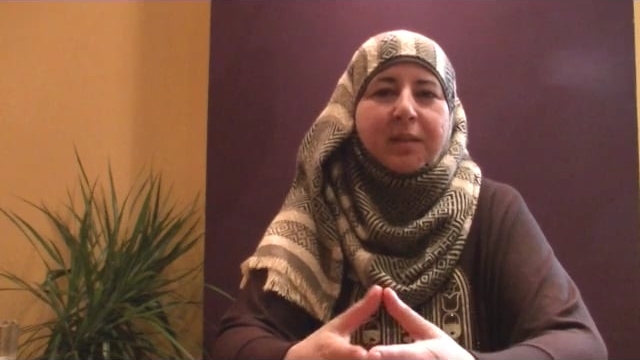
Country of origin: syria
Year of settlement: 2015
Age on arrival: 40
City: bochum
Gender: female
Language of the interview: Arabic
[i] Welcome, Mrs. [name], here in Bochum. We are present in the Humanitarian Coordination Association of the Middle East, in Westenfelder Straße. Today, we will have an interview with you. I am [name], the president of the Humanitarian Coordination Association of the Middle East, and I have a conversation with you today in the Europe’s History Program. Today is the 4th of January, 2019. May Allah bless you all with a year full of love and peace, and everything you wish for yourself, your family, and your children. Tell us about yourself.
[r] I am [name], I was born in 1975, from Aleppo. I am from Aleppo, Syria. Of course, I grew up in Aleppo. My childhood was very beautiful. I have four brothers and sisters. My family was very nice. Unfortunately, my father passed away when I was 9 years old. I am very saddened by that. After that, we studied and my mother brought us up. She was very tired of us. We studied and got married. So we got married. Two sisters and me. Of course, I got married, but moved to another city, to Homs. I have three daughters and a husband, who live in Homs. Currently, I live with my daughter, who was 19 years old back then. and my second daughter is 14 years old, and my daughter with me is 13 years old. Sorry, my middle daughter is 15 years old.
[i] May Allah protect them.
[r] May Allah protect you.
[r] Tell me a little about Halab [Aleppo]. Is Halab beautiful?
[r] Yes, it is very beautiful. It is beautiful in everything. In Nasa, the whole area is beautiful. It is a well-known industrial area. I have a lot of memories of it, and I hope to visit it again.
[i] Did you move to Homs to get married?
[r] Yes, I got married in 1999. I got married in 1998.
[i] You are young.
[r] Yes, I was 23 years old when I got married.
[i] Did you choose your husband?
[r] Yes, of course, because he is my cousin.
[i] Yes, you are family.
[r] Yes. May Allah keep you together.
[r] May Allah be with you.
[i] Yes. And I think you studied in Halab. I studied in Halab until high school. In high school, I studied arts.
[i] That’s nice.
[r] Then I studied for two years in the primary school, third grade. Then I got married and moved to Homs.
[i] Yes, and how did you spend your youth? How did you spend your youth when you were growing up?
[r] As I told you, my childhood was very beautiful. It was with my family and my friends. I still keep in touch with them. Although we are old, I still keep in touch with them. We were children in the street. Now we keep in touch, thank Allah, with our daughters. And, of course, with my relatives. Of course, they don’t get along. Yes. It was a gradual process. Mum raised us. We felt that [name] is old. But she is still young to me.
[i] She still lives?
[r] Yes, thank Allah. She is still in Halab. She is with my sisters. My sister is here. Of course, she moved to Germany. I came to her from the north. And now I am trying, if Allah wills, to move closer to me. Because I live in a remote area. And I hope that she will move to Bochum or Essen.
[i] Allah willing. What brought you here today? So that we can start our conversation. What brought you here today? What brought you here?
[r] Unaicious, with this ring. I have this ring. I keep it acquired if I get memory from my daughter. This is, when you first left Syria, this is my daughter. I can’t live without it.
[i] Yes, very beautiful. Because I saw that you always curses by wearing this ring. Why did you come to Bochum? Why did Bochum?
[r] I mean, the city is very warm and peaceful. And the people here are very kind. Even when we were in the camps, there were a lot of Germans who helped us a lot. Even now, where I live, I have German neighbors. No matter how much I tell you about them, it won’t be enough.
[i] Now, we will continue with the talk, but I want to ask you why you came to Germany?
[r] I came to Germany because of the war. I had to come with my daughter. I wanted my husband and my daughters to come with me, but due to some circumstances, they couldn’t come with me. I wanted to work for the North. I stayed there for a year, but I couldn’t work for the North. I haven’t seen them for three years and a half.
[i] Do you still contact them?
[r] Of course.
[i] Who made the decision to flee the war?
[r] It was a sudden decision. It was between my husband and my daughter. My husband and his sisters left. My husband’s brother also left with his wife. Yes, so we left. It was because they couldn’t finish their work. There were some issues. It was because their brother’s son was arrested at the age of 18. So they wanted to leave first, and then we worked for the North until they left. It wasn’t fate. He didn’t leave, and they couldn’t leave. Hopefully, I will find my daughters and my husband.
[i] I hope your dream will come true. Tell me. How was your trip?
[r] It wasn’t a good one. My trip was very difficult. I won’t forget it.
[i] Were you in a group?
[r] We were in a group. Even now, they tell me to leave my husband and my daughters to flee. I can’t. I don’t want anyone to go through the difficulties and hardships I’ve seen. I left through the desert. First of all, through the sea. We stayed for three days in the sea. We went through the desert. We arrived in Italy. There were waves. They had to take us back to Greece. We stayed in Greece for a while. We couldn’t go through the desert again. We had to go through the desert. You know the areas we went through. It was very difficult. We even got lost in the woods. I got lost with my daughter. We were lost in the woods with my daughter. In Greece, we entered the hospital with my daughter. It was very difficult for us. My daughter suffered from a cramp. My feet were swollen. They’ve become very thick, my feet were really swollen. Even the doctors refused to leave me. They took me to the hospital. They told me that if I didn’t go through the desert, I would have lost my feet.
[i] Where did you walk?
[r] I walked in the woods. I got injured a lot. I suffered a lot on the way to the desert.
[i] Were you afraid?
[r] Of course. Especially when we went through the forest in Turkey. The first time I went through the forest, when the sun came out, the first time the light came out, we would walk in the woods. We would walk between bushes and stones. We would fall. I suffered a lot. Me and the group that was with me. Thank Allah, everything is fine.
[i] Did you help each other on the way?
[r] Of course. When I woke up in the morning, I had a lot of injuries. The group that was with us stopped me. We helped each other a lot. We were one hand. Thank Allah. We reached Germany.
[i] Did you regret it?
[r] No. I didn’t regret it. On the contrary. We have arrived. Perhaps I wish to return because of my family, the people and our homeland. But here, one finds safety. There is still a war going on. Here, we find safety.
[i] After all the difficulties you went through, and what you saw, and the suffering you went through, you find that you are a person who went through a very difficult phase. It is a great joy that you saved your daughter.
[r] I didn’t expect it. To be honest, I am happy in the circumstances I went through. Until now, I still wonder how I went through all these circumstances.
[i] You are a brave woman. You have a lot of courage. I mean, you had a surgery. And then, you were forced to go through it.
[r] Of course.
[i] You didn’t choose it.
[r] No. I didn’t choose it. But the conditions of the war were what made me go through it. I mean, that wasn’t due to any danger.
[i] Yes. And, you and your family are communicating.
[r] Yes, thank Allah. I speak with my parents daily. I speak with my daughters and my husband. And, they are of course very sad. I hope they will see me. I mean, as long as I see them.
[i] Yes. Of course. I don’t want to put you in this sad mood, but this is a special achievement for those who live far from their children and their lives. You feel that you want to meet them in person?
[r] Yes, I hope so.
[i] How long did you stay here?
[r] I stayed here for a year. They gave me a six-month Stay. They gave me a three-month Stay. After a month and a half, they gave me a two-year Stay. But I hope I can do something for my family.
[i] If Iraq is in danger and you go to war, would you like to go back to your country or do you want to leave? It’s been three and a half years since I left the war. I want to go back to Europe, especially here in Germany. I want to stay here. What do you want to do?
[r] I hope I can go back to Syria. At the same time, I have my family, my siblings, my mother. I hope I can see everyone again. Of course, these are the conditions in Syria.
[i] Tell me something. Tell me about Aleppo, about Homs. Tell me when you got married. Tell me about your life. Do you have any friends?
[r] I have friends. Aleppo is very nice. Homs is nice. I lived and raised in Aleppo. I love Aleppo more. It’s true that my daughters are in Homs. I hope I can see Aleppo again. Aleppo is very nice. And my friends. You are the only one who can contact them. Thank Allah. Even my old friend moved to Essen. My friend is 30 years old. We met again here. Her name is close to my name. Her name is [name].
[i] [name] and [name].
[r] Thank Allah.
[i] Long live Islam. Is your mother good?
[r] Thank Allah.
[i] Are you talking to her?
[r] Yes, of course. Thank Allah. May Allah help her and keep her healthy. May Allah bless her.
[i] She has helped you in many things. You took care of your mother and she helped you.
[r] She worked very hard for us.
[i] Yes, but she also taught you this very good thing.
[r] Thank Allah.
[i] It’s not easy. You have four brothers.
[r] Yes, thank Allah. Four brothers are older than me. Thank Allah.
[i] Yes, you should be proud of that. She raised an entire family.
[r] Thank Allah.
[i] How are you and your husband doing now? What are you talking about?
[r] I talk to him daily. He encourages me and tells me not to worry. He hopes that my mother will come and see me and his daughter. He tells me not to worry. I hope that he will hear good news and that Allah will bring me together with them.
[i] Did you pay a lot of money to get to your mother?
[r] Yes, we did. In Syria, we were in a good situation. We paid a lot of money. We were even fined in Turkey. We paid $15,000. We were fined. We had to wait again. The guys gathered us from here. We came back. We tried to get back from the beginning. We wanted to see a person who took us abroad. What can we do?
[i] Did you know that you wanted to come to Bochum?
[r] No. They took us from one city to another. We were in Dortmund. They took us to Essen. We stayed there for three weeks. Then we came to Bochum. We stayed there.
[i] Do you want to stay in Bochum?
[r] Of course. Bochum is nice, calm, nice and friendly. The people are nice.
[i] Do you feel good here in your home?
[r] Of course. I feel good because of the people I met here. I didn’t feel bad. There are a lot of nice people here. They are both Arabs and Germans. The Germans treated me very well. Especially my neighbors. I can’t tell you about them. They are very kind to me and my daughter. I feel very proud of them.
[i] How is your language? Do you speak it well?
[r] A few words. My daughter helps me. I tried to learn the language. But I can’t. I find it very difficult. I don’t know it well. I don’t feel comfortable. I try to go to school. I tell myself that I want to stay. My mind is with the teacher. Suddenly, I don’t feel like staying. I feel like leaving. Even the teacher knows my situation. Sometimes, I cry. My mind is with my daughter and husband. I hope to learn the language. But I can’t. I find it difficult. I don’t feel comfortable.
[i] Despite this, you are able to communicate with people.
[r] Thank Allah. I love them. Even my neighbors. Sometimes, I understand a few words. I can say a few words. If I was wrong, I would try to talk to them. Especially my neighbor. She is very kind. She tells me not to try. She knows that I will cry. I cry. I am ashamed of her. But thank Allah. Sometimes, I like to see her. Even if I say hi to her. She is very dear to me. I love her from the bottom of my heart. If I say hi to her from the door, I won’t say no.
[i] You are a very kind person. Is your daughter studying?
[r] Yes, thank Allah. She is in the sixth grade.
[i] Of course, the language is better for her.
[r] Yes. She can translate.
[i] Yes. I feel that she is very smart. She is very smart. How are you spending your time?
[r] I mean, this course. This house. My housework. Sometimes, I like to make home-made sweets.
[i] Do you like sweets?
[r] No, I don’t eat a lot of sweets. But I like to make them. Sometimes, whenever I see a dish, I like to learn from it. I used to be in Syria. Sometimes, I make a dish and I give it to my neighbors. They like cooking and I like to make them. I make it and I taste it.
[i] You told me that you like to cook. Your sister moved here.
[r] Yes.
[i] How do you feel about this story about your sister’s family?
[r] Thank Allah. I hope that she will move soon to Essen when her husband works, hopefully. She lives far away from the region called Sisen [?] but around four and a half hours distance.
[i] Sisen.
[r] Sisen.
[i] Sisen. Okay.
[r] I will be glad with her future for a family that is healthy and good.
[i] Of course, of course, of course. When you decided to leave, how did your family and friends react?
[r] They were very sad, honestly. First of all, they were shocked. But they knew the circumstances in Homs, how the situation was. So, they were very upset. And now, sometimes they tell me to go back, although I know the situation. It’s hard, there’s a war going on. But of course, I don’t want them to go back just to see me. Of course, I want to see them.
[i] Did any of them leave with you? Did you remember any of them leaving with you?
[r] No, yes, they left with me from my husband’s family. I mean, my cousin’s wife and her son.
[i] Very nice.
[r] And there’s also my husband brother’s son.
[i] It was a difficult journey.
[r] Yes, it was very, very difficult.
[i] If you had left, would you have been on the road?
[r] I wouldn’t have left. I wouldn’t have left. And now, sometimes they tell me, they used to tell me, why didn’t your husband and your daughters leave? I mean, I wanted them to leave so that I could see them. I mean, I had been looking for them for a long time. But I go back and I say, I don’t want to taste what I tasted. Because I tasted the sea and the land. I mean, the land was very difficult for me. Very, very.
[i] Of course, it’s not a small thing. But when you came and arrived in Germany, how was your first impression, your first feeling after these difficulties?
[r] Of course, the first time I arrived, I mean, I was a little bit relieved psychologically that I was safe. I mean, it was a unique situation. I mean, I was like a person who walks and gets tired. I mean, I became safe. After a long, long journey.
[i] Of course. And you found a good treatment.
[r] Yes, of course. I mean, even when we were in the camps, the treatment was very, very good. I mean, in the camps. Of course, for the Germans, even any security in the camp, I mean, they treated us very, very well. Whether it was in Dortmund or even in Essen, even in Bochum, when I came down to the camp, the treatment was very nice. I mean, they respected us very much and the treatment was very good.
[i] That’s very nice. So, the first few days in Europe, Syria is an Arab country, Germany is a European country. How was it when you were with them? When they forced you in the camp, you were, I mean, I mean, you were with them.
[r] No, I mean, yes. Of course.
[i] Were there fears? What did you do?
[r] No, there wasn’t any fear.
[i] But were you afraid of them?
[r] No no, there wasn’t a fear. We were happy. As a result, we would go into the camp, like I was my close one, my mother’s girlfriend. I mean, I was always with her. So, we would go into the camps, we would find people from Sham, from Halab, the other from Hama. We would meet those who came from Iraq. I mean, we would all communicate with each other, I could feel that we were one. All people who come from war zones. We didn’t have any problems. It was a very nice life in the camps.
[i] Did you look for something that would remind you of your childhood?
[r] Of course. Whenever we would sit down, everyone would tell us about their memories, how they lived, who left them, who came with them. I mean, I spent all that time in the camps. It was a very nice life.
[i] How was the food?
[r] Of course, the food was… They would set up meals for us. Breakfast, lunch, dinner.
[i] Did you eat any of the food?
[r] No, we would eat. Because they knew what our food was. Of course. Yes, the food was regular. There was nothing else.
[i] Did you look for something like that? They would bring Arabic bread, for example, and you would like to ask about these things?
[r] Yes, they would give us salaries from the German government. Of course, sometimes they would tell us where there are Arabic shops. Of course, we would go and ask. It reminds us of the smell of Syria. The place of bread and vegetables. I mean, most of the things are in the camps. But there is food, of course, that is necessary in the special shops.
[i] Yes. The culture, the civilization, the things that you came with, the history, each person has his own history. Does each person have something that he likes to remember? Does he raise his children on it? Does he have principles?
[r] Of course, of course. I mean, each person has something to teach his children. Of course, you have to raise your children according to their upbringing. Of course, I mean, we can raise my daughter the same way mom raised me, for everything, whether it is from learning, education, religion. As our parents raised us, we try to raise our children.
[i] Do you feel that your parents raised you well, your parents did a lot with you?
[r] Of course, they worked with us a lot, may Allah help us in our life.
[i] May Allah help you in your life.
[r] As I say, they raised me with great respect. She was widowed at a very young age, at 40, and we were six, four boys and two girls. It wasn’t easy for them to get tired of everything while she was raising us. I have younger sisters.
[i] And she came here?
[r] Yes, thank Allah. My sister has been praying for about 11 months.
[i] Were there any difficulties in raising you? Was there a lot that was forbidden?
[r] No, on the contrary. As you remember, it was because we didn’t have a father. So, thank Allah, we weren’t deprived of anything. Even from the parents’ point of view. They were very kind to us. Even from the neighbors’ point of view, they were very kind to us.
[i] Did religion play a big role?
[r] Yes.
[i] Did religion play a big role in your lives and in your children’s lives?
[r] It’s normal. We didn’t bring everything from religion. We didn’t ask anyone to get rid of religion. No, there’s nothing wrong with raising children. Of course, we wanted to give them something. But in general, thank Allah, everything was within limits, and politeness.
[i] You said it’s a beautiful sentence. Everything is within limits and politeness.. Because politeness. is also good.
[r] Of course.
[i] This is a very nice thing. And wasn’t your home nice? When you were living there, was life nice?
[r] Yes, the house was very nice. I have many memories of it. It was very special for all the girls.
[i] This is something special.
[r] I don’t want to make it easy. I just want to say that me and my friends, we don’t have other than memories of our time in the neighborhood. There were many girls, maybe more than 11 girls. And the boys, there were many girls. We used to go out in the neighborhood and play. We stayed there until we were older.
[i] And the neighbors?
[r] And the neighbors, yes.
[i] In the morning?
[r] Yes.
[i] The morning is important.
[r] Or, no, not too much, at sunset, they sit in front of the door, When you have something to work on, to help her neighbor with the vegetables.. Yes, there were very beautiful memories. It was a very special time.
[i] These things are very important for us in Europe, like our country. We have the neighborhood, the settlement, and these things.
[r] It didn’t matter what the work was, like winter supplies or something. The way you put it, she goes to her place, helps out, spends the holidays and evenings there, to sleep together, spends the night together, bakes biscuits and sweets. These things were very difficult. It’s a bit difficult for someone to…
[i] Everyone lets the others try it. I cooked this, give it a try.
[r] Yes, yes, that’s right.
[i] This is also part of our culture.
[r] Of course.
[i] Do you also like to keep this in mind? Do you like your girls to be like this?
[r] Yes, as much as anyone makes a dish, I want him to taste it for his neighbor. Taste this, taste that. Even now, even though he’s German, I do the things he tastes for me. So they were surprised that this is normal, that I do any nice thing or any cooking thing, so I like to taste it for them.
[i] Does he like it or does he accept it?
[r] No, he accepts it. They tell me, your cooking is nice. Even the neighbor upstairs said, I went up the stairs to smell the smell of your cooking.
[i] Oh, it’s very nice.
[r] She said, I just smell a good smell, I know it’s from you.
[i] What were you doing at the time of the holidays? How were you having fun?
[r] In Syria?
[i] Yes.
[r] I mean, after I got married or…
[i] Yes, in general,
[r] Yes, generally speaking, we were married. How was our life? Of course, you saw it, you feel that today passes quickly. I mean, from raising children, from housework, from cooking. I mean, if there is a visit, I go out, of course, me and. … as they say, women, husband’s sisters, no, two sisters, we are in the same building, we live together, four of us. So you find there is a visit, there is a occasion, we go together. Yes, and sometimes we go out, like, of course, the young men, my husband and his sisters, we go out. We sit, I mean, every Friday, we meet each other at home, we have dinner, and we sit for a while. That was our life, I mean, every Friday…
[i] It’s a social life.
[r] Yes. It’s a social life, I mean, at home, we have dinner, and we sit for a while. Husband and sisters, and we ask them. It was, I mean, very beautiful days.
[i] Do you miss those days?
[r] Yes, a lot. A lot, a lot, I mean, I have beautiful memories. We were very happy, I mean, I wish those days would come back.
[i] Here, the communication is hard because of the language.
[r] Of course.
[i] You are telling me, your neighbors, you talk a lot about them, they are very nice, but they don’t speak the language. Communication.
[r] Of course.
[i] And the differences in cultures.
[r] Yes. True.
[i] Today, Europeans work here, and they have commitments, and they have promises. We also work in Lebanon.
[r] Of course. Here, it’s different, I mean, the situation changes for us, as you said. Here, they have, here, their work is something, and I mean, their lives are different from ours.
[i] Of course. Love plays a role in your life?
[r] In what way?
[i] That your husband loved you, and that you loved him.
[r] I mean, no, I wasn’t honest.
[i] You’re the one who told me.
[r] No, no. I was honest because my parents, they asked me from my father and my mother, so I didn’t like to upset them. I refuse both sides. So I don’t upset them. My father’s parents were very nice to me. So, so that they don’t say I took from my father’s family and I didn’t take from you. So, praise be to Allah. My husband still loves me for 7 years. So, I always say no.
[i] He was on the other side.
[r] Yes. So I refused him, I said I don’t want to be with relatives. I don’t want to, I mean, I don’t want to be upset, neither here nor there. And SubhanAllah, he stayed 7 years and he refused to become engaged to someone else. No. Only when I know that [name] has got engaged. Then she’ll be out of my way, and I’ll get engaged. So SubhanAllah, how did fate come to me later?
[i] But you loved her?
[r] Yes.
[i] You didn’t force him?
[r] No, no, I didn’t force him. But I didn’t tell you, I said, take it easy, take it easy. I mean, I’m sitting with my happy family. I mean, I said, it’s still early and I don’t want to be with relatives. But SubhanAllah, he stayed with us until we got married.
[i] When you got married and you decided to get married and have children, you said you had three daughters.
[r] Yes.
[i] Did you like to have a son?
[r] He is the one I wish for. I mean, I wish he would have this and that. But, it’s up to Allah. I mean, thank Allah. I said, I’m ready. He said, yes. I mean, there are people who wish to have children. My husband didn’t object to me saying I wish to have two children. On the contrary, when I got my first two daughters, he said, okay, that’s enough. He said, don’t be too much. Don’t think I want a son. He didn’t object to me saying I want a son. So, he said, okay. I got pregnant with my third daughter. He wanted me to have an abortion, on the one hand so that I wouldn’t suffer And on the other so that I wouldn’t think about a boy. At the same time, he said, don’t think I want a son. I have two daughters. I know how to raise them and raise them well. And thank Allah. But, we continued. We got the third one. He said, yes.
[i] He said, the society doesn’t have mercy.
[r] Yes. But, in this regard, neither I nor my husband. My husband still criticizes them a lot. I mean, sometimes at home, I say, no, no. So, they say, no. My father doesn’t say no to us. I mean, we’re used to everything that their father criticizes them. Even now, the two daughters in Syria, despite the fact that the older one went to university, and the second one is ten years old, they are happy. You always say no to us no matter what. They appreciate their dad, he doesn’t hit them. He treats them very well.
[i] May Allah keep you together. And, Allah willing, you’ll be happy.
[r] Allah willing.
[i] What can I tell you? Did you deal with a girl’s vagina? That’s a different problem.
[r] Yes, sure.
[i] But, you mean, it’s nice.
[r] Sure. Perhaps the treatment of boys who are disabled, whose minds are not normal, who say they want boys. I don’t know, I can’t find anything, the boy is as well as the girl, just as the elders say that the boy bears the name of his father. The girl also bears the same name.
[r] The father’s name.
[i] Right, definitely. When they decide to get married. Would you force them? Or would you let them decide for themselves?
[r] The thing is. No, I would definitely let them decide for themselves, but if I found something that wasn’t good for them, of course I would give them advice.
[i] Of course, give them advice.
[r] Yes.
[i] Education, that’s your duty.
[r] Of course, that’s my duty.
[i] Do you want them to get married early, like you did?
[r] No. I don’t know. I mean, was 23 years old. It’s not bad.
[i] No, it’s not early. It’s not bad. They are 23.
[r] Yes, it’s not bad. My daughter is 22 and I was 23. But there are people who are 18 or 19 years old. No, it’s the opposite. Even my daughter in Syria, when I brought her Syria, she said, No, don’t talk about it. It’s too early. It’s not good for her to think about these things now.
[i] They want to be educated?
[i]
[r] Yes, they want to be educated, and until you are with me, I should leave the subject aside. Then Allah will help you. But let’s not talk about it. Let us come together first.
[i] What do you dream about? What do you dream about?
[r] I don’t dream much. I just want my family to meet. That’s the most important thing for me in this world.
[i] Are you working on this subject?
[r] Yes, but I’ve tried. I’ve filed a lawsuit and I’m working on it. But now there’s nothing.
[i] They can’t do anything for me from the bottom?
[r] No, they can’t.
[i] They can’t do anything. Allah willing. Many people have pride and self-esteem. They have Stolz [proudness], they have Karame. Do you know?
[r] Yes.
[i] This topic is affecting foreigners a lot. For example, they don’t get a job. They don’t go to work. They get fired. Especially when you’re alone. I want to talk to you about this topic. Because when you’re alone, you feel like you’re trapped more than anyone else.
[r] In terms of requests or if I want to ask for something?
[i] Yes. You have a right. You have to ask for your right.
[r] There’s nothing. I’m used to it. I’m used to trying. Even if I want to do something. In Syria, I didn’t go to work. I never went out. I’m used to it. My husband brings me anything. I talk to him. I want this. I want this. I bring this. Here, I found it difficult to go to work. Honestly.
[i] You used to do shopping. You used to work.
[r] Yes. Here, I always try to go to work. I find it difficult. The difference is that in Syria, I didn’t bring anything. My husband brought everything. He didn’t do anything. I tell him what I want to do. I tell him to bring it. He brings me these things. Here, there’s a complete change. As they say, my head is on the line. Here, I can do everything by myself. I can go and buy things. Even the things that come in the papers. In Syria, we didn’t have all these things. Here, anything that comes to you, you have to go and see what’s in it. You have to do it. Of course, you have to do it. Whether it’s a promise or anything. I found it very difficult to do all these things. The papers. All these things are new to me.
[i] Of course. Here, it’s the land of the free. The land of the rich.
[r] Of course. We don’t have all these things. Even if there’s a small piece of paper, my husband can do it. Here, all this came to me. I found it difficult.
[i] But now you have it.
[r] Thank Allah. Yes. Thank Allah. I’m used to it. It’s a bit tiring to go and buy things. But thank Allah. It’s a nice thing here in Bochum. You feel like you’re used to this country. This beautiful city. I’m used to it. I mean, whether it’s Germans or refugees, whether it’s Arab refugees, from Iraq, from any country, you feel like they’re all together. There’s no difference. Like it was here, or in Syria, in Homs. I mean, you feel like it’s all one. There are Arabs here, and the same thing here. There are Arabs here, and there’s a connection between people.
[i] You don’t feel this foreignness?
[r] No. Partly, this foreignness that they started, and what I feel about it, is that, of course, I’m still a girl and a husband. I mean, I hope in the future that I’ll be able to meet them. That’s the most important thing. I mean, I feel a little bit of a stranger in terms of my family, and I’m a little distant from them. And my daughters and husband I hope they’ll be with me. I hope this will be a little bit lighter for me. I mean, of course, this language, which I can’t study, I mean, it’s still a little bit that my mind doesn’t understand this thing at all. I try to communicate, I try to study something, but I can’t do it by myself. I mean, I grab a book, even if I want to study a little bit, all of a sudden, I feel like I’m running away. I mean, I can’t understand it. I mean, I try to always open up, instead of just studying, I like to open up the internet and communicate with my daughters. I mean, I hope that all day long I can stay connected to them about what I did, what I did at school, in university, what I did for my daughter, what I cooked. I like to stay connected to her and see what she does.
[i] Do you spend a day without a phone?
[r] No, of course I can’t, but because my daughters and my husband are here, I can communicate with my daughters, and of course my mother and my brother. But I have to communicate with my daughters daily, voice and image.
[i] Do you feel that there is a big gap in your life, or is there no time for gaps?
[r] There is a gap, but I feel that there is no gap, partly because I tell you that every time I find a gap, I want to communicate. I think I am talking to my daughters, so I feel that there is no time. And I also feel that I am very busy. Even if there is a gap, I tell you that I want to communicate with my daughters. And honestly, I hope that I will work now, and hope for the remaining gap that I have. I hope that they will forget the thought and the concern that I have for my daughters. I hope that I will work.
[i] Do you have any hobbies?
[r] My hobbies? I like to work in the kitchen. I like to cook, I like to make sweets. I really like to learn how to make sweets. Any food that I see, I like to learn it. I like to increase it. And I like to walk. I like to walk, yes. And traveling is nice too. I mean…
[i] What is the plan that you have set for the future? What is the plan that you have set for the future?
[r] I will tell you that I will put something in my mind. I will not put anything in my mind, but when my daughters and my husband come, I will put something in my mind. I will not put anything in my mind until I see my daughters and my husband around me. And of course, I will work and hope for my time, until Allah restores me. I will tell you in advance that I will put something in my mind. I can’t…
[i] This is his ambition.
[r] Of course, to meet with my daughters and to complete their studies and their lives here.
[i] What is the experience that you have gained from them? What did you learn from them? What did you gain from your life?
[r] The first thing is that I was encouraged. In terms of marketing, I was encouraged a lot. In terms of work, I worked with papers and other things. These things changed me a lot. I had never worked in Syria before. I was encouraged in this city. Things changed a little. I could go out and in. In Syria, it was normal. Of course, it wasn’t that normal. I didn’t want to go out. In Syria, everything was guaranteed. Anything is guaranteed. You can come to my house and do whatever you want. Everything is guaranteed. But here, you have to do everything by yourselve. These are the changes that happened to me.
[i] What is the program that you would like to do here? What do you see? Is there anything that reminds you of your country? Any activity that you would like to do? Do you feel that you are waiting for the end of the week to come? Do you want to go or do something else?
[r] I would like to wait for the end of the week. I would like to meet people I know. You are my best friend, of course. And of course, there is a woman who has a daughter. These are the two days that I would like to communicate with them. This is the most I would like to do. I would like to go out with someone to walk. These are the things.
[i] Do you feel that there is someone here who hates foreigners? Did you experience anything like that? Did you feel that someone is against foreigners?
[r] I don’t know. I don’t know what to say. I haven’t talked to anyone about this. I don’t know. In my opinion, there are no such things.
[i] Do you think that foreigners hate you?
[r] Yes. Yes, a lot. As far as I saw it, yes, of course. I haven’t treated those around me very well. You were very nice to me. That’s why I haven’t treated you very well. As for other people, Allah knows. I am telling you as far as I know. This is a very nice thing.
[i] Do you feel safe?
[r] Yes.
[i] Is there anything forbidden here?
[r] I don’t know what to say. Of course, there are things that are forbidden. Like in any country. Every country has its own laws.
[i] Is there something you want to say to someone in your heart?
[r] Yes.
[i] Do you like the country?
[r] What?
[i] Do you like the country?
[r] Yes.
[i] Do you want to change it?
[r] No.
[i] Do you want to move to another city or something?
[r] No. No. I mean, I hope that if I start to move, I want to stay in Essen. I love Essen. But when I came here, I liked Bochum. First of all, I was in Langendreer. And I wanted to move to Bochum. To the city. And thank Allah, I am happy in the country. It is very nice. And the people are nice. And Allah bless those around me.
[i] Do you think any day that you will live somewhere? Going to Europe, better to Syria or to Germany?
[r] Until now, there is a secret that I now actually remember. How it got to be due to the war, maybe now I can come back to Germany. How long did I pray my prayer? 3 years. I still remember about that time. But how it got to me now? I live in Germany, with my parents. I left my husband and my daughters and I can be in Germany. Sometimes, I don’t even understand. I don’t understand why he lived in a country far from Syria. I find it difficult to think about it.
[i] Didn’t he decide to take someone from his head and say there was a war?
[r] Of course, it was the cause of the war. No one would leave their country. We lived and lived in it. But the circumstances of the war, it was very difficult for us. During the war, I would see bombs and missiles in front of me. When I was in Homs, I would see the missiles flying in front of me. It was very difficult.
[i] How did the missiles fly in front of you?
[r] Through the connections between the regime and the Free Army. We had bombs in front of us, or they had bombs in front of them, so there was an explosion.
[i] And the bomb was planted.
[r] Yes, of course.
[i] Did you see it?
[r] No, but I saw it on the balcony. I saw several missiles. I was surprised that they were in front of me. Then I realized that the missiles were coming from below. I thought someone was hitting me, but when I saw that they were in front of me, I thought that the missiles were flying. That was very scary for me. It was a very difficult life. It was Ramadan, we were fasting, and my daughters were sleeping. I took them to my uncle’s house. That was the most scary situation. There was another situation that was difficult for me. I went to my parents. I had been praying for a year and a half. I couldn’t see my parents. There was still no peace in Aleppo. There was a lot of violence. I couldn’t go. The roads were closed. I didn’t see my parents for a year and a half. When I tried to go to their house, there were some conflicts in Aleppo. I went to their house. On the second day, I heard that there was a missile. I said it was normal. We got used to it. There was fear, but I said it was a long distance. I went to my parents. There was a daily missile landing on the camp. Two in the morning and two in the evening. The airport is close to the camp. In Aleppo. There were a lot of missiles. Even on the last day, early in the morning, around 7 a.m., my daughters were sleeping. I heard the first missile. On the second missile, I went up to the roof of the house. I went up and heard the sound. I said it was going to land on the house. There were no missiles. It landed in front of my parents’ house. It was very scary. It was not normal. I had to go. I told my children and my daughters to get ready. I told them I was going to go back to my husband’s house. I stayed there for two weeks and came back to my husband’s house. This situation scared us. It was a daily missile landing.
[i] How long did the war last?
[r] From 2011 to 2015, it started.
[i] From 2011 to 2015?
[r] Yes. I arrived in Germany in August 2015.
[i] Four years, that’s not good.
[r] Exactly.
[i] In the war environment.
[r] Of course.
[i] You used to live here, eat and drink. Were there any difficulties?
[r] In our region, there weren’t many difficulties. But of course, it was very expensive. There are some things that you can’t find. But in Aleppo, yes. In Aleppo, there have been many blockades. To a certain extent. Even in the camp that my family lives in, the water has been cut off. They dug 18 wells. One of my brothers dug a well for him and the others. There was a lot of water being cut off. Electricity, of course, wasn’t available during the month. The cell phone was almost gone. For about two or three years, there were no cell phones left. They were cut off. Of course, they don’t have any more blockades. They have a good blockade now. About a year and a half.
[i] A year and a half?
[r] Yes, a lot of them are gone. Sometimes, I used to look at my face and get upset. The stores that were in the camp, if you take a picture of them, what would there be in the stores? A lot of garbage. The clothes that were washed. These things. Cleaning supplies. Or food. There was nothing. Nothing. They suffered a lot in Aleppo. They had a very bad siege. It was a bit… It was a bit annoying. Of course, there was a siege in Homs. But in Aleppo, the siege was more painful for me.
[i] Who was living in your family?
[r] My sister, of course. She suffered a lot during the siege. And my mother and my siblings. But I have a brother. He went to Sweden. A few months ago. But my three brothers, my mother and my sister, they suffered a lot during the siege.
[i] Your brother left Sweden married?
[r] Yes. Last year his wife and children were reunited.
[i] He has children?
[r] He has three children.
[i] What is his situation in Sweden?
[r] Thank Allah. It’s okay. But not that much. They were very happy. Maybe I’m happier than him here. Germany is very beautiful.
[i] Do you wish he would come to Germany?
[r] When they talk, I say, Germany is beautiful. I wish he would come. But of course, he left. I didn’t expect to leave. If I knew, we would have met or something. But suddenly, I left. So, I came here.
[i] Do you keep in touch with him?
[r] Of course. I keep in touch with him.
[i] Do you take his invitations?
[r] No, not yet.
[i] How long have they been married?
[r] About three and a half years.
[i] But did you take his invitations in Germany?
[r] Yes. I mean, I took his invitations. I mean, I took his invitations. But, I mean, he is very happy. Would you like to become a naturalised citizen?
[r] Of course, I don’t say no.
[i] Do you like this?
[r] Yes.
[i] By the way, you can bring your family here.
[r] Yes, of course.
[i] Do you want to get married? Of course. I really want to see my family, whether I become a naturalised citizen or not. But, this thing, I mean, I don’t know.
[i] And can you go to Syria now?
[r] No. It is hard.
[i] Is it allowed?
[r] No. No, it is not allowed.
[i] It is not allowed to go?
[r] No. I sometimes say to my husband, Let me come back. Because nothing, as long as I feel that there is something, I am not asking to see, I asked my husband and my daughters to come back. I said, if there is a war, I won’t come back. He said, no, the situation is very difficult. I said, because I was with my husband, I won’t come back. He said, the situation is difficult. Can you help them a little?
[r] I don’t know, I don’t know how to deal with things. He is ready, he doesn’t want anything, I just want to meet and talk with each other, that’s all I want, may Allah bring us together.
[i] Is there work in the hospital in Syria?
[r] Yes, thank God. He works with his siblings, they have a medical warehouse in Waza, in Sayadli. This is their work, his brothers are with each other.
[i] Of course, this work requires a lot of medicine, especially if it is in a place where there is a war.
[r] Of course. Yes.
[i] What about the girls?
[r] My daughter is ten years old, and the oldest one has enrolled in a university in Arabic literature.
[i] Do you love education?
[r] Yes, thank Allah, and most of them are from Bastaniya. Yata loves science very much, she keeps studying, even if she finished studying, she would like to keep studying. She is afraid. Even if she finished studying, she would like to keep studying. She is afraid, she loves to keep studying. Even if she sleeps in the evening, she would put the book next to her, she would hide it under the pillow, so she can sit and study, and I would take it from her. She loves to keep studying. She would go to school.
[i] Do they call you on the phone and try to talk to you?
[r] Yes, sometimes I get upset, but now I don’t show them. My middle daughter too. The week before the holidays, she has exams, she wants to study, enough, go study. She said no. She left the video phone on for an hour and told me, “I’m learning, please stay.” Please stay in touch with me, she always wants to connect with me. When I say hang up, it’s so that you can learn. You keep the camera open. Does she like to think I am talking and talking with her. For example, we close our eyes, and she prays she is students, then she says I am focused, but she keeps me informed. That is why the camera is open. My daughter all the days we go school. Once or twice or three times, she would like to be in touch with me. So this feeling is a bit relaxing, that I can open the camera and talk to her.
[i] We had a year-long study day of four months. How did you spend Eid? Where did you spend it? At home, I spent it at home. I opened the camera with my daughters.
[i] Where did they spend it?
[r] At home, too. They sat at home. They were at my parents’ place in Aleppo. They went to visit my parents. They had a good holiday. It was the Eid holiday. I saw them for two weeks. So they went to my parents. I called them. It was a bit difficult to use the internet in Aleppo. In the camp, it wasn’t the same. At home, I had Wi-Fi. But not here. It was difficult for them. So I spent the night. I talked to them about the camera. How did it go?
[i] Did they have fun at your parents’ place?
[r] Yes, of course. They had fun. They were the oldest and the second oldest. I told them that I would go to my grandmother’s place to take care of her. At the same time, we are happy that my brothers have good girls. We have six or seven girls. I like it. They get together. I like going to Aleppo a lot. Since I was little, I like going to Aleppo.
[i] She loves Aleppo.
[r] I mean, in the camp. My brothers live there. They live in the same village. They meet at my mother’s place. My children also meet there. We have a lot of fun.
[i] They get together in the camp.
[r] Yes. They spend the night and the evening there. I even took a picture of the girls and the boys together. The girls are going to buy the first baguette. They see the fruits and the juice. I took a picture of them. They made a small table for me. They are happy. They make me happy.
[i] Perhaps you even set off fireworks.
[r] Yes.
[i] Perhaps they had fireworks.
[r] Yes. They had had a bit of fun, they told me.
[i] They are happy.
[i] It is not easy to feel like that. It is hard. How did you start the new year? After that, at first.
[r] After that, I mean, no. I hope that it will be a good year for all of us. I hope to see you again, my husband and my daughters. And I hope the news will be good. Allah willing.
[i] You are currently studying at…
[r] At A 2
[i] At A 2 course Language.
[r] Yes.
[i] Do you want to complete?
[r] I mean, I am completing. I am studying. But sometimes I feel I’m learning for nothing. I don’t know. Because I feel that I do not understand more. First of all, the first course. I mean. I had good teacher. He was an excellent Turkish teacher. He was very nice and respectful. I told him that I didn’t want to go to school, so I told him to close the school. He laughed. I told him that I don’t want to go to school anymore. Sometimes he sees me crying. Even in the summer, if someone asks me what happened to me, I start crying. I don’t cry with my hands. I told him that I don’t want to play with my hands. I hope that I will be able to do it. But I have a lot of scars. I have a lot of scars. I don’t know. I don’t feel comfortable.
[i] What do you think about your job?
[r] I like to work. It’s better than going to school and feeling like I have nothing to do. Let me work. It’s a useful thing. It’s better than staying like this.
[i] That’s not so easy? Finding a job, especially when you don’t speak the language?
[r] Of course. But there are things that anyone can work on. If I find an Arab, I can contact them. They are married. If you are married, you can work with an Arab. These are the things.
[i] Allah bless you. What are you afraid of?
[r] Me?
[i] Yes.
[r] I can think of many situations.
[i] Yes.
[r] Allah bless you. If I die before I see my daughter and my husband.
[i] No. By Allah’s will, no. May Allah prolong your life.
[r] This is the most thing I am afraid of.
[i] Those who are going to die will die in their homeland or anywhere else in the world. Then you are with [name]. You are not alone.
[r] I am happy when the whole family is together.
[i] And you have good neighbors.
[r] Thank Allah.
[i] What problems do you see?
[r] Of course, there are more problems than what I have. Some people lost their parents. Some people lost their children.
[i] Are there many of these people?
[r] Of course.
[i] All those who came with you.
[r] Even those at home. I lost my husband’s brother. We lost my husband’s brother and his 18-year-old son.
[i] Did you know anything about him?
[r] No, we didn’t know anything. This is the reason why my husband didn’t come out. Everyone tells me, why didn’t your husband come out with me? How did you and my daughter come out? They are not in his hands. He had to come out. It is a coincidence that my husband and his sister are very kind. Allah bless them. They are very kind to each other. No one can leave the other. Everyone wants to be with each other. My eldest son, [name], who came with his wife, was kidnapped for 20 days. They continued to pay millions to get him out. From what they gave to the kidnappers. After he got out, [name] second son, his brother’s son, his husband, was 18 years old. They came and took him. The first thing they asked was, did you come back? They came and took him. Of course, we didn’t see him again. He was successful in high school. We are one family. As I told you, we were very kind to each other. Our relationship was very good in the same building. After three months, his father passed away.
[i] Did he pass away?
[r] No, he was being distributed to Sayadli. He left Sayadli and told him not to go to that area. There was a strike. He told him to put his hand on his neck. He told him that no one will take his neck except the one who created it. After he went to Sayadli, he went to the mosque to pray. He went to the second Sayadli. He left the mosque and came to Qazifi. Shazaya Qazifi came to his neck, wherever he put his hand. He passed away on the day of his son’s birthday. That’s why his brother passed away. Some of his brothers couldn’t get out. And he left his brother’s son. He didn’t know anything. They tried to help him, but they couldn’t. At least, they did it for his mother. Her husband passed away.
[i] Was [name] also in good health?
[r] She passed away. They were married for five months. They hit her car. She took it as a risk and distributed money to the poor. She was going to distribute money to the poor. He was hit by a car in Ramadhan.
[i] Allah bless you. Is your mother alive?
[r] No, she died a long time ago.
[i] Do you have siblings?
[r] Yes, I have siblings. That’s why I’m telling you that we didn’t get married together. Sometimes I say that your husband is strange. There are circumstances that no one knows why he didn’t get married. The reason is that his brother passed away. Before, I saw that his brother passed away. His brother’s son doesn’t know anything about him. I was hoping that they would leave before he came. Now, there’s nothing. He doesn’t know anything.
[i] Do you know if he […]? Did you hear anything?
[r] Every time, they say that he’s fine. Every time, they say that he’s dead. But the last time, they say that he’s fine. As long as they didn’t give us his identity or anything. For safety. I don’t know.
[i] Yes, we don’t know. People have lost a lot in the war.
[r] Yes, they have. That’s why I’m telling you that in the family, they’re very upset. Because they consider that they’re a family. They’re together. One of them was kidnapped. The other was 18 years old. What’s his fault? They say that he’s a terrorist. He’s 18 years old. Why would he be a terrorist?
[i] All these things affected your life.
[r] Of course.
[i] And they also affected your soul.
[r] Yes. This is very difficult. How could we be happy with each other in the family? I always told you that our habits… Any thing we send to each other. If it’s a meal, we cook it and distribute it to each other. If it’s a nice meal, I taste it. For example, I taste walnuts and raisins. I taste them and make a new meal. That’s how it is with each other. Every week, every Friday, we would meet with one of our friends. We would have dinner. We would have dinner and then go to bed. Even the boys would go to bed and we would have dinner. Our habits were very beautiful. You can’t forget these beautiful memories.
[i] But you have your friend here. You have your sister.
[r] Thank Allah.
[i] I want to thank you too. Does that make it a bit easier?
[r] Of course.
[i] We do not want to forget our rituals and culture. It is a blessing to be here..
[r] That’s right. My sister is here. My sister-in-law is here. My friend. But I’m telling you. I’m going back to those days. I’m sad about what happened to the country. No one expected this country to be like this. Until now, I’m really upset. Is it possible that Syria was destroyed like this? Syria was a very beautiful country.
[i] Was there security before the war?
[r] Yes, a lot. To a certain extent. For us, it was normal. I don’t know. I didn’t know how to get out and come in and out. Even the countries abroad. The Gulf countries maybe. They may know this. If they came to Syria, they would know that there was a lot of security. We would go on trips. Even at night, we would come back at a late time. Thank Allah. It was… It wasn’t like that. It was one of those fears.
[i] Do you like the celebrations?
[r] Of course. It was nice. Especially with the events. I see that the Arabs are an international tradition. And in the past, you have a great tradition. But today, the tradition hasn’t changed. Of course, it’s nice to see how after Ramadan people start preparing the sweets and the houses. They distribute them to each other. Even when they pass by the neighborhood, they smell the Kaak sweets. It’s incredible. They would be satisfied even if they did it here. But it’s not like what we do in Syria. It’s something different here.
[i] Do you miss Syria a lot?
[r] Yes, of course.
[i] Let’s continue our conversation.
[r] Go ahead.
[i] You have four brothers.
[r] Yes, I do.
[i] One of them is in Sweden.
[r] Yes, four brothers.
[r] The other three are in Syria. They live with their mother in the same building. No, the older one and the older two live with their mother in the same building. The younger one lives in a house a little far from them. But, thank Allah, they treat their mother very well. They don’t leave her. Even their wives are very respectful.
[i] Married?
[r] Yes. The older brothers take care of their sisters. And, thank Allah, the older brother, I respect him a lot. Since I was a child, like you, he was like a father to me. When we were young, when my father passed away, at Eid, he used to say to us, at Eid, my sister and I, we got used to him. When he was working, he would take care of us. He would give us money. He was very… He worked hard. Thank Allah. Yes, thank Allah, he was very kind to me. But, as I said, the older brother, he was like a father to me. He was very kind to us. My brother, he works in the municipality. And, of course, my younger brother is the head of the school. And, my brother is in Sweden. And, my younger brother, he is older than me by two years. He has opened a travel office. I mean, in the provinces of Lebanon. I mean, Iraq. He has opened a travel office. And, thank Allah, things are fine now.
[i] He has a normal life. He has stability.
[r] Yes, thank Allah.
[i] He has a job. He doesn’t think about losing weight.
[r] No, he doesn’t think about it. I mean, he got used to these circumstances. First of all, I was hoping after I left, at the same time, I would tell them, as long as things are fine, and, thank Allah, things are fine now. It’s true that there was a strike. And, he suffered a lot in Aleppo. And, he went through very bad conditions. I mean, he was there or even as I was in touch with my relatives, I mean, he had very hard circumstances. I mean, especially in the winter, I mean, they want to warm up, but there is no heating. He went through very hard circumstances. But, thanks to Allah, now, they have everything again. as I said, they are standing on their feet. So,
[i] Are things improving now?
[r] Now, I mean, there is improvement. But, I mean, there is no, If he falls and doesn’t speak, there is still a bit of fear, there is no peace. There is a strike from place to place, but there is no peace. The situation, whether there is a strike or not, it is possible that someone will be scared and won’t hear like before. In this situation, it is possible that he will come back like before. But, of course, it is expensive, and life is very, very expensive.
[i] A psychological war, an economic war.
[r] Of course, yes. This is something that affects him a bit. I wish it was, but they are the ones I would like to keep. So, I say, maybe, Allah willing.
[i] I don’t know if he would like to stay.
[r] Yes.
[i] But the situation is very difficult between life and death. Do they want to leave?
[r] Yes, especially the people who lost in the war. There were even people who were willing to leave, but the circumstances cost a lot.
[i] Yes. It plays a very big role.
[r] Yes, I am telling you, if there were people with him financially, they would have left. There are people… But I can’t… Why is this the reason?
[i] I mean, you paid a lot of money, and and you got ripped off?
[r] Yes, I mean, when we went to Turkey… I mean, thank Allah, we had a good situation in Syria. So, when we went to Turkey, we had a lot of work, I mean, a lot of work, a lot of work, as one would say. So, I didn’t expect that. When we stayed, I mean, we stayed in a hotel, I mean, it was respectable. I mean, it was good. It was nice, too, in Mersin. I swear, it made us happy. I mean, I was hoping, honestly, to stay in Turkey, but the people said, no, let’s go to Germany, I mean. But when we went to Mersin, I mean, the money that I brought with me and my relative, I mean, honestly, all of it was lost, like that. I mean, but not by our own hands, I mean, for food and drink. I mean, we sat in a hotel, just a room and a bathroom. I mean, there is no kitchen, I mean, there is no kitchen at all. I mean, even if we tell him to bring a small stove, I said, no, don’t buy it. We can’t go out these two days. We can’t go out this week. I mean, we stayed for almost two full months, and we were waiting in Mersin. Finally, the money that we had lost, $15,000.
[i] Are there any mistakes in Turkey?
[r] I mean, no, it’s normal. I mean, since we didn’t know, I mean, with the extra money, I mean, the money that we had, no, we feel normal, I mean. I mean, most of it, we say, that’s it. I mean, we put food and something in the restaurant, on the sandwich, I mean. So, we go to a restaurant, we order a sandwich, and we have to say, let’s go out these two days, I mean. When we found the long thing, I mean.
[i] How many children do you have?
[r] Me and my daughter, and my wife, my mother-in-law, and her son. And we also have a son with us. The son of his parents’ brother-in-law, who are still in Homs. I mean, he just came alone and lost with us.
[i] How old is he?
[r] Now, he is 14 years old, 15. My daughter is in Syria.
[i] Who was responsible for him?
[r] We lived together with my sister-in-law in the camp for about a year. We had shared a flat in Langendreer, but then we had to separate; we were told it had to be that way. So, when she went, she had a son with her, she had to take him with her, because she has a son, I mean, a daughter, and she is the oldest, so she took him with her.
[i] And not a daughter?
[r] No, not a daughter. Her son, and her son’s wife’s son, I mean. So, they stayed at home alone.
[i] Since you have a daughter and he has a son, you took his son and brought him here?
[r] Yes.
[i] So the son is related to her?
[r] Yes, the son of our brother-in-law, the son of our two husbands’ brother. He also came to reunite his family. We spent a lot of time in the camps together. We lived in Langendreer, in a house together. When we were in Turkey, we stayed for two months in Mersin. When we realised that the smuggler had tricked us. Not just us, we had to tell the guys again. They couldn’t guarantee us money, so we went to Istanbul. We also stayed in Istanbul for a month. Ramadan came and we stayed in Istanbul. It took us three days to go to Italy. Italy is very beautiful. We took a taxi to Germany. We took a taxi to Austria and then to Germany. We stayed for another month. We waited and waited until we got to a Yacht. Then we saw the waves.
[i] How many people were there in the Yacht?
[r] We were about 50 people. We went there at night.
[i] Did you get tired of the Yacht?
[r] No.
[i] How did you get tired of it?
[r] I got really tired of it. Whenever the smuggler went out, we would hear people traveling and sending us pictures. We knew them, they were with us in the street. We went out in a very nice and well-organized caravan. But when we got out in this caravan, we were shocked that they gave us a boat. We were shocked.
[i] What did they say? Did they give you anything good?
[r] Yes, when we got there, we went out in the woods at night. We took a bus for about 10 hours.
[i] How many people were in the bus?
[r] We were 50 people. But I don’t know if there was another bus. We went out in the bus and didn’t know if there was another bus behind us.
[i] Was the bus for the refugees? No, it was for the refugees. When we got to the woods at night, we were not allowed to light a cigarette. We went out in the woods. I know I was walking and I felt dizzy. I fell on my feet between the branches. It’s a very difficult situation. When the light came out, we saw the bus. When we saw it, we were shocked. It’s not a bad bus, it’s just a very bad bus. I had fallen in the woods when people came to pick me up. When I fell in the woods, my daughter started crying. My mother stood up and cried. Two times. The other day, a woman hit me. I mean, I swear. I can’t walk anymore. I’m walking, but it’s hard. I can’t walk because of leg pain. So, I lost a little bit from the beginning. I mean, I kept crying like this, I said, wait, calm down. I mean, imagine someone far away, and I hear a sound of a woman. I’ll see where the sound comes from, and if someone comes, I’ll continue with them. [name] was walking very fast because I was walking with her with two children, she was following me. We are walking back and forth, but it’s hard for me, my leg hurt, so I can’t walk anymore. This is the effect of the foot massage. That’s why it took a lot of effort. Even when they rescued me from the barge, I was still carrying my bags and I forgot to put my bag on the barge. After they took me to the Greek stadium, as I spent a good period of time in Greece, they took me there for two nights. The first night and the second night I went to the hospital, because I had a stroke. When I went to the hospital, they didn’t let me go out, but I told them that we absolutely had to stay with the group. I couldn’t leave my group, I would lose myself. They told me I had to take medication, after they told me about the serums. So I left the hospital with my daughter and went to Athens. It was nice, we enjoyed Athens. It’s a very nice city. We stayed for two nights, we had a good temperature.
[i] How long did you stay in Athens? About three weeks. We stayed and we shared three houses. All of us. We made two attempts to go to the sea, but it didn’t work. We were later forced to travel by land. After the three days at the seaside didn’t work out. We would have sunk. There were waves. We took the land route, and you know how how long the road was. You know from one place to another, Macedonia, Serbia, all of these cities, we passed through them. When did you arrive in Germany? I can’t remember.
[i] One day, twelve hours? No, we stayed for days. We stayed for days. We passed through several cities.
[i] Is there a country you’ve been to? Did you sleep in it?
[r] No, we didn’t. We passed through some cities. When we were in Athens, we separated. This is what I want to forget. Me and my friend, we stayed in Macedonia, I don’t know, Serbia. No, in Serbia. They put us in cars to go to another place. Everything was fine, but we had to get to the train. Me and my friend, we all had a mobile phone. This guy, even though he was young, we left like mafia cars, they say about us. I brought two pieces of cheese. I said, we arrived, how did we get back in the car? We didn’t find our stuff. We got in a car so we could all sleep and they put us in a forest. There was no one in this forest. We slept in the forest. We waited, until we found a group of three, four, five guys. We stopped and didn’t know where to go because we cut the connection. After we cut the connection with a woman, a Muslim, her name is [name]. We took her to the bus station, I don’t know, the train. We walked with her until we got there. I don’t want to forget this day. We got to the station. It was dark. There was no one there. We sat under the tree. The children, my daughter, they’ve fallen asleep, I’ve found a cardboard box. Then, we sat on the tree and left it there. Before the older men went to sleep, they gave us a bag and told us to give it to them. They told us that they would come at 6 or 7 in the morning. When the light came on, I connected the phone to the guy with us. He told us that he talked to the other guy who was responsible for us. He was from Turkey, but he was with the group. They told us where the meeting was. We had to go to the bus. We met the group again. We met in a big garden. We slept in the garden. It was hard to sleep in these areas. There were a lot of people in the garden. They were all sleeping. The first night we slept in the forest on the street, we spent a few hours until the driver came and took us. We slept under the tree and my daughter was sleeping in the carton. It was very hard for us. My daughter was also sleeping. Then we left. The last thing we did was take the car. We left the city in Serbia. The car was closed and it was cold. We left but not all of us. There were a lot of us. We spent 7 hours in the car because my back was very cold. I was standing at the door of the car. The car broke down and we almost arrived in Nemsa. We didn’t go to Nemsa. We went to the side where we were hidden. Then another car came and it was repaired. They brought another car. Then we arrived in Germany. The guys and girls changed their clothes and traveled. Of course, the police came and took us. We agreed to give ourselves to the police. Some of the girls came with us to change our clothes. They changed our clothes and took us. We were going to give ourselves.
[i] Were you afraid or were you scared?
[r] We were afraid. They took us inside and they searched us. Then they took us to Munich. We went to a friend of mine. We stayed there for two days. Then we took care of ourselves. How long did you and [name] sleep after arriving? When you arrived in Germany and left?
[r] Yes, of course. We were worried because we were moving. We were worried because we were moving.
[i] When you arrived in Germany you didn’t sleep at night?
[r] No, we stayed in the trains. The train had a large area. We were sitting like homeless people. We didn’t even sit on the chairs. The train door was open. It was a large area. We were sitting and there were a few people with us. Then we separated. That’s what happened to us.
[i] Did you contact anyone who came with you?
[r] Not everyone. I used to contact all of them but I don’t remember the ones I met in Turkey or in Greece or even in the camps. When we arrived on the road I couldn’t contact them because a year and a half ago I was back from the Job Center with my papers and I was crying. I put my phone next to my mother and I was crying. I put my phone next to the chair and it was black. I got off the train and I forgot my phone. They didn’t give me all the numbers.
[i] Did you turn off your phone?
[r] No, I wasn’t paying attention.
[r] I turned it on for a few seconds and I said to myself to put my papers back. I forgot my phone and I lost all the numbers. There are good memories and there are hard ones but at the same time there are good ones that I remember. There are hard ones and there are good ones that I remember. Like I said, if Allah gives us life we tell our children to pray.
[i] How long have you been in Bochum?
[r] In Bochum? I’ve been here since 2016.
[i] You didn’t take the train to come to Bochum?
[r] No, first we were in Mainz. We spent two or three days in camp next to the people we know in Mainz. Then they sent us to Dortmund. We spent about four days there. Then we went to Essen. We stayed there for three weeks. Then they took us to a school. I can’t remember the name. It’s next to August-Bebel-Platz.. I think it’s Elizabeth. I don’t know. It’s a school. We stayed there for about a month.
[i] Elisabeth-Straße.
[r] Yes. Then we moved to Langendreer. I lived there in Langendreer. It’s a small village. It’s all for refugees. The streets are full of refugees. It’s a social housing. We stayed there for about six months. Then we moved. I stayed in Langendreer for about a year. Then I moved to Haran. It’s a social housing. I looked for a house before they took me there. I was working with Sinami. I had a Turkish job. Whenever she saw a house, she sent me to her office. She took me in her car to look at houses. She helped me a lot. I won’t forget her. She used to tell me that sometimes when people saw a house and came to see it, she wouldn’t accept it. She would tell me not to go with anyone so that I wouldn’t pay a fine. She would tell me that when I saw a house, I would go and see it. If I liked it, I would take it. This house in Wattenscheid is my home.
[i] Are you happy with it?
[r] Very much. It’s my home. It’s my bedroom. It has a balcony. I like that it has a balcony. My neighbors are very nice. I’m happy with them. I have a Allepo neighbor on the upper floor. She is very kind. She was on the upper floor and on the lower floor. When I first moved in, I didn’t want to leave them. She helped me a lot. I have nothing at home. I only have clothes, kitchen supplies, or anything else. She helped me a lot. I love the woman on the upper floor. She remind me of my aunt. That’s why I love her. She helped me a lot.
[i] What did she do for you?
[r] I took money from the Job Center. They helped me a lot. My neighbor and his wife helped me with the kitchen. There is a neighbor on the lower floor. His sister lives on the upper floor. They are sisters. The neighbor on the lower floor has a very nice girl. Her name is [name], very nice, with her husband [name]. She works in a telecom company in Dortmund. They help me a lot. They are very kind. When they found me a bed, I got it through a friend. He bought it from me. Their uncle upstairs, wouldn’t go to bed until he’d built it. He said, I am responsible for you. I bought a bed without a cupboard He gave me the cupboard. He said, he will have it tomorrow. I cannot forget their help. They treated me very well. Now they ask me what I want and I tell them that it’s up to them. I ask them for anything. Sometimes I feel embarrassed and don’t ask for anything. But they know what I need.
[i] Do you like the German people?
[r] For me, there are people like you and others like you. As we know, there are good and bad people. Of course, there are bad and good people. For me, the people around me are very good. I can’t forget them. They treated me very well. Anything I want, I try to tell them. Even the neighbor who came by bus or something. If I don’t understand them, I tell my daughter. I tell her to fill this paper. I tell her that this paper has to be filled by the Job Center.
[i] That’s nice.
[r] Yes. Thank Allah. Of course, I don’t have anything to offer them. Of course, a week ago, I gave them lunch. They were very happy. They are 7 people. They are older people. I gave them lunch. They were very happy.
[i] What did you give them? I gave them mint leaves. I gave them chush barak. I gave them the stuffed ones. I was worried before I gave them. I gave them fried chicken. I gave them Kabse. I gave them. I gave them salad. They liked it.
[i] What was their favorite food?
[r] All of them. Because even after I finished, I gave them all the food. They liked it very much. They liked all the food. Sometimes, I write something on the phone. I translate it for them. Or I show them the thing. I gave them mint leaves. I gave them chush barak. They liked it very much. Even the stuffed ones. My neighbor told me the mint leaves. She told me that it is mint. I gave her a dish. My neighbor upstairs told me to teach her how to make it. My neighbor upstairs told me that when I cook something, I can smell a good smell and know that it is from my family. So, I love to eat the delicious food. I also like to taste them.
[i] Do you like them?
[r] Yes. My neighbor next door too. I liked it. It was my first time making it. She taught me the way. I liked it. She told me that it is more successful with you. It is more delicious. She told me in a good way.
[i] Are you happy that you are giving them the mint leaves?
[r] Yes. I can’t serve them. But, I am very happy with this food. They tell me. Even when I come to someone, I ask them. They tell them, [name]. I love cooking. Whatever it is, I love to eat it. Very much. So, I am happy with this thing. Even if I made a nice dish. Sometimes, even the neighbor next to me. It is not necessary to eat. But, the person next to me. The dish will not be boring. So, if it is a small dish, I like to taste it. Anything I cook, I will eat it. For example, I have a visit from my sister. She made a pizza. She became like me. She told me, Did you send them? I said, Yes. She made a pizza and sent them. I am happy. Even my neighbor sometimes brings me something. If she puts a piece of chocolate. She tells me, You Arabs have taught us to give each other. I give her the dish. She says, No, it is not necessary. But, tell me. You are teaching us how to give each other. They do not have this. This is normal.
[i] This is from our customs.
[r] Yes, from our customs. So, you are teaching us how to give each other.
[i] You are rushing in the process of integration. You are integrating through food. Yes, and you have taught them everything. My daughter is good at bringing the pairs of dots. She is already teaching person and teaching her. She created a habit of a pie called meat always. In the village, there is a sign of chicken I came here to ask her. I asked, She asked, What is this? The shepherd said, Chicken. She took me and I took her home. They eat anything they want, even my neighbor from this side is a picky eater. Even now, if I don’t find him, I get annoyed. I say that he is still a big man in his own age, so I would like to eat him a plate of food. I mean, I don’t know, I feel sorry for him. I say that he is lonely, as much as possible. So, I would like to give him a plate of food.
[i] In our tradition, old men are very picky.
[r] Yes.
[i] We don’t have this system to give them a plate of food.
[r] No, we don’t. The daughter and the father are busy.
[i] They tell us where to sit, and I say that I raised my children, I taught them.
[r] Yes, they don’t.
[i] They give me food when I grow up.
[r] We have these things, as you said, the love for the father and mother, and the care they give when they grow up. Yes, we have this a lot. I mean, I don’t know.
[i] It’s a duty.
[r] Yes, it’s a duty on us. So, I feel sorry for him, as for himself. So, sometimes, like the first time I gave him a plate of food, he said, don’t worry, don’t give it to me, I’m sick, I can’t eat sweets at all. So, if there is a plate of food or something, I like it.
[i] Does he eat it?
[r] Yes.
[i] Does he like the dish?
[r] Yes. So, the day I arranged the building, the German one, I was annoyed that he couldn’t come. He said that he has an appointment to make. So, I told him, I counted his account, even before the group came, I gave him the plate that he cooked. So, I was hoping that he would be with us. So, he sat for about an hour and a half. At that time, the table was still there. He would eat and say, I’m not feeling well. Then, he would come back and eat all the food. Then, he sat for about an hour. He stayed for about two and a half hours at home.
[i] But, you were in a certain way. You were giving him the good food.
[r] Yes. So, they were happy and took pictures. Two days ago, [name] came and took pictures of the food. She was sending pictures to me. I sent her the pictures. She took a picture of the table and we took pictures of ourselves. We were very happy. They come to my place and they like to taste anything. They ask me. So, this made me happy. It’s like I can’t serve anything.
[r] You are showing them something from your country, your culture.
[r] Yes.
[i] We also have a certain culture that we want to show them.
[r] Of course.
[i] Just like they have a culture, they show it to us. They come and welcome us, they help us, they open their houses for us. If they have good things, they give it to us.
[r] Yes.
[i] The German people are known to be very sincere.
[r] Yes. They are very sincere in these situations. What I need is … Even the older man upstairs says to my daughter, Tell your mother that I am responsible for you. She was very proud of herself. She cried. No matter what it is. Like my daughter, on the day of her birthday, she cried. Next to her, he made a cake for her. And a candle. And a candle would light up the room. It was very exciting for me. I am happy and sad. I don’t know what I can do. He had these gifts. Even last year, it was celebrated on the day of the birthday. We don’t normally celebrate. You don’t celebrate. We don’t usually do that. Some people celebrate or… You know, with the family. They bring these candles without anything special. But here, on their birthday, it’s something sacred for them.
[i] A lot.
[r] Yes, so they celebrate.
[i] So this is their heritage.
[r] Yes, yes.
[i] There is an exchange between them.
[r] Yes.
[i] An exchange of cultures.
[r] Yes.
[i] To show them something of our culture.
[r] Of course.
[i] How to take care of our culture. Without asking us to take care of it. Even if the plate falls on our face.
[r] Yes, yes. But I know that I love food. But as you said. Even if I do what I’m used to. What I was raised to do. To give them food. But of course. It shows if the person is eating this or not.
[i] Do you feel appreciated?
[r] Yes. Yes. I don’t know. I don’t know what to tell you.
[i] Yes. You told me a lot of nice things. I liked it. This courage that you have. That you have something to offer. To the German society. To the neighbors. They offer me help. To your daughter [name]. You couldn’t do it for her. On her birthday. They offer you things. But you didn’t stop me.
[r] I told you that I can’t give them anything other than this. But this is something that makes them very happy. To a degree. I tell you. I help them.
[i] It’s not about the material value of the food.
[r] That’s it.
[i] You stand there for a long time and put in a lot of effort.
[r] That’s it, they tell me that they’re happy. You take your time. This is what I feel. They tell me no. Even my neighbor next to me. When she takes it from the material side. She tells me that this is a cost. That I’m not sending her a plate. I tell her. Explain it to me. This meal is not going to decrease or increase. She is like me and my daughter. When I send her a plate. I am telling her. From this situation. You tell me. No. This is a cost. This meal, no. You’re not going to make it or delay it.
[i] Did you tell your daughter that your neighbor is going to be with them?
[r] I send them photos. Sometimes they see a video. They hear me talking about them. They know how much. At the beginning of the year, We were together for 24 days. They came to my house and brought gifts for me and my daughter. Even my sister’s daughters brought gifts for her. She asked me how old I was. She told me I was their daughter. I told her I was just a guest. Even she thought that I was her daughter. They brought her gifts and brought her to her mother’s house. They told me to get dressed and go downstairs. I didn’t know what they wanted. I got dressed and went downstairs. I tried to get a bicycle for my daughter. I opened it and found two bicycles. One for me and one for my daughter. Imagine, I hugged her and started crying. Can you imagine? I don’t know what to say. She was very happy. She cried and said she didn’t want to cry. I had been looking for a bicycle for my daughter for a long time. It was very small and she wasn’t riding it. They brought one for her and one for my daughter. Can you imagine how much money they gave to my neighbor?
[i] [name], is the situation like this?
[r] Not all of them are like this. I have a friend in Berlin. She is a friend of mine since my childhood. I haven’t seen her for 19 years. I wish I could see her. I’m far away. I’ve seen her go. She told me she hasn’t seen anyone like her since I was 20 years old. She said she would like to move to Bochum to see people. She said it’s not like that. She said she hasn’t seen anyone like her since I was 19 years old. But no one ever came up to me and said, ”If only she was a [name]. ” I don’t know anyone who knows me”. Someone told me, ”I haven’t seen my neighbor for 3 years”. ”I don’t know their faces”. I said, ”Of course, no one”. I never tell them, ”You are like this, Subhanallah, Allah loves you. I never tell them, ”My neighbors are like this”. No one ever told me that.
[i] You love your father?
[r] Yes. Yes, so I was surprised that no one told me that I had a neighbor, they told me how Allah loves you because he sent you a neighbor like [name]. I don’t know, and they love [name] a lot, they love her a lot, I tell them that she is because she is a girl and she is older than me, even my neighbor Volvi tells me that when I came to him last year, she grew up fast and told me how much she was like that, she was standing at the side of the balcony, and she said that she was very clear when she said hi to him, she said that she was a great person. They love her very much, and she takes care of him very well, she gets along with him very well, she treats him like a friend. I am very happy to be with him.
[i] Is there anything else you would like to say?
[r] Thank Allah.
[i] I want to finish this talk with these nice words from your father and your father’s family.
[r] I thank you very much for this wonderful meeting with you, my love. I hope that this year will be a good year for all of us, for all of [name] family. I hope to see my family soon, to see my daughters and my husband and to meet again.
[i] Allah willing, you will achieve all your dreams and see beautiful days for you and your children. I thank you for your time and I thank you for this wonderful meeting. You made us feel good things, made us feel good situations and made us feel sad. We talked a lot about your life, which was full of happiness and troubles. I wish you happiness in your life and in your life. Allah willing, you will see beautiful days.
[r] Allah willing, my love. Peace be upon you.


