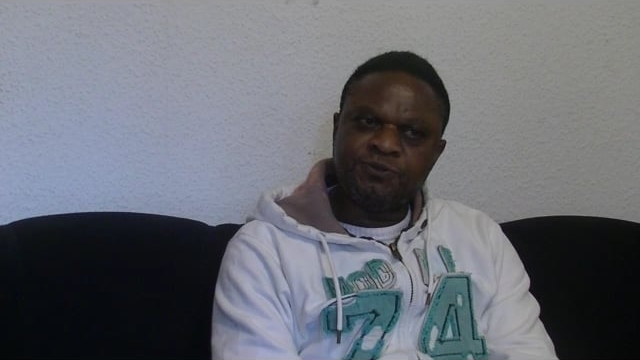
Country of origin: congo
Year of settlement: 1995
Age on arrival: 33
City: bochum
Gender: male
Language of the interview: French
[i] Well, we are in Bochum, in the Steinkuhl district. We received today [name] for our Specially Unknown project at the city of Bochum LWL museum. We have to interview him about his life here as an immigrant. And then, first, a greeting. [name], hello.
[r] Hello, [name]
[i] Thank you very much for coming to participate in our project, take your time, be available to come and participate. We welcome you.
[r] Thank you.
[i] Can you introduce yourself?
[r] My name is [name]. I was born in Congo, Kinshasa, June 10, 1962. I studied in Congo and went to university, precisely the law faculty in Congo. I worked for a year in a logging company, Makbwa, in Congo. I am married, father of three children. Anyway, now I’m in Germany.
[i] Thank you very much. You are in Germany. How did it happen that you arrived here in Germany? How was this done?
[r] In fact, it all started in the 1990s. There was the introduction of multipartyism and political pluralism in Congo, Zahir at the time. This situation has led to serious political uncertainties. There was looting. There have been human rights violations. So much so that I was in a situation of insecurity in Congo. And all that remained of me, is to leave the Congo. Faced with harassment to come outside and ask for asylum. It is for this reason that I came to Germany. Precisely around 1995.
[i] Thank you very much. You came in Germany. Which city did you arrive in?
[r] When I arrived in Germany. I came by plane. I went down to Frankfurt. And immediately, I presented myself before the immigration police. To request asylum. The police escorted me. Until Ingelheim. Which was a transit center for refugees. And there, they just asked for my identity. And the next day, they gave me a train ticket. To come to Düsseldorf. I showed up in Düsseldorf. At Bundesamt level. I had a little interview. Just to define my route. And to clarify my nationality. And my identity. And then afterwards, I was taken on a bus. I was taken into a boat. Where I spent two weeks in a boat. Waiting for an interview. At Bundesamt level. And subsequently, the Bundesamt Düsseldorf summoned me. For a preliminary interview. And I laid out the patterns. Who pushed me. To come in Germany. And then to ask Germany. I spoke about the persecution I experienced in the Congo. I spoke about the dangers I suffered in the Congo. And the fear I have in case I returned to Congo. Subsequently, I was moved to the boat level. I was taken to a reception center in Ginsburg. In fact, it is a transit center. Where we had to wait. To fix in one place, to the final city. Where we will live. And at the Ginsburg Welcome Center. I was spending two weeks. And at the end of two weeks. I was transferred to Bochum. It was precisely February 1995. But now you live in Wuppertal. How did it come about that you live in Wuppertal? When I arrived in Bochum we were immediately put in a center. Commonly called “Heim”. A center which was located on Hiltroper Strasse. In fact, they were containers. Where asylum seekers were placed. And for this purpose. I had to wait for the result of the Bundesamt. It happened that. Around 1996. The Bundesamt responded to my request for political asylum. But too bad. This request was rejected. At the Bundesamt level. That is to say at the level of the first instance. For this purpose. I had to file an appeal. At the level of the Gelsenkirchen administrative court. I submitted my appeal request. Near Gelsenkirchen. Within two weeks. As the law recommends. And I was assisted by a lawyer. This is where it was a real obstacle course. For simple reason. I had to wait five years to be summoned at the level of the Gelsenkirchen administrative court. To be heard on my appeal request. When I showed up in 2000 at the level of the Gelsenkirchen administrative court, It was said that. They examined my file. They followed. Clear and clear my defense. And I was given article 53. That’s to say. An article which defines that my political asylum was not accepted, but given the nature of the political activities that I carried out in Germany, this created an unreal fear of returning to the Congo. It was said that I was granted 7 stays. And. When I had 7 stays. I had the opportunity to change the city. Since. As we know. When you are an asylum seeker. Your movements are defined. In a region. Where you can’t move. And the goal of going to Wuppertal. Was motivated to look for a job. Since at the time. We were told that. As Wuppertal was close to Düsseldorf. Düsseldorf a big city. Wuppertal was close to Solingen and Remscheid. That several industries were located there. That there was the possibility of finding a job. It was said that around the 2000s I moved from Bochum to Wuppertal. It was a moment when my wife, who remained in Congo, joined me in Germany.
[i] Thank you very much. For this journey. What impression did you have? The first impression of the city of Wuppertal. And also from the city of Bochum. Because you have lived in Bochum for a long time. Yes, I lived in Bochum for a long time. Bochum in fact, for me, it’s a friendly city. It’s a city that interests me a lot. It’s a city that touched my heart. But despite that. I have had moments of difficulty. And moments of glory too. At the difficulty level. When I arrived in Bochum. First there was a voucher system. We were not paid cash. We were supposed to be given boxes of food. To eat and vouchers for it’s changing and getting clothes. It was a bit of a difficult situation. In the sense that we lacked liquidity. We were all stuck in the Heim. We didn’t have enough contacts. Some contacts we had the German community. It was contacts of circumstances. Or we met at demonstrations. And it was limited there. And through the wound for a little come out in this suffering. I had to work at Opel. A two-hour cleaning job. At the time we were paid 300 euros. But, I must admit that Bochum had a big impact on me. In the sense that we have undertaken many steps at the La Langria structure. Or sometimes we gave conferences To explain the problem of political asylum. To explain our suffering. And I also had other contacts firstly between African communities. But these contacts did not go very far. These were contacts which were limited to greetings and hellos. And there were also timid contacts with the German community. But these contacts were reduced only during demonstrations. Apart from demonstrations there were no contacts. SO. When I arrived. When I reported the city of Bochum, that I would like to settle in Wuppertal. One thing that stood out to me. The lady who worked at the immigration service. at Rathaus. Regretted. He told me. Mr [name] why are you leaving Bochum? But it was already too late. Since I had already made contact. With a real estate agency in Wuppertal. Where I was supposed to be housed. SO. When I arrived in Wuppertal. And afterwards, deep in my heart, I regretted leaving Bochum. Since I live. Suffering situations. Difficulties linked to integration. It’s almost similar. It’s almost the same thing. Whether in Wuppertal. Than in Bochum. But don’t mind. Although I am in Wuppertal. Bochum. Stay at heart. It’s my city of reference. My city is my favorite. And I have a lot of contacts. And I have a lot of African friends. And my nationality in Bochum. Which means that despite the fact that I am in Wuppertal. In conclusion. I still stay in touch with the African community in Bochum.
[i] Thank you very much. For all these details. We want to know. What are the barriers? That you had. Arriving here in Germany.
[r] First. The barrier to obtaining a stay. I had to wait 5 years to be regularized. And while I was not regularized. I didn’t have the right to work. In conclusion. I didn’t have a work permit. Only exception. I could work 2 hours of cleaning. And for that. Authorization from Arbeitsambt was required. The other barrier. In terms of language. Such. We were all disappointed Around Heim. We practically didn’t. No contact. With the German community. Our environment. Was only our African brothers. And our brothers coming from the same country. Which means that instead of speaking German. We were just talking. Our mother tongue. See even. Our dialects. The other barrier I experienced personally. I really wanted to learn German. When I was still young. But like back then. I had no papers. I didn’t have access has taught German. Since regulatory provisions. At that time. Stipulated clearly. Than to follow the German language. You must have recognized refugee status. This is what made it for 5 years. I hadn’t followed. I didn’t have time to follow diligently. The German language. But. He had another opportunity to learn the German language. Which required registration at the level of private education in fluent German. But all this was necessary. Personal financing. As. I wasn’t working. I didn’t have the ability to finance it myself. Current teaching in German. These are barriers that I have experienced. The second barrier also concerns employment. As I was seeking political asylum. Not holding a work permit. I didn’t have access to a job. All this put me in a situation of uncertainty. In a situation of precariousness such teaching. I didn’t have the slightest motivation to live and learn in Germany. Since we were in uncertainty. We don’t know tomorrow if we might be turned away. Or we can’t be turned away. So we were on alert. And we weren’t motivated to learn German. And all this was a great barrier to integration.
[i] Thank you very much. Before continuing. I would like you to make a comparison. The situation you experienced during the time you were asked for asylum. In the time that you had come in 1995. And the situation today. That’s to say. People who have just arrived now. I believe the laws have evolved. What’s the difference. According to the laws. Time passed. And today’s laws. On asylum seekers.
[r] Indeed there is a big difference. The young South Saharan generation seeking asylum. Actually started around the 90s. Precisely. With the events that happened in Russia. With the… the events that happened in Germany. The collapse of the Berlin Wall. There was. The multiparty system Congo. There were disturbances. Human rights violations. And many people moved to Germany. That’s to say. When we have to take the year 1990. Until 1900. 2000. I would say. 2010. Date on which. There was the war in Syria. We noticed with the excitement. of several Syrian refugees. The German government has changed the provisions relating to integration for asylum seekers. We. To do a comparative study. We, upon our arrival, When we are asylum seekers. First of all. You must live in Le Heim. The Heim. Which is actually the asylum house. And often these houses are located outside the city. Outside of the population. And for most cases. They were containers. And even on a psychological level. When. The Germans. That is to say the natives. Passed by. There was a way to locate. Look over there. Where asylum seekers live. That is to say, foreigners. We also had. A regional meeting. Where we couldn’t overtake. For example. If I live. In Bochum. I could only travel around Bochum. Herne, Castrop Essen. And see Dortmund. But to go to another corner like Wuppertal, Permission had to be requested. In case you don’t have permission. And that they arrested you there. You had to pay a Strafe [punishment]. And when we found ourselves seeking asylum. We didn’t have a work permit. We did not have free access to learning the language. But on the other hand. After the reforms that the German government made. On the arrival and granting of asylum seekers. Which is happening now. After three months. They have the right to a job. Subject to authorization from the Arbeitsamt. They have the right to a private home. They have the right to learn the language. It is clear that what is happening now has an advantage over integration. Since. While working. They have a country of means. They have the possibility of financing the lawyers’ fees. They have. the opening. SO. Bulk. I could say. We live. We lived through two periods. The period. Where there were no reforms. It was a difficult time. And the period. Where we made reforms. This is a time when. There is a small improvement in the living conditions of Germans. But to conclude. For us who arrived before. The conditions we lived in were detrimental to us. In the sense that. We lived for a long time with the understanding of being regularized. But while we were regularized our age had already changed. So what makes that. At the current stage. When we want to submit an application to find a good quality job. But considering how old we are. We have less chance of being accepted. Compared to younger competition. Thank you for your question.
[i] Thank you very much. It’s really regrettable. What you just said. And. I also wanted to go back a little to the impressions you spoke about. Cities. You have spoken. Printing. The welcome of the city. That is to say the authorities. NOW. The population. What impression do you have? Of the population. The street population. The neighbors.
[r] Yes. The street population. At first they were reserved. Since we have to confess. We are from the young South Saharan generation. It was practically difficult for the population. They were reserved around people I would say. In a pejorative way. Other colors.
[i] Black people, let’s say.
[r] Black people. And. It was difficult. Contacts were difficult. SO. It took us a long time to get the German population, learn our culture. But I would say. All this accelerated quickly with the birth of our children. Who were born here. And others who came at the age of adolescence. These children attend the same schools. Than German children. It is in this respect that German children must gradually understand. The culture and mentality of their friends. And to see broadly. The few Germans who are in contact with us, that is to say, the adults. The parents. It’s the Germans. Of which our children are friends. When there are sporadic visits their children come to us. Our children are going home. This is where little by little. There is a certain symbiosis between us with the Germans. However, these relationships remain mixed. At our level. We adults. And for our children we have noticed that they are more in harmony with their colleagues at school. Classmates. And they understood. That they are all equal. They are human. Or even. As far as I’m concerned. There are even German parents. Who ask my daughter to come to their house to teach to their children. Who don’t understand mathematics. Even German, Italian. All that other languages. So all that. It gave a certain opening to our children. And to ourselves. And little by little the Germans, the German community, must have understood our culture. Must have understood these people anyway, they are not stupid at all. How we were treated on time. But they understood. That there are even people who have studied.
[i] Thank you very much. For precision. You also talked about offers. Let’s say. Than during the period of years when you came. There were few offers. or almost nothing for asylum seekers. Even language classes. Even offers to work. Can’t you. Try to talk about offers. That is to say, what the city offered for the refugees. Something positive. Or there was almost nothing. Compared to today. Where we see language courses. There are houses. Orientation. There are really many offers for arriving refugees. That’s how it is. We can ask you. To still make a comparison. What did the city offer you. Let’s say. As a distraction. Or as a course. Or something social.
[r] Well there wasn’t much. But firstly at the level of small jobs. It turned out that if you were brave. You wanted to work. You could make a small request to the city. To work. To get a little job for €1. This is how we all found each other. We worked for a while in cleaning. Cemeteries. So general utility work. All this was to compensate. And to have a little something 200€. Since at the time we didn’t give money. There were a few organizations interested in immigrants. Who came on a voluntary basis. In Heims. I will cite for example. the organization of Langria. Who came to chat with us. And. Who asked us to move to the level of Langria. To do small cultural demonstrations. Sometimes we passed. We led choirs. But since there was no follow-up. All these initiatives were not moving forward. Since they were lucrative initiatives. They are organizations. Who organized such stories. Also at the Langendreer. Once they organized at the level of all immigrant communities. Everyone brings their own way of preparing food. Their diet. And all that allowed us. To compare the way we eat. The Turkish way of eating. Africans. Arabs. And all that.
[i] Thank you very much. You spoke twice about this Langendreer organization. First of all, what is Langendreer? The Langendreer district. And also if you can also first locate. The Langendreer district. Then this organization. You have an idea about that. You can explain to people so they can know.
[r] I have a fleeting idea about this organization. Too bad this organization was a temporary organization for a while. But for a certain time they decided to stop humanitarian activity. In fact Langendreer is an international café. Who had a vocation. To bring together all communities. Germans. Africans. And other regions. They could go there to have fun. To have a small glass of beer, Coke. At less price. Since there were cafes. Or practically for asylum seekers. It was difficult to access. Since they lack financial means. But this is how Langendreer created this structure to facilitate the least. To come and spend their time. Leisure.
[i] Thank you very much. You were in the Congo. You worked. You studied there. You had problems. You are moved to come to Germany. Before coming to Germany. You had an idea. Let’s say Germany. Like country. What idea do you have of Germany? When you were still in your country. According to history. According to geography. According to your general knowledge.
[r] According to my general knowledge. When I was in elementary school. We were always singing songs. Hitler said. I will not win the war. But I will.</> An earthquake. Oh my darling. What does it take to make you. Don’t cry. Because it will be war. This is the start. From our Lord. SO. Even when I was little. In history we were told about Hitler. Who fought the war. We were told that he wanted to dominate the world. And then. At the country level. The river Rhine. That’s what they were talking to us too. There was a river in Germany. Which was called the Rhine River. At the country level too. We only spoke German. It was a difficult language. Indeed difficult for us French speakers. Since it was a language of our Germano family. We reason with each other with our language, Roman. SO. I had a mixed impression about Germany. Because most South-Saharan immigrants, Francophones, initially aimed at France and then Belgium. Our colonizing country. But. When I arrived in Germany. I saw that the opportunities Germany offered were better. But on condition of being well integrated. And provided you master the language well. And I have to understand that language for me. And for so many others. It’s a real barrier for integration. Although having studied in the country. Although having a certain instructive culture. But not mastering the language. It’s totally difficult to face other barriers. Beyond that we can understand Germany well. We can talk well. current Germany. But technical Germany is really difficult for us. A generation that came of age in Germany. But unlike the generation of children of immigrants. Came as teenagers to Germany. And others born in Germany. Since. At the very level of reflections, we when we are asked a question in Germany. We have to first. We must first think in French to understand this question. But while our children who were born here. I would say they are Germans. When a question falls in Germany. They respond directly in Germany. But we have to do other gymnastics. We think first in our dialect. We understand this question. And then we respond. I must admit that the language. This is the very center, the great factor in the integration of an individual. And we missed a bit of luck at the time we came. If you don’t want to direct us directly. In effective training. On the German language. It could motivate us. And it could be productive for us. And now. It’s a bit difficult to learn German diligently. Given the stress we have. Considering how old we are. Seen a lot of occupations that we have.
[i] Thank you very much for the comparison. Good. You have an idea about Germany. You are in the country. Afterwards you have traveled. Let’s say you fled the country. To come and take refuge in Germany. What are. Is that the idea you have about Germany. It came true. Or what difference did you notice? On the idea you have about Germany. And the German reality. That you found there.
[r] The idea that. .. We had on Germany. That they are bad guys. They are complicated people. Who doesn’t like people. But when I got here. It’s not the same idea. I noticed that they were normal people. Courteous. And then. To paraphrase. When we do a comparative study. We ourselves understood too. Germany has experienced several immigrations. There is Turkish immigration. Greek. Portuguese. Polish. And that’s a personal reflection. For us Africans. We understood that when we were face to face. At the administrative level. With a real German strains. They have another courtesy behavior. But when you find yourself in front of a naturalized German. That is to say Greek, Austrian. Polish. Who are in the administration. They have a bit of a wary spirit. Compared with. I would tell the black man. That’s a technical observation. That we noticed. So like Germany. At first we didn’t stand out. Which is true German stock. Who is a real German? naturalized. Since in this structure from Germany. There are even German Russians. But overall the real German. They are curious people. Nice. Gentiles. Who are interested in knowing the culture of the black community. But I bring a caveat to these facts. This is where we find ourselves in regions. Since I had the opportunity to visit East Germany. The city of Leipzig. From Zwickau. From Gronau. But here we see that they are a little reluctant. Compared with. To the black man. In such a scene I once found myself in Leipzig. I was lost. And I had to ask a German woman for the address. Being to call it. She said no no no. She left. So I was surprised. And then I was amazed. But overall. We don’t have anything. Life is a fight. I think it’s us through our organizations. We must make an effort to make the Germans learn and understand. Our values. And our culture. Hence the importance of such an initiative.
[i] Thank you very much. You have life experience here. For many years already. If we count. Since 1995. Until today. It’s been almost 25 years. SO. If we ask you. What is typically German? What can you tell people. If you may be traveling to Congo or in other African countries. People who have never had contact with the Germans. What is typically German? What can you answer them?
[r] What I noticed. Which is typically German. It’s nationalism. The love they have for their homeland. Whatever their ideological differences at the level of political parties. But when the German’s interest is there. You see the old, the young united around their flag. Which symbolizes their value. And their identity. This is what I noticed positive about the German. And all this even translated into leisure time. When the German the German national team is playing. We see the interconnection of an entire nation. So I understood that they are a determined people. Concerned about his nation. Concerned about his nationality. And it all depends on their story. When I have to do even a comparative study on the granting of nationalities to the Germans. And they advocate. What we call blood law. While other nations like France. And advocate land rights. At the beginning to be German, you have to have a child with a German. The child there is German. That’s to say. What we call blood law. But well after. There have been reforms. In terms of provisions related to the granting of nationality. Reforms. This is what every child born here looks like. Who never returned to his country of origin. Whose father immigrated. has an indefinite stay in Germany full 8 years to acquire German nationality. These were all reforms. I would say that. For the Germans what I pray for is their identity. Compared to us Africans. We Africans are lax. When it comes to protecting our values. And our identities. And what I also understood as the German politician. He works for the interest of his country. The interest of his city. And what I also saw was positive. German federalism. It is truly a model or even the African country can complain about it. To ensure development. Since each German fights for his city. Fight for the emergence of his city. This is the point of difference that I see with us Africans. We have sold our culture. We sold our values. We make no effort to revalorize our seas. To explain to others. our identities.
[i] Thank you very much. As you spoke. Also talking about the city. As you talked about federalism. That is to say in Germany. The country is divided into states. And each state tries to develop in its own way. This was also reflected in cities. Every city is also trying to develop. Some factors. Like you just said. Developments. Each point develops. What if all points develop. That’s to say. Everything is developing. Compared to many of our countries. Where everything is centralized in the capital. The countries are very big. And nothing works. You are in your city Bochum or Wuppertal. You can speak. From your neighborhood in Bochum. Where you lived. And this neighborhood. What did this mean to you?
[r] At Bochum, I lived in 3 neighborhoods. When I arrived as an asylum seeker I was in Hilltrop. Precisely on Hiltroper Strasse. It’s a neighborhood. Where we were it was remote. There was less contact. We were in a container. Who was isolated. And from there I came to the Querenburg district. Always in a soul. But what I noticed. Querenburg district. It was a university town. And there too. We had less contact with students. We were in our building in Heim. And after Querenburg. I went to the Weitmar neighborhoods, on Hattinger Strasse I noticed in all these neighborhoods there is self-esteem. In this sense. That. We are at home. We don’t even know the neighbors. And sometimes even the Nachbar, the most immediate neighbors. We only believe ourselves when we open the door. Just a quick hello. SO. Everyone lives at home. And when we do a comparative study with our cities in Africa. There is a different fact. Since our neighbors in Africa, I would say, they are even brothers. You even know the identity of your neighbors. You even know the identity of the people on your avenue. You even know their origins. And you have permanent contact. You can go to the neighbor’s house ask for something you’re missing. And even see you can even go and sleep at the neighbor’s house. So when we briefly do a comparative study. In all the neighborhoods I have lived in Germany. It was a withdrawal into oneself. While at the level of Africa. These are areas of wide openings.
[i] You have described your dwellings here at Bochum. You started in a camp. With containers. And then afterwards in a home. Until arriving at a private house. Can you describe. How do refugees. Which arrive in your period. were housed. How were they housed?
[r] In our period, when you arrive, you have the status of political asylum seeker. You are staying at the hostel. Which can be a container. Or a habitat. But… A housing arrangement located away from the population. And when you are recognized as a political refugee, you are given the opportunity to look for a private apartment. But there too. This posed a problem of discrimination. I would say. It was also a bit difficult to find a decent apartment. Good conditions. Since most. When you show up. To look for an apartment. We ask you for a pay slip. If you work. On the other hand. When you say no. I don’t work. But it is the social worker who must pay for the apartment. Most of the lessors did not accept this provision. And what makes the refugee recognized. Though. Being authorized to occupy a private apartment. Occupy apartments which were not of the required standards at the beginning. And what follows. If for example. You got to work. To find a job. Who can change their address? And find a decent apartment.
[i] Maybe you can. Someone who has never lived in containers. Explain how these containers are organized. For people to live in it.
[r] Oh yes. This is a very important question. Since in language we always see containers. But we don’t know under what conditions. We were housed in the containers. In fact, a container was a room. It’s a room. Where there was a small space. Where we put a stove to prepare. And then on the other side. There was the sanitary facility. And then a shower. SO. In the small bedroom there were bunk beds. And often four people were accommodated in the room. With bunk beds. Two on the other side. And then two on the other side. Which meant that when I arrived we were single. Four adults. We stayed in a small room. Four people with two bunk beds. SO. Those who constituted a family. They were also housed in a container. With bunk beds. But in fact there was no lounge you enter directly. You find yourself in front of the bunk bed. And that’s it.
[i] And in the Le Heim home. How people are housed in the Heim in general.
[r] Generally in the Heim you also have single rooms. But you share a single kitchen for all residents. Residents remaining in the same level of the building. And you also share the same sanitary facility. The only difference. Let everyone occupy their room. But to go to the sanitary facilities. You use a common sanitary facility. And for cooking you use a common kitchen.
[i] Thank you very much. And leisure activities have rare periods from ’95 to ’96. Or someone who had just arrived. A Congolese who has just arrived. Who requested asylum. He is housed. Somewhere to wait for the response to his request. How does he distract himself. Like you said. There were no language courses. There was no way to go far. How do people distract themselves in general?
[r] Yes it was practically difficult. In the morning we woke up. We always stayed within the Heim compound. We moved around and brought chairs outside. We were chatting. If we have time we go into town for a bit. We travel. And then on the way back we enter the Heim. But I must point out. That it was a situation that was so difficult. For simple reason. We were short of work. We stayed all day in the enclosure of the Heim. And this situation created a… an beginning of criminality. For people who were a little weaker. At this point we wondered why we were all crossed paths. On the same speaker without any activity. And what makes that. There were malicious words. There were exchanges of malicious words. And there were also people who were weak-minded and had means. Who were committing acts of vandalism. Others even stole. And by ricochet. The German community made fun of asylum seekers looking at all these people who are there. All they know is to sleep, drink and then steal. In fact it is a provision which could also allow a certain amount of criminality. Due to lack of occupation, people came from the churches. SO. We were summarizing. Everything that we were given like a box of food to eat. And some good ones. That we had. This is to trade for cans of beer. And when we have to make a statistic on 100%. 20% of people who have adapted. Those who resisted this situation fell into banditry, into acts of vandalism. In mediocrity. And this situation we wonder on a philosophical level. If it wasn’t a deliberate situation. That is to say dragging someone around for 5 years. In a precarious situation. Without processing his file. And when that person fell in a situation of vandalism. He was going to prison. And his criminal record was… He had a problem of judicial failure. And then we no longer gave stays. When he had to go to court. The first action we watched. You, you have committed crimes. You stole. We directly rejected his file. Around the 90s. In such a sign, around the 90s, With changes to the provisions of the Schengen agreements. Or at the European level. We have asked Germany to try to regularize a little. The situation of immigrants, long dates. Because when we arrived there were other Turks. Who have been 25 years, 20 years. Who didn’t have a stay. Deregularize their situation. Compared, when we have to do a comparative study in other countries. France had to grant stays to long-term immigrants. Who had children there. And Germany also applied this law. By creating a provision called Article 53. That is to say humanitarian stays. SO. Which implies that the people who benefited from humanitarian stays. Were only rated at 30%. For simple reasons, most of them are broken in court were already tainted by a certain irregularity linked to acts of theft and vandalism. So in conclusion. Making people drag on for 5 years without processing their case. It was also basically implicit. Banditry. And then acts of vandalism.
[i] And you as an intellectual. You studied in Congo. You came here, still young and intellectual. How are you spending your time during this period. Like you almost don’t. The right to do many things.
[r] For me. I read a little. And then. I followed the political developments in my country. And yet I tried a little to introduce my academic files here. But it was a bit complicated. Since it was necessary to do what we call equivalence. As you understand. The German education system. And the education system. Congolese. It’s not the same thing. And the major obstacle I found myself facing it was also the language. Because even when you want to study you have to speak well. And then write the language well. For me I make an effort to bring my community together. And then the South-Saharan African community. By holding small conferences under the aegis of the language association. And we gave several conferences in German. Precisely in Bochum. A case of 75. conferences. But the big problem at the level of motivation Our community South-Saharan African. They became discouraged. Since they saw that during our conferences there was no follow-up. In terms of the German environment. Many people became discouraged. But I must also admit that with I awaken prayer groups, which is a postulate linked to religion according to our mayors. According to our uses and customs. Many South-Saharan immigrants were more interested to religion. To religious activities. And neglected cultural activities. Which was to define our identity. And which was to establish our postulate linked to integration. But anyway. We are not discouraged. We will make an effort to relaunch initiatives to promote our culture. And to understand the culture of the host country.
[i] Thank you very much. I would like to know what themes you deal with during your conferences. You are focused in one direction. Or in different directions.
[r] During our conferences we were all, we were practically focused around political themes. And precisely on themes linked to political asylum. And to the mechanism, which could allow us to be integrated. And then to get a stay in Germany.
[i] Does this compare with the lives of asylum seekers in other countries France, Belgium or England or Canada. Here in Germany, haven’t there been demands from asylum seekers? So that there is a change in procedures. Which were a little too harsh for asylum seekers.
[r] Yes indeed we have made real demands. First for the circulation of good packet systems. We took walks. We were received at the time by the mayor of the city of Bochum. To ask that we can eliminate this food voucher system. And we have raised as fair caution the city of Wuppertal. Who was the first at the time to abolish this voucher system. It was said why Bochum could not copy this provision. And there we won our case. And also in relation to Germany there were demonstrations. to ask the city to eliminate the container system. Actually. All these containers were containers made in Holland. Which we installed here. Everything went well. And the German government had to withdraw the container system. To place the asylum seeker in Heim habitations. We now also have a process. We have to admit with the green and the grune. With the arrival of SPD in power. For regularization. Regarding Article 53. Since we must be sincere, this SPD student. At the time of the CDU this provision did not exist. When the SPD arrived. With the help of a few Germans. He had a group created in Hannover. Which we called Caravan. We organized marches. And we also wrote petitions. Uh. I have a case. Which we dealt with at Bochum level. A case of a family. That I’m not going to say the name. For security reasons. Since I don’t have the authority to ask for his permission. He had a family Congolese in Bochum. They were, They had five children. They have exhausted all political asylum procedures. Even at the level of cassations. They were ordered to leave the territory. This family was discouraged with children. Who were at school. We contacted Langendreer’s organization. The Langendreer organization gave us the direction to write a letter to the foundation chaired by Madame Kohl. Who was the former chancellor. We tried, we wrote a letter. Mrs. Kohl acknowledged receipt. And he mentioned in his letter that he respected the principle of separation of power. Who could not join a decision taken by the administrative criminal authorities. But He recommended it to the minister and president. He asked, He complied with the minister and president of our state of North-Westfalen. Responsible from the inside to try a little to examine the situation of this family. And while he wrote this letter, it allowed the family to stay in Germany for many more years. The minister acknowledged receipt. He asked the city of Wuppertal to take action. No, not to give the stay to this family. But to cancel this order of repression. And at the same time when the law on regularization came. That is to say asking all families having totaled more than 7 years in Germany. To look for a job. And then to ask for and obtain asylum. And to get humanitarian stay. This family benefited from the humanitarian stay. All this falls within the framework of the activities that we were doing at the time in England. And another case also happened to us for another Congolese family. This family benefited from humanitarian stay arrangements. But the city of Wuppertal refused to give them this provision. For simple reason the document they had presented testing their marriage. It was a false document. So the city did not recognize it. That they were married. So this provision said that you have to be according to the city. You have to be married. And we contacted lawyers. Lawyers have interpreted the law broadly. They said no. Even if we refuse to give you two days. But you. You can get a stay since you are the legitimate father of these children. This law doesn’t just say that you have to have a wife at home. But you can also be a dad to your children. You also have the right to this stay. It’s like you can be a woman alone. But you have children. You are also a family. So what makes that. Even single women. We say beneficiaries. You must also give the stay. Even to single women who are not married. So it wasn’t just about being married. So it’s among. Activities that we did in Bochum. But we must also admit it is the technical plan. We also experienced another discouragement while doing activities. There was also friends of our community. Which discouraged us. In everything we did. And then as we did not have the political experience in the matter we withdrew. There was no follow-up in this alternative. This is what causes the delay that we experienced during I would say practically 18 years of inactivity.
[i] It’s all really touching. Your story. I believe that the people who will follow this. It will also affect them. We have two cultures. Congo and Germany. Or Africa in general. We arrive in a country. We are from the roots of our culture. But we want to find our culture in this country. Do you still have to find the culture of Congo here? Or music, the language, the traditions.
[r] Yes. The culture of Congo. We had the initiatives in terms of songs. At the time, we created a small religious choir. Too bad this choir no longer existed. We created. We also had the idea to create a small orchestra. For Congolese cultural songs. And it’s a shame that this orchestra also no longer existed. We had to live the culture according to our food tradition. And what is very important, very significant. When we had children. Who had. Who have reached the age of majority. That’s to say. The children had to get married, we were faced with two scenarios. When our children married among themselves from the same community. We applied the marriage rites according to our cultures. What we call dowry. That’s to say. In our traditions it is the man who marries the woman. And the wife’s family gives a certain list of property that the husband must give. And in our cultures marriage does not take place between individuals. As it happens in our German cultures. We in our cultures marriage is between families. That’s to say. Family X marries family Y. And in our cultures. It has great importance. In the sense that divorces are a bit lesser. And divorce occurs only in case of frequency. In case of loyalty. Since the two people who get married do not have joy in signing their divorce. In all their freedom. They must also ask for the woman of the family. Since they are the two who are married. This is when we celebrate the marriage between our children from the same community. But like our children were born here. Are teenagers. And the marriage system breeds a certain freedom. It turns out that our children are also with Germans. There. We are faced with two cultures. Regarding marriages, German culture and then African culture. And there we create a certain symbiosis. And as you know in German habits and customs. The system of others did not exist. We’re getting married. We leave at the Rathaus. We’re getting married. If you are a Christian. We return to the level of the church. Whereas in our cultures marriage is on three levels. What we first call customary marriages. And what we call civil marriage. And then the religious marriage. But in terms of positive law. Civil marriage takes precedence in the event of conflict. So that’s it. The difference. between two cultures. For German culture. Civil marriages and religious marriages. For us South Saharan Africans. We have three forms of marriage. Firstly, customary marriages. And then civil marriages. And then religious weddings.
[i] Thank you very much. As you have now spoken a little about marriage in your country of Congo. We have talked enough about Germany. We also want to talk a little about your country of Congo. There you spent more than 20 years, I believe, of your life. Talk a little about Congo. You left the Congo. You are detained in a foreign country. You have given up a lot of things. Do you have a memory? You brought a souvenir from Congo. Any memory. Or an object or else. A piece of music. Or anything. Which reminds you of your country.
[r] Yes. I… I brought it back into me. A status of the Congo. Since the artist Congo. Congolese were defined by statutes. We, in our time, our ancestors knew God. But this God was represented by a status. Whom they called Nzambi Ampungu. In fact we have our own ideas about religion. Religion as it is defined today. It was the West that brought us this religion. And when the West came. He told us no. You must burn all your statuses. Throw away your statutes. In fact the statutes represented our culture. Even in our tribes. A tribe was defined perhaps there is a status which defines a tribe. Even our ancestors. In their design perhaps to protect their families. Their bloodlines. They had a little statue. Or sometimes they invoked. Or sometimes they prayed. To protect their bloodlines, their families. But when we suffered colonization. The first step that the colonist did. It is to take our statutes. And the height of misery. It’s the same statuses that we took. They came to put this in museums here in Europe. Actually. Coming with these statuses. It is a modern statue. Which I brought. Since there are two kinds of status. There are ancient statutes. And then the modern statutes. It was for me a way to have memories of my country. From the beekeeping of my country. I also brought a little note. A memory of my grandmother. Who gave me. Because my grandmother he was He didn’t know. But he made hooks with little notes. I had to tell him the name. To write the martial bar. That’s what I brought to myself. That’s what a cultural memory is. That I have for myself. But as an intellectual. I also have a lot of memories about my country. Memories coming here. It allowed me to think. And then an analysis. First of all. How we Africans. We are considered throughout the world. We South-Saharan Africans. We have experienced several painful events. We started. Because historians call it the slave trade. We were considered. Like objects they took from us. We were tied up. As slaves. We were sold in the markets of Zanzibar. To be transported to America. It was around the fourteenth century. We Africans, we have experienced colonization. Colonization brought us to the point that all our wealth should benefit the colonist. We South-Saharan Africans. We were given independence from the facades. In the meantime. The same settler giving us independence. Kept the economic and financial systems imposed on us the political regime. The form of multipartyism was imposed on us. And imposed on us the form of the state. As you know. Africa has been carved up. Not taking into account of our ethnic groups. Of our kingdoms. But we were separated taking into account their interests. I will give the example of Ghana and Nigeria. The northern part of Ghana and Nigeria. It’s simply the same people. No. Ghana and Togo. But we separated them. By taking advantage of their interests. By creating states. I also spoke about myself. Congo, Zaire. There is what is called the Congo kingdom. The Congo kingdom which contained part of the Congo. Zaire. Part of Angola. And part of the Congo-Blaza. All this constituted a kingdom. But when the white man came. He separated us. We find our brothers who are in Angola. We find our brothers. Who are in Congo-Blaza. And other brothers. Who are in Congo-Kinshasa. And. When we look at the sociological level. A Congo of the Congo. Feels closer with a Congo. A Nyanga. Who is from Congo-Blaza. Then it’s the same people. He is closer than a Muluba. And only a Swahili. Who belonged in another kingdom. Kingdom Lunda. Then he had other kingdoms. And there. And all that. The white man in colonization. Uprooted us from our worth. We introduce into a system. Where we no longer adapt. Dictatorships were imposed on us. And all these dictatorships were financed by the West. At the time around the 60s. When a African Sydsarian came to ask for asylum. He was directly granted asylum. Since at that time it was necessary to let dictatorships reign, steal at the expense of the West. But with the fall of Berlin we were introduced to multi-partyism. Where we find ourselves in a situation of change. Of non-adaptation. We don’t understand the future. What will happen in our countries? In conclusion. It’s all these memories. Which I have. Because I lived under an authoritarian regime. I experienced the beginning of the multiparty system. And I am experiencing everything that we see as a political crisis. As delinquency of our country.
[i] As you talk about your family before we continue. Can’t you talk about your family here in Germany.
[r] I arrived alone in the year 2000. My wife was also in a situation of insecurity. in the Congo. My region and automatically also as Bundesamt. Knew the atrocities my wife experienced. We adjusted my wife’s speed. I had three children in Germany. And the first child. She had a temporary stay. When she reached the age of 7. The immigration office summoned us. And the city of Wuppertal asked us that the girl chooses to obtain German citizenship. Or to stay with Congolese nationality. We are faced with a difficulty in maintaining German nationality. This was a great obstacle to education. For the education of our children. Since there are school holidays. There is funding. We accepted. That our daughter in Wuppertal accepts. And German nationality. And we did the procedure. She declined his Congolese nationality. To take German nationality. So in terms of my family Me and my wife are Congolese. Me. I am a political refugee. With an indefinite status. My wife renounced this political refugee status. To resume his Congolese nationality. With indefinite status. So my wife is Congolese. For an indefinite period. But our children are German. Our children began their schooling at kindergarten level. So for the children. For the eldest it was a bit difficult. When she started primary school age. It was an adjustment problem and she didn’t adapt with her teacher. And as a reminder, I had contact with the teachers, I had contact with their director. We understood that her mistress had other prejudices regarding my daughter. And God helping, this mother teacher, mistress, had her retirement. There was another young person who came and my child adapted well. Which means that when he finished his Grundschule, he was obliged to go to the Gesamt-Schule. At the Gesamt-Schule level, my child’s intelligence opened up. She was shy, but it opened. And we had good contact with the teacher. And my child always had grades 1 or 2. Which means that when they made their Abschluss, Gymnasium Gesamt-Schule in Wuppertal, I repeat, which came out last year among the awards Nobel Prize for the best Gesamt-Schule in Germany, asked my child to continue to make Abitur. And my wife and child are preparing the Abitur for next year. And everything is going very well. The second of the children is there, I would even say he is a genius. From a young age, he was curious. He taught himself the German language at home. Since she started her studies, she is always first or second in the class. She was automatically directed to the Gymnasium level. And at the Gymnasium level of Sonakode, she has a heavy responsibility, since apart from his teachings, he gives lessons to other students who have a certain difficulty in mathematics, German, French, Latin. And for this, the parent of his students gives him 10 euros per hour. That is to say, he has 5 children every year who he has to take to school. And the last one experienced language difficulties. He had to undergo some therapy, since he had a problem adapting. Me, with my wife, we speak Lingala. We, with the children, we speak French. The children, among themselves, they speak German. So when she was born, she had problems adapting to several languages spoken at home. But for a while now, she has regained courage and she has good grades at Gymnasium level. So, after analysis, after reflection on the evolution of our children in Germany, I thought about it and came to a conclusion. There are two categories of parents. Since I understood that children only follow the example of their parents. When you are at home, if your child observes you, he looks at daddy, everything he does, it’s dancing, it’s following the theater, the child will also continue to follow the theater. But when the child observes, look at daddy when he comes, he is reading a book, he is in front of the computer, the child also struggles to read the books, to go to the library herself, to ask daddy, daddy, daddy, buy me tablets, laptops. And that, what I understood at the level of our community, we must confess with pride, there are children who have succeeded. In Wuppertal, we are very proud to see a child graduate as a doctor. Despite this child, her father died, the mother made an effort to support her daughter well. This girl is a doctor. At the level of Lippstadt, I saw a child of Angolan origin who worked in a Renault dealership, like Berater. He completed higher studies in automotive management. So, all of this, despite our parents, I would say that we failed in terms of adaptation. But we rejoiced a little, we are proud when we see that the children we brought, the children who were born here, give us value and make us proud in their education and then in their instruction. And when we find ourselves in parent meetings, we are proud. But in addition to that, we have another category of children who require a certain amount of monitoring, some supervision. With the ease, the libertinage that German society gives, these children did not take advantage of this educational opportunity, I would say almost free, have fallen into vandalism. And on that front, as parents, I would say that, in percentage terms, Error and fault reward parents first, 70% of faults, and 30% to children. Since an African, South-Saharan parent, in difficult conditions that we find, will have to fight to assume our integration and to be accepted by the host community.
[i] What message can you give to the German authorities by comparing your journey from the beginning? You talked a lot about inaction, inactivity for many years which meant that many people had papers as they got older and then the job market became difficult for them. So what is the first message you can give to the authorities for this situation? and the known case for asylum seekers of your time?
[r] I will give as recommendation as Council Observations of the German Authorities at first, I think to first support structures who fight for supervision and for integration immigrants, to support them and give them the means. I will also recommend to the German authorities to organize seminars cultural and which will allow us to be in symbiosis, to know each other better and live better together. I will also ask the German authorities to support immigrants and to offer them the opportunity for training. Those who have the will, the opportunity to follow an education and to support them in finding jobs adequate, noble which will allow them to ensure their meeting. And I will not fail to give a recommendation also to our community to reflect, to support us, to make an effort to promote structures that exist, that fight for the integration of African citizens in our society. And I will also tell my compatriots of the community to always keep hope despite the difficulties since it is we who must promote our values. And I will always tell our young people born here to always aim for excellence. Since there are more complications, more difficulties, but when you are excellent, who is excellent, whether injustices, It’s difficult to downgrade. That is to say, they must always aim the first, not aiming for the last.
[i] And for the emigrants who have just arrived, we see the scourge of the emigrants who come, Africans and Arabs, like many other countries who sometimes cross the desert or the sea to arrive and then they are welcomed. And they’re welcomed into the culture here, all that. What is the advice as an elder, someone who has lived through difficult times, someone who has seen many generations, what can you advise them for their future here in Germany, especially in Europe in general?
[r] Yes, I make an observation for practically South-Saharan refugees who come here who cross through Libya who come. I would say they are lost. They are lost in the sense that they arrive in a corner where they are unable to better motivate their asylum request. For simple reason, some structures exist, but these immigrants, when they arrive, they do not come into contact with other structures that exist to guide them, for advice. Which means that out of 90% of the analyzes that I have done, on some immigrants I met, we often meet immigrants seeking asylum, when their files are disgusted, and it is impossible to appeal. I will ask them, when they come to a corner, firstly, they must integrate into structures like this that exist, for advice and guidance, to see to what extent we can give them a lawyer. I see that these immigrants have serious problems, although others have a work permit, others have been hired, but these people have precarious stays. They arrive at their work, we tell them we are cutting your contract, go and regulate your stay first. As soon as we give you a three-month stay, you finally come, you won’t stay to work again. So their employment contract, it depends on their stay. And it doesn’t exceed six months. And most, what I noticed, their asylum was rejected. They are at the level of cassation. As we know, the cassation does not analyze the funds on the asylum request, only analyzes the form, to see if the law has been respected. Or I would say, 90% will not obtain asylum. Perhaps they may struggle regarding obtaining humanitarian stay. And there too, there is a big problem. It all depends on the city. Since the German government gives extensions and full power to cities to interpret article 51. There are cities that are rigorous, who did not give article 51. I will speak for towns that I know like Solingen, like Remscheid, where there is actually work, where the applicant seeking political asylum actually works. But in the end, they were dismissed. So that’s the big difficulty. There needs to be a lot of consultation. We need studies between the city and NGOs who deal with the problem of immigration to see to what extent they can regularize and integrate immigration problems. And this scourge becomes so difficult since we have done an analysis and understood all these immigrants, most of them come from Eritrea and the Sahel, Mali, Senegal, at the beginning did not come to Europe. They stopped at Libya. But with the Libyan war, the collapse of the Libyan state, instead of staying in Libya where they were good, they worked, they took care of their lives, they didn’t need to come to Europe, now they are crossing through Italy to come here. So the effect of the war in Libya led to collateral facts on the flow of immigrants in Europe and precisely in Germany. And second fact, the war in Syria brought collateral facts on the presence of immigrants here in Germany.
[i] To conclude, you are Congolese and then we know that the people who flee the Congo because of the dictatorship are a loss for the country since they are living forces who should have served for the country. We all know that. If we were in the country, we would play a role in the development of our countries. So, what is the message that you can give to the Congolese authorities in particular in Africa in general for their policy of dictatorship, their policy of non-occupation of youth in particular?
[r] I would say to the Congolese authorities first he had to use immigration first Congolese and African. Because immigration is actually wealth. When we look for example at the Israelis and the Greeks it is immigrants who have returned who are building this country. It is for this reason that I would tell the Congolese authorities to make an effort to get in touch with immigrants but to create structures which could allow immigrants to be placed once they return to Congo to work to give their expertise at the country level. As we have pointed out, there are two kinds of immigrants. There are immigrants who came from student immigrants. There are political refugee immigrants. As far as student immigrants are concerned, they are brains. It is one of the riches. This is one of the riches of the big technologies which are rotting here and in Europe. They must make an effort to copy the example of the Somali and Ethiopian authorities who have created frameworks and structures to bring back the children of immigrants who studied here. And I would tell the Congolese authorities to work for the country. To be nationalists. What I understand for the Congolese authorities is that they sign contracts and work for their own family. But here in Germany we see the authorities working for their city. I will give an example case for the city of Wuppertal. There was a well-loved SPD mayor. But once he arrived at the market without calling for tenders. But these are the members of his party themselves. He said no. What you did was not right. We are withdrawing your trust. The German authorities, if they can encourage through the projects they have in Africa to interest the student immigration which is here to play the bridge. This will be a real victory for integration. Since at the diaspora level we have everything. We have all the elite in all areas. And for the Congolese state it is a waste, as a German named [name] told me. He told me the Congolese took his children to Europe. They studied. Others were on scholarships, others were not on scholarships. Instead of returning to serve their country, these children stay here as immigrants. It is a total loss for the country.
[i] Thank you very much. I have no more questions. If you have a last word to say you can do so.
[r] I thank you for the initiative and I thank the organization. And I hope that such initiatives can be punctual and more continuous. I hope that despite our problems and then our difficulties that we take courage since we have the experience at a certain moment even ourselves we had a lot of courage but at a certain point we became discouraged. But discouragement is weak language. The fight must continue. To our South-Saharan African brothers it all depends on ourselves. If we want to be considered be proud it all depends on ourselves how we will behave. To the youth of the diaspora, children born here studied here. I cry for them because these children have acquired great technology, great intelligence, but these children with the disorder that is happening in our country, these children who were supposed to serve the development of Africa with the knowledge acquired outside I have the impression they will not do so they will not be useful. So these are the brains that Africa should use for its development. Thank you.
[i] It is I who thank you, Mr. [name].


