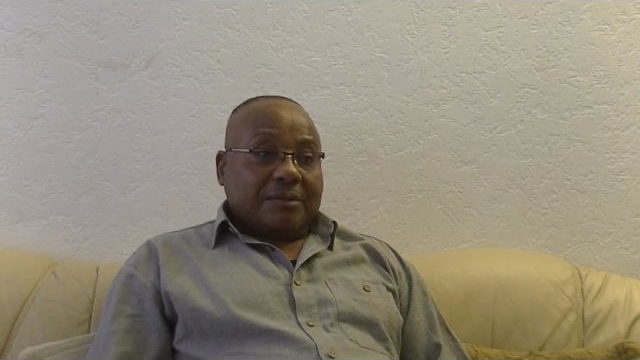
Country of origin: congo
Year of settlement: 1995
Age on arrival: 36
City: bochum
Gender: male
Language of the interview: Lingala
[i] Hello Mr. [Name], we are here with Mr [name] in Bochum Hamme, we are conducting an interview with him for our project the Bochum Museum, the Hanover colliery. We thank him very much for agreeing to take part in our project today. We greet you, Mr. [Name].
[r] Hello!
[i] Thank you very much. Like I just said, we will talk a lot about our city Bochum. We will ask you What was your arrival in Bochum like? How did you end up in Bochum? Why didn’t you end up in another city?
[r] I came here to Bochum, because I liked the city. That’s why I came here, to live here. I followed relatives who have lived here for a long time. That’s why I live here. With the people I live in the same part of town […] If you live on the same street as Turks, the Turks don’t have a good heart. They think this land belongs to them. That’s why our relationship isn’t that good. Each person is busy with their own projects. We don’t visit each other, we don’t even greet each other. Everyone stays in their apartment. That’s how we live here in Bochum. Other relatives live a little further away, We sometimes meet at the authorities, or when you If you have time, you can visit and chat. If you have time, you can visit relatives. We’ll talk there and then you can come back to yourself. That’s how things are with us.
[i] Thank you for your answer. you said that you live here with other nationalities, with Turks. Except the Turks, what other nationalities are there? live near you or who live in your district?
[r] There are people in my district, lots of people. We have Cameroonians, we have the […] We have people from other countries. We have white people from other countries who have recently arrived. People who came from Syria who have come. They have moved into the apartments that are nearby. There are people who live with us.
[i] How many years have you lived in Bochum?
[r] I have lived in Bochum for five years. […]
[i] You have been in Bochum for five years, now when we, when you came here, what difficulties did you have here? If we look at the offices or visits from doctors or visits from lawyers. What difficulties did you encounter in the city of Bochum?
[r] When I came here, I didn’t have any difficulty. I worked where I came from. When I came here, the people who welcomed me they then accompanied me to the authorities, so that I could be registered. [a telephone rings] I should register after […] then. [the phone keeps ringing] I had to be registered at the town hall. I was registered there, they had the address taken from the acquaintance where I went. The owner’s address, after that she accepted. I have returned. Then we had to go to the job center. Then we went to the job center. The pay slips were queried in the job center. I brought my pay slips with me. During this time I was still editing. I was then registered. I was done with the job center steps. Then she gave me permission to look for an apartment. I then looked for the apartment. I stayed for some time. Then I looked for work in Bochum. Then I started working. Then the work was over because the orders became fewer. We had to stay at home and if the orders increase again, we would be called. But unfortunately we didn’t get a call. Then the illness I have became become serious. My sugar levels got higher. Sugar, High blood pressure and other diseases. Because of this I was forced to stay at home and could no longer work. I was sent to the state doctors, I was examined there. Afterwards I was told that I can no longer work. That’s why I stay here, just like that, I sit the whole time. From the doctors’ side and doctors there was no problem. I go there regularly and I am treated well. After the treatment I stay at home. There is not a single problem.
[i] You said that They came and took their first steps in the community. We know that people speak a different language here. They are from the Congo and other languages are also spoken there. How did you talk to the people who are here?
[r] I was able to talk to them because I was in the German language course first. I learned and I also understand some German. I spoke a little. I took someone there with me who speaks better German. He translated words, partial conversations, things that I didn’t understand for me. He had hers too explained what I had said. Sometimes he asked me if I understood what was being said. I replied that I understood. He asked me to answer If something was missing from the answer, he added it.
[i] Thank you! You talked about the language course here. Can you tell us how the language course was organized here, that you had visited. How many months or years did you take the language course? Please try to explain that.
[r] I have the German course first in the city of Oldenburg, where I completed level A1. I had been doing this for a few months, but I forgot exactly how many months it was. I completed and I got a certificate. When I came to Bochum, I was sent back to school so that I could do level B1. I attended school to do level B1. After a few months I often got sick. I often had headaches in class. In class, when I wanted to concentrate on the lesson, I often had headaches I was sweating profusely. Because of this The doctor said I could stay at home. I can no longer go to school. That’s why I stayed home. Then they called me again to continue. That was in another school. I was able to continue school there. But unfortunately there was the same reaction. I’m about there two or three months then I dropped out of the course. That’s why I’ve stayed at home ever since and until now. I no longer go to school and I can no longer work. I just follow the medical treatment, I take the medication that the doctors prescribed for me.
[i] You talked about work here. When you were still looking for work, How did you do that to find work?
[r] I was helped by the job center. I was able to get work through the job center. My work supervisor asked me if I wanted to work. Then he had told me to return home. He would look for work for me. Then he wrote to me and gave me an address where I should introduce myself. I went there and I met the boss. The boss then hired me. We did all the paperwork. He then sent me to the place where I was supposed to work. I worked there until the job was over.
[i] In the work you have done, How were the contacts with the employees? Were they good or bad? Which countries did the people you worked with come from?
[r] The contacts were good and we had with Germans, with Turks, worked with white people from other countries. We only have two blacks. We had a good relationship, there was no problem.
[i] You said here that you lived in Oldenburg. Where is Oldenburg? For someone who doesn’t know Germany, how can you locate Oldenburg for him? Bochum is near Holland, but where is Oldenburg?
[r] Oldenburg lies between Bremen and Hamburg. That’s where it lies.
[i] How many years had you lived there?
[r] I arrived there in 1995. When I got there, I stayed there until the year nineteen hundred[…] two thousand […] two thousand […] two thousand-three. When I was recognized I got the papers. There was no good work there. There was only field work there. I didn’t want to stay there anymore, so I moved. I did everything to get here. So I could continue working. I then moved and I arrived in Horem first. I stayed in Horrem. I got a job in Cologne. I commuted between Horrem and Cologne. I worked there for about two years in total, then I had to leave work. Then I came here to Bochum. I continued the work here and later I lost the job again. I was told there wasn’t much work left. Some employees would have to take a break. I was there. The company closed our department. In the position in Cologne the company went bankrupt and it was also closed. That’s why I left the place and came here had come. Unfortunately, I had to experience the same thing here. Unfortunately, in the end I have to stay at home.
[i] If you take Oldenburg and would like to compare Bochum, How does Oldenburg compare to Bochum? Is Oldenburg bigger or smaller than Bochum?
[r] Oldenburg is smaller, Bochum is simply bigger. Oldenburg is smaller, Bochum is much bigger.
[i] The people in Oldenburg, how did they receive you there? The reception in Oldenburg and Bochum, which was better?
[r] When I was received there we were many black people from different countries. There were Guinea-er, Nigerians, Congolese, still others, […] from countries whose names I have already forgotten. There were a lot of black people. Once they got their papers, many left the city. Nevertheless, many still remained there. Here the city is big and people live far away from each other. But there, since the town is small, people live close to each other.
[i] You talked about the papers here. This means that we Congolese often apply for asylum in Germany. We leave our country and we come here to seek asylum. The people who are fleeing the Congo at this time, right now, and the people who fled during the time of Mobutu [second president of Congo], why do they each flee? What difficulties cause their escape?
[r] When we escaped there was the problem of Mobutu and his people from the security services. They had during the demonstrations the UDPS [Union pour la Démocratie et le Progrès Social] against the Mobutu regime, against Mobutu [demonstrated], people were hunted down and arrested. They beat people hard and also imprisoned them in cells. The detention lasted a long time and no one cared about the detainees. That’s why we took advantage of the opportunity. If possible, you will escape from imprisonment with the help of people. Once you’re out, you have to leave the country for fear that you Otherwise you will be imprisoned again and have to experience the worst again. Then you escape. And then you’re wanted to find out where you’ve escaped to. You may come here and submit an asylum application here. Every person who comes can choose which country likes to go there and live there.
[i] When people applied for asylum here, or when you came, did the Germans receive you well? How were you received? Were they hospitable, did they provide accommodation? Did they take your story seriously?
[r] They received us well. When we came, they welcomed us. If you apply for asylum, you will be sent to a camp to stay there. You stay in the camp first. Then you have to be heard. The people from the Federal Office for Refugees want to know why you left your country, how you got here and why you got here. If this is explained well, your case will be well pursued. If everything goes well, you are recognized and you are allowed to stay here. If things don’t go well, you get a rejection. If things don’t go well, you have to leave the country and return to your homeland.
[i] Besides the problem with asylum, were the accommodations good? Were the apartments good? Will good housing be provided? The food was good and the health system was good, for the people who had recently come?
[r] Yes, the people were accommodated well, the treatment was good. People were given vouchers to get food in the supermarkets. People were given beds, blankets, new cooking pots, Cooking stoves, everything for the kitchen, so that you could cook and eat. From this point of view there was no problem.
[i] Many people say that a difficult problem here at the beginning is the language. If someone comes, he is from a country where you speak a completely different language. He has come here now. A different language is also spoken here. What was the communication like with the authorities when you came? How did you talk to them?
[r] They were looking for interpreters. You invited someone who knows the language of your country. If you spoke French, these interpreters translated it into German. He had explained it to the officials from French to German. If he spoke the language of your country, for example Lingala, he was called so that he from Lingala can translate into German. That was the way I could talk to the authorities. If you had an appointment, you always had to have an interpreter be there to enable mutual understanding. After the appointment you went back home and you could wait for the letters.
[i] For example, if you received a letter, they will only write to you in their language, all content is in German, what did you do to understand the content?
[r] They could send letters. Fortunately, many lawyers spoke French and German. If you went to the lawyer, he would read the letter. Even the people we found here who had lived here for a long time, who knew the German language, they too could read the letters. We brought the letters to them and they read them for us and also explained to us everything that was in it. Then you took the letter to your lawyer, he would read again, and a response is sent to the relevant authorities and offices. Then you waited for an answer that would come from the lawyer.
[i] Mr. [Name], you said it to you Not doing well in terms of health. We are very sorry about your poor health. That’s why we want to know How do you communicate with your doctors? Do your doctors speak your languages? Do you speak the languages that the doctors speak?
[r] The doctors talk to me in German. You explain to me how things are and I do the same, I explain myself with the little language I know. We even understand each other. They tell me about my poor health and they recommend that I continue taking medication. I shouldn’t just stop taking the medications, even though there are a lot of them. Even though I take a lot of medication, I have to continue taking it as long as there is no change. If I want to continue living, I have to do many of them Continue taking medication. Otherwise I will die. Since I want to continue living, I have to continue taking the medication take. I shouldn’t say it’s too many medications. That’s why I continue to take the medication and I still get injections for the high blood sugar.
[i] Do you think the medications you are taking are helping you?
[r] Yes, the medication helps me, they have protected me to this day.
[i] Let’s continue our conversation. We are in the city of Bochum. If, for example, here in Bochum a Congolese wants to amuse for example if you want to have fun, want some fresh air, what do you do then?
[r] I’ll just go out. I can go to the city center. I make my rounds there, I look at the things in the stores until I get tired, then I’ll come back home. I’ll just sit at home. Or am I walking here on the street, I run and take fresh air up to a certain route. When I notice that the run If it’s enough distance, then I’ll come back home.
[i] Do you also have contacts with Congolese society? Do you have contacts with the people from the Congo?
[r] Contacts themselves […] Many people, people I left behind at home, people who had spoken to me, some have already died. I don’t have any others. I have the opportunity to have more contact with you? We have no contact with those who stayed because they don’t have my phone number. Me too, I don’t have her number.
[i] I wanted to ask about Bochum and also about the area around Bochum. Do you also have contacts with people from your home country?
[r] I have few contacts with the people from my hometown, not so much. We meet with them at funerals and celebrations. We also meet in our club, we talk there and just stay together. Then I come back to myself.
[i] And with the locals, do you also have contacts with them, I mean the Germans?
[r] Um, contacts with Germans […] There are no contacts, there are only contacts with those who live nearby. They meet us outside and we just greet each other. That’s all. After the greeting everyone goes on their way. It’s not like we take the time to be brief and chat. We never sit together, there is no such thing, we just greet each other.
[i] We hear that foreigners are very supportive. Do you also have contacts with other foreigners? They can be Africans or people from other continents.
[r] No, I have no contacts with these people. I don’t meet her. I don’t want to talk to them either, because if you followed them, there could always be problems. There could be misunderstandings, some people would say something about others. To avoid all such things, you should stay at home. That’s why I’m not in touch with them.
[i] But with the family, can you tell us about your family? For example the children. Are you in contact with her family? Please talk a little about your family.
[r] I have family and I have contacts with my family. I talk to them by phone. I’ll call her and then we’ll talk. She also sometimes call me for entertainment. We talk about family occasions together. I have to keep in touch with them, so that they can know how I’m doing and so that I can also know how they’re doing. We talk together, there are no problems.
[i] They come from the Congo, Congo is a big country, it has a population where people live together. When you were there, you had contact with the family. Now you are far away from her, Are you thinking about your family or your life in the Congo? Are you homesick for your country or what?
[r] There is homesickness, because when you live together with your family, then it’s something different, you talk to her […] than living far away from family and also for many years. They just talk through the phone without meeting her. That’s a bit worrying. But I can’t take these worries too much to heart, because I can have health problems because of my illness. That doesn’t work because they said that I shouldn’t think much because of the illness I have. When I think a lot, this can lead to blood pressure rises or sugar levels rise. And all of this could lead to my death. That’s why I can’t worry too much.
[i] That’s true. They had lived in the Congo for a long time. You grew up there. They were used to a lot of things there, like the music, your language, French, Tshiluba, Your tradition, your dance […] They were used to it. You now live in Bochum. If you still want to get this kind of entertainment, what are you doing? Don’t you miss all these things? If you want to revive your old traditions, what are you doing, so you can still hear music from the Congo or the language? Like other cultures in general.
[r] I’m following this since there’s now the internet. The things are uploaded to the internet, the music and the “Theatre de Chez nous” [Theater and Film from the Congo]. With the Internet can you look at all these things, If you need it, you can call it up and follow it. You can also follow things from here, the broadcasts from Germany. If it’s enough, you can go to sleep when it’s time. Or you can turn on the TV to follow the information from Germany.
[i] That is the situation today. But when you came new, The Internet was not as widespread as it is today. YouTube wasn’t much. What have you done to to look at things from your country? What did you do please?
[r] There was no way to watch it back then. We only looked at the things from here. We followed the things from here, the things from Germany. Sometimes we watched Belgian shows or French shows. We also watched football shows on the TV, how it was played. We didn’t have the options to follow movies or music from home. If there was information, we could follow to know what is happening in the world.
[i] Thank you! Let’s continue. Let’s talk about the population of Bochum. If you are the population from Bochum would have to compare with the population of the Congo, I mean people as they are, what can you say? What difference is there between the two peoples? the people from Bochum and the people from the Congo who live there.
[r] They meet in the Congo, they talk to each other in their language and They meet again and again on the paths and they talk at the meetings. Meetings with people from here are prohibited here. There are no long speeches, on one occasion we will just greet each other. Everyone lives in their own home. To avoid all things, everyone stays at home. If they meet by chance they will just greet each other like that. One says: “Hello”, that one another replies: “Hello”. Then everyone goes on their own path. That is the difference we have from each other.
[i] If someone doesn’t know the Congo or hasn’t been there yet and She asks what life is like in the family in the Congo, or life in the Congo between friends, what will you tell him?
[r] If anyone wants to know something about life from there, Life there is quite good, but it depends on the place that you encounter. That depends on the place you are in, from the people who will receive you and from the manner in which you will speak to these people. When you get into a bad place, you will consider Congo a bad country. When you come to a good place, you will notice that you are well received. People will show you the country by showing you different sights. They will also show you different places in the country. What are the different places like? What are the different attractions like? Until the end of your trip or visit.
[i] It is said that Kinshasa is a city where the people are hospitable. I’m sure it may be the same in other cities in the Congo and also where you have lived. Foreigners are well received. What does this hospitality look like? How do Congolese people receive people, compared to the reception in Europe?
[r] The Congolese, in the capital [Kinshasa] Congolese from different regions of the country are represented, from different areas of the Congo. There are the Baluba, the Bakongo, the Baswaili, the people of Kisangani, the people from Mbandaka and so on. The fact is that the mentality is not the same. Every people has its mentality. When you meet people who are good, they can receive you well. You can have a good stay there and do everything well. But if you meet people who are bad, they won’t show them good things there. They will cheat on you. Because there are people who can have a bad idea, like cheating on you. To take the things you have and run away with them. If you come to a good man, he will accompany you well until the end of your trip and then you can take your plane and travel back.
[i] We always hear that the Congo is a country that has many natural resources. But if you look closely, the people who are fleeing, many of them come from Congo. Now there is all this wealth in the Congo, why don’t the Congolese benefit from it? They leave their country, some apply for political asylum here in Europe. Can you talk a little about why the Congolese are not benefiting from this wealth and where this wealth is going? Do you have an idea?
[r] The natural wealth of the Congo […] The problem is that the country’s leaders are stealing this wealth. You benefit significantly from it. They put the money from these natural resources into their own pockets. If the population wants to benefit from it, they will be killed, arrested and imprisoned. Therefore they cannot benefit from it. In addition, the countries where we are benefit from these riches. The riches are all brought here. How can the country’s population benefit afterwards? You cannot benefit from it. We must wish for a good government to come, that work will be created for the population, that everything will go well. People could benefit from that. But if there is no change, will there will always be suffering. Because of this suffering, people are fleeing the country and also because of the bad treatment they have to experience there. If you have done something badly, then, If you demonstrate against it, you will be beaten and killed. People are fleeing because they are being beaten and killed. That’s why they escape and come here.
[i] Mr [name], You have experienced a lot through the Congo regime. Let’s take Mobutu’s regime, the Kabila regime, the regime of Kabila’s son, and now we are in Tshisekedi’s regime.
[r] Kabila’s regime […]
[i] If you should say something about these regimes, should give an assessment of all regimes, what could you say? How did these regimes go?
[r] For all regimes I can say it like this: Mobutu was a bit good, he was a dictator. Then Kabila came. When he came I wasn’t there anymore. I was here during the Mobutu regime. With Kabila’s father’s regime, his regime was a bit good, but he didn’t stay in power long, he was killed. Then came another, he was a great dictator. He had killed a lot of people. He caused a lot of mess. There was no work in his time. He only gave work to the Chinese. He gave work to the people of other countries, but the locals didn’t go through a single one Can benefit from work to earn some money. Now Tshisekedi has taken power. We watch him first, how he will lead the country, whether he will lead the country well or whether it will be the same will be like the leaders who came before him. Since people from Kabila’s regime are still with him, are they still firmly in power, That’s why we’re still seeing what can happen. Whether there will be a change or not.
[i] If you should give some advice to our politicians, it may be the President of the Republic, Tshisekedi, it can also be a minister, What advice can you give them compared to how the country is run to date?
[r] You will not follow anyone’s advice. You can’t take advice from anyone. Where will you meet her to advise her? There is no way to meet them to give them advice. You are always proud. You can’t obey anyone. A lot depends on the president who took power. He is the one who can bring about a change in the country. These people still have the mentality that they got from Kabila. They still have that mentality there. Since he wants to change the administration of the country, maybe it can go well. Maybe things will gradually get better with time.
[i] Let us now return to Germany. You came to Germany then to the city of Bochum. If we can [may] ask, who helped you in the city of Bochum, who did you get help from? Any help that can be any help. She can do that be an escort to the offices or something else, when you were new in town.
[r] I was often helped by [Name], um, from [Name]. She welcomed me into her home. We went to the offices together. I was reported at her address, so I could look up my own address. Then later I got this apartment and then I could live here. I live here with myself now. She is the one who helped me with a lot of things.
[i] What was the living situation like? Not just from Bochum, but when you arrived in Germany, the accommodation situation, what was she like? The living situation when you first arrived?
[r] When I came I was assigned to a place where I had lived in a camp. We had a man there he was German, He had worked in the offices of large companies there, of […], in Oldenburg. It’s the one who helped us with the things from […]. He had read letters for us, he had explained everything to us, he had told his child […] Since his child spoke German well when he [the father] read the letters, he explained them to him. Then the child explained to us everything he had discussed with his father.
[i] How had the accommodation changed? Has the living situation improved? Did you leave the camp to go somewhere else? Can you explain a little bit about what the change was like?
[r] We were in Oldenburg, that’s where the camp was. Then we left Oldenburg, we were assigned to a specific place. With the assignment everyone was sent to a certain place. Some who were with us were sent with me to the Wardenburg [indistinct]. When we got there, we were distributed into different buildings. Everyone had their own apartment, some lived with two people in one room. We had lived there, all the years we stayed there, until we got the papers. Then everyone chose the place where they wanted to live.
[i] If you live from here, what you live here compare it with life in the Congo, what would you say?
[r] Life here and there is different. Here they have everything. You have good medical treatment. There is no good medical treatment in Congo. It’s hard to make money there. It’s hard to afford food. If you stay like this without everything until […] Since I have so many diseases, if I were in the Congo I would have died a long time ago. I would have died a long time ago. Because there is good medical treatment here and everything is going well, that’s why I’m still alive. There’s no way to compare life from here and from the Congo, It’s not the same, the difference is very big.
[i] Why is there no good medical treatment in Congo? What’s missing, hospitals, medication, doctors’ self-confidence, or what?
[r] There are no medications, the doctors are not paid well. It would be better if they were paid better. You have to treat the people with the poor pay. Here when you’re sick will be treated first. But in the Congo, if you are sick and go to a hospital, then you have to pay money first, then you will be treated. If there is no money, If you don’t get treatment, you’re more likely to die. They will say that they are waiting for the money, to treat you.
[i] But I know, back when we were kids and growing up, The hospitals were good there. How did this change come about?
[r] Hospitals were good during the administration of Kasa Vubu [first president] and by Mobutu [second president] when he came to power. During these times the treatment was good. People were treated well without any problems. The change came when Kabila took power. He didn’t pay the doctors. He didn’t do anything at all. Do doctors and nurses have to treat people without money? That’s why life became difficult. They had to buy medicine to treat people better, but the medicine wasn’t being bought. They took the money and they put it in their pockets so that they could fill their pockets.
[i] It’s bad because back then, I remember, officials had cards for treatment. You didn’t have to pay the money yourself at the hospital. You can also make this arrangement today.
[r] All government employees had cards. If you were sick, you went to the state hospital and got treatment there. If you were sick as a child, your parents took you to the hospital and you were treated based on this card. But now such things can no longer be done. That’s why I said that we should watch the new president to see whether he can bring such things back in the country, whether it will be feasible. Let’s let him work first, we should wait. We’ll see if he’s worked for a year or two, then we can see if there’s a change. Since he’s only been in power for three months, three months are not enough to detect a change.
[i] Why is it difficult to have general contacts here? to accommodate people? Because you said that you have few contacts, both with Congolese as well as with Africans or with Germans. Why is this difficult?
[r] It’s not hard, it’s just to avoid problems. There are stories like: “He did it like that, look what they do.” See how we have the Turks living on this street, they have an evil heart towards people. When they see you pass, then they say a lot, when you sit, tell them a lot. They want other people. They just want to be here alone, they think that the land belongs to them. But the locals are not like that. You live well with the people, they like to greet us. They can ask you something and you can answer them and that’s all, then you can continue on your way. But the Turks are not like that, they think that this is their homeland.
[i] Is the situation only like this in this part of Bochum or is it the same in other parts of the city too?
[r] It’s in the part of town where I live. In other parts of the city, I don’t know what their mentality is like there. They are always the same, they don’t change. They are the same everywhere.
[i] Maybe there are a lot of them in this part of town compared to other foreigners, Maybe that’s why you behave this way?
[r] Yes! There are a bit many.
[i] Do you have contacts with the Congolese society in Bochum? or not so much?
[r] I am in contact with the Congolese society from Bochum.
[i] What is this contact like?
[r] When there are gatherings, Let’s go there, we’ll sit together. We talk about the state of the country, how things are going, how we live here. If someone has a problem, then we will visit him, we will help him or her. These are the things we do and that’s the way we talk. There is no problem there.
[i] Do you also have contacts with their region or their tribute, to those with who they grew up together, in the Congo, or to those with whom you Were at school together as a young adult? Do you have contacts with them?
[r] No, I have no contact with them, they have stayed for 25 years. Some have already died, others I don’t know anything about. Those who were at school with me, I don’t know which places or countries they are in now. But here in Europe or in Germany I don’t see anyone. I have no way of being in contact with them.
[i] Let’s talk about the family again. Do your children contact you, do they call you, do they come to visit you? Do they [the children] think of their father? Or have they forgotten their father?
[r] The children cannot forget their father. I talk to my children. Some are in South Africa, some are in Kinshasa and a child is in Mbuji Mayi. We talk to each other on the phone, we talk together. You ask about health, how I’m doing, whether I am already free of the disease or whether the illness is still with me and they bother me every day. I told them that I was slowly getting better. Since I can stand up, since I can walk, it’s good. It just so happens that in one day the illness becomes severe. When I go to the doctor, I will be treated. He can change the medications that I have been taking for a long time. Then sugar will go down. There will be very little left.
[i] Please remember that you [the children] should come and visit you here sometime or that you go to visit them?
[r] They want me to go and meet them. How can I meet her now? Because I should work first […] I can’t work now. How can I get money and buy a flight ticket? Then travel and travel back. I still need to buy some things for them to give as gifts. Now I don’t have a job, how can I travel there, how can I buy things for them? How can I buy the round-trip ticket? All of this is also a problem.
[i] We would like to talk a little about childhood. You were born in Mbuji Mayi, right?
[r] I was born in Kananga.
[i] Can you please us? about the city of Kananga, as we only hear about this city in the news. We only see images. Maybe you can say a little something about this city, so we can get an idea.
[r] We were in Kananga, we were at school, we were little children. There was a war there in 1960. The people of Kananga had the baluba of Mbuji Mayi [=Inhabitants of the Kasai region in the center of the Congo] were driven away. It was Baluba of Mbuji Mayi who were chased away. They all had to go back to their hometown. We left the city and went to ours Hometown returned. We were little children. The houses that the parents had built all remained. They had left the cars they had been driving there. My father had a Ford and a VW, he had to leave both cars there. It wasn’t just him, but all the people, many Baluba, who lived there. They had left their things there. We just left, we fled, until to Mbuji Mayi. We went to Muene Ditu first. We stayed in Muene Ditu for some time. Then we left Muene Ditu and went to Mbuji Mayi. We were given a job there. My father had been given a piece of land. All the people who came were given plots of land. They bought them and built a house. My father built his house and we lived there. We grew up there too. Everyone started their life after that, until we grew up, until we came here. Afterwards he died there. He died when I had already fled because of the problem, when I was arrested. Then I came here. He had stayed there. I then got the news that he had died. I only organized a funeral service here.
[i] What work did her father do? What was his job and did he do it?
[r] He has at the TP [Travaux Publique, at the State]. He was, he has Cars, the metal sheets, put back in order after an accident.
[i] Was he a car mechanic?
[r] Yes!
[i] Why were the Baluba of Muji Mayi, chased away from Kananga? There is the same people, it is the same country, they are all Congolese. Why are they fleeing? Congolese today to come to Europe, but people used to have in their own country, drove away their own people? For what reasons?
[r] It happened like this: Because they [Baluba from Kananga] didn’t want that the Baluba [from Mbuji Mayi] stayed with them longer. They chased them all away and told them to go back to their hometown. Driven away with violence, they beat and even killed people. This was almost an ethnic war. Then the hunted people left. Are the Baluba good? When they had done these things, they also came to Mbuji Mayi. But Mbuji Mayi’s Baluba had not caused any problems. But if you go to Kananga you will come across checks. They will ask you about your stay. If you show the card, they will still pay the tax ask, they will seriously disturb you, even arrest you, so that you can pay money as a bribe. That’s why I told you that people, every tribe, has a different mentality. It’s not that we are Congolese and therefore all the same. We are not all the same. Every group has their way of life and their way of reacting to something. As many are killed by Kabila, that’s why they came to us again, so that they can form a single group with Baluba of Mbuji Mayi.
[i] Baluba from Mbuji Mayi and from Kananga are different?
[r] We are all Baluba, we speak the same language. But they have their bad mentality, they don’t have a good mentality. How they are when you are with them want to do a business, Giving money together to start something together, then he will cheat on you at some point. He would run away with the money.
[i] Back when we were children, there was a war between the Baluba and the Baluba, Was it this war or something else?
[r] The war started in 1960. During this time the war started. People were killed. There was a lot of stupidity. Since they said that they have changed, that we now agree, we will see how they will manage the country.
[i] Since you talked about family, I can ask you How many children did you grow up with in the family?
[r] In the family, our father had three wives. My mother is the first woman she had given birth to four children. The second had no children and the third wife had also had seven children. She’s already died, the third woman. The second one has already died, only our mother is still alive, she is already very old.
[i] And are all the children still in the Congo or do they live outside the country?
[r] Some have already died. Our second father has already died. He was a captain in the army, he was a pilot in the army. He died, he was sick. He died, supposedly Kabila had given them things to kill people. The one from […] the sixth was also sick, he then died. The one from the third wife, two have already died. The second and the third, they have already died. The other […] Some, I’ve heard, that they went to Shaba when I came here. The first is in Kinshasa, the others stayed in Mbuji Mayi.
[i] Do you have a souvenir from your childhood, something that reminds you of your childhood? Any souvenir?
[r] A souvenir from here, right?
[i] From childhood, something you grew up with, something from your childhood, maybe a souvenir, something that sometimes makes you think about what happened. Something that reminds you of your childhood.
[r] I had all of these things. I also had photos from my childhood. Since I fled, all of these things stayed in the country. I came here with none of that.
[i] Do you have a friend from your childhood that you remember? who you grew up with?
[r] The friends I grew up with they have already died, many have already died. One has died in Kinshasa in the last few days.
[i] What was his name?
[r] [name]. The other, the other died in the last few days, he had had diabetes.
[i] In Kinshasa?
[r] In Mbuji Mayi. He didn’t know he had sugar. When he found out, it was too late. He then went to the hospital and was treated, but that didn’t work, then he died.
[i] What was his name?
[r] [name]. Another also died with sugar and blood pressure. His name was [Name].
[i] Always in the Congo?
[r] What?
[i] Did he die in the Congo?
[r] In the Congo, in Mbuji Mayi. Two have died in Mbuji Mayi and one is in Kinshasa died.
[i] Don’t you know the names of those who stayed?
[r] Those who remained the others, There is none. I said that a lot of people have already died. Others are scattered, like [name], [name], he died. Because he had money, he went to South Africa, he died there and then his body was returned to Kinshasa, where he was buried. But [name] died in Mbiyi Mayi, A lot of people died. One is in Mbuji Mayi remained. He often calls me and asks for money. He says that life is difficult, he has no options. His name is [Name]. He’s still alive. I answered him that I don’t have any money. When I get money, I will send something. At the moment I have no money.
[i] Did the parents pray?
[r] Yes! They prayed at the Catholic Church. Every Sunday at six o’clock are you up, well dressed, then they went to church. After the service They came back and sat in their special place and they had made and drunk certain drinks. When the drink was ready and when they were done talking, then everyone returned to their house to rest.
[i] And you, did you pray with them, or Did you have a different faith?
[r] They went to the six o’clock service, then they came back. We were in the service of […] in the third service. You could go to the third service go around nine o’clock, we left, we took part and we came out around ten or eleven o’clock. Then we came back home.
[i] How was the church organized there?
[r] The Catholic Church is organized there in the same way as it is here in Europe. She is good. We went there, we attended the service, We sat on the benches and prayed and then the service was over. You could also give a donation. If you had a franc you could donate. In the end […] you could also receive communion. Then, […] In the end we went out and we went back home.
[i] Do you also have contacts with the church here?
[r] I don’t go to church here. I went to church in the city where I arrived. That was in Oldenburg. I went to church there, I was the treasurer there. Since I moved out there and moved in here I stopped going to church.
[i] Was the church a free Protestant church or a Catholic church? No, that wasn’t a Catholic church, that was a free Protestant church. We prayed together with the Germans. In the morning we prayed with the Germans and in the afternoon we only met the black people. We prayed then we went out. We were even given a bus to drive the believers. They were picked up from their homes because they had a long way to get to church. So we could take her to church and so that we could also have many people in the church. After church service on Sunday we had brought them back to their homes. Those who had their own cars, came alone with their family.
[i] But why did you break off contact with the church? Because it was a good thing if we pay close attention to it?
[r] But the church remained there, there is none here. The church remained in the town where I lived. When I came here, the pastor who was with us asked me if I would stay at home without going to church. I answered him that I was staying at home and that I wasn’t going to church. He recommended that I go to Baudouen to pray. I answered him that I couldn’t go to Baudouen because he doesn’t behave well. I’ve heard things about his church, so I can’t go there to pray. I explained this to him and he said, because that’s how it is, can I stay at home. He also asked if there was no black church here. I answered him, that there is a church the Congolese only give from him. There are some, but from people from other countries. They preach in English.
[i] We’re coming to the end, we still have seventeen minutes left. In Mbuji Mayi, where did you go to school? And in which city did you complete primary and secondary school?
[r] I did all my schooling in Mbuji Mayi. I completed primary school and after graduating I got a certificate. Then I went to secondary school. I did mechanics in secondary school. I have this made for about three years. After three years I was in one State workshop set up, so I could do mechanics. We were tested first, whether we knew the work or not. They had seen that it was good and they said that I should stay there, so I could work there. I replied that I couldn’t work there because the wages weren’t high enough. They tried to convince me, but I refused. They followed me home to work. They felt that I knew the work well. Still, I continued to decline. After that I did my own things. I won money, then I bought cars and worked as a taxi operator. When they [the cars] broke down, I repaired them myself. I repaired them and the car continued to be used for the work that was planned for it. When I was traveling, I went for other thing, for example, to look for diamonds in the forests, or to buy ivory, then I came back. When I came back, I had Cars that were broken. I still repaired them and they continued to be used. Then came the problems that led me to come here. When I came here, the cars that remained there, they were sold. That was two. These were a 504 for seven people and and […] 504, 504s for five people and 404 for seven people.
[i] Thank you very much! You have a big family. Why didn’t the family continue this work of the taxi company?
[r] The person I showed the work to he died. He died while I was still in Africa. He got sick because he had drunk a lot of alcohol. I took him to the doctor. He was then examined. It was found that his liver was not good. Liquid was found there. There was a lot of fluid there that had formed. He was then forbidden to drink alcohol, Also, he shouldn’t eat chili anymore. When things got better, and since he had a car to drive, He often secretly drank alcohol. He had drunk alcohol so often in secret. Then the illness came back. The doctor had told him if he were to drink alcohol again and if the illness came back, then he would die. What the doctor said happened. When the cars stayed, the father saw that no one who could have worked with it was there. One of my oldest brothers, when I was away the cars were still running. He dismantled the radiator of a car and sold it. He just left the car like that. That’s why the father saw it that way it was better to sell the cars. That’s why he looked for customers and sold the cars. He then took the money.
[r] They say Kasai, Mbuji Mayi or even Kananga be the cities of diamonds. You were in these cities, you grew up there, can you tell us about the diamonds?
[r] The Kasai region Occidental [West Kasai] has diamonds in the area of Tshikapa town. And in the villages around Tshikapa, like in Kamonia and other small villages that surround Tshikapa. Mbuji Mayi also has many diamonds. In Mbuji Mayi first, in the village of Tshimona when crossing the Krasch River. In many areas around Mbuji Mayi there are diamonds, for example in Miabi, in Kabeya Kamuanga. Diamonds are everywhere there, in many places. Also in Natshitenge. Diamonds have been found inside people’s homes, then soldiers came, they arrested people and destroyed the houses. There are many cities that have diamonds. One can go to different cities to buy diamonds. Now, with the politicians, the camp has gone bad. Diamonds are hard to come by now.
[i] How are diamonds mined?
[r] To get diamonds you have to dig holes like […] It’s like this… You go and test them. They dig up a hole up to seven meters or up to ten meters deep, even five meters deep. They will find gravel down there, they put this gravel in bags and bring the bags up. They then take the sacks into the river where they have to sift the stones. Often holes are made near the river. As I said, they will sift the stones. Then diamonds are taken out and if you sift further you will see small stones and black stones like coal coming out. There are diamonds inside the small stones. If you seven, at the same time take the diamonds mixed with small stones. Throw the large red stones back into the water. They will only leave the black stones and the diamonds with them. If you sift this in the water, lift the sieve every now and then, then you will see the diamonds within the stones. Then you see where they are.
[i] Are these private individuals who do this? And then When they get them, do they sell them, or how does that work?
[r] If they have money, take them for that people, these people, that can be ten, or seven or even eight, you have to give them money to keep it in their family to feed the wife and children. Then go to them the place where they have to dig. You also have to give them money to buy food can buy that they will eat at work. They still have to find accommodation for them in the forest, where they will sleep the entire time they are working. Then, every morning they’ll go to work early, up to for the evening. You will put the diamonds you won in a cup. Someone will sit there to take the diamonds and put them in the cup. When you’re done the diamonds are weighed. Then you know the weight of the diamonds that are in each cup. Then the cups are sealed well with adhesive tape, like a package. The package becomes the owner of the group given or to his representative. He’ll keep it safe. Tomorrow they come back and they repeat the same work. When all the stones are finished, they will go away with their diamonds. Then will They evaluate the value of the diamonds together. The group can be like this: the boss who hired the people, the man who controlled the workers and the workers themselves. Then they will sort out the diamond: the black [diamonds], the white [diamonds], those from sorting, by Cri After sorting, they are weighed. The value is determined in carats. Then the boss will take all the diamonds. He and the entire group will share the amounts, for which the diamonds are sold [determine]. All prices are determined and noted together. The boss will suggest an amount to the workers for their work after evaluating the diamonds. Next we will determine the weight in carats and the corresponding prices. Then the boss will calculate the reward for the whole group. If he has enough money in place, he will pay people immediately. If there is not enough money to pay the people in the group, he will pay half, then the rest after selling the diamonds. He can bring the diamonds to Kinshasa and sell them there. After the sale, he will return to his location and pay his group the rest of the money. Then he stays with his winnings. If the work continues when they get a new location, the group can continue working with it. That’s how it works.
[i] To conclude, can you tell us here in Bochum how do the authorities receive people in the offices? How do you assess how people receive you when you have something to do at the authorities. Are you satisfied or not with the reception in the different offices?
[r] When they receive you, it depends on the letter you received. How you’re going to go there, and how they’re going to pursue your cause, such as it is. And they will ask you question. They will tell you what to do or what to do. We need these things or go and do this. We want you to look for work. It is as their laws require. That’s how it’s done here. They welcome people well and don’t cause any problems. If you don’t meet the conditions they ask for, then you say that they are bad. But they’re not bad. They do their work to improve their country.
[i] Many people say that the Germans are racists, that some officials insult the customers.
[r] You are not racist. If they were racist, they wouldn’t accept people into their country. If they were racist they would have us as what came, sent back home. They would say, “Go back to your countries.” But now they’ve taken in people, Would you then say that they are racist?
[r] Are you satisfied with your life in Bochum as they have welcomed you? Is there anything you noticed about the authority in Bochum?
[r] Since I came here I have been well received. When they told me to work, I worked. The illnesses then bothered me. I don’t see any bad things. Only in the last few days I have been told that I am sick, [so] I should go to the state doctor. I was with him, he examined me and told me that I was sick and that I shouldn’t continue working for the time being. I can’t continue to live with the benefits from the Arge [employment office], I have to go back to the social welfare office. My benefit comes from the consortium and the social welfare office. My money comes from the Arge. But now The benefits will come from the social welfare office and the Arge. This is how I get paid and also my rent. Then at the end they told me that I have to get the papers you asked for. I’m supposed to hand the papers over there. So that the people from the social welfare office can process my file. They will decide together how to do it will pay this money. What amount they will send to the job center.
[i] Many people are now coming to Germany also many Africans. If you have any advice to give to them in relation to the changes between the time today and the time when you first came, what can you tell them? What can you do for people? say those who have recently arrived, especially the Africans?
[r] The people who have recently come each person has his own problems that he brought here to Europe. What problem brought him here to Europe? You have to know how this thing is going, what this thing is doing, because many people don’t listen to advice. You can give him advice, but he will do it in his own way or react [in his own way]. That’s why they don’t move forward. If you explain to him with your experience that this thing is like this, do it like this, it works like this, follow that path, but he will refuse to follow what you said. You can’t help him by force, you can only watch him. All you can do is watch what he does. Whether that will work or not. If that doesn’t work, that’s his business. The locals will know how to deal with him. Many do not listen, only a few hear what is said to them. The people who listen also follow what you say to them. They follow what you tell them. The others find it difficult to hear.
[i] I think we have reached the end. We thank you for your availability and for the time you took to answer our questions, to talk about your life, here and in your homeland. We wish you good health and then courage, but above all thank you.


