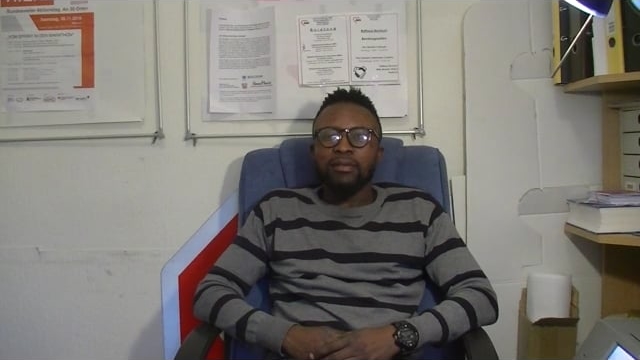
Country of origin: congo
Year of settlement: 2015
Age on arrival: 24
City: bochum
Gender: male
Language of the interview: Lingala
[i] Thank you very much. I hope you will join us for the next episode too. I would like to thank you for Thank you for your willingness. We’re back. Thank you for that you were there. This is the first one Part of the video.
[r] Thank you for that Opportunity to discuss with us. We are in the office,… […]
[i] Thank you, thank you. Good afternoon Mr [name], we thank you for your consent in the project of Hanover Museum from Bochum. We have this project that can help us in the future how the migrants come, what can be done to help them. What can be improved? In the 1950s the Italians were the Greeks. And in the 80s are Africans, Congolese came. We are Congolese, how would we like to know, why do Congolese come. What problems do they have? and how they are in the live in the city of Bochum. That’s why we’ll mainly talk about the city of Bochum, My first question: When you arrived in Germany, what was it like? come that you came to Bochum, Mr. [name]?
[r] Thank you President [name] for the question and also thank you for your you took time, to receive me, today at Bosangani’s office. Thanks for the question. At first I knew them Not the city of Bochum. When I came I have mine Asylum application filed. Then it was… In Schöppingen, I went to Schöppingen. People were no longer accepted there. Then I’m in Dortmund went. I went to Dortmund, I think sent to Olpe. This is the area surrounding the city of Siegen. Afterwards I received a final assignment to the city of Bochum. That’s how it was.
[i] Thanks for the answer. You came to Bochum, where exactly did you arrive? What was your first impression when you came to Bochum? That means, how did you find the city? city like the buildings, the residents of Bochum, how did you find her? How did they receive you?
[r] Yes, that was good, the reception was good because when I came… We went by bus, we have, I believe, It took an hour by bus. Thereafter when we came to Bochum, We stopped at the town hall first, I think. We had to get out there then we will until Social welfare office brought so that we get a taxi, and then get a residency position. The reception was actually good. The reception was good. I also liked the city of Bochum. When we arrived there a market at the town hall. Because I’ve seen a lot of people
[i] Thanks already! In which month did you come to Germany? or what year?
[r] I’m in Germany per year 2015, that was in the month June, I believe it was June 15, 2015 If I’m not mistaken.
[i] And in Bochum?
[r] I no longer have any ideas in Bochum because…ah I no longer have any ideas in Bochum because it’s been a long time. I’ll try to verify. Next time I will answer this question.
[i] You came to Bochum, how did you find the people from Bochum, the city of Bochum, the food of this city, and the tradition of this city? We mean the Germans and others Foreigners who have lived in Bochum for a long time.
[r] I like seeing people in the flea market. And then to see how they live, Since it was the first time for me, I observed first, then it was good. That was good, to look at the people, then…
[r] What difficulties, obstacles, did you have when you first came?
[r] First it was the language, the language because we came from a country, where French is spoken. We came here and found another language. English is not spoken much. The first difficulty was in the language, then second it was in the first city I was in. The city was very wide and in the forest. There were no people there. It was actually a bit difficult. In the first city, her name is Olpe. That was the first Difficulty after that…
[i] Except that Language, didn’t you have any other difficulties, were the people open or reserved, what was the reception like?
[r] No, the reception was good, the people welcomed us well. The only difficulty was the language, you couldn’t talk to people. We couldn’t understand each other. In order for us to talk, someone had to be found, who speaks a little French. or who already speaks some French. Then they can talk.
[i] They had no interpreters for them provided because they already knew that they have come new. Some of you speak Arabic, Iranian, French, or others only speak the language of your home country? Didn’t they have interpreters prepared to help you?
[r] Thanks for the question. Yes, there were, but they came often, if an important one There was information to give. They had us in such opportunity brought into a room, and there was in English, in French, in Arabic, and also spoken in German. That was the case, but not always. Only when they have a message. That’s what they did.
[i] Thank you! Where do you live now in Bochum? Or which one Municipality of Bochum? Can you describe your community a little? This can give people an idea what your community is like, what your district is like?
[r] At first I lived in Bochum on Allee Straße, I don’t know if I’m there can call the city center, or another part of the city. In Alleestrasse
[i] Here in the city center?
[r] Yes, but in the side of, in the Direction from the tram from Höntrop At first I lived there then I moved and I’m in the district Wattenscheid gone. I currently live in Wattenscheid.
[i] Can you do something yours? Describe your place of residence: Allee Street? How were they accommodated?
[r] That was hard because I suffered there. I’m there stayed about 6 months, and then The sleeping condition was not good, the accommodation was made quickly, that wasn’t so good. That was not in a good one Condition actually. That was before, I think a basketball playground. The rooms were divided and thus the rooms were formed. It was really a bit difficult. The food was always at a certain time, you have to be there while eating. If you’re not there, then you’ve missed out. That was difficult. We also had to be assigned quickly, but it so happened that we stayed there for up to 6 months. Because it was hard. Besides, that’s how it happened when you Pressure was put on the boss who was responsible for the assignment, then you could get an assignment. If you don’t push, you’ll stay there. That is the difficulty what we had. It happened like this, every time the boss came, we went to him and put pressure on him, talked to him and said that we Need assignment. Because it’s in avenue street. was difficult. It was a bit heavy. It was good for me that I was there had contact with the football team. Our accommodation was direct Neighbors with a soccer field. Every time I went there to look since I had nothing to do. You couldn’t go out either because if you went out. We were protected. Besides, everyone had their time. There was a set time for eating. I often had to be on the soccer field. I watched football. I then found a team that trains there. One day I got mine Called a friend from Bavaria, I put him in touch with the trainer because I couldn’t communicate with him myself. I asked him to ask the coach if I could train there. So that I can get the endurance and regain performance. Then the coach took the phone, by me I printed out the drawing. He even has that took the phone, then he heard my friend. He explained to him that I am a player and want to train with the team. He was very happy because they also had a lack of players. Then he did with mine enjoy entertaining, he asked him everything, including about her positions. My friend gave this. Afterwards he had told me, that I should come on certain days, he told me in English. He mentioned the days of training and asked me to come. Then I stopped training. First day for me was difficult because I hadn’t trained for a long time. But they have filled, that I can play. He has already played. After spending 2 weeks there, I could then play better then you have one Looking for an interpreter for me he was a Senegalese, so that we can talk about the able to maintain a contract. They also suggested me if I could play. She wanted to know my idea. We talked and I started playing after that. Allee Straße was open for doors, although it was difficult. That’s how it was.
[i] Before we delve into details, I would like to ask further: You came from Africa, in Congo you ate a little differently. Here in accommodation they are given other food. Did you like this food? or how did you see that? The food from here as they have a big difference with the food from your homeland.
[r] Thank you President for your question. That was difficult because we come from a culture where we found different foods. Really it was hard. It was hard, but we had no choice, we had to get used to it. But there were a few things that I was used to from Kinshasa. I often preferred eating that. But the other one, the one I didn’t know, had caused me difficulty.
[i] For example, what things have you seen here, what have you eaten in Congo?
[r] Yes, first salad, we already ate that in Congo, We also ate eggs in Congo, lots of fruit, like apple, oranges, orange, we are already in Congo used to it. Because that’s how it is.
[i] Did you have the opportunity to cook yourself or were you offered the food that had already been cooked?
[i] No, we didn’t have that option, we only had the opportunity to do that Eating what was brought to us. There were none Possibility to cook.
[i] If you say “difficulty”, you can’t describe what difficulty? I mean in Allee Straße. What difficulty you can’t say. Difficulty because of this and this, because only difficulty is vague.
[r] Difficulty, first of all because of the living conditions, what we had to live there, the living conditions were not good, because there were many people, and all the accommodations were full. This place was fabricated, that was a basketball court, they separated it with a tarpaulin. That was the first difficulty and instead of not staying there long, we had to stay for 6 months. We didn’t have any there Internet, no TV, You could only sleep Collect food according to schedule. There they are difficulties. Moral we were very beaten. Morally I was defeated. I had thought a lot, it was hard.
[i] And there the understanding between you there was good, or there were some conflicts? Since there were different nationalities there, with different languages, everything together.
[r] Yes, there were really a lot of misunderstandings, there was brawling, and then every time the police came. Because everyone with his way of life brought by his family. That was really difficult. But what had helped me I had already had the time to live with different people, at work as a soccer player. We were together with thugs, with educated people, including at the university. So I know how to live with people. I can avoid the bad, and also the misunderstanding. That helped me. I didn’t want any get problems.
[i] Can you tell us what nationalities do the people who were with you belong to?
[r] Yes, sure. We were mixed I’ll start in Africa first: In Africa we had 2 Congolese, and then Nigerians, they were, I think 4, then there were Syrians, they were many, also Iraqis, Macedians, they were also a lot and then some more from which country… uh. That was almost all.
[i] Had these Accommodation possibility Entertainment in the sense that you can use your time. Like watching TV, playing, or go outside, take a walk. What entertainment did you have there?
[r] It was the first conversation like I just said, was football because that Football field was at the back. Since football is my report, was my first Entertainment football. But there were also televisions, but the broadcasts were in German. Since in the beginning we couldn’t understand the language, That’s why it was a bit difficult. We only had that Watched TV pictures without knowing what was being said. But there were no games. Only the Syrians had the game People don’t annoy me. They would sometimes put it on and play it. That’s how it was.
[i] We will talk about football later. First I would like to know what it was like in the Wattenscheid district? You described the accommodation in Bochum, then you’re in Wattenscheid assigned. What was the environment like there? How are you? Example accommodated?
[r] I found the district Wattenscheid good. When I first drove through the district, I am, I believe in the City of Gelsenkirchen gone, I found it good. When I heard in the home, that people in Wattenscheid were assigned, there was also a Congolese among them. The Congolese man informed me that this city is good. Then I prevailed on the boss so that I wasn’t sent to the city center, but to Wattenscheid. When we got there the reception was good. The residents of the district came to welcome us. I liked this city, I have found peace. The city is well built and we were well received. Then one became school directed. People had chatted with us. People who spoke French came and spoke to us. Some tried to speak in French. It was really good.
[i] How were you accommodated? It was like in Allee street or was it different?
[r] The living conditions have changed somewhat, because we were given housing, and there were 2 of us in the apartment. You could also cook alone. There was a small change.
[i] Did you have the opportunity to buy things yourself and then cook them to your liking?
[r] Yes!
[i] What does the city of Bochum mean to you? for comparison, say in your life? You lived beautifully in Bochum for some time, didn’t you? For a long time, I don’t know, what does Bochum mean to you?
[r] Yes, I have been living in Bochum for 4 years, I think it’s good, since she is still calm, it doesn’t have many Stress, it’s quiet. You can concentrate better, first of all for them Education of children and also for his own activity. You can concentrate well on school and work. My wish is to stay here forever.
[i] Let’s talk a little about sports and leisure in general. You said you play football, Here in Bochum or in Germany which team do you play on? Or since you’ve been here, which ones Have you already met any teams?
[r] Thanks for your question. First here in Germany, I played in Germania, that’s the name of the team, in Bochum, the Name was Germania, that was in the district league, I think so. Because that was the beginning. I just needed to be able to train myself. I played for a year. After I a played year, we had in Halle Bochum Stadium played. Then I had I was lucky because there were a lot of people in the hall who had also seen my style of play. There were some Africans from Cameroon there, They came from Cameroon, they spoke a little French, we exchanged contacts. That gave me the opportunity to change the team. Afterwards I was taken on and I did a test in Wattenscheid with another team. That was before, I in Wattenscheid live. That was good. After that, when I finished, I had to play there. It was the national league there, I think. There was a different level there compared to the team where I played. After that it came When I was running one day, I met 2 young Turks. They saw me as a player. They were interested in me. We greeted each other and entertained, even though I didn’t understand the language. Since I was with a boy who has lived here for a long time, we had talked. We had a good exchange of contacts. They suggested me to do training with them. When I was waiting for the people from Wattenscheid, I went to them, to do training. They didn’t want to let me go anymore. They said we had to talk. They said that they needed me and that they wanted to develop the team further. I had no choice because I had signed a contract with them. Your team was far away in Gelsenkirchen, in the direction of Buer, opposite the Schalke stadium. I did a test there, then I started it. The team is called Genclerbirligi Resse. This belongs to the Turks. I’ve been there for 3 years. We got along well.
[i] You have here in Germany Football played in 2 teams. You were accepted and they noticed that you play football well. Let’s go back to when you were a child. Where did you start playing football? In which city in which municipality?
[r] Thanks for the question, I was born in Ndjili, I also grew up in Ndjili, exactly in Quarter 2. In Njili on the street
[i] In which city?
[r] The city is Kinshasa. I’m in Kinshasa Ndjili commune was born. I had the time to start a football game there. I have there Soccer game started. Ndjili is the commune, where I grew up. Also in this commune we really had the opportunity to play football. At first we had a lot of soccer fields, that led to that everyone was lucky being born in Ndjili had the wish to play football. We grew up with football. There were lots of soccer fields, our older ones had played we accompanied them and eventually took part too. That’s how it was. Football talent runs in the family, because my father also played. When our father played after our father, Growing up we always went to watch football. There was a team in Ndjili called Afrika, their president was Savanier, he was a musician. We went many times to support this team. We were still small, then this team was released. Then another team was founded in the same football field. in Ndjili Epome in district 7, nearby the Mangobo market. The name of the club was Safe from President Tshamala. This was the team that had replaced the other when Africa was dissolved. When Africa was triggered, Tresor was founded. In safe there was many teams in different categories: Minime cadet, junior and senior. Because we always watched the players from this team had who were known Since the team was big, we had the desire to play football. Then one day… I had already played football, but not in a team. That was games in tournament, sometimes there was pay, but I didn’t make the team. I was afraid. I thought that people those who play in the team are special. They know a lot, I can’t how they play. Over time I have several had played tournaments a few times, I had played in a tournament during which I met Tresor’s coach. His name was Lucien Mbaya, he was in Liege, Belgium. When he saw me playing, he came to me. He had spoken to me, he said, that I will play football well. He asked me which one team I will play. I told him that I don’t play on a team. He continued to ask me what I was going to do. I replied that I went to school. He further said that he wanted to take me so that I could be in his team could play. I was afraid. I told him that I wouldn’t make the team. He said I should come anyway. But he always came with me Gifts, he sometimes came to our house. Sometimes he took me in his car. He brought me Football equipment, as a child, I found it special. The first day of my training there, I had I was afraid because the players were very talented. But he encouraged me I should keep training. Then I realized they weren’t anything special. The training had gone well. Then I got used to it. When I was there for two weeks, I got the rhythm of the team. I felt like I belonged to the team. Then I stayed there. After training,… Because I used to be in one Team trained before I started in the club. I had, I think I played 2 games. The person responsible for this The team came to me and said that I would be part of their team. I wasn’t allowed to change. Our trainer Lucien Mbaya, Since he already needed me, he had this Coach spoke. Although he’s not the right one was a coach, but someone who took us to play on his team. He had considered me his player. He was given some money and then I was finally able to enter the team vault. Then I trained and played there. I had only started at Mini, then we had gone to cadet. From cadet I became God’s help I played directly in the 2nd league. Because I played in the 3rd league. We went straight from Junior to the 2nd league. The first year in the 2nd league was difficult because many players were older. In the second year we were able to dominate the second league. We played well there. Thereafter I’m right in the 1st league gone. I was in the first league Team Tresor played for 3 years. During the 3 years we had enough time to play there. We had enough time to get to know each other, we had good contacts. Then I went out. I went to the stadium for my first team, which was called Kin Titi. I played there for 1 year. Thereafter I’m on the team Regideso, that’s the one Water supply company in Congo. I also played there for a year. After Regideso I was in one Barumbu team gone. The team was in Beau Marche in Olsen’s field. I played there for, I think, two years. After playing there for 2 years I got a good offer. I went to Dragon, Bilima. In Bilima I received the offer from Tunisia. Although I don’t The test went because there were complications. When I got this offer, it opened a few doors for me. When I didn’t leave, I was still on the team “Imana” went into DCMP. In DCMP I had had time I was staying in Kinkonle. We had time to train there. But when the time came for the transfer. there were complications. Since the leaders had not agreed on the money, I had changed I’m too scared. The team belonged the ex-president Kabila. But the team was in the responsibility from his brother Zoe. […] I played there, I think, for two and a half years. After that I’m in Rogelu entered. Rogerlu was the team of Roger and Romelu Lukaku. They have the team there. You have the in Congo founded. I didn’t play there for long before I left. Football on everyone case is something good, this is my career.
[i] Thank you very much. You have a lot to say about your football career spoken, from your childhood until you left Congo, But you didn’t mention, which post did you play in? What positions did you have? owned in the team?
[r] At first, when I was a child, my first position was center forward. I played number 9. In French it says: Avant center [center forward] I had the position 9 played for a long time, then it has come to pass that I played in the middle. As is usual with many trainers. According to some He brings them to play team in his philosophy. I’m in the midfield, then sometimes played as a right winger. That means number 2 in the right position. Thereafter they had me in Center line, number 5 or 6 There is the position what I possessed, I stayed in this position for a long time, I mastered the position well. To date my positions are: midfield, defender and Centerline.
[i] If you can introduce your football career in Germany, like you made them for Congo, what can you say?
[r] Uh, yeah, mine Career in Germany was difficult at first. I had no contacts at first. Like I said, where we were accommodated, there was a football field. Every Sunday they played I looked and noticed that their level was down. If I will train myself, it will be better. Afterwards through my friend, when I called him, and he had spoken to the trainer because he already knew the language and because he had lived here for a long time. When I talked to the coach, he allowed me to train with them. When I trained with them, all the players were happy with me. She asked me where I came from. I replied that I will live here. She had felt sorry for me. They asked me my name. I just had with something Answered in English. Because I’m with that Language was zero. I didn’t know anything. After that… Since they were happy with me, they had told me to come back tomorrow. I came tomorrow too and we had trained again. They told me normal that I Should come back the day after tomorrow. They had given me their game plan. Then I now followed the plan. They had seen my style of play and they were interested. They said that I will help them. They didn’t want to let me go anymore. They had me in that Brought to the changing room, there were shoes and I had to choose a pair of shoes. So I could train with it. I continued to say that I should come regularly. I took it and I got further. After a week they had one Interpreter brought. They wanted to talk to me about the contract. They wanted me to sign so I could play in the team. Since I also wanted to become active again, I had no difficulty. We spoke through the interpreter and I stated my conditions. They agreed to it. I had a photo taken. Then they had to Papers were taken care of and then I could start. I sat the first game. I had just seen and in the end I had to go in and play. When I went in and how I played, they praised me for it. She repeats that I had to help them a lot. There, they played at the front and I played as a center forward and played left winger. We had changed. In the second game I played from the beginning. I was the keeper. It stayed that way, I was always the placeholder until I broke up with them. In the current team, since they have a lot of players, the coach Suggested me to play in midfield. because she Looking for midfielders. I told him that it wasn’t a problem. I’ll play, I am versatile. I’ve played in different positions. Because he had me in that Let midfield play. Then he let me play in midfield for a long time, and later he decided that I should still play at the back. Because there was one player left in the midfield, he should continue playing there, and I should go back. When that worked, he said that I wasn’t an attacker and that I should continue playing in this position. It also happened that I stayed in this position. I play in the central axis, and then in the midfield. It was a little hard to go in midfield. But the coach had told me that it was better there. I’m just supposed to be in these Positions help. That means midfield and Defense. These are roughly the same positions. I still play in this position to this day. This is actually very good. Things are going well. The difficulty was just that climate change, the cold weather, the unknown language, that you don’t know, you have to express yourself with characters. But since football is already in your head communication was automatic.
[i] If you have to compare, life in the Team in Congo when you were there life in the Team there and here. Are there differences, How is the understanding with them? players there compared to here?
[r] Yes, yes, there is a big difference. The difference is big. In Kinshasa, if you Plays football, really is the moral… there is a lot of stress, there is a lot of stress, besides you play in a different morality, because you are under pressure from spectators, and also from And also from the team supervisor from the President, and from some friends. The difference is big also the climate. Here in Europe it is different. You play and people don’t say. You feel that… You play, the ball may or may not be lost the people are quiet, she encourages you, they know that you on the next one You’ll do better. It’s not like that in Congo. In Congo if you played badly, are you insulted, threatened: we will demolish your house. They will say many things. There is no stress here, you play without pressure, you play with calm, and there is also that Difference of football field. Here is the field made so that the Ball follows your style of play. But in Congo it was hard because our fields are on sand, moreover it is difficult to control the ball. The ball often bounces somewhere else. But all the football fields are here in good condition. The climate here is good, but in We play Congo under the sun. We sweat profusely, the climate is good here, and then.. The Difference is big.
[i] In addition to your free time with football, you have others Leisure time, what do you prefer in your life?
[r] Yes, thanks for the question. Except football is my other free time: I really like the music, my hobby is music, I often listen to the music. When I’m not busy playing football, I often listen to music.
[i] African Music or all music?
[r] No, African music, more often the music from my homeland. I hear that more often.
[i] Do you have any preferred ones? Musicians from your country?
[r] Yes, I have favorite musicians that I often hear.
[i] For example?
[r] The first is Werrason, he is my favorite musician, and then is the second Fally Ipupa then third I hear Heritier, because he is a friend. They’re almost mine Favorite musician.
[i] I’m sure you don’t miss this music because we are in a world of technology and we have internet. Do you have the option through YouTube, or through other sources, to hear them easily? Or maybe you are missing them since you are far?
[r] Yes, I have these Possibility because it always YouTube exists, I follow this, I have… I follow the message, when an album comes out, I’m watching this. The possibility is there. I also have internet on my cell phone. Every time I’m free, I hear through the headphones. So I have all of these options.
[i] Except football, we’ve heard that you play football a lot, Except football here Germany in Bochum What else do you do in your free time? Except football and listening to music. Do you have anything else you do to spend your time in Bochum?
[r] Yes, I often spend my time… That’s also in Bochum, that’s also sport, I do fitness. I also spend a lot of time there. When I’m free I go to the gym. I work there a bit. Because school is already finished. I have already completed the courses. When I was still at school, I picked up books and read them in my free time. The language here requires you to read. Since school is already finished, I go to fitness, when I’m free. And when I’m done, I repeat my courses. I’m looking, where there is difficulty. I use my books for this.
[i] With the German one Society I want to say with the Germans how is that? I want to say the German and others Nationalities you found here. How are the contacts?
[r] The contacts are above all good, ‘Cause all the people I meet since I am friendly towards them, I am well received. Until then, all contacts are good. The German and also that Foreigners, if we are known to each other, we have good contact. Contact is really very good.
[i] And with other African societies except the Germans the Europeans, Do you also have contacts with African committees?
[r] Yes, sure I have contacts with everyone Africans, we have a good time. Contacts are very good. The contacts are very good. We have a good one with Africans Relationship and we talk very well. The contact is really great.
[i] Let’s see in that area of culture. You said that you the Music from your homeland follows. Because our African culture is different from the culture of Europeans. How do you see them? Culture of them? How they live what difference do you see? the type of life in Africa?
[r] Yes, there is a big difference. First, their food is different, second is her mentality different, of Africa is different and thirdly, they have their way of life. If he doesn’t want something, he says clearly that he doesn’t want to. He’s not afraid to say She reacts directly. Aside from that is also the difference in such a way that they are very calm. Really we are different with each other. The difference is clear.
[i] The difference is big if we do that You have the opportunity to look at food here the food of Africa. Do you have the opportunity to find this here. Because the difference is big with theirs. Do you get the opportunity to get your food here?
[r] Yes, I have this option because there are various Afro shops. They are offered there. When I have time, I go there and I buy what I need. In the food side there is no difficulty because all the food is almost here.
[i] If you the population of population of Bochum the residents of Bochum. If you make a comparison between the residents of Bochum and your place of residence in Africa, in Ndjili. What can you say, roughly what’s the difference? How do they react and how do they live? And what the residents look like where you came from and where you lived. Can you have one? Make a comparison?
[r] Yes, there is a big difference. As I already said, the mentality is different. The population of Ndjili or of Bandal, I also lived in Bandal, is different because the residents are from there When he meets you, he immediately asks you for help because he doesn’t have food. This is a disorder but here there is none. There is nothing like that here. Everyone is quiet here, he doesn’t speak. You get the feeling that everyone is focused on what they’re doing. The time for pointless things There is no entertainment. The mentality is really different. But in Kinshasa it’s not like that. In Kinshasa it’s always loud, riots, discussions, … The difference is big But here you have the time to think, to do something.
[i] It’s loud with them residents of Kinshasa, because the city is big, there are many bars and many churches. But Bochum is a small town, that’s why they can Difference be a lot. In order to get in touch with the residents of Bochum, is it easy or a bit difficult?
[r] Yes, it is contact not hard, it’s easy. It depends on the people you’re talking to depending on your problem or yours Project. They are ready to receive. The Europeans are even open he will receive you then they will be entertained enough. It’s not hard but it is even simple. If you give him one bring problem, you will have a good time about it. If he doesn’t agree with this thing, he will tell you afterward. But to get in touch with someone, it’s not difficult, but simple.
[i] When you were here in Bochum had come, which people on helped you at the beginning?
[r] Yes, when I came to Bochum, there was first an acquaintance, who was in the same home with me, he is Congolese, he has been there for a long time, he had helped me. He had me an office from Africans, which is here, called Bosangani. When I was in Bosangani, it has come to pass that I met Africans there. Thereafter I had met the president of the club, then I got a lot of help from him. his name is [name] and also from his deputy President [name]. You took time to help me. If I have problem, I went there. […] We still have a good relationship to this day.
[i] Can you tell us what does this organization do? What help did you get there? Can you give an example?
[r] This is first of all an African club, they help Africans in all the problems they have. What kind of help I got there was first the language and then reading letters. So are the help that the club offers. He helps if you has difficulty, especially first with language the club is ready to help you. They can read your letters for you. If you have a problem, that need an interpreter ,they will accompany you to certain office. Besides, if you problem of …. you have, … If you have problems with computers, or want to learn computers, are looking for work, or want to write an application, the association is there to help. There are many things you can get help with from the club. They always find a solution.
[i] You came from Congo, you came to Europe, you probably fled there because of problems. When you came here you had a difference according to your idea of Europe before. Did you have a big one? Noticed the difference, right? a small difference?
[r] Yes, there was one Difference because we are in Africa had thought that Europe is different. When we came here… In Africa we didn’t know that there is political asylum. When we came here, there is political asylum. You have to go there, lots of them Doing stuff, really it’s nothing. The difference is big. You are isolated, you are without family, you are sent to a city without your will. You’ll live alone until you have completed all levels, Is this really torture? This isn’t easy.
[i] You’re talking about family here, do you have contact with a family, who stayed in your homeland? If you have contact, who?
[r] Yes, of course we have contact, using the telephone, we entertain ourselves through it. We communicate through WhatsApp, and through normal ones Communication every time I am free call us. In addition, if you have credit, Call me and we’ll talk. I’m really in touch.
[i] Did you bring a souvenir from your homeland that reminds you of your country? It could be a photo or anything. An object that you can hold onto, that reminds you of your home, where you came from. Whether you have what you brought with you, for example.
[r] Ah, then I have Photos. When I look at her, remember different places. Examples of souvenirs are photos, when I look at them they remind me of places.
[r] Are photos of family, Friends or yourself?
[r] My, from the family and friends. These remind me of Africa when I was there.
[i] When you came new, What difficulties did you have at the beginning, how did yours Life slowly changed, until it gets better? To compare with your life at the beginning. Every beginning is difficult, then you can talk about your development, until you have a certain have achieved stability.
[r] Yes, it is… At first I only had the will to follow the laws of this country, then the will theirs courses to follow, Will to learn. Willingness to integrate. After all of these then it came when I understood the language a bit, I got peace and I was able to achieve other things. I can say that integration is the basis of development.
[i] When you came, not a single language spoke German. Are you now able to get involved? To be able to understand people? Talk, buy something, go to the doctor, right? Can you say a little bit what level are you with the language?
[r] Yes, I’m at this level I can handle myself alone People communicate, and then I understand a lot, I can also speak a little. That means the level has come high, I have nothing, which can cause me difficulty when someone is speaking. The level has developed significantly.
[i] If you have to make a comparison with your country, what do you find better in your country? for comparison with here or what is worse in your home country always for comparison with here? There are good ones too things in your country. Things that are better in your country than here in Europe. Take positive points from your country in general from your country.
[r] Ah! Yes, my country is good too. First you feel good, and you are with the family. You are with the family, and secondly eh, phew, are you with the family and friends. You know the country. The climate, the Temperature is always good, you know all 4 corners, you know where to go. But here you are new, you start everything from scratch. That’s how it is.
[i] Do you want to say that you miss your family, or your surroundings, or your friends? Can you talk a little bit about that?
[r] Yes, I miss the family, the surroundings too missing because we were used to it in Kinshasa everyone To meet each other. We played football together and talked. But here I miss that.
[i] Here you have it few contacts with people or are you alone or are you with family?
[r] Here I am alone but I also have Guys, I have contacts. I am alone without family.
[i] I also want to talk about the neighborhood. The neighbors who live with you like you said you were in the home. But you also have neighbors in the same room or hallway or the same home. How do you understand each other? How is contact with each other?
[r] Yes, contact with the neighbors is good, contact is good. There are some that I like have relationship. But if someone I also show it has a different character …, I also avoid contact aside from that … to avoid problems. Who is a little nice, we will greet each other, aside from that .. That’s how it is. It’s better for me that I’m outside at any moment, Training, work, school. I won’t be there long it’s hard to get problem. [The respondent is called.]
[i] Let’s talk about them contacts with neighbors, you said that the contacts were good. How do you spend your day in Bochum, can you explain to us?
[r] Yes, I spend the day normally because I’m already working.
[i] If you get up early you can explain how do you spend your day?
[r] I get up at 4 o’clock, I clean and I shower, then I go to work. I will finish work at 2:30 p.m. I’ll get home, I think, around 4:30 or 5 p.m. After that I prepare, I eat something and I go to training because I start training at 7:30 p.m. That ends at 9:30 p.m. I take the time on the weekend sometimes a few thing to do, to visit people. Sunday is the day by going to church, to pray and it is the day we play football. We usually play every Sunday. Really …
[i] What work do you do? Can you explain a bit about what work you do? Do you like the work?
[r] Yes, I work in a situation I’m in a situation and then I drive a forklift. Forklift, I drive it. I like that. I have the will to do this. That encourages me. The work is good.
[i] Are you in touch with friends, who stayed at home? You already said that you are in contact with family, now with friends.
[r] Yes, with friends I have contacts through Facebook, and We talk WhatsApp often. We talk and it feels good. In conversation we talk about the former Living together is good. Contact is available.
[i] Here in Bochum do you have contact with People from Congo too?
[r] Yes, I have contact with many,
[i] In which cities besides Bochum?
[r] Besides Bochum, in many cities, like Essen, Cologne, eh…, Wuppertal, Dusseldorf, Mönchengladbach, Bavaria,
[i] We know that Congolese pray a lot, both in Congo and in Europe. Are you also connected to a church here in Europe?
[r] Yes, yes, I go to church in Essen if I don’t have time, I’m going here in Bochum. It is a church also for Congolese.
[i] How about that Authority here in Bochum. How do you feel about it when you have to do something there? Are you having difficulties or is it possible?
[r] If I need something from the authorities I don’t have any yet get difficulty, I always find a solution there.
[i] It is said that the German Bureaucracy is very difficult. You have long papers, which you have to fill out. Do you also have …, what do you do if you… have such difficulty, or if you have such get forms? How do you take care of that? Can you explain a bit?
[r] Yes, the problem is that you have to do what it asks becomes. Since you’re the one who needs help. You have to be patient. You have to be quiet, take time. If you fulfill their condition, you will always find a solution. It’s their culture, we have to follow that logic. I don’t think so Difficult to fill out.
[i] If you now take the people out Congo who remained there an idea about life here, advice, what can you tell them?
[r] So no, life is hard everywhere, that demands to be brave You should also do something, like an apprenticeship. You have to be brave because… Brave at work. You have to be willing to work, and you also have to learn and have a paper, one Completion of training. Because life was as we thought it would be in Congo, it is different here. Here there is school first, then work is difficult. In Kinshasa In Kinshasa . ..Here is work first. Here people live through work. You have to have the work spirit.
[i] If you have the opportunity to give the authorities advice here on how you got into the difficulties, what you have suffered. What can you tell them? What change can you make to the life of Migrants who came or those who have lived here for a long time? What advice can you give?
[r] It’s just your problem Apartment for to provide, like it is in other cities. They give that Apartment not quickly. They leave migrants in homes for a long time. But in other cities The apartment will be given quickly. This is what I can say about it.
[i] You have about the Apartment spoken and about that Residence of migrants. To grant residence to someone who has applied for asylum or who studied here. Can you say something about it?
[r] Yes, they don’t give you a stay very easily either, they are a bit strict. They give with difficulty. If they change, it will be better. Because it’s still in this one There is difficulty on the side. problem of the apartment, of being strict in the office, to give people stay, I can do that Authority offer to change.
[i] Thank you very much Mr [name] for everything you said and above all for your availability to answer our questions. We really thank you for that, we wish you a lot Good luck for the future, you should do well Develop football, including at work.
[r] Ok, thank you, thank you, I the same thank you again for taking your time to help me in your Office to receive. I was very pleased. I will be happy It shouldn’t be the last time that such initiatives are continued. If there is still will give the opportunity when we have time, can we keep talking, the interview is good.
[i] Thank you very much!


