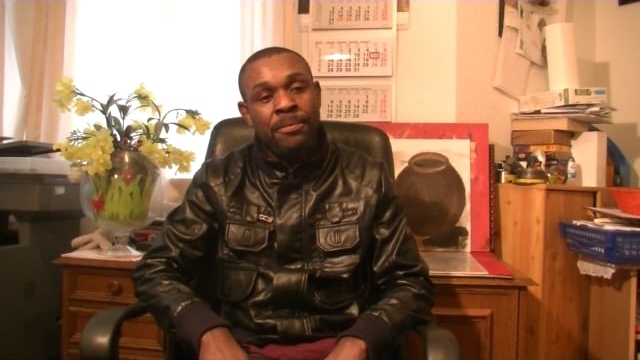
Country of origin: congo
Year of settlement: 2015
Age on arrival:
City: bochum
Gender: male
Language of the interview: Lingala
[i] Hello, how are you?
[r] Hello, President [name].
[i] I would like to thank you and invite you to participate in the upcoming program. We are in Bochum, in the village of Bochum. We start and then we accept it. So I would like to introduce you… I would like to introduce you…
[r] Okay, we introduced ourselves. [A woman comes into the picture with bottles.]
[i] Thank you Mr [name] for your participation in our project from the Museum [Zeche] Hannover in the city of Bochum. We ask you to imagine so that the people who will follow you know who they are dealing with. Where you live and which country you come from.
[r] Thanks for the word, but Before I start, thank you very much too for today’s invitation to this interview. I am Mr. [name], I live in the city of Kierspe, Kierspe is located near Hagen, maybe some people don’t know this. This is a small town. I am Congolese, I really came from the Congo, strictly speaking the capital Kinshasa. That’s the way it is.
[i] Thank you very much, they come from the Congo, you can tell people who don’t know Congo say in which continent Congo is located, what the population is like, which important languages are spoken there? And also what important things can you find there?
[r] Thanks, Congo is in Africa, in the African continent. Above all, Congo is located in the middle of Africa, in Central Africa. Congo, we have Congo Brazzaville, a Central African Republic, Gabon, Rwanda, Uganda, Burundi, the Sudan. These are the countries that surround Congo [Democratic Republic of Congo]. Congo is really in the middle. So now we are around 90 million inhabitants across Congo. To be precise, there are around 10 million inhabitants in Kinshasa. That’s how it is, if I haven’t forgotten. 10 million inhabitants. The main languages we speak there are Lingala, French, Swahili, Kikongo and Tshiluba. These are the languages spoken in Congo. Congo is a beautiful country. It’s really a beautiful country, it’s full of natural resources. There are actually a lot of natural resources that the whole world is looking for. Congo is even capable of feeding all of Africa and Europe. Because everything is there. There is cobalt, diamonds, gold. Everything is there. So when I look at the Inga hydroelectric power station, it can provide electricity to the whole of Africa because it has strong performance. Although, as you know, our African presidents don’t quite have the will or concern to build Africa. That’s why they will notice to this day that Congo is always behind. So, the population lives on at least less than one US dollar every day. You can judge for yourself, these are things that shouldn’t be possible in our time. These are outrageous things, really outrageous things. But God helped anyway, we have now experienced a change of power. From the president who was in power for a long time. So he was in power for at least 17 to 18 years. He didn’t do anything, he destroyed the country, there are no roads. But he still distributed power according to his will. But not entirely according to his will, but also with the pressure of the people, the pressure of the population. He couldn’t bear this pressure, the population was on the streets. They had said that he is no longer allowed to take part in the election, because he wanted to achieve a third mandate. The population rejected they were against him. He had no choice, so he accepted. That’s why we went to the election on December 30th. Everything went smoothly, now we have a new president, Felix Antoine Tshilombo. He now leads our country Congo. That’s how it is.
[i] Thank you for all accuracies, that you have communicated to us. I’m sure people do now have an idea about it. Let’s come back to Germany. We would like to ask you, How did you come to this town called Kierspe? How did you end up there?
[r] If I should start from the beginning, then as each person comes. You travel to Germany. You start with the procedure first. The procedure means you have to register with the police. I went there straight away, I met her. They welcomed me, I gave up my name, my entire identity. That’s how it was. They took me in and sent me to the city of Düren. I don’t know if you know the city of Düren. The city of Düren is located near Cologne, Leverkusen. I stayed there for a day, then I was assigned immediately. I stayed in Düren for at least two months, then I was assigned to Kierspe. This is my city today. Really. Where I live today. I don’t know which day I’m leaving this city because I love this city very much. Although this town is small, but I like her very much. So the city has no disorder, there is no trouble, it is a city of responsible people. Really, there are no thugs, that’s how it is.
[i] Thank you. You have arrived in Kierspe, you came all the way from Africa. It was the first time you came to Germany. What impression did you have of Germany in general? when they arrived. Was it a foreign country?
[r] When I say I landed in Germany. The reception that was made for me, at the airport, from all people, customs, […] above all, that was very good. I was very happy. I didn’t believe that I will receive such a reception because we hear that the Germans are racist. And that they really don’t like black people. But I didn’t notice that. Really, I was received very, very well. The whole process was really pleasant. I was happy about her.
[i] This is for Germany, let’s now take Kierspe, how did the people of the town of Kierspe receive you, what impression did you have of the residents and the authorities of the town of Kierspe, where do they live?
[r] Thanks for the word. When I arrived in Kierspe I was a bit disappointed. Because I couldn’t stand the place I had to stay. So it was dirty, really it was very dirty. The toilet was unbearable, there was no place to step into. Wherever you stepped, it was impossible. So we sometimes spent three days without going to the toilet, without taking a shower. Because it wasn’t possible to go to the toilet. So we were forced to do our business in a bag and then throw it in the toilet. There were many diseases and we were of different nationalities. We had Syrians, Iraqis, Afghans, people from […], Moroccans. In any case, there were a lot of us. People from different countries. They have their ways of life. In any case, we were there with thieves who went out, they had stolen. They came back with stuff and they sold it. That was the case, but for us Congolese it is not our style. We don’t steal. When we come to a country we adapt, that’s what we look for first. But I was really disappointed with where I was sent. That wasn’t so good, and at that moment we wanted to learn. But they hadn’t given us the opportunity. They said that we Congolese and other friends from Mali and Guinea that I found there were not allowed to learn the language. The people who were allowed to learn were Syrians, Iraqis, Somalis, and people from Eritrea. They are the people who were lucky enough to learn. We weren’t lucky enough to be able to learn. I stayed at least a year and a half without going to school. I started my own research, learning from Google and YouTube. I could say “please” and “thank you. ” Knowledge from my own strength. To search with this strength, how to adapt, in this environment, in this city where I came, I searched for that with my own strength. I was able to find a club of women who gather with the purpose of helping people who are new. I looked for them, I met with them. I told her I wanted to learn. They were looking for a woman for me who started giving me a course. That was once a week. Bit by bit. That was twice a week. I did the course for three months. During these three months a position was found in a school, but in a different city. I started going to school in this city. I studied in this city for at least three months. Afterwards I was lucky enough to get an internship position. That was in a company. I did that, I was accepted into this company. I work there now. Kierspe is a good town. In any case, the mentality of the people I met there is good. Besides, only old people live there. There aren’t that many young people. You meet a lot of old people there. Old women. These old people are sometimes scared when you meet them on the street. They can’t approach you. That bothered us a bit. But they are not racist. But that’s their way, that’s how they were trained. Until they grew old, they had no habit of being around people like us. But over time they got used to us. We talk well to each other. We greet each other on the street. Even they start with the greeting. That’s why we live well together. Really, I’m happy with them. The city is good. Especially if you want to work. Then it’s just up to you. Because in our town of Kierspe there is no unemployment. If you want to be unemployed, that’s just your will. You prefer to stay at home and continue sleeping. There is work. If you look for work, you will get it. Really, if you’re looking for work, you’ll get it. This is a good city. What’s bad here is getting paper. It is difficult to find a stay in Kierspe and the surrounding area. There are many complications. I have friends and acquaintances who live there. They have already been recognized. They had already received papers. But getting the electronic card is difficult. One man had waited another year. Then he got an electronic card. But he had to wait a year. But in other cities, if you are recognized, it doesn’t take long. After two or three months. I also have friends in other cities. In Essen or in other cities. If the asylum is recognized, after three months, he will receive his card. The electronic card. But that’s not the case here. That’s why there are some regrets we have.
[i] Thank you for all the details. When you arrived in Germany, what idea did you have about the Germans? What idea did you have about what you would be like? What did you see as the opposite?
[r] When I came, in the distance, when I hadn’t yet arrived in Germany. We had heard that the Germans are strict, that the Germans are racist, that the Germans don’t like Africans. The Germans are just like they don’t really like it to make friends with people. But when I came, I didn’t see that. Really, I didn’t notice. And to this day I have never seen it. That I really noticed that a German not a foreigner like, I haven’t seen that yet. But I hear that. I hear that it in other cities there are many racists. But I haven’t gone to these cities yet, I just hear that. But I haven’t experienced that myself. Really, I haven’t experienced this yet. The Germans I work with like me a lot. We have a very good relationship with each other. You yourself know that Europeans Not inviting you into her apartment, letting you in, that’s hard. But the Germans I’m with, be they women or men, really invite me, they let me into their apartment. We drink, eat and talk together. Anyway, it’s really good. So far I haven’t seen anything bad with the Germans, I really haven’t seen anything bad yet. They are good with me, so am I, I am good with them. Even friends I’m with I haven’t heard anything bad in any case. But we had heard from afar that the Germans were very strict. They would be like that. But on this page I congratulate them very much. Because their police, they themselves call “police” they really know their work. And the German people still really respected their police. They are afraid of the police. Above all, they are afraid of the law. You yourself know that in the country when the law is not respected, then it is no longer a country. But here the Germans respect first the law of their country. First of all they respect their army, their police. And now, you are a stranger who has just arrived. Do you see that the locals obey the police, what are you supposed to do? You just have to follow the same rhythm. In this context I really congratulate they are very strict. Their laws are good, although some say these laws are harsh. They control people a lot. So the Germans are very strict, but in my opinion I think that’s very good, that’s good, I’m very happy. The police are also their good side. You will never see them just calling someone out on the street. “Come here, come here! What do you have, show me.” That they monopolize something, nothing. In any case, that doesn’t exist. If you see them, you can go up to them and greet them. You can go further, they also go on their way. Even if you meet her at night, at 1 o’clock, 2 o’clock, they will never force you to stop, to ask where you come from in 1 o’clock or 2 o’clock. Never. ‘Cause sometimes I come back at 1 or 2 o’clock, I meet her often. Sometimes they stop me and they greet me, we talk a little about health, then they go on and so do I. I go on. But they will never arrest you, mistreat you, no, no. Your behavior is ok.
[i] Let’s leave the German side. Try it a comparison between the law here in Germany and the law at home, that is, in the Democratic Republic of Congo.
[r] If I will talk about what is right, if it is the right that prevails here in Germany with us too would be […]. We also have laws there are also strong laws, above all, there are laws. But to respect the laws, that is missing. Because there is a lot of corruption. Someone can do something bad he is also arrested, he is also taken to prison, but after two or three days he will with the help of corruption, with money, released again. He is released. He’s gone. But here, never, you can see things like this, when the police arrest someone, take someone away, then they bribe them, then they give them money to release them, never. These are things I’m talking about. If people would respect that, including the laws in Africa, then we would be like here too. I can say from another side, if people don’t exactly respect the law in Africa, especially our army and police, I can say it is like that everywhere because there is also a crisis. Like a policeman, who receives $50 a month. He has an apartment to pay for, he has to pay for electricity and water, he has to eat, the children have to go to school. With 50 dollars. He can’t survive with that. That doesn’t work. He is forced to take money. If someone bribes him, then he has to accept it. First you have to start paying them well, then Corruption will also come to an end. If you get paid well, no corruption will be accepted either. That is Germany’s advantage. The policeman is well paid. The military is well paid. Everyone gets paid really well. That’s why there is no corruption. Everyone respects the law. Because you know when he breaks the law, then he is arrested. He cannot be bribed. If the court for him five years or ten years Prison decides, then it will stay that way. But we there in the Congo, if they send you to prison for ten years, you can laugh. Because you know that you will only stay a month. Mother will bribe people then you will be released. That’s how it is. That’s the bad thing in Africa.
[i] We know that there are many obstacles in Germany, when someone new arrives. What obstacles did you encounter first? Obstacles, that is, something where someone has prevented them from progressing.
[r] For me, the big obstacle, really, I didn’t come across that. There was only one big obstacle for me, as I said, I came and I haven’t been given the opportunity to learn yet. But I really wanted to learn as soon as I arrived in Germany. But I was told that we Congolese were not allowed to do that. We weren’t allowed to study. Because supposedly there are European Community only Money around people To enable Syria, Iraq, Somalia and Eritrea to learn, but not to us. That’s why I had regrets. That wasn’t good for me. I stayed for a year and a half without learning. Really, I hadn’t learned. That gave me a delay. The people who came with me, or those I met here, where I arrived, because they were Syrians and Iraqis, they had already started to learn. They have already started speaking the language. But we came together. But I haven’t started speaking yet. I only knew “thank you” and “please”. That’s all I knew. But I gradually learned from my own strength. This is the problem I found. So in the next few days you should give this opportunity to everyone who comes. They should not differentiate between countries. Oh he is a Syrian, he can learn, the Somalian, he can learn, no, we are all human beings. Everyone who comes here should have the opportunity to learn the language. He really needs to go to school. If they get this favor to be able to learn, then the other nationalities, Congolese, Guineans, Malians, then we should all get this favor. We also have to learn. For example, let’s say someone comes today, he says he wants to study, should you send him to school. He can learn there. Instead of separating, differentiate, some are allowed to learn, some are not allowed to learn. Some need to educate themselves. That’s very bad. I really beg the Germans for a change with this regulation. You should consider the possibility all people give, who are in this country. They should have this opportunity to learn. One should not taking into account that only Syrians should learn. Only Syrians get papers only Iraqis get papers. No, everyone who comes. The law says that everyone who fled from problems and came to another country, to apply for asylum, it should be protected. This person deserves Protection. There are laws, which they themselves elected in the European Community. If a person has fled and is wanted for a political problem, then he comes here and his asylum is not recognized. While, while this man fled from there because of problems. If you send him back there, then he would be killed. What then? It is not good because it becomes, as it is called, a failure to provide assistance to people in mortal danger. They are the ones who prohibit the oppression. They talk about respect for human rights. But you arrest someone who is wanted and even they send him back. That’s the regret that bothers me a bit. The consideration of countries. People from some countries are preferred, for school, for papers, for work. They are preferred for everyone. But people from other countries do not have this option. That’s how it is, I think it’s a bit bad.
[i] Thanks for the recommendations to the authorities. I know when someone gets here, when a foreigner arrives in Germany, just as you came from a country where French and languages from the Congo are spoken. You came here and the language here is German. How did you do that in the beginning, so that you can cope, talk to people, have contact with authorities, with the police and with the immigration office and with with citizens of your city, how did you do that?
[r] In any case, it was really difficult for me at the beginning. See, I’m still stayed a year and a half. But at the beginning I was looking for the women who are close to us. I had a bit of luck because a woman nearby could a little French. She could handle it. It was like this, when I have a letter, I brought it to her and she read it and explained the contents to me. I didn’t understand some things because they didn’t as good as I knew French, but she helped me. She accompanied me to the authority during this time. That’s why we traveled a lot together. She had helped me during this phase. One day I was called to report. I had called her so we could go together. She told me she didn’t have time. She had to go out herself. That was the moment that gave me the strength. I had said that I had to make an effort to study at home myself so that I could attend my appointments alone. From that moment I started using YouTube and Google to know what the meaning of “thank you” in French is, of “with in French is […] I learned some words. And over time I memorized more and more words myself. One day I told myself that I won’t call anyone to accompany me. I went to the immigration office alone. I went in, I was amazed. I went in, I tried to print myself little by little. The man heard me and understood me. He even congratulated me and asked me if I had attended school yet. I answer: “Not yet, but I’m trying to manage on my own.” In any case, he was very happy with me. But I congratulate this woman because since she didn’t have time to accompany me, that motivated me. I told myself I wouldn’t call her anymore. I will try my best to attend my appointments alone. To this day, I go to my appointments alone. Another effort I made since there were many of us, with Malians, Guineans, and so on. We tried to speak in German. Even if you don’t know, you said “thank you” to the other person, for example, and the other person replied “thank you” in the same way. One said “please” and the other replied “please”. That’s how it was. We spoke to each other in German. Sometimes we decided that we would not speak our language for a day. We would only speak German. Everyone had to try to get along with German. We had definitely talked in some way, what we knew, we had spoken. That could be good or bad, [as long as] you just kept talking. But that helped us a lot. That helped too. Today we can talk a little. You can go to an office even if you meet a German who speaks German quickly. Even if you explain to him that he speaks fast, he can’t speak slowly either. He’s so used to speaking quickly. But it still works. Today it’s possible.
[i] We continue our story, [name], Now we want to know where you live. In the city of Kierspe is there a district where you live, or is there no district because the city is small? If there is a district of Kierspe where you live, can you describe it?
[r] In my town Kierspe, in my town Kierspe there are no districts because the town is small. So you can walk from the beginning of the city to the end on the other side in 30 minutes. Then again to the other side, to the other end. You’ll be ready in 30 minutes. So in two hours you can walk the entire town of Kierspe. I mean the city center. Only where there are houses. You can walk through it in two hours. I can finish the whole thing in two hours. Kierspe is a bit big, but the rest is just forest. But in the city where the houses are, you finished the whole thing in two hours. Then you’re done because the city is very small.
[i] In Kinshasa, which municipality did you live in?
[r] In Kinshasa I lived in the Ngiri Ngiri commune. I lived right between Ngambela and Khartoum streets.
[i] If you find your district in Kierspe, let’s say your small town Kierspe and the place where you lived, Ngiri Ngiri, How can you compare the two? How can you compare the two? What are the people like? How are the two cities structured?
[r] First I will say, when I look at the structure, Europeans have their own style of building their houses. We also have our design. Let’s see, Europe wasn’t built today, they started a long time ago, long before us. That’s why they’re a little more developed. We’re still a bit down, we are underdeveloped. But to see how to live, Things are good here in Kierspe. Because there is no noise. You have enough time to do something, […] to rest compared to us there. On the other hand, here at 4 o’clock, At 5 a.m. everyone is already outside. At five o’clock everyone is outside. Even small children, old people, we are all on the streets. Everyone sets up their table to sell something. But here in Kierspe it’s not like that. I’m talking about Kierspe, This is not the case in Kierspe. You can’t see someone setting up a table outside, and sold something, like onions, chives, no, that doesn’t exist. You will never see that you meet five people at once on the street. You meet the first person, then after a few steps the next […]. It’s not like that there in Kierspe, You can walk, about a few kilometers without meeting people on the street. Because everyone in a small town has their car. He strolls quietly and alone with his car. There aren’t really many pedestrians. But if, as far as the mood is concerned, Really, from the point of view of the mood, Congo is ahead. Congo really has more of that. Because we Congolese like a good mood. Everyone knows that, and we also like to dress well, that’s our culture, of us Congolese. But the Germans who are with us in Kierspe, they are very clean, I like them a lot. But if you look at Kierspe and my municipality of Ngiri Ngiri or my city of Kinshasa, then the difference is very big. When I say the difference is big, because if I take a German who lives in Kierspe and take him to my commune, Ngir Ngiri, then he cannot live there. He will notice that it is very loud there. Because there are children playing on the street, it is very loud. He can’t stand this. We grew up with it, we’re used to it that way. We’re definitely used to it that way. When I arrived in Kierspe it was a bit difficult. Because I came from the side where it is loud and then I came to a place where there is no noise. You are always at home, you don’t go out, and in Kierspe there is no place where you can go to sit and chat. That doesn’t exist. Like I see in other cities, like in Essen. There are places where people can go, sit and chat. We don’t have that in Kierspe. Really, we don’t have that in Kierspe. That’s why there’s a bit of regret, but I’m still happy about it. I like it that way too, Since I’ve gotten so used to it, I can’t stand a place where it’s noisy anymore. For example if I say, that I would go to Congo in my commune, I can’t do that anymore, really, live there with the noise, I won’t be able to do that anymore because I’ve now arrived in a place where it’s quiet. There are no people on the street I’m always at home, when I come back from work I’ll stay at home. But in comparison to the Congo, I don’t go back home after work because there are many bars. There are a lot of things, there are a lot of people on the street. Even at night, at one or two o’clock, there are still a lot of people on the street. But in Kierspe, there is By 5 p.m. there was no one left on the street. These are some differences. But where you have arrived, if you’re already used to it, if you are already adapted to the culture there, then that’s better. As for me, I’ve already adapted, I’m already used to it. I can no longer live with myself in the Congo. In this respect, the Congo, the way the people live there, the atmosphere there, I can’t stand it anymore. Because I’m already used to the peace and quiet here and the culture I’ve encountered here. I’m also used to their food, the Germans’ food. I’m really used to it. At the beginning I couldn’t, especially in the asylum accommodation where we were. The food that was given to us, really, I couldn’t. Sometimes I hadn’t eaten for two days, I only had breakfast. In the morning I had bread and drank tea. But in the evening I couldn’t stand the food. Really, I had suffered, lost weight, really accepted because I couldn’t stand the food. For the first time in my life I ate this dish. The first time I ate this. But now I’m used to it. Really, I’m used to it. If I haven’t eaten this, I can’t do it anymore. I’m really used to it, even the Germans who work with me, when they invite me to their place, when they offer me food, then I really eat. I actually eat it better now.
[i] Let’s talk about free time, for example, if you don’t have a job, you are free, how do you use your time to entertain yourself? What do you do, where do you go, what hobbies do you have? in your life in Germany? That means in Kierspe?
[r] If I don’t have to go to work that day, like Saturday and Sunday, I don’t work, Saturday morning I get up at 5 a.m. or 7 a.m. I go outside, I jog, I run. When I’m done I’ll come back and do some gymnastics at home. When I’m done, I’ll have my breakfast stick. Then I’ll go out because we don’t have a place in Kierspe where you can go. I then have to call a friend and then I’ll visit him. We talk, go outside, go for a walk, then everyone goes back to their own houses. If I have a ticket, because tickets there are expensive, especially compared to Essen, Bochum, where tickets are a bit cheaper. For us the bus only goes from Kierspe to the other town. So the bus doesn’t run within Kierspe, there’s no such thing. Only he drives from my city to the other city. That’s why the ticket is expensive. If I leave my city to go to the other city, it costs at least four euros and something, or four euros and fifty. If I have to go there and back I have to pay around ten euros. But this city is only connected to ours, but I have to spend almost ten euros. That’s also a reason we don’t go out often. Because the ticket is expensive, the authorities there should try to help us. It’s about the cities like Lüdenscheid, Meinerzhagen, Kierspe, Halver. You should try to look at the prices of the ticket, the prices are very high. We can’t go away often. There are no places for entertainment in Kierspe either. Sometimes we go to the town of Lüdenscheid, where there are a few places to sit down. There are some gardens, you can sit down, there are also many people. People come from other cities and we gather there. There we see music groups playing, festivals taking place. There are always festivals there in Lüdenscheid. There are many festivals. They will then help us a little. If you don’t go to work, you’re forced to go to Lüdenscheid because you can have a conversation there, better than if you just stay in Kierspe. Really, it’s very sad. So Kierspe is very stressful. To escape the stress you have to go to Lüdenscheid. That’s a bit good for us. What’s still bad in Kierspe is that there is no train station for passenger trains. That’s the worst, that’s the disadvantage. Even if you went out, you are forced to return home at 9pm because there are no buses after 9pm. Really, there is no bus. Even if you went to Lüdenscheid, you are in the mood for the music there, but when you look at the time, you always remember to return at 9 p. m. Then you have stress again. You know there’s nothing in Kierspe, I’ll just go there to sleep, really, just to sleep. That’s what still bothers us. That’s why when they give us If you still want to help, you could change the time of the last bus. They could also build a station for passenger trains for us. Since the train now only goes through the city without stopping. The train from Meinerzhagen passes through the city and continues. Especially since I don’t go to work in Kierspe on Saturday, I’m forced to go out. So that I can visit friends who live in Bochum and Essen. In any case, I’m going. If I miss the time it will be difficult for me. When I take a train in Lüdenscheid, this train passes through our town near my apartment. I see my apartment, but I have to go on to the other town, in Meinerzhagen. I get off there and there is no bus to go home. Then I have to walk home. At night I have to walk from Meinerzhagen to Kierspe. Both sides of the forest, only in the forest you shall walk. There is also no light, you have to walk in the dark to Kierspe. That’s the worry that we have. That’s why we ask the authorities to help us. They should set up a train station for us, where a passenger train can stop. We would be very happy, if you set this up for us.
[i] You talked about the food here. You are already used to German food. As I know [is it the case that a Congolese also needs food from the Congo. If you want to eat food from Congo, what are you doing, do you have a chance to get this? Is there a shop that sells foods like this from Congo? This will make you happy for it.
[r] If I want to eat food from Congo, in the beginning it was for me a bit heavy. It was like that when friends from France or Belgium came, then they brought me food from the Congo. That had helped me. But with time you get used to the country, then I have discovered the place, where they sell our food from the Congo. That to me very much well done. If I want to eat food from Congo, then go me to Hagen. There’s a woman who opened a shop there, she sells food from the Congo. All food from Congo. I can get that there. I buy it then and then take it to me. The difficulty, unfortunately, is then I really don’t can cook. I can’t cook. But I have it tried it myself gradually. If I will say something briefly, I don’t know, we have food there, which are called “Pondu” [cassava leaves]. First I had that cooked with tomatoes, I put tomatoes in it. I always cooked like this with tomatoes and then ate it. While we actually cook these leaves without tomatoes. This hurt me a lot, but I have had this for a long time cooked with tomatoes. I ate them like that for a long time. But now I am happy because I can eat all foods. Everything I want from us in the Congo. I eat this regularly, If I want to eat this one day, then I will eat this. If I want to eat German food, then I will eat that too. I have become very good at eating. Regarding this point I’m good. I’m eating now very good.
[i] Aside from Hagen, is there a store in other cities in your region to buy things?
[r] Apart from Hagen There are other shops that opened in Wuppertal, and they still exist today. If there isn’t something in Hagen, I go to Wuppertal and buy it there. There is still a position in Dortmund. I was there once. I also have an acquaintance who also sells food from Africa in Duisburg. She helps me, if you want to buy something you can just call her, she will come with her car and she will bring the goods to your home. In any case, it helps a lot. Really, that helps us. With her you can even just order, everything you need, then she comes to your apartment in her car to deliver the item. We in Kierspe, if you still have to go away, the return journey to buy things, that costs a lot of money. This money, if I want to buy things from the Congo, For this money I can eat for two weeks. The food for the fare, I can eat for two weeks. Then I have to use this money to buy tickets just to go back and forth to Hagen. That’s a loss, I think that’s a big loss. I still have to buy a ticket to go to Hagen. With this money, you can eat for two weeks. If I want African food.
[i] Now we want to talk about contacts, We humans, we need contacts. Since we come from Africa, we need contacts with Africans. But since we are in Europe, we also need contacts with Europeans. Do you also have contacts with your community, say the Congolese community? If yes, what type?
[r] So, […] At the beginning it was a bit difficult because I was new. I didn’t know any people. But since I went out and walked often, I sometimes met Congolese on my way. We exchanged addresses from time to time. One day you go to his apartment. You can have a conversation. He may also get another visit. Then you also get to know the visitor, and so on. The relationship continues to grow. I also discovered our church, the Church of the Congolese. And I met a lot of Congolese there. I often visited church and met many people there. I became really known within our community and God helped too. Then I got to know another club called Bosangani. I met even more people there, Guineans, Gabonese, Congolese, Angolans […]. I also met people there, I was very happy about our organization “Bosangani” [in Bochum]. This helps a lot of people. Really a lot of people, especially the people who are new. This club really helps. A course is also offered there. So, he gives people orientation so that they can know what Germany is like. If someone is new, the culture of Germany is explained to them. He explains what the Germans like. What does German law say? In any case get people good information there in the club Bosangani. Congratulations to the club, to the people who came up with this idea, new people coming to help. I’m very happy because, when I go there, then I meet all people: Moroccans, Guinean, Gabon-er, all nationalities. There you meet all nationalities. Really, I’m very happy.
[i] Thank you very much. They have enough contact with Congolese and Africans. Do you also have contacts with Germans? If yes, what type? How did you get these contacts?
[r] So we say, to get a relationship with Germans, in my town in Kierspe, there are women who have come together to form a group. They founded a club in Kierspe. Other people are there as donors, who pay a contribution every month. These women founded their club, At the end of the month you pay a contribution. They were looking for us, in our asylum accommodation. They gave us an invitation so that we can meet in a church every Monday. We went there every Monday. And we met German women and men there. We had Ate coffee and bread and chatted. We had had relationships there. It started like that. But strong relationship with Germans, I got it at work. At work let’s meet, let’s talk, exchange phone numbers. A colleague can call me from his apartment and I can also call him. A colleague can visit me and I can also visit him. Other relationships with Germans are tied in the church. Because there is a church there that they go to. You have come to our place. And they picked us up in the car early in the morning. Then we went to church. They hadn’t taken into account whether you were Muslim, They just picked us up, we drove to church, then we prayed and after church they brought us back. I then had a few relationships. I made relationships with people from church, I have relationships with the women’s association in Kierspe, which came together were to help people who had just arrived. And the relationships I made at work. All of this helped me to make contacts with Germans. With real German friends, women and men It’s bad when you have a relationship with a young woman and the parents find out that the child [the daughter] has an African father, it’s really a big problem. The mother will do everything to prohibit this relationship. She must forbid this relationship. The causes us problems, that’s why. We have relationships and friendships, but mostly with old people. Only friendships with old people we have a relationship with.
[i] In what languages do they speak to the people. Do you speak in German, or do you sometimes switch languages and mix with African languages, or do you only speak in German, what you know?
[r] Especially me, in my town Kierspe. There are at least three people who speak French. One speaks French very well. Two others are trying to get by with French. So, I can’t really confirm that they speak French. So, they try. But with some German we have, we try to talk to them in German when we meet. They don’t want to speak in other languages when we meet. They like that we only speak in German. So that we can continue to improve our German language, this is how it works when we are together.
[i] Let’s talk about culture. Our African culture and German culture. They are different. That means our way of life, our language and our tradition. What do you think of German culture?
[r] So, if I may make a small comment, then is German culture and our African culture is not the same. And they won’t be the same. I think the German culture, what I found here, is very good. They often like a good mood. They like it too celebrate, they like to drink often. There really are everyone knows that. They like to drink. In any case, when a German says, that we should meet at 10 o’clock, really, definitely, then it must be 10 o’clock. If you miss 10 o’clock, then this becomes a problem. This is what is required you have to give several explanations. You have to look for how to explain your delay. But if you said 10 o’clock, that must be 10 o’clock. Their way of life is only for Germans, I haven’t seen that with other people. We Africans also have our way of life. If you bring our culture here from Africa to be able to adapt to the culture you found here. However, that takes time. It takes our time, really. That takes time. There are people who can’t do that. You can’t. An adaptation to German culture. There are people who come and they get used to this culture. That’s how it is. But with time let’s get used to the German way of life. To life.
[i] You know that the Congolese people really like music, they like dance, Music is played all over Africa. Do you miss our music or not?
[r] So our music, I miss that, that’s too much to say. I can say because I music, since we have music, which we call Kirklian music, and the music we call profane music or secular music. I never listen to profane music, only church music. If I want to hear this, I go to YouTube. And I look for this music and I hear it. I often prefer German music. Because when I hear them, my knowledge of German gets better. This allows me to hear the emphasis better and then apply it later. That’s the reason why I prefer German music. So every day I listen to the radio. And I listen to music, or I follow this music on TV. I follow her through the show. For me it is good for the language. Because this music, there are others that I still haven’t gotten used to to this day. I’m not yet familiar with some German songs. But over time, as I listen to it more often, I’ll get used to it. I can say that I’m already used to it. But if I want to listen to our music, music from the Congo, Then I’ll definitely go to YouTube. That’s where I hear our music. I can say that I listen to them almost every day. So our music because there is some stress in Kierspe, then you hear our music, it feels good. […] Sometimes I listen to German music That’s good for me too. So, during the day I mix the two. I really mix the two styles of music, so that I don’t forget ours and don’t forget that of the Germans either. That’s why I mix them every day. I hear this a bit and I hear the other one a little too. I also listen to the news. I follow particularly often the news from Germany on television. The country where I live I have to adapt to that. I need to know how the country runs, what you want, what their laws are, what happened that day what information from the day is there? Really, I’m not missing out. Every day. When I come from work, I follow at home the news.
[i] Thank you if you are asked to make a comparison between the population of Kierspe who lives with you the population of Ngiri Ngiri that you grew up with, what can you say?
[r] I can say that there is a strong difference. Really. Because the Germans know how to live with people. They respect people. Since I’ve been in Kierspe, I haven’t seen a German fight with another. So I haven’t seen it yet. I have never seen Germans fight or come to blows. Then the police come. I haven’t seen that yet. I haven’t seen a German ship someone on the street either, I haven’t seen that yet. But we have that against it fights every day, people often argue, people are fighting, the police are coming, a person is injured and taken to the hospital. Especially here in Kierspe, where I live, I never have here encountered such a thing. Until today, since I came to Germany, I haven’t experienced that yet. Really, I have never encountered anything like that Two Germans fighting or a German with a foreigner, I haven’t seen that yet. In contrast, I see other nationalities fighting. These could be Syrians and Iraqis fighting each other, or Africans with them with Iraqis, or with Moroccans, or with Syrians. But I haven’t seen yet that an African fights with a German. I haven’t seen that yet. Above all I have never seen a German fight with a German. Or that a German argues with a German, not yet. I haven’t seen that yet, it’s just often Foreigner. They are foreigners who often fight each other. For comparison, with us in Africa, in the Congo, there are a lot of fights, even among children. Children fight with each other, sometimes they get up early in the morning and fight each other. For what reason? Maybe dad gave a child money for bread and the other child didn’t get any money from dad because dad doesn’t have any money anymore. He was annoyed, he saw that other [child] was eating and he wasn’t eating. He is jealous and they fight. It’s the same with adults. One of them didn’t get any money for the food, he walks around with his anger in his heart, if someone pushes him even slightly, he will get angry and he will quickly fight with the other. Almost everyone there is angry because of the difficulties, because of the suffering. People have bad things in their heads. prostitution is run by young women and minors. Minors become prostitutes, they go out at night, a child of 14 years will be with a man be together at the age of 60 just to get money. While I haven’t seen anything like that here with the Germans, that a young woman at 14 years old or at 15 years old is dating a man who is 60 years old. I definitely have that in Germany not seen yet. What I say is what I saw and what I haven’t seen yet. But I haven’t seen that yet. I have never seen a man with 60 years with a young woman 14 or 15 years old. I don’t have that yet.
[i] Thank you very much, You have arrived in Germany, first in Düren and then in Kierspe, where you live now. When you got there, Did you have people who helped you? When you came, with the first steps, Do you remember anyone who helped you? Is someone very important to you, and if so why?
[r] When I came to my city, I was placed with a friend from Mali. He is the one who had helped me a lot. Since I was new, I didn’t yet know the ways I didn’t know the offices. He had helped me. To this day we are together, I thank him very much. I can’t forget him, he is still in my heart to this day. And some colleagues from Guinea were there, She cannot forget herself. There is also a German woman, she helped me a lot, really she helped me a lot. She even picked me up at the apartment, we drove to Lüdenscheid, we drove to the offices, she came in her car, she had picked me up, we were away. It couldn’t be any time. No matter when I had an appointment, 10 a.m. or 11 a.m., 12 o’clock. So at any time, there she came, She picked me up and then we left. You too, I will never forget her. I will truly never forget her. And wherever she is now, I give her many greetings, Ms. [name] in Kierspe, and Ms. [name]. They are all in Kierspe. They helped me a lot. Thanks to them, I got the private apartment where I still live today. Thanks to them. They found this apartment for me, I signed the contract with the landlord. The apartment that I paid for myself at the end of the month. She found the apartment for me. They fought a lot because in our city it was said that there was no housing. There is no apartment, because the place where we lived wasn’t that good. The toilets were bad, that wasn’t right and with their help I was able to get an apartment. They fought a lot. Then they found an apartment for me. Where I am today. Wherever you are, I greet you. Kind regards, Ms. [name] and Ms. [name]. Wherever you are, best regards. I won’t forget her in my life. Everything they have done for me, until today. They help me, they come to my house, they ask me about my work, about my health, about my life. Sometimes they stay for 10 minutes with me, they also come to my apartment, also drink a coffee. There are people, especially many Europeans, when you receive them and if you only offer coffee, then they won’t take it. But not her. When they are in your apartment, sit quietly. You can give them tea, they drink without a problem, They also eat bread. You will be well entertained. When they’re done, they calmly walk away. So, Two months can’t go by without one of comes by them again to ask about my health, how I’m doing, […] how I live, what problems I have what difficulties I have. If I have difficulty, I tell them that and they really help me. You help me. An example I can give when we got the apartment we didn’t know that we have to pay for the electricity ourselves. We didn’t know that. But we had at least five months lived there, then a bill came. We had to pay for five months. We said we would when we did had gotten there, That’s when we got the apartment and we didn’t know that we had to pay for electricity. We had to pay we had to at least after that Pay a thousand and something euros. That was with late fees. We didn’t know what to do. This woman, Ms. [name], she has come. Then we took steps together at the power plants. We went there, she talked to these people. They then reduced the fee to 800 euros. She paid 800 euros herself, with her own money. She paid for it, I can never forget that. She paid herself, then we should pay her back in installments. That’s how it was. God should protect them!
[i] Thank you for your positive testimony. Many people, who are hesitant in front of Germans, or […] or who give negative testimony about the Germans, with the examples you gave, show that there are also people with good hearts. In general, what advice can you give to people who… give, give negative testimony about the Germans? According to your experiences, which are very positive. Many say that the Germans are reserved, but after what you said, they are not like that. What advice can you give to the people who have this negative image?
[r] As advice I will say them, because I myself, before I came here to Germany, I just heard that the Germans are like that, that the Germans are tough, that many are racist. But when I came, I approached them, Then I saw that they weren’t like that. I really saw that they weren’t like that. They are really very good. Therefore, as advice to some friends: just what you hear is not good. When you hear something, approach that person, first get to know him, only then can you know that he is good. Then you can say that you avoid this German for nothing, but he is good. When you get close to someone, only then can you know what their good sides are and what their bad sides are. But don’t judge them from a distance. Just because someone told you that the Germans are bad. The Germans are like that, no, approach them, then can you know. Anywhere in the world, also in the countries from which we came, is there that. There are also some Congolese, who have their own unique behavior. That’s how it is, you can’t change it. Here too, with the German, There are some who are like that too. He has his behavior, his behavior is like that, you can’t change him. He doesn’t like foreigners, that’s him, There is something like that everywhere, even in France, in Belgium, in the USA. We see that the white police officers from America the killing black American population. Even though they didn’t do anything. There are things like that everywhere. It’s not like when you meet a German who treats you harshly, then you shouldn’t look at all Germans like that. No, they’re not all like that. What advice will I give, we should approach them, we should not avoid them. We should get closer, we should unite. Then we will realize that the Germans are good. They are really good people. You can live with them. When I look at things, the things that happen in the USA, here in Germany it hasn’t happened yet that a German police officer kills a foreigner. I don’t want to say [specifically] an African, but a foreigner. This foreigner didn’t do anything, but he just killed him. I haven’t seen that yet. Really, I haven’t seen that yet. We should get closer to them, we have to go to them because they also have their culture. We who came here, we came from different corners, there were many of us, everyone has their own behavior. We came here with criminals, thieves, crooks and rapists among us. People can’t just approach you because they don’t know you. He doesn’t know you, he must be afraid. He has to be careful, he has to protect himself because he doesn’t know you. A lot of people came. That’s how it is, we usually have to go to them and show that we’re not like that. We are not like that. If a German thought, if I approach this man, then he is like this. No. If you approach him, the German will realize that this man is good. You will also understand that Brother [name]’s advice good, he spoke really well, he’s right. So if you approach someone, then you will see that the one is very good, that the Germans are very good.
[i] We would like to talk about the living situation. You’ve talked about it before. When you came, What was your living situation like? Can you briefly explain this to us? How has that changed today? That means, your living situation, the apartment, How has your situation changed since then? What was it like?
[r] When I came, as I said at the beginning, I was assigned to a place where I wasn’t very happy. I wasn’t happy with it because he was very bad. That was very, very bad. So I didn’t go to the toilet for two or three days. But I looked for opportunities on my own, bought toilet products, cleaned the toilet, I also bought gloves. After a week our boss came, he came, he saw the toilet, he asked everyone who would have cleaned the toilet. He was told that there was a Congolese here there is the one who has come here new, who made them. He was looking for me and he congratulated me. I was definitely very happy about it. I was very pleased. I stayed in this place for a long time, until the women I have talked about here came. So they helped me get the apartment I have today. They also helped me with school and a lot of things too. If I am in the apartment where I live today, it is thanks to these women. They really fought, they fought so that I could get the apartment where I live now. Now I’m really calm, I feel comfortable where I am, I sleep peacefully. Everything is comfortable, the apartment is good, I have a TV at home, I have internet at home, there is WiFi, I have a radio, I have everything Home is necessary. I have everything a person needs at home. When you enter my kitchen, then you will jam, that it is my kitchen. The kitchen is nice, the bedroom is beautiful, everything is really very good. Even these women who gave us the apartment when they come, then they congratulate us on the cleanliness of the apartment. Really how clean the apartment is. But one regret I have is how our landlord behaves. This is causing us difficulties. Because there is a place in our kitchen where you can wash the dishes. So there are pipes down there, the water no longer flows. When you wash dishes, the water doesn’t flow. The water no longer flows. We have told you several times so that they can fix it, but he doesn’t come. We continued to let them know, but to no avail. The women who gave us the apartment went to him several times, he will come, but he never came. Until today, it’s been two years since this problem occurred. So the dishes are now washed in the toilet. Plates, spoons […] I don’t know, you can understand it yourself. When you wash the dishes in the toilet, I don’t know what can happen then, germs […]. It’s not good for us. We looked at whether he was racist. Because… luckily he’s not German. He is Turkish. His wife is Turkish. To this day we always live under these conditions, we wash the dishes in the toilet. So we wash the dishes in the toilet. Since we did everything, we informed him, but nothing happened. We have given up. We don’t know what we can do anymore. We said to each other that he can do whatever he wants, what he thinks is good. I pray, if God helps, Finding people who can help me move out there. I want to look for another apartment. I am forced to look for another apartment. I can’t live under these conditions anymore. This can cause illness. This can bring us many diseases, when we wash dishes in the toilet. It happens that the colleague who lives with me is currently using the toilet for his needs. When he just comes out, are you forced to go in there to wash dishes, to wash cooking pots, for you to wash. I don’t know if I have germs. I don’t know what germs are present in my body. People with good hearts could help me, so that I leave this apartment and get another apartment, because I can’t stand these conditions anymore at the moment, I can’t stand this situation for more than three months [more than three months?]. It’s really not good.
[i] Thank you for everything you said. Now you are here in Germany, you go to work, or do you go to school or what do you do? Can you describe your daily routine? A normal day, how’s it going?
[r] My daily routine, when I have to go to work, then I get up at 5 o’clock, I take a shower, […] I’m preparing, I go out at 6 o’clock I’m going to work, I come back home at 4 p.m. I’m looking for something to eat, I turn on the TV, I follow the German news. When that’s finished, then I’ll go out for a bit, I’m going out to catch your breath, 30 to 40 minutes. Then I’ll come back home quickly. I take my notebook, to try to learn the German language. I study at least 30 minutes every day. When I’m done, I go back to the TV, I listen to the music from the Congo, when I’m finished there, I still listen to the German music, I then follow a program that I really like, unfortunately I can’t remember the name, I watch it almost every day. When I’m done there, I sleep around 9 and 10 p. m. If I don’t have to go to work, I get up in the morning, at 5 or 6 or 7 am I go outside to exercise. I’m running, I jog. Then I’ll come back, I do sports at home. At 10 o’clock I’m looking for something to eat, I eat, I watch TV. I’ll go back to sleep if I don’t have to go away. Since I like sports, I’m only in front of the TV on Saturday. I watch football. I follow any championships, it can be for Be Germany, or for Spain, for France. I really take the time. I’m watching, I’m really watching this. Since I am a fan of Dortmund, I like to follow Dortmund games. I follow the TV to listen whether my team won Dortmund or drew or whether she lost. If she loses, then the whole day is ruined. If Dortmund lost, then I really can’t sleep anymore. This is my Saturday. I spend Sunday like this: I get up in the morning, I bathe, I eat something. At 8 a.m. I go to church in Essen, The service ends at 2 p.m., I go out when I have to meet a friend, then I will meet him if not then I go to our office at “Bosangani”. I meet the president and other people. We share our ideas, what everyone has they share with the others. We’re talking, When I’m done, I’ll go straight home, because I have to sleep early, I have to prepare because I have to go to work on Monday. This is how I spend my weekend.
[i] We talked a lot, but still we would like something about know the family that stayed in Africa. How do you maintain contact with the family?
[r] My family stayed in Africa, they are fine. I’m just worried because I lost my father when I was already gone. He died, because he was concerned about my cause, about the events that happened to me in the country. How I ran away how I left the country, how I was wanted, My father didn’t know how I left the country. He didn’t know whether I was arrested or what. Since he was very old, he was 95 years old, if he became ill with this worry, then he died. To this day I still suffer greatly from it. He died because of me. But my mother was still alive, the other sister is still there, a brother has disappeared. We don’t know where he went. Whether he was killed, whether he died. In any case, we don’t know where he went. But the mother is alive, she is sick because of the thing we had. [?] The sisters are there. There are contacts, we make phone calls, we ask about health. They inform us about the development of our mother’s illness. That’s how it works. My two children, they are doing very well, they go to school, God helps them. In any case, if I… If I have to say it generally, then they are very good. My concern is, that our brother, who has disappeared to this day, because of the thing we had. It has to do with politics, this concern remains in our hearts to this day. We didn’t mourn because we didn’t see the body, we don’t know at all what happened to him. The concern remains in our hearts to this day.
[i] Do you have a souvenir, an object that you remember your country, Congo, or the city of Kinshasa? Do you have anything as a souvenir?
[r] As a souvenir, how I left the country I really didn’t have the opportunity to bring anything with me, that could serve as a souvenir. I left the country just like that. Without anything. I have no souvenir. what when I’m home that can remind me of my country. I don’t have a single souvenir.
[i] Thank you very much, we will now talk a little about your life here in Germany. Did you make any new friends here? Because you left the Congo, you left your friends, you left your family, you came to another country. Did you have the opportunity to make new friends or new contacts here? Be it with Congolese or with Africans or with Germans? Or is he difficult to get contacts with?
[r] At the beginning it was difficult because I am the only Congolese in Kierspe, where I am. There is no other Congolese. It was hard for me. I have just arrived in a city and I am the only Congolese. There is no other Congolese. There are no Congolese in the surrounding cities either. So it was very difficult for me. I’ve come into an environment and unfortunately I’m just alone. I really didn’t have any friends, but when I went out I met an Angolan man in another town, in Lüdenscheid. We got to know each other, he showed me other Congolese in Lüdenscheid, he brought me to them and we met. So I was able to make contacts with Congolese. When I’m at home and have nothing to do, I go there, we meet, we talk, I spend my day there and I come back in the evening. I’ve often traveled further, then I still have Get friends in Bochum, in Essen, in Duisburg. Today I have friends everywhere. Really, I have friends everywhere, in Cologne, Leverkusen, Aachen, Hagen, I can say I got friends everywhere, many who call me we chat, talk about health. If there is a celebration, then we’ll meet there, we’ll stay together until tomorrow morning, then I go home, they also go to their apartment. I have many relationships now.
[i] Except friends, Do you also have contacts with organizations either from Congolese, or from Africans or also from Germans?
[r] So far I have no contact with German organizations except with the women’s association who help us there in Kierspe. Otherwise I am in contact with our association Bosangani. I’ll go there, we’ll gather there. Our club helped me a lot, at the beginning I had took part in the course there, because I wasn’t allowed to go to school in Kierspe. Like I said at the beginning. I was there for a year and a half without going to school. During this time I went to Bosangani to learn the language. There I learned some basics, such as: I, I am, I have […] I learned that there, thanks to our association Bosangani. I went there, I learned something. May God help the Bosangani association.
[i] Let’s talk about the German language. How do you find the German language compared to French, the language you speak?
[r] I find the German language really difficult, it is really difficult compared to French. But the German language is really difficult. She’s really heavy.
[i] Nevertheless, you can get along with the language at work, You speak it with your German friends, Can you also print it out so people can understand?
[r] Yes, I can get along with the language, I speak a little. Although the person cannot understand everything, she will understand the subject of the matter. Even if I talk a lot, he can’t understand everything. But the main idea, what I want to say to him, he will understand that. But the language is difficult. The pronunciation is different. Pronunciation is difficult. It’s very difficult. Above all, the application is to: in, in the, die, accusative that confuses me. At the school where I was, I had a colleague Syria, he had because of leave school because of this. When he came he always said: “[name], the, the, the, den, accusative, […] he didn’t understand that. Then he said he wouldn’t come to school anymore. He went on to say that he had done everything but he couldn’t understand it. He wouldn’t come anymore. Then he left school. But it’s good if you know the language, this will be interesting to talk about. The language sounds good, I like it very much. I really like that.
[i] How you arrived in Germany Did you get the opportunity to get any training other than the language?
[r] Yes, I had the opportunity to do an apprenticeship, in the field of plastics, training in the production of bags, of all things made of plastic. I had the opportunity to learn this for three months. That helped me. At the moment I know machines that make these things. Making things out of plastic. Really, I know her. So I am also able to dismantle the machine. I can disassemble and assemble them. So I know the materials from which a plastic bag is made. I know her. They are called […], they are called granules. This is the material. There are various modules in this granulate, I can tell that “Pepe” is in it, Polyamide is also included. So this thing is the solution to make plastic. I learned things like this during my training.
[i] You said you are working now. Can you tell us about your work? So that we can get an idea about your work. How long have you lived in Germany?
[r] I’ve been in Germany for four years now. At work I signed a contract for one year. When the contract ended I stayed at home. I’m not working now, I’m waiting for another job, If it is found, then I will continue working. Where I worked, I worked in the mechanical field. We were responsible for repairing machines. I worked there for seven months. Then I was sent to Lage, I went there to check the granules, I have checked the materials that I have mentioned here. Really, I could control everything. I took them and put them in the machines. You shouldn’t make a mistake. One should not confuse Pepe and polyamide. Otherwise, if you put polyamide in the machine instead of Pepe, it will be a catastrophe. You have to be careful, you have to know that this material is put into this machine, the other into the responsible machine. I worked there for five months, I master this area, I really master this area. Apart from this area, I also worked in another department, where the remains of all the things that are produced there, from plastic, from containers and from other things, all these remains are brought to me, I should then sort them pack each specific plastic into an appropriate box. Plastic from polyamide to katon from polyamide, plastic from propypropilin to katon from propypropilin. I know a little about this matter. I know this thing, that’s why I want one again Work in this area, packaging. I would be very happy, if I could continue here. I would also like, if given the opportunity, that I can continue to learn in another training course, even for a year. I would be very happy about that. I’m looking for people who can help me. I’m looking for organizations that can help me so that I can still learn things, which could be a year, because the training I did only lasted three months. I learned even more at work. But now I want to improve myself, that requires further training, even for a year, even for another year. That is why I am speaking to you, the authorities of the country, if you can help me attend a school that can allow me to do so for a year to learn about packaging. That would help me a lot, I really need this training. I would like to further my education in this area. I really want to learn more about granules. If you can help me, it will be good for me.
[i] Have you already spoken to the employment office in your city to explain the project to you so that you can see if they can help you find training in this field?
[r] So I was there, I talked to them. They told me that it was not possible for me to do an apprenticeship because I was already older. That’s why it won’t work to do an apprenticeship. They didn’t say anything more about the training, they told me that I should still look for a job. I said that I can look for work, it’s good, but it would be good if I further deepen my knowledge with training, even just for a year. This will help me a lot when at work where I was, when they told me that I has to take a break because they get a person, a German, who is doing training. He replaced me, he replaced me, that’s how it is. That’s why the boss said if it was possible, I should do further training or training for a year. And when I go back there, he will hire me permanently. Therefore my request to you, if it were possible to help me so that I can still can do a year of training in this area.
[i] Can you complete it yourself? what is it your future plan? You’ve already said a few things during the interview, but we would now like to know what are you planning for your future?
[r] My plan for the future is this: I really want to learn first, that is the priority for me, I really still want to learn in the subject area in which I have already worked. I want further training, even if it’s just for a year. This will help me. If I know this very well, it will help me in my work. I’ll do the job better, I would like to know the language very well, I want to know the laws of this country well, what they say. The person who comes to this country and wants to stay here, how can he live? I want to know these laws very well, that’s how it is. My concern is, that I can also help with the NGO, that I can help in clubs and organizations that are in Germany. I would also like to participate in the support. I would like to help. That’s where my worries really lie, but what is really a priority at the moment is further training, be it just a year in my factual prayer. I want to do another year of training. That would do me good, that would expand my knowledge. With the knowledge I have, if I’ll study for another year then I will gain even more knowledge. That will only a win for the Germans, for this country because, Wherever I will work, I will contribute something. It may be that some people who will come new that I can continue to educate them too, with the materials that I already have in mind. That’s how it is.
[i] You stopped working. Are you unemployed now or what are you doing?
[r] Now I’m unemployed, I’m not working, I’m at home.
[i] How long have you worked?
[r] I worked for a year.
[i] Do you receive unemployment benefit, not the money from the job center, but unemployment benefit?
[r] Now I don’t get any money yet, but I have already submitted the application, but they haven’t paid yet.
[i] Now you can ask for training at the employment office, If you are unemployed, the state can give you the opportunity to do training. When did you ask about training, now or when you were still working?
[r] I was already there, I spoke to my supervisor and I told him that. But he just told me he didn’t see doing anything. As I said at the beginning, the people who benefit here are different. It’s the Syrians, Iraqis, Somalis, people from Eritrea. We are not favored. He didn’t see what he could do for me. He told me to look for work. I told him that he could also look for work for me. He replies that he doesn’t have time for it. I have to look for work. That’s how it is. That’s why I really regret it. I am very sorry.
[i] I think I’m done with the questions. So I’ll give you a few minutes to say what you have to say about your homeland, the situation there, how you arrived here, what the situation is today.
[r] If I can make a summary, I left my home because of political problems. I left the country then I came here in Germany. It was a little difficult at the beginning. Since I was new, because I found a different culture here. So I found a lot of things that I didn’t know. It was hard to adapt. Then I was assigned to Kierspe. At first I was disappointed to go to Kierspe. Because I noticed the town was small. Where I slept was bad for me. The toilet was dirty by all standards I found there were not good. I wasn’t happy with that. What also bothered me is that I wanted to learn but I was told that I’m not allowed to learn. I am not allowed to lean. I stayed for a year and a half without learning. That caused me a delay, because I wanted to learn quickly. This really gave me a delay. That hurt me a lot. But do I have the opportunity to do an apprenticeship. I even forgot to say something, Thanks to our association “Bosangani”, the president was looking for a school for me, a different school than that, that I visited. It was found by our president [name] from the Bosangani association. He called there He looked for contacts with the people at the job center. With these contacts I was given the position where I did my training. With this training I was able to get the job. The work also helped me a bit because I was now paying for the apartment on my own, Electricity, water, gas, I pay for everything myself. WiFi too, I pay for it myself. I pay it myself because I work. Now I don’t have a job anymore, I don’t know how I’m going to continue to pay for it. I really don’t know. I really don’t know. It’s a little hard for me now. But I ask you to help me so that I can continue my education. This will do me a lot of good. I know that you, the Germans, like people who want to learn. They like people who want to integrate. The people who need integration, I am one of them, I really want to integrate, give me this opportunity, the opportunity to do training for one year, even for three months. No matter what I get, I am ready to do the training. In general I’m good so far, we live well together with Germans, we have a good time, we will meet when possible, we meet at the music place, we meet in the park, we talk there. We have fun together, we call each other by telephone, In any case, our relationship is good. In my town Kierspe All Germans who have contact with me like me very much. Also the Turks we are all there, all the people are there, we live in good relationship. Since our town is small, we all know each other. Really we all know each other, in our small town. These are a few sentences that I wanted to say at the end.
[i] Thank you for your availability and good luck for the future and for your work. The messages you have sent will be received and I hope that these messages will be taken into account.
[r] Thank you very much for this opportunity and for the interview. I thank our President [name]. I thank the people of the group of our association “Bosangani”. I thank everyone who comes there, of all nationalities. To all who gather with us, I greet everyone. I thank the authorities in Bochum very much. You wouldn’t forget to look at my case, that I’m looking for training, I can also do it in Bochum. I’m ready, I’ll do it. Thank you very much. To all the authorities from all over Germany, I thank you very much for everything you are doing for the people who come. For the migrants, thank you very much. I thank all Germans. I greet you, best wishes wherever you are. God should protect the country of Germany. God should protect all authorities in Germany. I would also like to thank the authorities in my town of Kierspe very much because they fought a lot for me. Thank you very much and I say goodbye to you.


