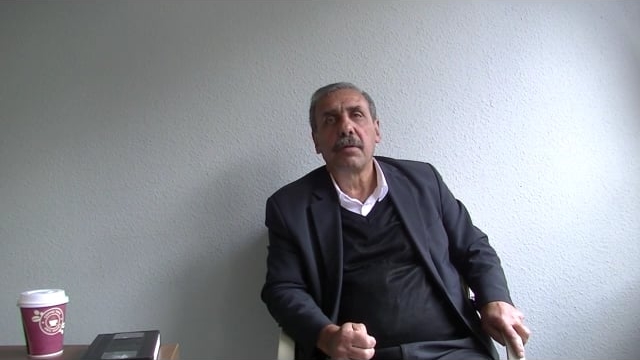
Country of origin: turkey
Year of settlement: 1993
Age on arrival: 35
City: bochum
Gender: male
Language of the interview: Turkish
[i] Today is April 28, 2019, Sunday. Now Mr. [name] is my guest, I want to interview you. Thank you very much Mr [name] for taking the time on Sunday. Are you ready for an interview?
[r] Welcome.
[i] Before we start, you have a video cassette with you as a souvenir, I suspect no one recognizes this cassette anymore.
[r] Yes.
[i] Take the cassette in your hand and [tell me] what [is that] cassette?
[r] This cassette since the year… There weren’t many videos back then, in the eighties. We start in 1988 to 1991. I took some photos in the village; many of the relatives I took in have already died. Visually, what do you say?
[i] Video image.
[r] Correct. This excerpt from Selhe [village], Midyat, Nisebîn and Mersin. When we lived there, from our family and surroundings and people from the village. That includes things like that for me. This is a very valuable memory for me. When I’m bored I watch this tape, I look at old times, what was it like then and what is it like now. That’s why this cassette is important to me.
[i] Won’t it break?
[r] I saved them on CD and other media, just bringing them with me as a souvenir. This is an old cassette, after a few years we changed the cassette, I put it on another cassette and I have them on CD and also saved on a stick, Images captured.
[i] You have your life story secured?
[r] Yes, yes. There are a few of them, but this is a source, you can say the main source. Back then I have many like this cassette taken on camera at the opportunity, I knew I needed some time this…
[i] How did you take this cassette with you?
[r] After our arrival we got them, after two or three years, later you sent them to us.
[i] Was it sent to you later?
[r] Yes.
[i] Let us come to your life, can you introduce yourself to us? When were you born? Where?
[r] I am officially, I believe, a two years have written me in lowercase [?], I’m in 1959 born in Selhe, a village of Mityat bin and in my opinion, was my birth 1957, because I’m after the name of [name] am called. The Democratic Party was good back then, the democratic party and the transition to the first multi-party system, it was the CHP and the Demokraft Party, in 1957, the Democratic Party won under the leadership of [name]. I know I was born at the same time in 1957. It was the election in October 1957. They gave me this name, this name comes from there, I know it like that. I’m official 1959, but in reality born in 1957.
[i] They wrote you down for two years so that you could later be sent to the military.
[r] They didn’t know that either, they just went with it at the time Nufus and by everyone’s estimation the 1.1. written but mine is on the 12th, how did that happen. And you have written 2 dates. All were released on January 1st. written. I started in 1965 with primary school, in 1965. I attended primary school in the village for five years. Thereafter I went for three years to the secondary school in Midyat and I attended high school in Midyat for two years and last year I moved to Cizre. My brother was an official in Hazex [city name] in the health sector. I also went to the city of Cizre, I graduated from high school in Cizre. After graduating from high school, my brother took a bus for a service between Midyat and Hazexè, he bought a dolmuş [minibus] . We couldn’t find a driver, he told me I should learn to drive, I drove this car for two years without a license. I worked as a driver between Midyat and Hazex. After that we had a truck and in 1979 I joined the military. After military service I got married After that I worked as a driver again to Iraq, Iran, from 1980 to 1988 I worked on the way to Iraq. I drove oil trucks and trucks, I brought goods there and transported oil from there. I was working on the way to Iraq from there I drove the truck to Europe in 1988, with Termoking [?]. I start after started in Europe as a truck driver, um, me worked for three or four years on the way to Europe. In the early 1990s the country began to deteriorate.
[i] Which countries did you go to?
[r] I mostly went to Iraq, I have cement from Mardin and wheat loaded from Cinar. We loaded cargoes from Antep and brought them to Mosul. We unloaded the load in Mosul. After 1983 all were converted into tankers for oil. We carried oil from there to Batman, we were out every other day to Batman.
[i] Where did you get it from?
[r] From Tilahfer, near Mosul, Afterwards we got something from Besh. Also the work on the tanker continued for a few years, Oil transport. We often went to Batman, then to Iskenderun, then as I said, we loaded fruit from Mersin.
[i] Which country in Europe did you deliver to?
[r] Mainly to Germany, the center was Germany, more often the Netherlands. I used to often load strawberries from Bursa, strawberries and anedes[?], that were frozen, we carried from Bursa, have it unloaded in the Netherlands. [?] They said they made jam from it back then, I did truck transport for a few years. I worked on the truck, like I said, most of the time we also delivered meat, Badkirche, Germany. from Bremerhaven, I often loaded things from Nuremberg and I transported them to Iran. We delivered meat from here to Iran, we carried the meat from here for the Turkish military, we exported fruits from there. It lasted until 1992, 1993. The situation has now changed worsened in Turkey. We have our house from Nusaybin relocated to Mersin. We bought a house there conditions have worsened, politically. Life for the Kurds became difficult in the nineties, then the children came here. After the children came here and applied for asylum. I stay with my children, I leave work, Since 1993 we lived in Europe.
[i] Okay, let’s get to Europe now. In 1993, which cities did you come to?
[r] To Bochum.
[i] Have you been in Bochum since 1993?
[r] We have been in Bochum since 1993.
[i] What does the city of Bochum mean to you? Have you ever been to Bochum as a truck driver?
[r] Yes. When I was a truck driver, my wife’s sister was here, married. I visited her, That’s why I knew Bochum a little. Sometimes I stayed with them for a night or two. You get used to the place you already know. Now Bochum is beautiful for us. We don’t replace any place with Bochum, because we have lived here for over twenty years. Bochum is a beautiful city for us, to say that you get used to this city and the conditions are not bad.
[i] Before you came to Bochum, how did you find Bochum? You used to only come here as a guest, look at it through the eyes of those days.
[r] I looked at it through the eyes of the guest, otherwise I would not think and never thought I would come here and settle. I had a store, if I even dreamed they would call me crazy. Circumstances change. Bochum was very nice but I never thought I would come to Bochum and live here. At that time there was the Opel factory. I visited Opel and the university when I came as a guest. Bochum looked beautiful but I didn’t think I would come and live here. We are still happy with Bochum.
[i] How many years did your children come before you?
[r] Uh I say, When I was a truck driver, my children were already here. When they applied for asylum, I left my job as a truck driver and also applied for asylum, at the same time we can say. I came before them but when they applied for asylum, I had to stay with my children.
[i] Where were you in Bochum?
[r] In Werne.
[i] Werne. Have you been in an apartment?
[r] Yes, in an apartment.
[i] How was the apartment?
[r] It was an attic, Attic with two rooms. It wasn’t pretty, but it was better than a home. We said we would rather be here than a home.
[i] The house you lived in, was it for foreigners or for everyone?
[r] That was for everyone, the owner was a Turk, two and a half rooms.
[i] How many people lived there?
[r] We had five children and with us seven people, two and a half rooms, the circumstances were like that back then. They either lived in a home or in a place like this. There was no other way we stayed there for five or six years until we found a slightly larger one in Werne. It was like that, but it was bigger. We stayed there for a few years and in 2004 we bought an apartment in Goldhammer, our son bought it for himself and we were tenants, As I said.
[i] What were the contacts with the neighborhood? earlier?
[r] It doesn’t matter if our neighbors are Turks or Kurds, until now, since we lived here until now we didn’t have any problems with the neighbors. We don’t have any problems even if [they] are Turks, Kurds, Germans. Now we have Yugoslavs as neighbors, but we had no problems with the neighbors. I don’t know, I don’t know whether it’s from us or from them. [?] We never had any problems with the neighbors.
[i] How was the contact?
[r] Also the contacts, we respect each other, when we see each other we don’t drink tea without our neighbor. Um our contacts are not bad, we think it’s good.
[i] It’s good.
[r] Yes, that’s good. There are Turks, Kurds and also Germans. So far we have never seen anything negative from our neighbors.
[i] You said before that your wife’s sister lived in Bochum. Can she help you in a bureaucratic and linguistic way?
[r] Correct.
[i] You know that Germany is a bureaucratic country. A place with rules, how is it for you?
[r] That’s right, my wife’s brothers and sisters were here, without their help we would of course have had a hard time in terms of material and linguistic aspects. They did what was more necessary, they had help in relation to language. When you’re new, you know nowhere without the language. They helped us a lot, my wife’s brothers and sisters. There were also many friends from the country. People we know have helped us everyone helped us. Material, spiritual or human. Anyone who could do something did it. You didn’t neglect us, the acquaintances.
[i] How was the stay? Have you had residence problems?
[r] I think we haven’t had a stay for five or six years until our asylum application was recognized. After five or six years it was the stay for six months or a year, then they did three years and the moment we’ve come to now, my wife and all children are already German citizens. You have both German and Turkish citizenship. I only have Turkish nationality.
[i] You have the Turkish but a permanent residence permit, even a permanent one, right?
[r] I have a permanent residence permit. I also have a business and the apartment is mine too.
[i] When you were new here, weren’t you in the German language course?
[r] No, I learned it myself. There was a tape recorder back then and there were no courses like there are now, there weren’t that many courses back then.
[i] There was no course and without a residence permit you have no right to the course.
[r] Not allowed. Now anyone can take a language course; now it is accepted or rejected in three months; it used to take six to seven years. Even then they had no right to go to a class or do anything else, at that time I studied with the tape recorder.
[i] Nobody knows [that] anymore!
[r] Yes, nobody knows that anymore. There was Turkish and German and an accompanying book for writing. I sat there for months and learned, and the translation was very good. For example, I say “tak” in Kurdish then I get the answer in German. People speak Turkish, the answer was German. I listened to him in the evenings for months. I listened to cassettes and looked at the writing because spelling and reading German are not the same, reading German is different and spelling is one type and reading is one type. If we read German the way we read, it won’t make any sense. So writing and reading are not the same. A few months I learned that, I learned the rest from the street. Now I can express myself in German, I won’t stay on the ground. I could express myself in language,
[i] When you came here, have you traveled a lot. You have traveled extensively to Asia, Europe and other places. So we come to the branch. Come and share your life… After you came to Germany, What do you think? You came to Germany and are never allowed to go back.
[r] Correct. Um, when I came here in the truck, I said to myself that I would come and travel across Europe. If one day I told someone that I would go to Germany one day, I will apply for asylum there, I will live there for years, run the store and buy a house, When I said that, those who knew me said, “You’re having a crazy dream.” So that means people’s dream is real. So I saw it that way. I ask myself today, would I go there? Germany is now the center of Europe. Other countries, no matter how far I travel, the best is Germany, in traffic, in justice, in humanity, in human rights, Germany is the most stable country in Europe, Germany comes first. When I said come here and I’ll settle down, they called me crazy. It was a big surprise for me too. Sometimes dreams come true, we didn’t dream either. I say, how can I take my children there? We didn’t have a plan, but when conditions in the country worsened, we came here. I think that was our fate, which I never imagined but happened.
[i] What kind of problem did you experience in Bochum?
[r] I have not encountered such a serious problem.
[i] Did you have no other opportunity to pursue another profession, vocational training, training or further education other than as a driver?
[r] I am over sixty years old. It would have been better if I had done it earlier, but the conditions were not favorable, I didn’t have a residence permit. I received a permanent residence permit a few years ago. You couldn’t do anything without a permanent residence permit. Until we have received a permanent residence permit, our age has passed. Today I am sixty-one years old, what can I do after this age? Previously the conditions were not appropriate the stay was a problem. You can’t do anything without a permanent residence permit. You couldn’t open anything in your name, if you had dreams, would you? The stay was a problem.
[i] When your family came here, did you still have relatives back home?
[r] My mother stayed there, for example my sister is now in Istanbul. My mother died twelve or thirteen years ago. My mother was there my brothers’ wives were there, so many stayed there only my children came here.
[i] What was your relationship with them?
[r] Our relationship was over the phone. I could only go home after receiving a residence permit, my mother died and I didn’t see her, I couldn’t go. Then I visited her grave, I didn’t see her, I couldn’t go when my mother was alive. Two years after my mother died, I was able to leave. I went to her grave, I couldn’t see my mother when she was alive.
[i] I would like to ask this: when you came as a driver before, you knew that you came as a guest. You unloaded in the evening and loaded in the morning, you were free. You came here and are no longer allowed to leave, you don’t speak any language and you don’t have a passport. How was it for you?
[r] It was a very difficult situation. If your mother and your relatives are not in the country If you can’t visit, you’ll feel like you’re in prison. No matter how free this country is, even if it would be a paradise You are not allowed to visit your mother or relatives back home, you’re like in prison. There is no difference. We had, we had no other choice. Even if we go to our country and wanted to see our mother, we couldn’t. I would like to see my mother, unfortunately such conditions were.
[i] Couldn’t they come here either?
[r] They couldn’t come. If they could come, there would be no problem. They couldn’t come either You can’t come today without an invitation. Today, when I bring a relative here, their circumstances are difficult. You can afford it when the person cannot walk.
[i] I know that there are many Kurds in Bochum, You know most of them too. How are your relations with the Kurds in Bochum? Do you have a club? How do you see yourself? How do you meet?
[r] Relations are weakened, relationships used to be better. Now people are strangers to each other, not like before. In the past people met in the club, they met lovingly, and discussed lovingly, but but today it is not like that. It used to be better. Now the meeting is less frequent. Um… what can I say, these days we can only meet relatives and friends in this country at a funeral or a wedding. Today we can’t see each other if there is no wedding or mourning. Nobody visits nobody’s home. In the past, you could spontaneously visit a relative or acquaintance at home. You go to them and say, “Es salamün aleyküm, I have come. He said, “Welcome.” Today I have to make an appointment three days in advance. Make an appointment or what? First you have to ask if they are there at a certain time accessible so you can easily visit them. What happened today There was no such thing before. There was friendship between people. Once people found each other, they couldn’t let go more. They spoke from the country or from here. Today we pretended today our people are very cold. Like I said, either we’ll see each other at a wedding or we’ll see each other at a funeral service or by chance we’ll see each other outside. I don’t know, whether it’s like that in the country or just here or in the country people were so carefree. I believe that it is the same in the country, I don’t really know them, but people here are cold to each other. They say, “I don’t need help from anyone, I have everything. Um everything is robust, “I don’t need anyone, I don’t greet anyone.” That’s not the right way, today we are relatives of each other, we came from the same village, country or we know each other. [?] People need to ask each other and they need to support each other. Um…. There is no longer a close friendship, our relationships have lost meaning. Our people can no longer face each other, I wonder why? Is it the culture from here? The culture from here isn’t that bad, though we have become bad.
[i] Is there anyone else from your family here besides your wife’s brother and sister?
[r] Yes, my family, my brother’s children are here, my sister’s children are here, I have many relatives here.
[i] How are the relationships?
[r] As I said, not much, the relationships are there but cold, not so warm.
[i] How many children do you have?
[r] It was five o’clock at home, one was born here. He is seventeen. We have six children.
[i] How many girls and how many boys?
[r] Three girls and three boys, three are married and three are single and are two married girls in their own home. Our married son is our neighbor. My two older sons work in a company. The smaller one is still studying.
[i] The three unmarried people live with you?
[r] The three are with me, the other goes to school.
[i] What is your relationship with the Germans?
[r] Relations with Germans are, whether in the store or as neighbors, good. Germans aren’t bad Germans live according to their culture, us according to our own culture. But our cultures are more or less the same, we are similar. Our relationships are very beautiful, For example, in the shop I have more relationships with the Germans than with my compatriots in my shop. I have customers who come to my store and I also have neighbors here. I have a shop under the Bochum town hall. There water [bottle tipped over] officials who work there. My relationship with the people who work there is very good. We love each other so much and often wonder. We are very good to the Germans.
[i] Sometimes you are not able to communicate with the Germans, because you don’t know the language. You don’t really understand the Germans, because you can’t express yourself correctly in language and don’t understand them. Then you blame other people.
[r] Yes, right but 100%. We have been here for thirty years and if we go annually Once we have learned a word, we must be able to speak. Let me say something briefly, It was three years ago, one came into my shop to buy a newspaper. Let’s say the newspaper Picture. He told me… He asked me if I was a foreigner. I said, yes. If we had any problems, of course he asked in German. What is it to you, I replied. He said, “Don’t be angry with me.” I said that his question was not correct. He asked if I [him? Mustafa?] know? No, I didn’t recognize you. You tell the truth how should I know you? He said he was a member of the SPD, Axel. Then I say okay, you don’t have to say that, Axel Schäfer. I knew your name though I said, in our country, if a representative, visits the city, sixteen people protect him. You are like an ordinary customer. I heard your name. I saw you on TV, but I didn’t know you today. Axel Schäfer is still a member of parliament, “I would like to ask if you have a problem with Germans or the bureaucracy.” I said that we don’t have a problem and… Thank you very much, that’s how we both met. Germany’s bureaucracy is like that. We admire such bureaucracy, we wish for such bureaucracy in our country. A representative from a parliament who comes alone into a stranger’s shop. Regardless of whether you are a foreigner or a local, go into the city alone, without protection. We are shocked here.
[i] Do you think something like this will happen in our country one day?
[r] I… even if possible, fifty, sixty years later, we are at least fifty or sixty years behind. Fifty, sixty years, maybe more, but I appreciate it so, perhaps. Today the mayor of a city is there are sixteen [people] guarding him and they drive in a bulletproof car. I see the mayor of the city of Bochum, the weekly market is in front of the town hall. The mayor takes the basket, earlier was it a woman, what is her name?
[i] Ottilie Scholz.
[r] Ottilie Scholz. I always saw her with the basket in her hand, the mayor of the city of Bochum. She was shopping at the market. It’s something so unimaginable in Turkey. It’s like my dream to come to Europe. I can’t even imagine something like that in Turkey, that the mayor of Istanbul should do something like that. Here’s why we’re back, hopefully we will see it but too late.
[i] That depends on a little, for example Ottilie Scholz or Axel Schäfer like a member of parliament. They are not afraid because they do not steal and have no corruption. Why do they need guards and why should the cops be with them and close the streets? This is the reason.
[r] That’s right.
[i] Because there is so much theft and corruption in our country, he cannot go alone because he does not trust himself.
[r] Now everyone takes their own followers and friends. There is a lot of injustice in our country, there is nothing like that here. Namely, um, I’ll say something else. The elections take place here, many people come to my shop. I tell them that there are elections today, they don’t vote. Oh what? Why don’t they vote? It’s your right. Says no matter who wins, our right is our right. Look who is in government so CDU, SPD whoever comes, my right is my right. Nobody can take away my rights. It’s not like that with us, We research the winner to the end to see who didn’t vote for him. If you’ve worked there as an officer for ten years, they’ll fire you. They take their followers, so we have injustice. There is no such thing, They say no matter who wins, my right is my right. Whoever wins should… it’s not like that with us, what we don’t do to ourselves until the end of the election. The problem is there, everything runs through followers and relatives. Our problem is there, it is very difficult until we improve.
[i] That’s correct. Here comes election day, you don’t know it’s election day.
[r] That’s what I say too.
[i] Did you see one day at the elections, that someone was shot or had an argument?
[r] No and built crowd, There is a rally every day and they block the city. You have no right to do this to people. A Turkish government official, if he wanted to go to Istanbul, all streets were evacuated three days in advance. Despite the crowds, these people will block roads. Who are you? Such things must be abolished [stopped?], but when?
[i] We come to Bochum. You say that Bochum is very beautiful and you like it too, what does Bochum mean to you?
[r] Bochum is like our last name. You actually know people, in the beginning, even if you live in the country or on a mountain for forty years, live there for twenty, thirty years, it becomes a um…
[i] A home for you.
[r] It’s your home, you love it and you couldn’t leave now. For us, Bochum is the same. Now what you give me in these other cities, in Essen or in Dortmund, when I go there, it’s like I’m going to a foreign country. That’s what happens to me. Bochum is like my home, I’ve been here for twenty-five years, Bochum has become my home. How much I love my home, I love Bochum so much. Bochum was like that for me.
[i] Where is your favorite place in Bochum? Which district? Which street or corner?
[r] One of the most important streets is Kortumstrasse. Kortumstrasse is the center of Bochum. When you talk about Bochum, the first things that come to mind are Kortumstrasse and the Bermuda Triangle. I really like the university and the botanical garden, it has a beautiful garden. The university is nice too. Otherwise in Bochum, Bochum’s soccer team is in the second division. When it plays, I always want it to win. That’s how we love Bochum, It doesn’t really matter how things go. Whoever it plays with, I’m a fan of Bochum. People ask me, why Bochum? I’m from Bochum, how can I not be a fan of Bochum? And I don’t help him? There are many things to like in Bochum, the Ruhr Park is beautiful. The Ruhr Park was supposed to be the first in North Rhine-Westphalia.
[i] There are also many museums in Bochum, There is, among other things, the Mining Museum, what is your interest in museums?
[r] I was once in the mining museum, the mining museum is nice. I haven’t been there in a long time though the mining museum is famous.
[i] Are there places in Bochum that you don’t like?
[r] No. I wanted Opel to stay in Bochum, but it didn’t work out.
[i] That’s right, with the closure of Opel, many people lost their jobs, Opel, Nokia.
[r] When Opel closed, the Bild newspaper did an interview with me. My photo and interview were published. They asked me, they said, “What should we do to stop them from closing?” I said in the interview, “People who live in Bochum and can afford it should buy an Opel car so that we can show our solidarity.” I presented my thoughts there.
[i] What do you do in your free time?
[r] I’m home, I watch TV and look at old albums, um… When the weather is nice I’m in the garden, I’m busy with the garden. my free time goes like this.
[i] You drove for almost twenty-five years, you started with an omnibus and then you drove a truck.
[r] Yes, I drove for a long time.
[i] And you do it here something else, why?
[r] Like I said, my driver’s license from Turkey was not valid here. They said I should have a driver’s license from here, if I wanted to drive a truck and I wanted to like driving trucks in Europe, but I had to get a new driver’s license. My asylum lasted eight years and I was not allowed to get a driver’s license after eight years. I worked in this job so that I wouldn’t be unemployed. We opened a small shop so that we could make good use of our time. Otherwise because I don’t like the truck driver. I would like to work as a truck driver, it is very nice in Europe. I couldn’t get a driving license for eight years because I didn’t have a residence permit and the Turkish driving license was invalid here. I have been a truck driver for many years, my driver’s license was invalid here. I had to get a new one here, you have to pay a lot of money to get your truck driver’s license, the state didn’t pay the money even without recognition. I had such a challenge. I had to open the store, then I worked in the store after I got used to the work. I connected there, I couldn’t let go,
[i] You work in the kiosk, working in the kiosk is a difficult thing. You have to work twenty-four or twenty hours a day, how do you manage that? How did you come up with the idea of opening a kiosk? What did your children say about it?
[r] My opinion was that I should do something so that the children could help me. My children go to school, they study and they come from school and go out, maybe they make bad friends. So that the children don’t go down a bad path, I would like to open a shop for us so that the children can work in the shop when they come home from school. I opened the children’s store to stay in business. I opened this shop so that the children could stay with me, help me, so that they don’t get into bad habits. I opened the shop so that the children could come along in the store when they get home from school. They should spend their time in the store doing something and reading the newspaper. At first just for that, but after a few years have passed, if you are used to a job and if you specialize in it. Everyone is the professor of their profession, everyone is successful in their life. When a person has worked in a job for a long time, he becomes like a professor. I am a professor of this work. After I got used to this job, I couldn’t stop I take our remuneration from this and an activity for my children.
[i] Although you have a small kiosk, you employ two people, that is a very beautiful thing.
[r] Yes, two people work for us, two temporary workers spend their time with me, They both help me and earn something from it. I can’t afford any more. I said that both of them should help me and earn something, yes that’s right and the children help me too. It works now as far as possible.
[i] So even if you have difficulties.
[r] There are many difficulties.
[i] Are you satisfied with your work?
[r] There is no life without difficulties, everything has difficulties.
[i] What does culture mean to you? Let’s say art and culture whether from Kurds, Germans or foreigners.
[r] I am interested in culture, I follow world culture, we introduce our children to our culture as much as we can. You learn the culture from here yourself through reading and seeing. They are used to the culture here, we tell them our culture, What they don’t know, we tell you. Children remain between two cultures, a little bit of ours and a little bit of theirs German culture. You have to combine both cultures. We already implement our culture for ourselves, our children must embrace the culture of this place because they live here. We can’t say we just take ours, but We’re not interested in them, it’s not possible. If the person has lived here for twenty years, Can’t you say that I don’t accept anything here. That’s right, life is that. I came to this country. I’m going to the mosque go, but I wouldn’t say the church is haram. It must not be they must remain in balance. They should love theirs so they can love yours too. This is the culture and life.
[i] That’s right, the church is not strange to us because we also have churches in our villages. Where there is no church, how should they respond?
[r] We went to church a thousand times, regardless of race and religion you must know to respect the opposite, if it is like that. People don’t get mad at each other. If I respect the church, the synagogue and others, they will respect mine too. If we respect each other, we won’t torture each other anyway. We can’t do anything about each other, the problem of the world is here. We have to accept each other, we have to get to know each other, we have to get to know each other’s culture. I have to like his culture, I don’t have to say if I’m Muslim, call myself Christian. So if the other person is Christian, he is not obliged to say that he is Muslim, but we must respect each other. We have to respect each other.
[i] Correct. So you’re saying that if we have Ramadan, we also need to know that they have Easter. Now it’s Easter time.
[r] Right, we know that beforehand. As they said, we had Christians and still had churches in the village. We already knew their festivals from the village. We know their festivals in the village and here we also know the festivals twenty years ago, here perhaps no one knew and here they didn’t know what Ramadan was. Well, because there are so many Muslims here, they know Ramadan better than we do. That is, this is how they get used to our culture, we have to love each other’s culture.
[i] What does home mean to you?
[r] Home is everything to me. For me, home is where I was born, its stone and soil. […] I say when I was a child I was born here and lived here. I just feel like new born, there is nothing as valuable as home and the earth for man. If I lived here another hundred years, the soil of the country is different. Some said, “Our country is better than here.” That’s not true. We don’t say it, but the place where man was born, even though he be of fire, we were born there, lived there and grew up there, he is sweet for us. I’m not saying this place isn’t beautiful, but, but man’s own country is different. Going there puts you in a good mood, the weather is nice. When you go there, you remember your childhood. You remember your youth, you went to school, you traveled around there. Everything comes into your eyes as if you were newly born. Home is like that for me.
[i] That’s true if you takes the children with her, How much would you remember of your childhood from here if you took your children with you? How much would they tell their children? Their minds are here because this is their country.
[r] Yes, they think about here but we tell them. We were born here, this is what we did here, so that they know. They should know that we came from there, were born there. Um for example, Our roots come from there, let them know where we came from, this is the culture. They should know that they came from this country, to ensure that their future is not lost. It may be that if someone asks you here, “Who are you?” that “I am German, I was born in Germany” is not enough. They need to know where their parents came from. We teach our children as much as possible, It must be.
[i] Even if you don’t tell the children, they will notice because you speak a different language at home.
[r] That’s right.
[i] Children ask you, “What is that? Why do we speak German in kindergarten and school? Where does this language come from?”
[r] It’s true. But it would be better if people took them into the country and told them. You have to explain your roots in a way that they can understand. Of course the child asks you. It knows we are not locals and we weren’t born here. You have to tell your child. If you have the opportunity, you should do it every year bring them home and you’d better tell them that you come from here. This is our culture, here is our village, that’s how it should be.
[i] I think you can go into the country now?
[r] Yes, I can go for a few years, I go almost every year.
[i] Once a year?
[r] Yes. We go [there] once a year, we visit it once a year, that’s enough.
[i] You’re right, let us come to your childhood and youth. You told a little about your childhood, tell me about your childhood in the village? What kind of dreams did you have? What did you want to be? What did you want to do? You were born somewhere and had to go to another country! How many siblings do you have?
[r] Yes, we are right in the village. Like I said, we were three brothers and one sister. My big brother died in 1987, no 1978, 1978 and the other in 1983. My two older brothers died when they were younger. Each had five children, her children are here, they came to Germany. My sister currently lives in Istanbul, she lives with her children in Istanbul. As I said, my childhood was spent in the village. When I grew up a bit, I worked as an animal herder and then I went to school. I went to school in the village for five years. My dream was school, I wanted to go to school until I became something, so I had no idea what I would be. The conditions were difficult At that time the conditions for attending school were very difficult. I wanted to graduate from high school to the university, which subject didn’t matter. You can’t just say that I would definitely take this subject because the circumstances were difficult, we were ready for anything. There were no financial options either. If you didn’t have money, you couldn’t study. Nowadays every city has a university, previously there was no university there, only in Ankara and Istanbul. If you don’t have money, it is not possible to study in Ankara and Istanbul. We attended school in Midyat under very difficult conditions, without money this is impossible. I had no dream that I would do this job. I just wanted to study whatever I could afford, I dreamed like this Unfortunately, my dream and my real life didn’t match. The conditions of my life changed, it developed in a different way. I left school and started driving, that was exactly the opposite of what I wanted.
[i] Yes, that’s true. When you started driving were you with your brother?
[r] My brother was in Hezex, my brother was a nurse in Hazex. Yes, I stayed with them, That’s why I had my registration from Midyat high school in Cizre, At that time there was no high school in Hezex. I went there because it was closer to Cizre. After he bought a car, there was no one to drive. I had to learn to drive the car. My brother bought the car there. When he bought the car and after I learned to drive, I drove the car.
[i] In the village and town where you grew up and went to school, there were different religions and nationalities. There were Christians, Yazidis, Mihalemiye and Kurds there, what was your relationship like?
[r] I attended school in Midyat for five years, and we were together for five years. There was no difference between Yazidis, Arabs, Christians and Muslims. We had no difference, as humans we were all the same. When greeting there was no problem. When I think of Midyat, I think of multiculturalism. Multicultural is Midyat. Midyat and Mardin. Then I moved in with my brother in Hazex, where there were Christians and Muslims. There were no Muslims in Hazex before and they came to the center later. The mayor was Şükrü Tutuş, he was a Christian. We were like brothers, I was small but he saw me like a brother. He joked with me even though he was the mayor of Hazex. He was mayor of Hazex for several years. There was no difference between religions and we had no problems with each other. I went for military service, after military service we came to Nusaybin. We lived in Nusaybin for ten years. We were in Hazex for six to seven years, then we stayed in Nusaybin for ten years. Until we came here we were in Nusaybin. There may have been no Christians and no Ezidis in Nusaybin, but culturally. People loved each other very much and they lived harmoniously with each other. I spent my best time in Hazex and Nusaybin, I was still a child in Midyat, so I couldn’t say much. But in Hazex and Nusaybin I had the best moments of my life.
[i] Are you saying people lived there without problems and harmoniously?
[r] There were no problems between people or religions. Christians and Muslims were harmonious, After us, problems came later and it still goes on, and even worse. It really wasn’t a problem before.
[i] Now in Ramadan, every place in Midyat is closed.
[r] I would say it, used to be in Ramadan Cafes everywhere and restaurants open. Those who wanted to ate, those who didn’t want to didn’t eat. Nowadays that’s not the case. If you go there today, you can’t even smoke a cigarette in the city, but if you drink water you will be stoned. It was so bad, now I can’t go home for Ramadan. It doesn’t matter where I couldn’t go in Ramadan or say I’m sick. For example, a sick person takes ten medications, he couldn’t fast. They say, “No, you have to do it.” Why? Because if you die while fasting, you go to paradise. If I know that I do not take medication during my illness and fast that I die, I know that if I do this intentionally, I will go to hell instead of paradise. If someone says, I will go for Hajj. (Pilgrimage to Mecca) I’m not against it, I’m not against such things, but everyone should be free to decide. We will go to Hajj and if we die there, we will go to paradise. They want to die in Hajj to go to paradise. That is not right. Go to Hajj, but not to die there. That is not correct. After you have committed a hundred thousand sins, go on pilgrimage and I will go to paradise, [?] and perhaps they would die there on purpose so that they could go to paradise. That is not right. You will commit any sin and if you die there, you will go to paradise. That’s not true. Most of our stuff is wrong, but you can’t tell, we can’t tell our people. We say that Hajj is not obligatory, do not go and we do not say that fasting is not obligatory and do not fast, but those who have problems should not fast. You can’t tell anyone. I say, “I’m sick and have to take medication,” they say, “No, you have to fast. If you die while fasting, you go to paradise.” You couldn’t go to paradise because you know you’re sick. There is no such thing, it is suicide. They have made the conditions of Islam there more difficult. It didn’t used to be like that, back then there was Islam too, no matter who goes to hash, who fasts. The conditions were clearer, now they have tightened them.
[i] They have converted Islam into politics.
[r] Of course as…
[i] That’s why it became harder.
[r] … political Islam came to power, this is what happened. Of course, such pressure is already coming from the government. If political Islam weren’t like this, it wouldn’t be like that. At the moment the conditions of Islam are becoming more severe.
[i] There are hundreds of thousands of prisoners in prisons in Turkey. Now 7,000 political prisoners are on hunger strike, There are also many people on hunger strike outside.
[r] Nobody cares.
[i] These imprisoned people have in one Islamic country has reached the critical stage of death. They’ve been in it for 172-173 days right now, but no one is talking about it. How do you see that?
[r] The people under the pretext of being a terrorist to be in prison deserved to die in the eyes of the state. You don’t see them as people, they call them terrorists. You see, They tried to lynch the leader of the opposition party on the pretext that he was helping terrorists. This is what happened now. Very dangerous. If it continues, people won’t be able to get out of there. If things continue like this, it will be difficult for us to go home. I say in relation to Islam. They have tightened up Islam and they don’t see the other things. They say these people are terrorists. If they all die in prisons, I won’t mention it. If they’re dead, they’re dead. Because he doesn’t understand humanity, [he] doesn’t see them as people. If he sees them as people, even if he has already been convicted. He is a human being but he doesn’t see it. He blinds his eyes and turns his face.
[i] Why do we personalize religion in our country and throughout the Middle East? It would be removed between man and God. What is the reason?
[r] No matter how far we go, the conditions of Islam will be more difficult, there is now Daish [IS], they wanted a new Islam. What is the new Islam? It brings even more difficult conditions. What has ISIS done to the world? And there is still danger they are increasingly aggravating Islam for those who want this stricter Islam. If they have power, they will Islamize the world. A very difficult condition is placed before the world. They made Islam so difficult if we can say some, most of it comes from politics, when the government advances political Islamism and if she gets votes through Islam, what would people do? They intentionally tighten the constraints.
[i] Okay. If I hadn’t made this mistake in my life, it would be better. I wouldn’t do this if I had my current head, what do you regret in your life?
[r] things I regretted, Things were always going well in my life. Sometimes I said I wouldn’t do something like that and even when I did it, things worked out better for me. I have never regretted anything until now, as I said.
[i] What is the good thing that you are proud of?
[r] I am proud that I took my children from danger and brought them here. I try to work with all challenges so that I don’t have to accept help from anyone and so that my children don’t need anyone and my family doesn’t need anyone. already in life is enough for man, I never let my children need anything until today, I’m proud of that. So far I have not allowed my children to make mistakes. I supported her as much as I can. My children have not made any mistakes to date, I am proud of what I have done for my children and myself. Life goes on.
[i] Let us come to your youth. Every man falls in love in his youth, have you ever been in love?
[r] I fell in love and I took my love.
[i] Tell us about that.
[r] Now we return to the country again, according to Hazex, when my brother was in Hazex. My wife is also from Hazex. When we got there we found ourselves, after a few years… I already saw her there, I fought for it for a few years and then I was lucky we were married with great love.
[i] What year?
[r] In 1976 we saw each other, We got married in 1979. We waited five years. It was very difficult, but in the end we did it. How to say? What we have done for love and how many difficulties we have had, Because it ends happily, we don’t regret it.
[i] Of course that’s a good thing. But many people fall in love because of the difficulties one could not meet each other.
[r] It is the greatest death, we waited a long time and had many difficulties, we met under difficult conditions, but after we were together we forgot everything. We don’t regret it.
[i] Let’s… How did you decide to come here? You and your wife and your small children. How did your parents feel about your decision?
[r] At that time my wife’s father and my father were no longer alive, only our mothers were alive in these years, when I came here as a truck driver. The political situation in Turkey had deteriorated. Most people came here most people came here in the early 1990s, Most of the people were already here, I saw them in the home. I didn’t dream of bringing my children here. I came and went. I didn’t have a dream But when the political situation in Nusaybin became more difficult, we moved to our house in Mersin. After a two-year stay in Mersin, the conditions there also deteriorated and the political situation deteriorated. In the 1990s, 1991, 1992, the political situation became very bad. It was very difficult to be a Kurd there, the life of the Kurds was very difficult, there was a lot of pressure and there was a lot of bullying. Everyone knows the nineties. When I came here in the 1990s, my children decided to come here. They said they couldn’t live there anymore. Yad and Av Zarok bones. Yad and Magta Girtin, Zarok Rauch. And it reminds you of that. Zaharok bugba. So Gısal. Teaching has already done damage, it has done damage to a piano. This is a great blessing, my lady, even a great blessing Hua Raven-i Mavruf, the air is fresh for everyone, read it, mother. We decided that after the children came, I had to come too.
[i] What was the separation of the family like? Were the children smaller back then and your wife had her mother or did you leave your mother and relatives?
[r] In those years, if someone here had the power of attorney for the children, the children could come without a visa. At that time my sister-in-law and brother-in-law were here and they invited our children. Then the children could come without a visa. They took custody of the children. When the children came to live with them, my wife was left alone. My wife came here on the run. As everyone comes. After she came here too, I was able to come, and I came too. My life didn’t stay there. After the children came here, I applied for asylum and stayed here. My mother-in-law and my mother stayed at home. My mother was in the village and my mother-in-law stayed in Mersin in our house. It was luck and fate. We came here for the political reasons, we didn’t come here voluntarily. I didn’t want to come here, there was no need to come here. I had a very nice life, but the living conditions drew us here.
[i] Are you thinking about going to your country and living there in the future?
[r] Well, even though me and my wife wish it, we can’t leave the children. Even if we want to, children don’t want to live in Turkey. Children who grow up here go to school here, have a house and a job here. No matter how much we want, we cannot take children with us. 90% of the children belong here. We can’t separate the children from here anymore, even if we leave. After the children stay here, what will we do there? So we’re here until we die. The conditions are like this. After we buy a house here, where will we go? But we would like to go to our hometown. When we see our hometown, we like it when we go there. We are relieved because we see the relatives and friends who stayed there. We would be relaxed, but the children are not like us. The children can say we go every three years. We would like to go every year, we are over sixty years old. Even if we go every year, we could only go ten times. Do we live a hundred years?
[i] So you’re saying we just go there to see it and not to stay?
[r] Yes. We go there to see our relatives, acquaintances and the country and come back. We belong here, we pay taxes here and live here. I can’t stay away from here for more than three weeks, the house, the shop and the cars are in my name. We belong here more than the people who already lived here. Me and all my children, we belong here.
[i] Yes it is true, If you work here, you pay taxes here and hire employees here.
[r] How much tax do I pay here per year? But I don’t pay anything in Turkey. Our life is here, as I said, even if I wanted to, my children are not coming. If my children don’t come, what should I leave for? And the conditions of our lives […]? After living here thirty years, when you go, man’s life would be in disarray, it doesn’t work anymore. Even if it’s possible, my life isn’t enough for that. We became the property of Europe until our death.
[i] That’s it, thank you very much. You answered all of my questions openly, honestly and from the heart, thank you very much.
[r] Hmm, long live for you too, I’m grateful.


