Country of origin: turkey
Year of settlement: 1996
Age on arrival:
City: bochum
Gender: male
Language of the interview: Turkish
[i] Today is March 11, 2019. I’m sitting at [name]’s house right now and I want to conduct an interview with him. [name], thank you very much for taking the time for the interview.
[r] Thank you too, any time. If you need anything I will be happy to help you.
[i] You have a prayer beads in your hand, does it have any meaning for you? Can you tell us something about that? How did you get it and how long have you had it?
[r] I have had this necklace since my time in Midyat [city in the province of Mardin in 13 BC]. That was 26 years ago. When I was in Midyat for the first time, my cousin noticed that I liked it and bought it for me. That’s how I came to it. I only use them at home. I take it in my hand. When I think about time, I take it into my hands. I leave her at home.
[i] If you give it out of your hand, it’s gone.
[r] That’s it. If you give it out of your hand, it’s gone. I make sure she doesn’t get away. I’ve lost so many chains, but these are the ones I pay special attention to. I pay a lot of attention to these and don’t give them away. It’s my first prayer beads ever, When I take it in my hand, memories of the village and my home come back. When the longing and sadness become too great, I take it out. I feel like I’m in the village when I hold it in my hand. It connects me with home, otherwise it has no meaning. Believe me, whenever I have it in my hand, I dream of the village at night. That’s the way it is. Either from the village or the field. I’m either on the vineyard or looking after the animals. As soon as I hold it in my hand, I’m in my dreamland. It is from Allah.
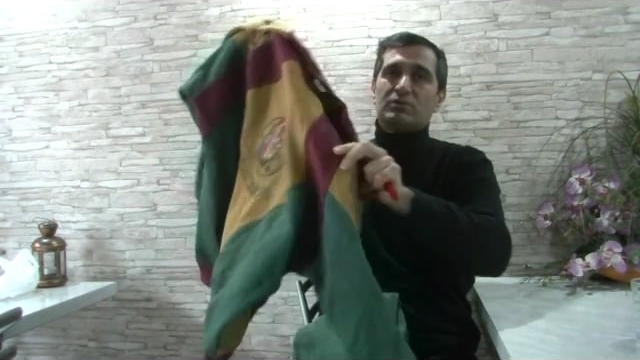
[i] Did you also have clothes with you, can you show us them?
[r] I have the clothes here too. When I was in Istanbul.
[i] When?
[r] It was 1995. 1995. When I was there I bought them and I’ve had it with me ever since. When I came here we got married. We had children. I was just 26 years old when I had my first child. She is still with me.
[i] Won’t it break?
[r] No, it won’t break. I don’t know, clothes usually rot, they get moldy or smelly. But nothing happens to the clothes. I wash them regularly but nothing happens. Like new.
[i] Are you wearing them?
[r] Yes, I wear them. What do I do if I don’t wear them? She is anyway a memory and a beautiful thing. Not to be broken. Look how new. The fabric and color are the same as they were back then.
[i] The colors are green, red and yellow.
[r] The Kurdish colors namely.
[i] Do you only wear this at home?
[r] No, I only wear it at home. Yes, only at home when I’m sitting with the children. Sort of like a sports suit, very comfortable and the lower part is just as new, nothing is torn, nothing is mended, nothing at all. No, nothing at all.
[i] Very nice piece.
[r] Yes, yes, it’s so easy, I have other suits. I wear the others too, but this is a keepsake like the prayer beads. It reminds me of home. When I wear it, I find myself at home, memorabilia. Because I’m 25 years old I haven’t visited my homeland for a long time. [Shows photos.] These are my photos, I have many photos. I rarely look at the photos because I get very sad, when I look at the pictures.
[i] Do you actually get sad?
[r] Yes, I get sad!
[i] Can you hold the pictures towards the camera, please.
[r] Here I was, newly arrived in Istanbul. I worked in a restaurant. These are all Russian businessmen. I cooked for her.
[i] What did you do in Istanbul?
[r] I worked in a restaurant. The restaurant belonged to a Kurd from Amed. I worked for him. I came here shortly after. I played billiards here. Life there was nice, but I was wanted for military service. That’s why I had to leave the country. The truth is: I didn’t want to come here, I would have liked to stay in my home country. Life there was very nice. Living in the country was nice, in Midyat. After I went back to Midyat and got married, the military was looking for me. I was in a difficult situation at that time. It was a big deal and I was scared. At first I wanted […].
[i] What year did you get married?
[r] In 1995.
[i] 1995?
[r] Yes. February 25th
[i] February 25th.
[r] February 25th, I’ll never forget that.
[i] On February 25th I wanted to interview you, you said no.
[r] That’s why I said no.
[i] That’s why you said no?
[r] Yes, that’s why. I went out with my wife. [coughs] Now there was a problem, that’s why I came here. For me our country is more beautiful. They say the nightingale has a golden cage, yet he said… It’s the same for us. Well, we adapt to life and the values here and are used to everything, just like Germans and Europeans. Sometimes when I look at Germans, then I think we are more adapted than they are. Nevertheless, your own homeland is better.
[i] Do you have wedding photos? The photo in the front is before the marriage. Here we are already married. [He shows a picture]
[i] How old were you when you got married?
[r] Twenty.
[i] Twenty?
[r] Yes. I was twenty years old. This is my wife. [he shows her photo] The children don’t belong to us. This is my brother, my brother and my uncle. My uncle lived in Izmir. I also went to Izmir. He died of cancer, he smoked a lot. He died. He was a good person. Here I can be seen with my wife. 24 years ago. Look at how time flies.
[i] Correct.
[r] Yes.
[i] You said you came here 25 years ago?
[r] Yes 23 years ago, I came here in 1996.
[i] Which city did you come to?
[r] I came to Bochum. I stayed in a camp in Dortmund for three months, in the camp in Dortmund. After applying for asylum, I stayed in Dortmund for three months. Then I was assigned to the city of Essen. Become in Essen, I lived there in a container. About a year. My wife came here before me. She came a year before me. It was like that. Up until our marriage we had great difficulties, she was a minor, she was younger than eighteen.
[i] Didn’t you get married before?
[r] No, we didn’t have a civil marriage, just a religious one. We already had the religious wedding, but not the civil one. Because I had not done any military service, I was not allowed to officially marry in Turkey. I couldn’t get married, so I came here.
[i] Where was your wife when you came to Germany?
[r] My wife was in Bochum. Because we were not officially married, I was assigned to the city of Essen and lived in the home in Essen. My wife was with her father in Bochum.
[i] What was life like in the camp?
[r] Yes, how was life in camp […]? The camp in Dortmund was good, that’s how it was… On the one hand we could do our prayers there, there was a prayer room. I couldn’t tolerate the food I asked for other food because I was sick and needed other food. The doctor prescribed a special diet for me. I had different food in the morning and evening, because I couldn’t tolerate the other meal. It was good there, I can’t complain. Financially it was nothing but with food you could continue life. There were many different nationalities. Then I came to Essen. I was in camp for a year and it wasn’t nice there. The bathrooms were outside and it was mixed. Women and men were separated, but open to one another. There were some from Africa, from China, it was mixed. This side of the camp wasn’t pretty. There were four of us living in one room, in bunk beds. We made it.
[i] Were you four Kurds?
[r] Yes, we were Kurds. We were Kurds, but two were not “real” Kurds. To be honest, they were Turks. They posed as Kurds in order to apply for asylum. Some were Alevis or Muslims and I forgot, I don’t know anymore. They were rarely there. I was busy getting married for a year. It didn’t work. I had to go back and forth every day. To get to Bochum I had to pay 20 German marks. [He smiles.] For a year I paid 20 German marks, At that time I paid 20 German marks for the permit. The cities of Essen and Bochum are different districts I believe.
[i] Did you pay the 20 German marks to the camp management?
[r] I paid the immigration office for the permit. I told them that I wanted to go to Bochum, for two days or a week. Every time. I stayed there more often until we get married. I wasn’t allowed to leave Essen. They said I could go to Düsseldorf, but not to Bochum. Essen and here are different districts or something, I’m not sure. After marriage, I came here and lived in the home up to the year 2000, 1999. Until I got my passport.
[i] Which home were you in?
[r] Here?
[i] Yes.
[r] In Langendreer, in Langendreer, in the high-rise buildings of Opel. We lived there. After that we came to Laer. We lived in containers for a while. Then they dismantled the containers and we were assigned to Herzogstrasse. Herzogstrasse in Bochum Riemke. We stayed there. After recognition I received my passport and we moved to the university center, left the home. It was nice on Herzogstrasse. Our place was nice and we were good to each other there. The others came from Mizizex, Ezidis and some from Yugoslavia. The ones from Yugoslavia were very good, there were some Kurds from Turkey, we were neighbors. Some Yazidis from Syria lived there and we had good contact with each other. Then everyone went somewhere.
[i] After a year you came to Bochum, how did you find Bochum? Your first impression, not now.
[r] It was nice back then it was good, not bad. Of course I wasn’t allowed to work back then. I wanted to work, but depending on location and bureaucratic procedures. If there were no bureaucratic procedures it would be good, otherwise [it is] not good. I didn’t want to stay here for the first three years. I would have preferred to run away. I wasn’t allowed to work or do anything; I almost went crazy. I was just at home. And back and forth to the social welfare office.
[i] Were you given a six-month or one-year residence permit?
[r] Six months.
[i] Only six months?
[r] Yes, six months, like a dead life. It was like a prison. We compared this with Turkey and came to the conclusion: life here is not life.
[i] Were you also not allowed to attend a German course?
[r] You weren’t allowed to do anything, you had no life as long as you didn’t have a residence permit. Until you have been granted residency for either humanitarian or political reasons, there was no life here. In my opinion, you’re like dead. Because you could Don’t even do anything for five euros. You beg for 5 euros from the social welfare office, it’s not even enough for cigarettes. I smoked back then. But I stopped. The money I received wasn’t even enough for smoking. What did you do without work? Besides doing nothing, 300, 400 or 1000 euros.
[i] In your opinion, what is the German bureaucracy like?
[r] In my opinion: Germany is unique in the world, in a social and bureaucratic way. In this regard it is better than many countries. I was in Holland, Belgium, France and Switzerland. I was also in Poland. So when it comes to the system and discipline In my opinion, Germany is better than everyone else. Germany is better than everyone else, but then again there are in other federal states for example before my asylum was recognized, in the social welfare office it varies from person to person. You don’t have a good view of people, they see you as a stranger, but generally most are good. You have a good life here.
[i] What problems did you encounter? What problems?
[r] What do you mean [that]?
[i] For example, when you were new in Germany. You didn’t have a stay. You didn’t know the language. How was your life?
[r] Challenges like, we felt comfortable in our country. You are free. I was free. I did what I wanted. Relationship between friends, there was nothing like that here, we went to the club, you could have good conversations there, in the Kurdish club. There was a beautiful life there, without this club there would be life of Kurds from Turkey dead. I thought most would commit suicide or leave the country. Regardless of how well you were doing here, there was no life. The first difficulty was the language, language comes first. If you don’t speak the language you can’t talk to anyone. You can’t do anything, you can’t shop. Had to the authorities you have communication problems. Maybe the clerk was good but because we couldn’t answer, um, it became difficult for them too. And in our eyes, these people weren’t nice. We complained about the officials. Maybe he was good but because we couldn’t understand each other, I saw him as bad, because I couldn’t communicate. Namely for example when our daughter was born, We didn’t get any money for her for six months. The social welfare office did not pay the money, because we couldn’t file the objection in time. I went to the lawyer. He told me that the objection period expires after three months and that it would be on the notice, under the letter. But we couldn’t read it. You’re right, but because you don’t know the language you can’t do anything. What value does it have? These are big challenges. You will receive a letter, but you can don’t understand the content. I’ll come to you once or twice, but you’re also busy, working, you too have children and also receive letters, you have worries too. They want money, I can’t give it to [them] either. What should I do? That’s why we can’t seek help and are left alone until we no longer receive benefits. That was a big problem. We still have this problem to this day.
[i] You have been living in Bochum for around twenty years
[r] Twenty-one years.
[i] What does Bochum mean to you?
[r] Yes, what does Bochum mean to me? We have gotten used to Bochum. Bochum is like our village for us. It has become a second home for us; our children were born here. When we go out we say, “Our kid went to this school,” When we walk past a court, we say, “Our kid played ball here.” We say we were here before, and so on. Just like this necklace, it reminds me [of] where [when?] it was given to me, or where I bought these clothes. This is our home. If I go somewhere else now, I don’t want to stay there. I say that I want to go home to Bochum.
[i] So, is it your second home?
[r] It became our second home. This is my second home. No matter where I go, I want to go to my village. I didn’t live there long. I was seven years old when I left my village, but the village stayed in my head. Bochum comes second.
[i] Where do you like it best in Bochum?
[r] In the countryside, in the green, I go where there is green and to the garden, Ümminger Lake i like it and I go to a park in Wattenscheid, and near the Josef Hospitals has a park, I go there too. I like gardens and trees, I like the green, quiet places.
[i] Do you prefer parks?
[r] Rather parks, green spaces and forests, Rose garden.
[i] Which part of Bochum do you not like?
[i] Where you think: this place would be better not in Bochum.
[r] It’s not a nice question, [he laughs loudly], I don’t know, but every place in Bochum is beautiful. There are certainly corners that aren’t nice because, for example, the municipality doesn’t work well, the Bochum municipality, that’s what I would say.
[i] Are you in favor of the city council leaving?
[r] Believe me, it’s better if the city council leaves. [?] If someone else rules and the church doesn’t go […] [?] When someone else rules, [it] is better. Beside us has been for two years or dug for a year. The road is closed, neither do they work nor do they do anything else. An example: They dig into a place and leave it like that for [a] few years. They don’t do anything. Why do we give taxes to the government? To serve us. We pay taxes and local governments also receive money from the government. They receive money from Parliament, so that they can serve the citizens, but [they] do nothing.
[i] After you have received a residence permit, did you get an apartment? How was your life in your own home?
[r] Living in the house felt good, it was great, you are free. We were happy even though the apartment was small. The office wanted, it didn’t want to approve the apartment, because the square meters was too small for a family our size, but we accepted it, because I really wanted to get out of the home. I had to sign that the apartment size was okay for us. I signed. The apartment was on the 13th floor, top floor. The balcony was six square meters. The length was one and a half meters, why wouldn’t we like it. It was great.
[i] How did you get along with your neighbors?
[r] In the home or in the house?
[i] In the house.
[r] So far my neighbors and we are happy with each other. To this day, none of my neighbors have complained about me. Germans, Turks or Kurds everyone is happy with us. Even with our children. We are also happy with our neighbors. We’ve never managed something like this before. We couldn’t do it. If you’re not good to your neighbors, They won’t be good to you either. If you’re good, why shouldn’t your neighbors be good to you? We tried to move out a few times. Our caretaker has used by the landlord to that he won’t let us move out. He told the landlord that we weren’t allowed to move out. Twice. The one who takes care of the apartments. If we weren’t good, why would he tell the landlord something like that? He harassed the landlord so that we wouldn’t move out. We are good to others and they are good to us. If we weren’t good to them, if we had been loud, called them names and insulted them, then they would have collected signatures to get rid of us. We got one as a neighbor. He beat his wife every day. The police visited them maybe twenty times.
[i] Where were they from?
[r] They were from, I don’t know, Albania or Bulgaria, I don’t know exactly and I didn’t ask them either. We collected signatures and spoke to the landlord so that he could be evicted. For example, he beat his children and his wife every day. That wasn’t nice at all. Of course we weren’t friendly to him either. Once I insulted and insulted him and He wasn’t friendly to us either. Now we are good neighbors as neighbors. My neighbors are nice to us and we are friendly to them too. We don’t have any problems with each other.
[i] You mentioned the Kurdish association in Bochum that you received a lot of help, that without the support of the club you would not have achieved many things. What have the club and the Kurdish community done for you?
[r] The Kurdish community was used to be very active. That was quite pleasant. No matter what context you needed help in, they could help. Psychological, social and so on. There was help there. When we received a letter, they helped us. Even if we just had a headache, we went to the club. When we were bored we went there. For example, when our wives annoyed us, we went there. No matter what happened, we went there. The club was like a hospital for us. If we had problems, we found a solution there. Before, not anymore. Now we only have one office in Bochum. There is nothing else in Bochum. Back then you could play billiards, take a baglama course, go to the theater, There were folklore courses. What wasn’t there…? There was information if something happened or someone was sick, There were notices: Person X is sick. When someone died, money was collected. If someone had an accident, we would visit them and help. If I got sick and you came to visit me, of course I would be happy. If I die, you won’t come […] [?]
[i] Why is that?
[r] Yes, why did it happen like this? It’s nice everywhere, but not in Bochum. With regard to Kurds, social life in Bochum has declined. Even the help The solidarity of the Kurds in Bochum has decreased. I was in Aachen, they bought a building. They bought the building so that the Kurdish people could meet there and to fight against theft and other crimes. In order to prevent family divorces, so that children do not come into the home. There’s nothing like that here. In Dortmund, Bielefeld, Mannheim. No matter where I go, there is a place like that. But there is no such thing here anymore. Why is there nothing here? This is a big problem. Why isn’t there something like this in Bochum? Many Kurdish organizations were founded in Bochum. For example, the first club was founded in Bochum. The club was If I’m not mistaken, the first Kurdish club in Europe. This was founded in Bochum. Everyone said Bochum, Bochum and Bochum. They told how Kurds in Bochum helped others. For example, if there was an earthquake or people needed help or there was another problem, whatever regarding Kurds. All the solidarity found in the city of Bochum and social cohesion. Beautiful meetings took place in Bochum, but now.
[i] Now how is the contact with other Kurds in Bochum, how is it going between you? You said it used to be good, how is it now?
[r] It’s too little, far too little. Our contacts? Have become very weak. With the Kurds in Bochum between Bochum Kurds. Only when it comes to a bereavement, but even then you only find out about it after a month. There are no mutual visits. There are no other clubs where we can meet or ask anything. Only if there is a funeral or a wedding. But unfortunately that too has become more of a business thing, otherwise it was something else! There is no cohesion among the Kurds in Bochum. No, it’s not anymore, I can say that. No contact, no mutual visits. Well, you can be a very good person, I can say that I am a good person. But you should tell me that I’m a good person. Or someone else should say that I’m good. We should visit each other so we can see each other. Many friends that I have known for over twenty years since we lived in Bochum live not far away from us. Unfortunately we haven’t seen each other for two to three years. We live in Bochum, three kilometers away from each other and we don’t see each other. Why don’t we see each other? I don’t know where he lives. He doesn’t know where I live either. I have been running a restaurant for four years, many of them don’t know that I run a restaurant. I was recently at the cafe [a meeting place for men]. He asked me what I was doing. I told him that I had been running a restaurant for four years, for example.
[i] You’ve had this restaurant for four years, what did you do before?
[r] I previously worked in a kebab shop. In a kebab production. I prepared kebab, in a kebab factory. I worked in Unna for a while, in Gelsenkirchen, in Krefeld, I worked in Bochum-Langendreer. In 2001 I opened a kebab shop in Langendreer. I ran it for a year, ten months, and then I started in kebab production, I’ve worked in jobs like this so far, I haven’t worked in anything else.
[i] For four years.
[r] I opened this shop four years ago. We work as a family, we earn our bread. As already said, I didn’t want to live on welfare. It doesn’t matter what we earn. The main thing is that I don’t need anything from the social welfare office. We will work as a family and it works. I now have a second store. Since August last year. We opened in August 2018 in Bochum. We also offer pizza. A restaurant near Bochum train station. Although there is little activity there, but it will go well.
[i] What does your free time look like? if you work in the catering industry? I know today is your rest day and I’m stealing two hours from you. What do you do after that?
[r] What should I do? I have no free time, I’m always in Movement, how should I put it? I never stop I’m always working. Even when I’m at home, I work, I wash the dishes, clean, iron, I do everything at home. At work I never tell my employees or children what to do, I do it myself. When I have free time, I like to go for walks with my family. We go out with my wife, I’m tied to the family. I’ll put it this way, our origin is Seyid, that’s why we are tied to family and religion. I feel tied to our traditions and customs. I look after the children a little. Of course there are things we aren’t very good at. You don’t want to do things that aren’t good. You want to do something good so that others will talk well about it. I don’t think I have any bad habits. When I have time off, I spend time with my children. I go for a walk with them. Honestly, my bad habit is that I go to the Turkish cafe. Actually, it’s not really a bad habit, but I go there to get news. News about friends, deaths or weddings. We visit our friends and relatives.
[i] We Kurds have [a] wedding every Saturday and two to three deaths a week.
[r] It is a duty. We have to go see them. We mostly have weddings and condolence visits. If we do not fulfill this as a duty, you cannot say that you are Kurdish. For example, when Germans’ parents die, Do the mourning ceremony for just one or two days. The majority of Europeans mourn like this. Naturally they also mourn for a long time, the pain remains. For us it takes longer. If we don’t follow this custom…
[i] Let’s get to your childhood, where were you born? What was your childhood like?
[r] … my childhood, I was born in Nebile, we are originally from Becirman, Batman Becirman. Naturally my father and my uncle came to Midyat, my father came to Nebile. An uncle of mine went to Ziwinge, one to Difne, one after… bamide, clamp, My father and an uncle went to Nebile. He married and stayed there. People liked him a lot, that’s why he didn’t want to go. He received accommodation there. He married and we were born there too. You just asked about our childhood. It was very beautiful, the country, the people were very beautiful. There was good and bad. We went outside, played freely in nature, we played with stones, we fought. There were many games. We were shepherds. I can’t understand it, I decide that… I was still small and I went to school there for a year. Thereafter I didn’t stay in the village. I went to another village, I attended a Koran course there. I was a Faqe [Quran student]. I worked as a faqe.
[i] In which village?
[r] That was in Bizgure, I went to Tinate, I went to Fafe, to Cibilgrawe, I went to Mazidag. I stayed in a village for two weeks to a month. Otherwise I was in the area of Fafe, Mikre. I was in Bizgure, Cibilgirawe, Tinate. I was an apprentice there. Every now and then I returned to my village, haven’t seen the family much, but When I came to my family, I experienced a lot of love. Because I learned I didn’t live my childhood. I’ll say this: I didn’t have much of my childhood, I had a very sad life. We say that humans somehow… Our childhood was in poverty.
[i] The fate of most Kurds is like this, you are not alone.
[r] About 60%, maybe even 80%. It is like that. We spent our childhood in poverty. Poverty not in the sense of food and drink. Many things were out of reach for us, a dream they say, um, um […] This is also a kind of hunger, a sadness. Now when I see a child I still don’t let my children work. I am in favor of learning being more important. They helped me at the opening, I tell them not to work I do all the work. Because I have experienced many difficulties in my life. Of course I also experienced good things, but most of the experiences weren’t that nice. Although a lot of nice things could have been done. Namely, somehow, there was such a pain in life, that cannot be expressed through language. Some things cannot be conveyed through language. You can’t say it because it stays in your heart forever. Namely, you have a great longing for something, something like being hungry. You eat in time not, but when you see the food you want to eat it all. That’s why children are everything to parents. For example, until now I didn’t want my children to work. My son is already twenty-three years old, but I don’t want him to work, I want him to have a nice life. He should do an apprenticeship, read, read, read. I want him to study. So that they have a beautiful future. Of course they shouldn’t forget our culture and our lives. We didn’t experience much in our childhood. We didn’t live our childhood. What should I talk about? I didn’t have a childhood.
[i] How much sibling are you?
[r] Twelve.
[i] Twelve. From a mother and a father?
[r] [He laughs.] Twelve, yes. We are eight brothers and four sisters, four girls, twelve in total. With the parents that makes fourteen.
[i] Where do your siblings live?
[r] Everyone lives in their homeland, one has lived here for two years. I haven’t seen one in twenty years. I wanted him to stay here. He came here and he stayed here. He works for me and we are together, that’s the way it is.
[i] How do you keep in touch with the others?
[r] I have good contact with everyone. I have little contact because I haven’t seen her. I don’t know, I have already said that I have great longing. That’s my life. a life, how should I tell you I have great longing. I don’t think anyone can imagine my longing. [He laughs] Believe me, you can’t imagine it either because you grew up with your parents. I haven’t seen my parents since I was seven. That’s the way it is. When I talk to them, it’s like I’m talking to you. How I talk to you on the phone is exactly how I react. “How are you? How are things going?” and so forth. Of course the feeling towards my mother is completely different, [coughs] but it’s not the same with the others. The conversations are superficial: greetings, saying hello, asking how things are going, how the children are doing, and so on. I don’t need anything from them and they don’t need anything from me. Now we can see each other live via cell phone. Otherwise, if I ever see one of them somewhere, I won’t recognize them, I didn’t even recognize my mother. When I got married in 1995, I stayed at home for about two or three months. Otherwise I never saw my parents again. As I said, I didn’t see my siblings either.
[i] Are your parents still alive?
[r] My father died in 2009 and my mother is still alive. Now everyone lives in Istanbul. My brothers are in Istanbul, two sisters live in Midyat, one in Aydin Söke. One in Nusaybin, Bamide [a village in Nusaybin]. My sisters are at home and my brothers are all in Istanbul. The oldest is in Izmit, he works on a ship, the others are in Istanbul. I haven’t seen them but they should be fine. I haven’t been back to my homeland since 1996. I only remember the village, nothing else. I don’t remember much about her. They don’t appear in my dreams, I see the village and Nusaybin in my dreams. I was always away. My childhood and my life was like that. When I was little I was in the village for a few years.
[i] How was love? Have you ever been in love?
[r] Love… I was in the village before I get married. There was another one, who I wanted to marry.
[i] How old were you?
[r] Eighteen to nineteen years old. . I think I was eighteen or nineteen. There was one in the village that I loved. We loved each other. Her father didn’t allow it, he was very religious. I also did my prayers.
[i] You went to Koran school.
[r] Yes I was, but he didn’t know me. I think that’s why he was against it. I didn’t stay in the village and he didn’t know my life. Even though I prayed When I went to the village, I went to the mosque before him in the morning. [he laughs] He didn’t want to. My uncle spoke to her father, he asked for permission he was my cousin. Her father didn’t allow us to visit him at home. I wanted to kidnap her, but she didn’t agree. So nothing came of it. Luckily it didn’t work. I had such a short love, yes, that was my first love. It stayed in my heart and stayed with me until now. Of course you don’t just forget something like that, but she is the mother of my children and we are happy. […]. Her family is doing well too My in-laws… Your villagers are happy with me. I am also satisfied with them. As I said before, if you’re good, the person will be good to you too. If you are not good, others will not be good to you either. You won’t [be good?] to others. [?] Thank God we are all happy together, my in-laws… Her villagers and uncle are happy.
[i] Are your in-laws there too? Is it like that?
[r] My in-laws… My mother-in-law, my father-in-law, my father-in-law’s [my father-in-law’s] [?] brother, they’re all here. Many of them are here.
[i] Is your relationship good too?
[r] Very, we have a very good relationship. Honestly, many from their village, my in-laws are here. Two complete villages are here. They must have 200 families here. There is no one from my village here. Two brothers and a cousin are here. There is no one else from our village here. There are only three people from Nebile, three families are here from Nebile.
[i] How many children do you have?
[r] Five, two sons and three daughters.
[i] How old are they?
[r] The oldest was born in December 1995. He should be twenty-three, right?
[i]
[r] Twenty-three and the youngest girl is seven years old.
[i] What are your children doing?
[r] The oldest goes to university, he studies mechanical engineering. The second one graduates from high school He’ll be ready now, he’s playing football. The second son, he plays American football.
[i] American football?
[r] Yes.
[i] Where does it play?
[r] It plays in Cologne.
[i] In Cologne?
[r] Yes. He’s going to Cologne. And my eldest daughter, she’s turning eighteen. She turns eighteen this week, on the 16th of this month she turns eighteen. She is training with a diabetologist and .. the other… goes to school, the second daughter. And the youngest started school last year. She started school last year.
[i] You said one of your sons plays American football in Cologne. Isn’t it difficult for him to go back and forth? How many times a week does he travel?
[r] I don’t know if it’s difficult for him but for me, it’s not a problem for us. Because I didn’t have a childhood and couldn’t get an education, I want for my children what they want. He was very good at football, He was very hardworking, so I wanted him to play football. He didn’t do it. Then he tried American football. His friends also wanted him to play football. He wanted it too. Now he has decided to do so. He’s going to Cologne. Sometimes his friends take him with them, they like him, his friends are nice too. Occasionally his trainer takes him with him their trainer, the teacher takes her with him. Sometimes we give him our car.
[i] How many times does he travel per week?
[r] He travels three times a week. Sometimes, rarely four times, usually three times a week.
[i] What is your wife doing?
[r] My wife is with me. Whatever I do, she does too. Most of the time she is busy with the children. But now the girls have grown up, they usually do the housework. We run the business together. If she’s not there, I have no life. We are connected to each other.
[i] You said that there were no options before. There are options here an education, Further education, training. Why didn’t you do any training?
[r] In Europe? Here in Bochum?
[i] Yes.
[r] Honestly there was, As I mentioned at the beginning of the conversation, I was here came like a blind man, deaf, without speech. I couldn’t do anything. At the beginning I couldn’t do anything, because I wasn’t recognized yet, we didn’t have a residence permit and I didn’t have a work permit, after we were recognized, in the year nineteen hundred…, I came here in 1996, I think I got residency [a residence permit] in 1999. Our life is gone. You can learn something for up to twenty-five years, but after that it’s too difficult. I wasn’t allowed to do anything. I could have gotten an education but I thought that I was experienced in the catering industry and I also enjoyed working in the catering industry. I worked in the catering industry and didn’t do any training.
[i] You mentioned that you worked in the restaurant industry before coming here.
[r] Yes, I worked in Istanbul for a while. When I attended madrasa, I also cooked. I was just a kid back then, I did most of my work myself. That’s why I quickly got used to the area. After I came here I worked in restaurants and in the butcher shop. I like it, I love to serve. I want to serve, that’s why I like it. I don’t think I would do any other job. I can work twenty-four hours in the restaurant industry. I can work without money if I enjoy the work. Sometimes there are Kurdish events. At a festival I did all the work there. Gladly and voluntarily. That’s why I like to serve, I would like to serve.
[i] What kind of dreams did you have before? What did you want to do? What did you want to be? when you were a child?
[r] My dreams I wanted to be an imam as a child. Because the options weren’t there, I changed my wish. I wanted to work and have money, so that I can live a good life.
[i] Did you go to madrassa [Quran school]?
[r] I said I had trouble, because we had no money. There was no money, we had a bad life in the village. We really didn’t have that much. There was just enough for the daily meal. we went, we collected zekat [alms tax], Zekat time. We gathered for Ramadan Fitre, like wheat and so on. Then we sold it on, so we could buy the books and clothing, it wasn’t enough. [?] Each of us went to a house in the evening and asked for something to eat. You know, we’ve had a life like that. Every night I came to you and wanted… You, your wife or your children open the door. The children call the father, the mother, Fakah has come, whatever Allah gave, they filled our plates, we were very grateful to them for their help. We came home and ate the food we collected, wherever we got it from. If there was enough money, [?] then we wouldn’t have needed anyone or if the state had helped. [?] This budget is for this student, for food and clothing, then I would have liked to continue. But there was no such thing, we had to do everything ourselves like beggars. This is a kind of begging. If a German comes to dinner every day, I brush him off. It’s the same. I give him food once, but not the second time. But we went every day. Every day, morning and evening, we ate the rest of the food at lunchtime, every day. Morning and evening I couldn’t sleep, you had to go morning and evening. That’s what our lives were like, you know? The family we went to maybe had a fight, sometimes it was like that. In fact, they sometimes had arguments. When we went to them they shouted at us. See, that’s what our life was like. How can we forget that? For a piece of food, sometimes throwing our plates. That also happened. That was our life. As they say: You can’t tell things like that, but you have to experience it. You have to live it, right? Unspeakable, unspeakable, you want to say a lot of things, but it really is unspeakable. You really can’t tell some things, even if you remember them, it becomes heavy in every person’s heart.
[i] When you realized you couldn’t do the fakeh, did you leave?
[r] That’s why I left it, there was no future.
[i] Then you got married?
[r] Then I married my current wife. My wife came to Germany, so I came here too. That was our life.
[i] Did you come to Germany immediately after your marriage?
[r] Shortly after our wedding my father-in-law said, that she should go to Germany. It was like a dream, I don’t know how it happened. They came here and they brought her here, she was still a minor. She was not yet eighteen years old. I didn’t want to come here I mean after the woman [laughs]. That’s how it was. She came here and then I had to come here, Of course, there were also problems regarding the government and the military. I had problems, that was the reason. I came here too.
[i] You already came to Istanbul to come here?
[r] I came to Istanbul to get here. Otherwise I would not have come to Istanbul and stayed there. I wanted to come here.
[i] Yes, were you in Istanbul until you found your way here? Did you work there?
[r] Yes, but black. I stayed there for a while, how shall I say, … Istanbul was beautiful too, but I was afraid. The police arrested strangers every day. That was something that’s why I couldn’t get used to it I couldn’t stay there. I wanted to go home but I couldn’t go there.
[i] How long did you spend in Istanbul?
[r] I stayed for a year. We got married on February 2, 1995. After three months in the village, I came to Istanbul. I came at the end of 1996, I was there for more than a year,
[i] How was your arrival here? Are you feeling well?
[r] It was difficult we came here in a truck.
[i] Did you give the smuggler money?
[r] I had a friend there. My brother spoke to him and they gave someone money. My brother told him “You get the money, after I came here.”
[i] How many days were you away? We were here in ten days.
[i] Ten days
[r] Yes. One week, ten days.
[i] Were you alone or were there others with you?
[r] No, there were many.
[i] Were they all young or were there families with them too?
[r] There were young, old and children. [you can stop] [Camera stops]
[i] Did it take a week from Istanbul to here?
[r] Yes, you can say, yes. It wasn’t easy, there were a lot of us. There were children and women, there were Kurds, Turks, I don’t know, some were black.
[i] How were things together? Nobody knew anyone and you were traveling together?
[r] No. One was from Diyarbakir, there were two women in our refugee home, we helped them. They did a lot.
[i] When you arrived, did you come straight to Bochum?
[r] Yes, we came to Bochum.
[i] When you came to Bochum, what was it like? The police and the employees there?
[r] Back then not many foreigners came because it was dangerous. It was New Year’s Eve. Somehow I had an appointment with a lawyer. Me and my father-in-law went together to a family, it was his uncle on New Year’s Eve. You said it, brother, you said it. There was no bus in the evening. The buses stop running after 8 or 10 p.m. There was nothing at all. There’s something on the mind bus. He fell… The police came we stood [?] then they came to us. […] They said to us, “Good day, good day.” Me and my father-in-law didn’t understand a word of German. They showed their IDs and asked for them. The police, I thought, what should I do? [He laughs.] She says, “Where’s your ID?” I didn’t have any ID. We hadn’t applied for asylum yet. But that is also a deadline. I showed the lawyer’s business card. He said, “No, that’s not an ID card.” He doesn’t know. My father-in-law showed him his ID. We’re Australians, that’s how it is here. One moment. The policeman said, “All right, you can go.” They handcuffed me and put me in the car. I said, “Why are they doing this?” I came to Germany for the first time and I was arrested. I’m taking part in this competition. It has become like a memory.
[i] Did they send you an interpreter?
[r] No, not until the next day, they would get an interpreter for New Year’s Eve?
[i] Did you stay there the night?
[r] I stayed there until the next morning. They brought a Kurdish interpreter. They asked me: “What did you do?” I said, “I’m new here and have an appointment with the lawyer and I don’t know what I should have done. And I’m here with my father-in-law.” They asked again, “What are you doing here?” I replied, “I was visiting and want to go home.” They believed me and said, “You can go home now.” This love is a bit short. Let’s not draw, come on. I believe in love. I am grateful for the interpreter. He accompanied me to the train station. He said: “You can get in here.” I didn’t have any money with me, he also paid for my ticket, the bus ticket. I got in. When I got there I recognized the bus. I drove to my father-in-law’s house. He wasn’t at home. That was strange. Otherwise nothing special happened, everything was fine. But for me it wasn’t good because I didn’t feel ready. We weren’t ready yet I didn’t feel ready for the new life. Firstly, I didn’t speak the language. If you don’t know the language, that’s it everything foreign. I didn’t know the place because I didn’t want to go out. I took the train to see my father-in-law. From there I went to the asylum center. There was another dormitory in Essen and I didn’t go there.
[i] You mentioned that after Istanbul you lost contact with your family; a brother of yours was there before. How was it? Was it easier for you? Agriculture is over, right? Buzani for example. I have not seen anything.
[r] I was always in my village. For everyone, their village is their country. Before our trip, when I left my village, when I entered [entered?] into a foreign country I knew if I went to Europe, I can’t go back. I haven’t seen my family anymore, that’s why it was particularly sad for me. Because for me people are important. That means I’m a person made of ink. When you emigrate, you leave all the people behind. These people were very important to me. I left them there. I haven’t given up, I just left my country. That’s why it was difficult for me. I am human and they are also people, you live in one country and has to flee from there.
[i] Were you twenty-one years old when you came here?
[r] Yes.
[i] When you came here, what did you think? And I mean, now it’s been twenty-three years. If you had thought then as you do now, would you have done it differently?
[r] If I had had the ideas I had twenty years ago now, then I would have directly received training. And I would have done business, I would have done business. And [I could have done something?] in the restaurant industry. I would say, on the one hand it was good on the other hand, you have a nice life. But business is better than everything else.
[i] How is your life here? I think it’s not like it was at the beginning. It is without fear. Life is beautiful here in Europe. I have already mentioned in Europe, the countries that I have seen Germany, Germany is first. That’s how I see it. I was in Switzerland, in Poland, Belgium, Holland. Many people say Holland or somewhere else is beautiful, no. I particularly like the discipline in Germany. I went to Holland several times but there the discipline and life are not like here. It’s much nicer here than in Turkey [laughs]. Turkey is fifty years behind.
[i] Everyone loves their country.
[r] That’s something different, love is something different, I don’t mean in that sense. Love and belonging are different, as I said, I left the village very early. I haven’t lived there for as long as I’ve been in Bochum. But the memory of there is more intense. That’s why my life there is more in my thoughts. For what reason? Because I was born there.
[i] How do you cope with the culture?
[r] I don’t feel distant from my culture. I like my culture. I always say to my children: “If I stay here another 100 years, I will not forget my Kurdish identity.” When I talk to my compatriots on the phone, many of them can no longer speak Kurdish, even though they live there. When my children talk to them Are you amazed that my children can speak Kurdish? If my children didn’t know Kurdish, Should you learn Turkish, Arabic, Italian or French first? Of course they have to learn Kurdish first, then German. Kurdish, then German, actually. As long as I live! That’s why we fled, how can we free ourselves? We Kurds have not had a country for thousands of years. Till now we are not free, that’s why we have to focus on it. My Kurdish identity and culture is very important to me, also my mentality. I have a lot of Kurdish clothes, four pieces, even five or six pieces. When I go to an event, I put on my Kurdish clothes or go to a Kurdish festival, I prefer my Kurdish clothes. First of all, thank you for watching this video. Yes, in my first sentence.
[i] What does “own country” mean to you?
[r] For me, one’s own country means life, human life. You can say that the country and humanity belong together, are equal. If you don’t have a country, you’re not human. Normally: if you are without a country, you also have no life and are not human. Home is humanity, If there is no Germany, there are no Germans. Without Turkey there are no Turks. On the one hand there are no Kurds, because there was no Kurdish country, we do not have a homeland that is a country [Kurdistan]. If we had our own country, we could live normally, like all other people. Nobody counts us at the moment. When we say, “We are Kurds,” they say, “What is that?” There was, but currently it doesn’t exist, there was and there wasn’t [?], we have no country Kurdistan, they say, didn’t exist. The name does not have to be Kurdistan, it can also have [an] other name. The country means mentality. How do you say? Culture is everything?
[i] What is identity for you?
[r] Identity?
[i] For example, identity,
[r] identity is, Personality, person, character… any connection to one’s own identity.
[i] How are you feeling? Do you feel like a Kurd? [?]
[r] I…
[i] As a Muslim, as a German or Seyit?
[r] 400 to 500 years ago, that’s what our grandparents said, 500 years ago we were Arabs then, 500 years ago we were originally Arabs. So our family because we are Seyit. We are descended from Imam Ali, we are Shiites, we came to Turkey from Baghdad 500 years ago. That’s why we grew up as Kurds, but lived in Turkey. In Mesopotamia, we don’t call it Turkey, in Mesopotamia we lived as Kurds. My father was Kurdish, my grandfather, great-grandfather and great-great-grandfather were also Kurds until 500 years ago, after which we became Kurds. We became Kurds. That’s why we say we are Kurds. First we are Kurds, then Muslims. There are Yazidis among the Kurds, also Asurians. They are all Kurds. Among the Germans there are also Catholic and other directions, they are different. Are all Arabs Muslims? But we are Kurds first and later adopted the Islamic religion. Now, thank God, we are Muslims, but Kurds. Our ethnicity is Kurdish, but that was a very long time ago. It was 500 years ago something different.
[i] If you look at your life now, I’m proud of that, what would that be?
[r] The point I’m proud of in my life, is that I am Kurdish. [he laughs]
[i] Or, “I did something wrong at this point in life, what do I regret”?
[r] My only mistake in my life was leaving my village. I should have stayed there. Every person is happy in their place, it was a mistake. Everyone should stay where they were born, then we would achieve something. If everyone leaves, they can’t achieve anything. You can protect everything on site, you can’t protect it from the outside.
[i] It’s true.
[r] I’ve owned this store for four years. I can’t run this store from outside, I have to be inside to operate it. It is like that. I left my village Nebile, How many times can I say it, it’s my village. It’s pointless. The house there is no longer my house, it has been sold, what can I do? I was born there and I often dream about it. I have this dream where I take this necklace in my hand. Believe me, when I’m sad, I pick up this necklace. So Nebile can be, what will they do? It’s my village. I say my village, simply verbally, not my village. The village belongs to others who live there, their land, it no longer belongs to me. I like our tradition. We say that we have experienced something, we work so that our children don’t experience the same thing. Even if it is bureaucratically difficult, we will Help them so that they don’t experience the same thing. They should have a country. We had no homeland, they should have their own country. They should have their own. I told you we couldn’t live our childhood, let our children live. We didn’t do anything to get our land, our children should have their own country. We are all human, but those who come after us should have their lands. Germans have their own state, Turks have their own, Arabs … There are several Arab states, Holland, Belgium, France, some countries don’t even have 500,000 inhabitants, but… How many million inhabitants does the Netherlands have? Eight million, how many? Take a look at Brussels They also have a state. [He laughs.] If we look at a map, we see some states that don’t even have 500,000 inhabitants. 500,000, I did some research on the internet today. There is um… thirty inhabitants, but they have their own land. In Australia, I happened to see this recently on the Internet, there are some countries with 100 or 500 inhabitants. They became a state. Forty to fifty million Kurds do not have a state. [He laughs.] It’s very unfortunate.
[i] Thank you [name] for the interview, that you answered all questions openly.
[r] […]
[i] It was a nice interview, thank you very much.
[r] You’re welcome.


