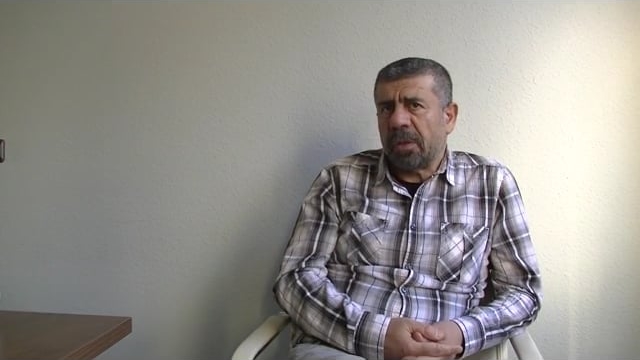
Country of origin: turkey
Year of settlement: 1988
Age on arrival: 22
City: bochum
Gender: male
Language of the interview: Turkish
[i] Today is the November 18, 2018. Opposite me is the friend [name]. I would like to thank my colleague [name], even though it’s Sunday you took time for me and you’re ready for an interview.
[r] With pleasure
[i] Cordially Welcome to our home.
[r] Thanks for coming wild.
[i] Today we are doing the interview at our home, we usually visit our friends at their home. But today we are doing an interview for the first time. Dear [name], when you had to leave the country, were you able to take anything with you? Do you have something with you, a memory, an object that reminds you of those days?
[r] I have nothing with me now. The truth is, I couldn’t take anything with me back then. I could only come here without everything. I didn’t take anything with me. I could only escape naked. I came alone back then. I had a lot of things I could have taken with me, but I couldn’t. Because of the living conditions there, I wasn’t able to take anything with me.
[i] Let me put it another way. If you could have taken anything with you, what would it have been?
[r] If I could have taken it with me, of course it would have been… I play the lute, I would have brought my lute with me. I had photos as souvenirs that we took there with my friends. Things existed. I had books that I would have taken with me too. But I didn’t get anything out of it.
[i] Well, let’s look at it another way. Introduce yourself to us. When were you born? Where were you born? Where did you start school? how far have you come? In short, introduce yourself to us.
[r] I was born in 1966. I was born in the province Dersim, in the Mazgirt district in the village of Karsikonak. I attended elementary school, middle school and high school there. Our primary school, secondary school as well High school were in Akpazar city area. That was it then Akpazar High School. Middle school and then that High school were in a building there. I visited both there. I attended school until the 1983, 1984 school year, but I have this Didn’t complete high school. Due to the strong Military repression. There was a big one back then State of emergency. Our region was in a state of emergency Dersim under a total military occupation. This meant that the repressions of the Military men are noticeable in all corners of Dersim. They had occupied everything. We lived in the village and even there they had a base. A complete unit was even permanently stationed at the base. That’s how they all held it Villagers under pressure. We were there, even though we were children, we were then 16, 17 years old, even though we were that age, we were the target of this repression. Because of this repression we were unable to attend school properly. We were also constantly disturbed at school. For example, generals were invited and came to class. These generals rated us as terrorists. All the people in this region saw her as Terrorists and treated us accordingly. Because we couldn’t accept that, we resisted. If we rebelled, we were called in for interrogation or taken to torture. Because of all this repression and torture, we were able to […] I couldn’t do that finish high school. At that time I was forced to leave high school in the 2nd grade [11th grade]. I dropped out of school and left home and moved west. That’s where I look Looking for living opportunities. For example, I went to Mersin, I worked in construction there and in this region, sometimes here and there, trying to make a living. We didn’t have the chance to stay in this country because of the military Repressions were very strong. This took place over a long period of time. Until I fled abroad. Since we no longer had the right to exist there and we were not given any living space, I was forced to leave the country. I was forced to leave the country in 1988 and sought refuge in 1988 Germany after asylum. I fled to Germany and applied for asylum ever since I live in Germany.
[i] Let me ask you this: You said generals came to school, did they just come to school or did they teach?
[r] They came to school and taught.
[i] Which subjects?
[r] National Security
[i] National Safety lessons.
[r] Yes, exactly.
[i] That’s still the case, that hasn’t changed.
[r] True.
[i] You said that you came to Germany in 1988. Where to go in Germany?
[r] Stuttgart, or rather to Frankfurt am Main. Since I’m with that I arrived by plane I have mine Asylum application submitted there. From there they spread us all out. To Schwellbach or Schwelm, something like that. Either Schwelm, or Schwellbach.
[i] It won’t be Schwelm, that’s near us in North Rhine-Westphalia.
[r] It was something similar.
[i] It could be Schwellbach.
[r] It could be Schwellbach. We went there first. We didn’t stay there long. We stayed there one Week or after they sent us Direction Cologne to Limburg. I stayed in Limburg for 2 months, a while. The asylum conditions here were then, and certainly still are, in the form of marching rations. They gave us breakfast and lunch food. They gave us some pocket money every month. I tried to get by with this money. From there they sent us to Karlsruhe. We were in a camp in Karlsruhe. There we went through another camp phase. We were in camp there for about a month. From there they sent us to Göppingen, towards Stuttgart. We went to Göppingen, where we camped in the same way. 3/4 of the people were always accommodated in one room. It was identical everywhere. 3/4 of the people, 5 people in some rooms even more. There they didn’t give us cash benefits but food benefits. Every week, they had weekly They packed food rations and gave them to us. After we get around the After we were there for 2 months they sent us to a place where we could live permanently. Where we regularly got money into the account and were able to buy our own food. We then used the money to buy ours Food and got along in this way. We were in Stuttgart Filderstadt accommodated. I stayed there for about five years. After being there for five years, I was there until 1992, I went from there NRW [North Rhine-Westphalia]. I came to Bochum, my Brother and stuff were here. I lived with them; they were also in the home, but I moved in with them. It was important to live with them. After that they were Asylum applications also approved. So we moved into an apartment. So we were allowed to look for an apartment and got a work permit, so we were allowed to have ours Maintain your own needs. We worked ourselves and logically made our own living. In 1992 I came to this region in North Rhine-Westphalia. Since then I have always been in this region.
[i] Are you by chance Stuttgart, or rather flew to Frankfurt, or did you have friends there?
[r] I had no acquaintances there. We flew, that Plane landed in Frankfurt. We have it right away Applied for asylum at the airport. Right at the airport.
[i] Did you come alone?
[r] Alone, alone Alone, we were with several friends but as a family I came alone. Nobody from my family was there at the time.
[i] Your friends, have you been sent to a home together or have you all been scattered to different places?
[r] Some of us were in the same place Home others had to go to another place. We weren’t all in one home. We were only in the same camp with 1/2 friends, i.e. in the same place. The others are different Places in Germany have been sent, I don’t know exactly where.
[i] You have the 5th Lived in a home for years. Did you have that during that time? Opportunity to attend a language course?
[r] No, I couldn’t attend a language course at that time because my asylum application had not yet been approved. As a result, I couldn’t get a language course. I just didn’t have the opportunity. Rather, I was involved in political work. Which was aimed at Turkey, because I knew and experienced the repression there. I was in organizations that worked in this direction, clubs and NGOs. I took part in political activities with them and am still active. What kind of country Turkey is, what pressure Turkey puts on people, we want society to talk about these things, introduce and educate the people here. With the democratic ones Together with organizations and associations, we predominantly do this type of work. Of course there were also clubs in these Cultural programs in which I took part. For example, lute, be it courses or playing the lute. I got involved in such cultural and folkloric events and through this and as a club I focused on these things.
[i] While we’re on the subject of Turkey. Let’s also talk a little about the current political situation in Turkey, because there are about 30 Years passed
[r] Yes.
[i] From 1988 to 2018. If we look at Turkey now it is really very bitter. While others consider it as Looking at the 21st century and looking forward to the next Century, Turkey is similar to the last years more of an open prison. Unfortunately, it is always declining, We are still committed to the democratization of Turkey. What do you think about it, why is that?
[r] Yes, of course it is a very sad and bitter situation that a person cannot live in the country in which he was born and raised, his happiness in life is forced and to look for living space in another country. This is very bitter for humanity. Of course, the heart wants the person to be free in the country in which he was born and raised, with freedom of expression, with his own ethnic identity, with his own being, with his own political ideology, in short. that the people can live freely. But unfortunately there are these Not possible in our country. Ours has already become historic Country always ruled with a dictatorship. The dictatorship of 1960/62, the dictatorship of Kenan Evren, was at the same time as our youth. This country experienced its worst dictatorship during the time of Evren. At that time many were Human lives ended. If we had stayed there, lived there, We would probably no longer be alive, at least for me. The country is ruled dictatorially. That hasn’t changed to this day. We now live in the 21st century, a world in which everyone people all over the world flows into each other and mixes. We are in a phase in which borders could almost be removed. An era in which everyone can live wherever they want. But there is still a dictatorship in our country. The people are with you Faced with repression, torture and terror. State Terror, made by the state, organized by him, staged himself in order to then die To be able to blame people. Then the accused are convicted as guilty instead of the state having to be convicted. He simply blames his own guilt on living people and peoples. These are then condemned in the media. Actually, he should do it himself Be convicted. It’s just the state. This is how it happens in all countries that are governed by dictatorships. The state makes the mistakes but blames the population. That was the case in the past and is the case today Time still like that, until today. Logically, there has been no change in our time either. There is no difference between the 80s and today, on the contrary, in our country, in a country like Turkey, it has gotten worse. Not a day goes by without someone being arrested or executed on the street. Even, for example, academics. In the era of Tayyip Erdogan, under his leadership, hundreds of academics were accused. They have initiated an association, accuse people, arrest them and imprison them. He orchestrated this union. Tayyip Erdogan has worked with them in the past. For example, he accuses them of being Fetö followers. Fetö, he is Fetö’s age […]. Fetö [Fethullah Gülen] is even his mentor, Tayyip Erdogan’s mentor. What did he do? He staged it as a terrorist organization and put everyone classified as fetö in prison or suspended from duty. Unfortunately there is in ours country such circumstances.
[i] Unfortunately, this is a special one What all dictators have in common. That’s why everyone is Dictators are the same everywhere.
[r] Certainly.
[i] But so that it changes there. For example, if we Compare the 1980s with today then there are small ones Differences. In the 1980s, leftists, Kurds and Alevis were particularly targeted and now all opposition members. If you are oppositional, then it’s over. No matter if you are a leftist, you are a democrat, you are a religious you are an academic or artist, it makes no difference. As an opposition member you will be imprisoned. Just two days ago became a Kurdish artist, in Europe, at the same time as you, From the military coup in the Escaped in the 1980s, the naked one Survival assured and in settled in Germany. A Kurdish artist in possession of a German identity card. Although there is nothing, she went there as campaign worker, should hold a few concerts for the people. The person was sentenced to six and a half years in prison on charges of being a member of a terrorist organization. There are still a few people with German citizenship who are affected. What do you think about the fact that the German state is keeping quiet towards Erdogan or is observing everything?
[r] I think that the German government is not approaching the whole thing correctly and is playing a double game. I see a set-up. In a phase where Tayyip Erdogan against Europe and Germany with “Hey Germany, Hey Europe” ranted, and threatened towards Europe, During this phase, most of the arms exports went to the German state, the German government, to Turkey. That’s just an example. Here you can see the following, the two sides are in a mutual plot game, in the time when they threatened each other, were the hardest on each other, met them, in principle the greatest advantage, maximum profit, behind closed doors Doors secret agreements. Agreements that the will harm society. For example, arms sales. Arms trafficking harms all of humanity. And in this one of all places The German government has time regulates most arms sales to Turkey. From this I conclude the following: If the German government in the media, rails against Erdogan or Turkey in front of the media, this isn’t real. This is a setup Just acting around your own society, your own people, at that moment, against the people from this country to fill with hate. This is a polemic nothing else. This is what I observe and interpret. As well Tayyip Erdogan, especially during the election period both make such speculations. They smear each other in a campaign-like manner. Weather each other. Media threatening gestures like “Hey Germany, hey Europe, Who are you to tell me something? in interviews and press releases, he stages in order to benefit from his population, especially its population in Europe, to get votes. That’s why they stage speeches like this.
[i] But there is something else strange. Especially the Turks who live in Europe, let’s say people of Turkish origin,
[r] Yes.
[i] Here they generally vote for left-wing parties and social democratic parties. So the SPD, the Left Party and the Greens.
[r]Yes.
[i] These very people the same people, elect a fascist, fundamentalist, one of one Dictator-led party. Isn’t that a contradiction?
[r] That’s a big one in and of itself contradiction. That’s the bitter thing about it. Imagine you live in Europe, you live in any country in Europe and are a voter for a left-wing party, but there is a dictatorship in your country of origin and this dictatorship constructs a person, Tayyip Erdogan, with his party AKP or whatever they complain about, and you go and support a party in your area country of origin is dictatorial and terrorizes the population. This is very difficult to understand. This is a huge absurd contradiction. People have one Problem with her mind. Either they can’t quite follow the whole thing, so they think about it or they were dumbed down, I don’t know. Whether they were given medication whether there are such drugs that Tayyip Erdogan injected into them. So that she can be his followers belong. It is not possible to understand this.
[i] Couldn’t it be like this: I think that Erdogan hasn’t vaccinated them with anything medicinal. Because German society didn’t accept these people, because they saw themselves as foreign and isolated here, couldn’t that be a reason for these people?
[r] Possible, of course that is also possible of course. The German government, As I mentioned before, this is a set-up game. So the states, and the people who run these states, are playing rigged games for profit. During Tayyip Erdogan says this, the German government developed one Exclusion policy against citizens from the country. Precisely because of this They, Tayyip, were able to engage in exclusionary politics, Tayyip was able to take on the role of a daredevil, they think that Tayyip really and truly thinks that way and is against Europe. This means you can have the attitude of belonging to your followers.
[i] Okay. Let’s admit it Bochum come.
[r] Yes.
[i] 1992 you are after Bochum came. When you arrived in Bochum, where did you go and what impression did you have of Bochum?
[r] Bochum is a small city. She’s beautiful, I have Bochum grew fond of. If I’m being honest, at least it’s small and quiet. There is no high crime in Bochum. If they exist, then I don’t know. I came here in 1992. Here, here I also continued with political work; I have always worked with democratic mass organizations and still do. I also have cultural interests Organized events, I have a Baglama School opens on the Maximilian-Kolbe-Strasse. That was in the period 1996-1998. In 1996 we have them Found premises and renovated the place together with three friends. I was able to hold out until the last quarter of 1998. When I opened, there was a high demand for culture, especially lute music There was a lot of interest towards [musical instrument]. Of course the media also exerted an influence through the artists of the time, Amateur artists e.g. Cetin Akdeniz, Arif Sag, Musa Eroglu or also Names like Erdal Erzincan. Even today they are still popular and alive. They were very useful and influential. They were there almost every day Television program represented. This led to the development of People have a curiosity towards the instrument Baglama. This demand created a need. When this need became apparent there were only limited ones People who could teach that. There weren’t as many as there are today. At that stage I opened such a school because people had a lot of interest at that time. Until 2000 no, until 1998 I continued these courses with my friends. In the subsequent phase, demand fell. This made it increasingly difficult to pay the room rent, I closed the shop. I continued on a club basis.
[i] You say that the Demand has declined. People stopped going to school or what were the reasons for that?
[r] The decline in demand, hence the crowd.
[i] Let me ask different questions, Has everyone learned to play Saz?
[r] No, not everyone could learn it. There was the following situation. The people who came had the setting within one day or one week to be able to play baglama, not with the attitude that it is an art. With the thought that there is a They thought it was a fun instrument and you could learn it within a few days or a week. They come with this attitude, but when they start playing, i. e. start taking lessons, they realize that you can’t learn this instrument in a few days. This causes them to lose self-confidence because they cannot do it straight away. You experience disappointment. This extends to the entire period. During that time he still can’t do it, and it becomes more and more difficult break off with the thought “I can’t do this, it’s best if I don’t go there anymore.”
[i] Did you do the following back then? So asked a German institution, for example the cultural office or the local school authority. To work with them on their initiative such a cultural one To be able to continue work?
[r] No, we, Well, I personally have not made such an application. Ours was a private school, so structured like a school. We financed it through the students. Our initiative also reached the German government. On the initiative of Federal President of that time, it is even being taught at their schools at the moment, Baglama lessons Yeki founded. This developed with our initiatives, we have overcome such things, the demand seemed until there. Because of this demand, they made new regulations at schools in the form of Lessons baglama lessons taught. Under Project Yeki the lessons will continue.
[i] Are you part of this too?
[r] No, I’m not taking part in Yeke. I don’t have time for that anymore either. I moved on to a different industry. This allows me to… and through my hearing problems I have this kind of resigned from activity.
[i] You have been in Bochum up to this point attended any language course to learn the language?
[r] I never took one as a language course attended a language course, let me put it this way, I had the opportunity but I didn’t go, I tried to study at home. I bought books so I always have it at home Learned German. But I didn’t attend a language course.
[i] You said that you have reoriented yourself. If you would tell us something about it.
[r] When I said reorient…
[i] You mean that professionally?
[r] Yes, I mean that professionally. Then I learned to be a welder. The first phase lasted six months. 2008. Yes, that was 2008. Back then I attended the first welding course in Langendreer, which lasted six months. After I finished leaving, I looked for a job. They expected experience or other qualifications. So I have others Exams passed. I did that in Herne. That took four months. So this other test. There are a wide variety of tests in the welding shop, which are referred to as electric, Mac and TIG welding. You will be in these three Categories classified. In every single one In the category there is a different working technique, sorted by material. So we studied there for four additional months in order to be able to take the exam. When I was finished, my working life began. Since then I have worked in this industry at various companies Regions of Germany. I also work in this profession in various countries in Europe.
[i] Isn’t that a bit difficult? If a person has a family and goes to work in other cities and regions, how does that work? Do you commute daily or do you have options to stay there?
[r] Most of the time we stay there. When we are around 100/150 km away we stay in the hotel there. Sometimes this is booked by the company, sometimes we organize it ourselves. But most of the time the company organizes it. You then book the hotel. We pay for our meals, the other costs of the hotel are covered by the company.
[i] How long does this take? A week, ten days?
[r] Sometimes it takes a while week, sometimes three days. You never know for sure. This is an order. Sometimes we are sent to the wrong place. So before it is completely clear which one work needs to be done, So what kind of Work it is. I work for one Sub-company. we are not with the Main company employed. So for a rental company. The rental company comes to an agreement with the client and without knowing exactly what kind of work it is and what kind of work it is, send us there immediately. We go there and there find out that they mechatronics engineer or mechanic, So need someone from these 2 professions. But not a welder. I experienced an example of this recently. The company I had to go to needed these two professions. When I was there I just sat around. I sat around without working for 3 days. Then the man came the construction manager, and said, that they don’t have a suitable one have work for me so not much have welding work. They had 2 parts that I welded, After that he said, I have nothing left. There would be predominantly there need for mechatronics engineers and electronics engineers, cables must be connected to each other. Because there are machines there. Steel construction machines are brought there to be overhauled. It was like that 15 to 20 machines. All but one of them was newly installed, machines that were checked and repaired. Old parts were replaced, but ultimately they are all cable connections. So they need electricians and on the other hand mechanics. To loosen and reattach the screws, who knows what they do. So I have 3 days sat around until the man came and said, that they don’t need welders. Three days!
[i] The workers who work for the temporary companies are usually employed through the temporary employment agency in the first year but are then taken over by the main company in the second year. There with the main company contract is concluded. Did you have that? possibility not, why do you work for the rental companies?
[r] Some companies don’t pay, That’s why I don’t work with these companies. Then there are companies again they work this way, but they pay little. The earnings are not enough. It’s not enough to live on, so
[i] Is the salary generally lower with a temporary agency?
[r] It’s little. The earnings from rental companies are of course lower. But it changes with the wage groups. In our group the minimum wage is 12 euros, 11 euros or 13 euros. minimum wage, Companies usually pay minimum wage. We do not work with companies that pay minimum wage. Our wages must be above the minimum wage. They are on the market Hourly wages for welders are high. They are not less than 17/18 euros. The rental companies you mean only pay minimum wage. I don’t work with them.
[i] You mostly work on weekdays.
[r] Mostly on weekdays. If there were weekend work, I would also work on weekends. These are the guidelines of these companies, no work is done on weekends. For the For example, the company I currently work for doesn’t work on weekends, only on weekdays.
[i] Good. What do you do on the weekends?
[r] I’m mostly at home on the weekends. From time to time there are cultural events. So we have such activities together with friends. I’m into these cultural ones Activities included with my children and family. I am with them and deal with them. My weekends go by this way.
[i] How many children do you have?
[r] One. I have a girl.
[i] How old is she?
[r] She is currently three and a half years old. She’s turning four.
[i] She is still small.
[r] Yes.
[i] You will be around for a long time be busy with her.
[r] Yes.
[i] Did you get married late?
[r] Yes, I married late. I got married in 2007.
[i] Did you get married to someone from here?
[r] No, with someone from Turkey. You came from home.
[i] Is she a relative or acquaintance?
[r] No, she is not Relatives or acquaintances. I was there. I vacationed there. By chance
[i] Have you met?
[r] Did we meet?
[i] That’s how it worked out.
[r] Yes, exactly.
[i] Well then, congratulations.
[r] Thanks to you.
[i] I wish you lifelong happiness. Let me put it this way. As far as I understand, you have some cultural activities in Bochum, you also had political activities, You say that you also have a certain circle of people here.
[r] Yes.
[i] Is this one Circle predominantly Consisting of the Club members or how he introduces himself together, how do you get together, how do you work together?
[r] I mostly built up the circle when I gave the Saz course. People from almost all backgrounds came to the Saz course, not just those from the club. So people from anti-social milieus to all milieus have attended the course. So they were able to see over a long period of time what kind of person I am, who I am. So they had the opportunity to get to know me and I got to know them as well. The children came with their fathers and families. That’s how we got to know each other. I had students as young as 7 up to 60.
[i] Did you also have German students?
[r] Germans came one two, not many. Back then I had Language difficulties. I could tell them because of them Language difficulties cannot be fully addressed. Only when I learned the terms of had learned music literature, I could give them lessons. But they came. One/two people came to me. That’s how I got to know the children’s families. This kind of getting to know brought us closer. This is how a circle of friends developed. In Bochum I know that 60/70%. In general, I have a good dialogue with most I get along with them very well. This means there is someone from every background.
[i] So you’re from Bochum after all.
[r] Yes, from one Perspective is like that.
[i] How are your relationships with German society?
[r] I don’t have many people with German society, just my neighbors, I have a good dialogue. As a neighborhood, or people that I’ve met, that I’m in contact with, I generally have a good dialogue. Also with German society. But not with those I haven’t met.
[i] Did you experience situations in which you were not wanted or were excluded? Be it from neighbors. at work?
[r] I notice this at work. This happens at work. We even discuss things from time to time. There are some pretty tense moments. There were even times when I was kicked out of the company because of such situations. I experience this at work.
[i] Because you are a stranger? Of course, because I am am a stranger. For example if you go to the client or the company, and permanent employees are xenophobic and turn on you immediately. He comes because he doesn’t want you and immediately [causes?] trouble. Because I don’t let such things lie on me I also answer directly. If violence is necessary, then I’ll use that too. If I have to use harsh language, I will give the answer that is necessary. He then complains about me to the boss. The boss then comes and says we don’t want you here.
[i] Did you come across any of these in Bochum?
[r] No, I haven’t worked on a job like that in Bochum. I’m pretty sure that in too Companies here have such problems. But in society, among Bochum residents, I have never experienced that. I also ran a kiosk before – I didn’t tell you that. So I opened a drinking hall, Mostly only Germans came there.
[i] Where did you open it? When you run a kiosk you are one on one with the people.
[r] Yes, that’s right. In Bochum, Bochum Weitmar. It was on Hattingerstrasse. I ran it for a few years. I have in general German Society has not experienced something like this. So such a reaction, Xenophobia. I was a stranger and yet everyone bought from me. We were almost there Friends, so close to each other. We talked, only the landlord, including the kiosk landlord, he only has a few made difficulties. That only against his own people, not me.
[i] So you want to say this: Since you’re in Bochum is where the people of Bochum took me in. There was no exclusion, they welcomed me like one of their own.
[r] Yes, exactly like that.
[i] So you isolated yourself from them a little bit. Because you in others industries, sought contact with other parts of the population.
[r] True.
[i] But, you had no obstacles from the German population in Bochum.
[r] This is something that is related to my industry and my job. I don’t practice western music. Logically, I practice the music of Country in which I was born and grew up. This leads to my dialogue with the… People from my society are stronger. These people are more interested in this instrument. Anyone who plays this instrument is part of this society. That’s why I spend most of my time with these people. Germans are also there. I have a guitarist, he’s German, he used to be the guitarist for Cem Karaca. He is currently with me. We work together, when there are performances or something like that, we go together. There is also one Accordion player. We also had joint projects with her. I don’t see her that often anymore but that’s another story. Because we work as welders, we don’t see each other as often anymore. When I find time for projects, I do them with people like these. When we have projects, we also give concerts for German audiences. A few months ago there was music in Bochum.
[i] Summer.
[r] Music summer, yes, we had a performance there. We mainly played there in front of German audiences. We also take part in such events.
[i] What cultural activities other than music interest you? Are you also busy with other things? For me it’s music, I don’t have much to do in the other forms. Of course there are also different cultural events, for example folklore. But I don’t have any Points of contact with folklore dance.
[i] For example is Bochum is a museum city. There are many museums here, many mines, visit these museums, Cinema, theater, things like that, outside of Folklore, things like that. Do you concentrate on that? Music because you don’t have time, are you not interested in other things or do you just not have time? How do you rate that?
[r] Things don’t interest me as work. Be it theater or Movies, things like that. When events take place, I go as a spectator. I have no ambition to be a part of that to be an event and to collaborate. Of course, this is also tied to the time factor. If there was more time and I could dedicate time to it, I might take part in theater projects, but I don’t have time for that.
[i] I don’t mean as a participant person but as a spectator.
[r] As a viewer, I visit such Events, if any take place.
[i] What does your wife do? What is her relationship to music? Do you have a common hobby?
[r] We don’t have anything in common Hobbies. She is not interested in music. Also in general Not towards art. She is busy with housework. Furthermore, she has none Occupation.
[i] Housewife?
[r] Yes, we can call her a housewife.
[i] You said that you are mostly under You are people who come from Turkey and you address them in their own way. You can almost see the culture you are in You lived your homeland one on one here after living, without any difficulties?
[r] No, I have no problems with that. I live it out the way I want to live it.
[i] Please tell us something about your family. You have here a brother.
[r] Yes.
[i] Is your brother married, single, did he come before you, why did he come? What is he busy with?
[r] I have two brothers. Not one, I have two brothers here. Like me, you had to because of them living conditions in Turkey come here. They came after me. First I came over then they followed. One lives in Gelsenkirchen, the other used to live in Gelsenkirchen, Here in the region we lived together. Then he followed suit Wesel. From there he is now heading Stuttgart drawn. He lives there now.
[i] Are they older than you or younger, are they married?
[r] Both are older than me. The person who lives here in Gelsenkirchen is married. He has three adult children. His children are between 30 and 35 years old. The other is not married. He is still single. He lives as a single and also wants to live as a single.
[i] How much Are you siblings?
[r] We are seven siblings. Three out of seven Siblings live here, the others live in Turkey. Three have died. They already had a specific one Dude, they died, they’re no longer alive. We, the remaining four, we are still alive.
[i] The other one?
[r] The other is in Izmir.
[i] How is your dialogue with him?
[r] Our dialogue isn’t particularly good. He has another one Worldview. He has an assimilated one Way. Therefore he tends to do his Denying identity and roots. That’s why I’m hardly in contact with him.
[i] He is young settled in Izmir for years?
[r] Yes, somewhat. Since he was 18. Since his eighth to tenth Throughout his life he has always lived outside. Therefore he hardly knows village life. Since he has always been outside, he has lived in metropolises. So he has one too Inclination towards the lifestyle in the metropolises. In doing so, he has separated himself from us and his identity. After he was 20 to 22 years old, he settled in Izmir. He lives there.
[i] Are mother and father still alive?
[r] No, mother and father… When I was a year old, then my mother died. When I was seven years old, my father died. I never met my mother. You say a year, but when I look at the documents it’s four months. I…, ours, the older ones, my sister, my brother said one year. When I look at the date of death in the family register. I compare my date of birth with hers Date of death, there is a four month difference.
[i] Do you currently have any relatives in your hometown?
[r] Sure, there are relatives.
[i] Close relatives.
[r] I don’t have much contact with them. I don’t have that much Contact them.
[i] Are you going to Turkey?
[r] I drove recently. A month ago, in September. I don’t drive often.
[i] Where were you?
[r] I was in Elazig. Or rather, my wife’s parents live there. She was there with the child, so I went there too, to see them. I was there for a week. I drove for my little daughter. She was homesick. According to the motto, either I will be brought to my father or my father comes to me. I was working during that time. I left at short notice and took a vacation.
[i] Which means Identity for you?
[r] Identity?
[i] Yes.
[r] Yes, identity. identity is important on one page, but after a certain time it no longer has any meaning. Of course at the beginning, for example If a republic has not yet been founded, it is important that this nation has this identity. So it exists but it is ignored. In this sense, it is very important that she gets her own identity. That one nation that exists is declared void, is in the eyes of the whole world, especially from one The oppressive country is completely ignored and becomes your own Identity being assimilated is not a thing that can be accepted.
[i] I don’t mean this from the perspective of the nation. I meant that in a social sense. You are currently talking about the republic, having a state or being stateless. If I asked you what does home mean to you?
[r] Yes, I would like to combine the two things. Existing on the base but not visible is it important that a people but which exists for is declared void, gains its own identity. Because only after it has gained its own identity does a national identity become worthless in the international arena, in the global world. From mine perspective viewed.
[i] But I don’t mean “Kimlik” as in Germans as an ID but in the sense of identity. Identity, i. e. not tied to a nation or Citizenship, the individual identity. For example, one says I’m a socialist, the other I am Alevi, the other one I am gay, another I am a feminist, these are all identities, personal identities. I mean it in that sense. So not tied to one nation, to a citizenship, but as an identity. In the same sense as him person imagines. For example, you are now a Kurd, Turk, German, Artist, I can’t know. From the point of view it is meant. It’s a provocative question. So that the individual can identify themselves is any identity that the person has chosen, even if you ask, what she imagines may be important for this person. Of course it’s from the Perspective of identification important. Even a name is already an identity and of course it is important. An identity based on racism and For me, nationalism has neither meaning nor value.
[i] I didn’t mean it in that sense at all, but in the other sense.
[r] In the sense of Identity is important.
[i] So the person himself.
[r] It is important for the individual. Identity is important. Let’s assume we get to know each other and first you ask me my name. If you ask me and I answer with nothing then there is no point. When I say my Name is Nobody. Then I deny myself too. So I have to have a name. Whether it is A, B or C. Naturally, I also introduce myself to them by name. That’s why it’s part of mine too Identity and important to me. From the perspective of being able to imagine and identify yourself as a person, an identity is important.
[i] Let us come to another point. You know, Germany is a country of bureaucracy. It is a country of Worries and rules.
[r] Yes.
[i] When did you first encounter bureaucratic procedures? How did you feel and what is it like now?
[r] Bureaucracy. There is an abyssal gap between the bureaucracy here and the bureaucracy in Turkey Difference. The bureaucracy in ours Country of birth is like a snake pit, if you fall in you can’t get out. The bureaucracy here is more orderly. It is built on a more social basis. In general it is after that Principle of “service to citizens”. Of course, errors appear from time to time. Of course, sometimes you are confronted with irregularities. But never extreme. Even then it is still orderly. Let’s say when you get an appointment, you go to the appointment and he can ask you in for your appointment, deal with you. There is a little more democratic rulemaking here.
[i] What you mean is this: Once you understand how the bureaucratic procedure works, then it will be easier and more convenient for people. Because you don’t have to wait in line for 5 hours for an appointment like in Turkey. Let’s say you’re sick over there, go to the emergency room and wait three hours, this is where you call and get an appointment and you don’t have to wait. It simplifies life.
[r] It is lower-threshold and more service-based. On this basis the dress becomes.
[i] Are you here with anyone Difficulty faced? You came to Bochum, master it language just something, So it was more bad than good and you moved from one city to another. You’ve been to many places, you moved from home to home, are different met people and you came here with something What challenges did you face?
[r] Yes here… At the beginning I had difficulties, it would be a lie if I said no. Not knowing the language, for example, shines on that working life. You have problems to find work, before everyone else. So, if you don’t have a job, For better or worse, you have some financial difficulties. Whether you want to or not. These were problems that developed because I didn’t know the language. So you can’t just find a job like that. You go there and the man wants… But it is also like this; People must have a minimum command of the language in the country in which they live. Because all companies belong to this country. Logically, in almost all of them Companies speak the language of the country. The person responsible with you about the If you want to talk about the work you have to do, you have to be able to explain it to yourself. About what you should do. If you don’t understand, If he explains this to you, he won’t be allowed to hire you. From that perspective, of course, we experienced difficulties initially. But after I. .. I can’t say I learned the language very well to have had difficulties.
[i] Germans also have the following characteristic: Be it through their experiences in the First and Second World Wars and the experiences of Hitler’s fascism, they are hospitable towards strangers, a willingness to help. On a voluntary basis, called voluntarism in German. Germans are at this one Very modest point. Was there anyone who helped you in Bochum, were you able to get help from anywhere?
[r] Of course, there are also German organizations and associations here that implement and organize such social democratic mass work. So companies Clubs, institutions etc. Be it as an institution, be it the IFAK e. V., AWO, MLPD, and 1, 2, 3 institutions, societies and organizations that are similar to them. Be it the Greens, to some extent the SPD, although it is one If you are a party to the system, you can help people in the social sphere. you did it, I’m sure they still do it. I noticed this personally. For example, in the times when I didn’t yet speak German, or in the times when my… Asylum status was not yet recognized, there were German friends who helped me helped me get my asylum recognized. They helped me a lot. They helped everyone. They have provided a great deal of help, particularly to foreigners seeking asylum. They even housed some in their own homes. I know a lot of Germans Democrats and humanitarians who have reached out to lend a helping hand at this level.
[i] When you saw that, how did you feel at that moment? You come and a person you don’t know If you don’t know the language or don’t know the culture, you want to help in your own country without expecting any benefit.
[r] Of course, when I see people like that, people with a way of life that I want and an attitude to life that I defend, When I meet such people I am very happy. That’s exactly what I want too, that one person unknown to another without between the to select people the person with all aspects Offers help to those who need help. That’s also what I think mentally, ideologically, the attitude to life that I adopt and belong to those who want it to be used in society. So when I see people like that who want to share life together, wanting with all your heart and put that into action. If I I see people stretching out their hands, that makes me very happy. Then I think to myself: Hey, there are people here too who share the same ideas. A person like I want. What I would like to apply in my life is given to this person. That always makes me happy and joyful.
[i] There are many people in Bochum who are like that. I know this from my own experience. I’m in the industry myself, I work with them myself Volunteering together, there are a lot of people in Bochum. But Bochum really does have something like that. It’s a very helpful city, as you mentioned before, be it the low-rise one Crime, or the police presence on the streets among citizens being less compared to neighboring cities, is not due to that size of the city, but because the people of this city are very social, show solidarity and trust each other. Let me ask you this, you have been in Bochum for many years, what does Bochum mean to you?
[r] Bochum as a city. Bochum as a city, like I said before: Bochum is a beautiful little city. Here people really live together on a somewhat more social basis. She is one of the Cities I love. The reason why I love her is the warmth and closeness of the people among each other and on this basis, there is a variety of here Organizations that address social problems. It really is that who take care of people’s problems, for example, if people want to hold their own cultural event, the doors open Institutions and organizations. They open their doors. That’s my opinion a very important interaction. This makes all of these things present in the city, in the city of Bochum. The city of Bochum has also been in the hands of the Germans for years Social Democrats. As the name suggests, social, i.e. with close contact with the population, dealing with the problems of the employing the population. The city is in the hands of a party that deals with the problems of the city in a solution-oriented manner population employed. In that sense it is Bochum Germany wide, there are some cities in SPD hands, but the best and most effective implementation is in Bochum. In that sense, Bochum is a good city for me compared to the other cities. It’s small, but a very lovely place.
[i] Which place in Bochum do you like most? A place that you find indispensable?
[r] Yes. A special place to name Bochum is a bit difficult. The city center of Bochum I prefer something more. Mostly if I want to meet people, Kortumstrasse. I can meet almost everyone I know there.
[i] Kortumstrasse is the only mile it has. Now that’s somewhat lifted. Since there is no other road, you come here if you want to see someone.
[r] Yes, that’s exactly how it is. If there are people you want to see, that you haven’t seen for a long time and say to yourself: Let me go there, I meet him there. When you get there you can actually meet the person. In that sense it’s a nice place also to stay in touch. Since it is a small town, people can Even if you want to break off contact, don’t do it. It’s a small town there [Kortumstrasse] we meet again.
[i] Well. You don’t work on weekends.
[r] Yes. You said you’re mostly at home and spending time with your family. But a weekend consists of 2 days.
[r] That’s exactly how it is.
[i] Are you really just at home for the 2 days or how are you spending them? Days, tell us something about it.
[r] My weekends, I’m not just at home. Up to a time I’m busy with the children until 3/4 p.m. Let’s say 4 p.m. We usually have a meeting on Sundays with a music group made up of friends. We make music as a cultural activity.
[i] I remember, for example, you have a choir. It consists of a wide variety of people. Can you tell us something about the choir? For example, are the people all Kurds, Alevis or Turks? How did you get together? With which ones Do you perform at events?
[r] The choir was formerly part of the DIDF structures. We met when IFAK e.V. was still on Bremerstrasse. a locality, Now refugees, Syrians, remain there. We used to make music there not as a choir but as a group of friends. It was every Sunday, either Sunday or Saturday. One of the two I don’t really remember. During this time a few from the DIDF choir came to watch us. Then they invited us to their place. They rehearsed in the basement of the IFAK e.V. building on Essenerstrasse.
[i] 57.
[r] Yes.
[i] Essenerstrasse 57.
[r] Yes, with those on Essenerstrasse, I don’t know the house number but that’s where it is. They invited us and we went. They didn’t have a Saz player. There were people in our group who played Saz well, three or four of us play Saz really well. Well we’re there. They also had an events program and offered us to play Saz there. We agreed. It wasn’t a problem for us. We’re playing anyway. So we went there and had with them in their program, they made an appearance at the event, selected the pieces together So we went and played instruments for them at the same time, So Saz played. That’s how we got to know her. They offered us to work together. We then decided to work together at the beginning to see if it was a good fit. I already knew that, but the other friends didn’t know that yet. I used to work with them. So also courses in theirs Clubhouse given. I used to do club work there. We decided to get to know each other a little more. Well, after playing together for a while, a few friends split up from the group. I stayed in the choir, but there were a few of us, never more than ten people. Usually four to six people. With us when we participated we became together 20 to 30 people. That’s how we have it Choir took over. They named their group DIDF Choir given. We said no, it doesn’t work under that name. We make art, in my opinion, art shouldn’t be limited to one be tied to ideology. Ideology and art must be separated from each other. With an ideology you serve one person, or the ideology of an organization, but an artist involves the entire population. An artist separates the different ones Groups not from each other. Rather, he expresses the concerns of the entire population through his art. Therefore, art must separate itself from political organizations. That’s why we said only if it is independent of the DIDF can we become a part of it and work, otherwise we cannot work tied to a political organization. They accepted that. They gave their consent that it took place in the form. We have the choir called EMEK choir. We have it emek, i.e. “effort” and “work” mentioned because we are on this side. When we make art, we also have to share the effort, the work, the high value that it has with the population. Not with a political ideology, but with the population. Given the circumstances, we have accepted this and are practicing ours Music under this principle. From time to time we have ours Work also done within the club. We have ourselves Events organized, various Evening events at which various artists perform have taken topic. Be it Mahsuni Serif, Asik Veysel, Neset Ertas. Artists of the past who have carried this form of art up to the present day. We have organized events that have remembered these people. We have that within the Club locations made. We had most of them Civil society organizations in Germany, i.e. in this one Region in North Rhine-Westphalia, also German, in organizations that are committed to the Turkey-oriented people worked at most of these events Organizations we took part in the program. Every time we have ours Art, be it as a choir or as a group “Gönül Bagi” is practiced. So the culture, our musical culture shared with them. We showed up and practiced it.
[i] Yes, that was very nice. You also appeared at my events a few times, we were very satisfied. You have a very good choir. Rich in diversity and multilingual.
[r] Yes with us
[i] A group that we can only recommend. As best as I can, I want balanced, of course, you continue to be with me Welcome events. Of course if the group If I have time, I usually prefer this group first. Friend [name] let’s talk about your childhood. We didn’t get to your childhood, we started with Germany. What was your childhood like? I know it hasn’t been easy. You have an Alevi identity and also a Kurdish identity, the place where you come from there was a state of emergency, well there was always too State of emergency and emergency laws. But if you still told something about your childhood?
[r] I can’t say that I lived out my childhood. People who live in the village don’t have a good childhood. We didn’t have a childhood like kids have today.
[i] Yesterday is yesterday and today is today. They live in luxury now, don’t mix it up.
[r] Yes. Our childhood, as far as I can remember. Well, we have 7 I started school at 6. I started a little early. Because I looked taller I was registered at school at the age of 6, normal would be at 7 years old. So legally. Well they registered me when I was 6. Life before school is clear. I can claim that it is It was a matter of luck to survive. Because of the illnesses we had, there were no doctors, nothing, no medication. In my time in this There wasn’t time for that. There were none in the village Roads and no paths. Are you at the doctor when you are sick? […] it’s already over with you. There is nothing. The doctor is miles away. There is no car. Cars simply don’t exist. Especially when it’s still winter. When it’s winter our life is over. Life with us. We are then only within our own four walls and on that Central square in the village. You go there and play Football if you want. You can’t even do that in the winter. So I can’t say that our childhood was particularly wonderful. The school years were a complete torture for us. The walk to school was total torture. Back then there was the Kemah Dam, which was built in 1977 and the Expansion came to us. There was this dam on our way to school. When it froze over in winter, it was ours too School life ended. Completely cut off. We couldn’t get to me School. We waited for the ice to get really thick. If the ice is thick enough, about a meter, that’s how thick it is, we used it as a bridge. So we were able to cross the ice. That’s how we got to school. But when spring came, around March/April, when the season came and the ice melted, our lives were completely cut off. In our case there was a bridge 10 km away direction and 10 km in the other direction so 2 bridges each in one direction but each was 10 kilometers away. No matter which route we took, we had to walk. We had to run, we had no one else Possibility, not an alternative. We froze on the way, the snow was high. Our feet were frozen, they were numb. They became numb, we no longer felt anything and continued to walk step by step. By the time we got to school we were soaked. Sometimes the oven wasn’t heated at school. There was no normal heating there. There are no heaters there. Stoves heated with wood. Sometimes there was no wood, sometimes there was no coal, we were freezing. We sat there with our wet clothes School was over. We sat and the wet clothes dried on our bodies. Of course it made us sick. If that’s on ours bodies dried. We lay at home suffering from this illness for days. Of course there wasn’t one Doctor, there was nothing. We lived on the chance.
[i] What was your youth like?
[r] What?
[i] How was your youth?
[r] Well, the youth period. Our youth was during our school days. As I said in the schools of the 80’s the existence of the dictatorship, the existence of the Kenan Evren’s dictatorship didn’t particularly give us that Possibility of a life, of a youth. No matter where we went we were confronted with the military. We had nowhere to go. You can’t get out of there.
[i] Have you completed your military service, Didn’t they let you do that?
[r] I didn’t want one do military service. I was during one ID check, well, they arrested me right there and…
[i] They drafted you.
[r] Yes, they drafted me.
[i] Tell me something about yours Soldier time. Where were you stationed?
[r] The military is… a senseless institution. Military service in Turkey is completely pointless, an illogical institution. It has a training system that has nothing to do with logical expertise.
[i] The foundation of the military is like this, all of them.
[r] Yes, everyone is like that.
[i] They are anti-human Methods.
[r] Yes, that’s how it is. The military is freed from all reason. Imagine them referring to it as Basic training unit and private unit, it doesn’t matter, military service is military service. There is no difference between privates, the methods are identical. When I was assigned to Izmir for the first time, I saw an aircraft from the Cypriot phase. Because the plane during the war, the Cyprus war, didn’t work, they gave the plane a penalty. It sits on a summit and is not used. Look at the logic. Can you imagine that? Because the plane didn’t work during the war, they punished the plane, placed on a summit and never use it. It is beyond all logic. The education system, well, one There is no such thing as an education system.
[i] Where did you get yours? served?
[r] The first 3. Months in Izmir. In Izmir Nalidere. Then Istanbul.
[i] Your military service was in good places.
[r] What good? Military service is military service! That’s not nice anywhere. Nothing about military service is good, it’s the same everywhere. Istanbul is the same, so are the methods of the sergeants are inhumane. Simply anti-human. You’re leaving anyway, that guy checks your ID and see you have a Kurdish identity, the regions of the Kurds are known, it says there
[i] The name is given, the place of birth is indicated.
[r] The place of birth is a Kurdish city, he sees Dersim, Tunceli, he immediately treats you like a terrorist. Immediately. He says you are a terrorist. Then he tries to hit you randomly. Gives you arbitrary punishments. You ask, “What have I done?” He just tells you to keep quiet. Then he also tries to beat you up for speaking. Because you contradicted me. It’s that kind of thing. Be it in the military or in my normal life, I have never accepted any form of repression. I always responded immediately. As soon as he hit me, I hit back.
[i] If I were to ask now, Do you have plans to go to Turkey or to? Kurdistan to return in the future? Do you have a dream like that?
[r] I used to have that. Maybe when Kurdistan is founded, it’s still like that, when it is founded, if this is actually how it should be governed, that people can live in freedom, then of course we could go back. But my daughter was born here since she was born here. This means she will grow up here. She will be with locals living conditions growing up. I have to structure the rest of my life accordingly. I’ll follow that too. For their future, for their living conditions, where appropriate living conditions exist I will live by that. Not according to my wishes, but based on her.
[i] What does your wife think about this?
[r] She will think the same way. Even if they have no connection to such topics or such thoughts, she has no detailed education or information about them, so she will follow her [Daughter] Orienting the future. What else can I say about that?
[i] Let me ask the following. You’re almost 30 years in Germany. You were dealing with the problems surrounding your status for five to six years until your asylum was recognized, so you’ve been here for 20, 25 years. Have you never considered German citizenship? assume, why haven’t you done that yet?
[r] I’ve thought about it. I haven’t found time to deal with it. The regulations didn’t exist before, they were added later, so they apply to me. I have to do this B1 course. I haven’t found time for that. To take this course, If I had done that I could Change nationality.
[i] Yes, with you it is because of things like that. Most of the time, there are some who come from Turkey, especially the Turkish fascists, we cannot switch to German citizenship. That’s the kind of attitude they have.
[r] No, like that I don’t have any thoughts.
[i] We can’t do that Change citizenship, but you also don’t want to do without the German welfare state. Such a
[r] This is a racist one Attitude.
[i] Yes, that is racist.
[i] I…
[r] In theory, I am a person with socialist ideas. Since I think socialistically, I don’t have anything like that. So such distinctions, or a racist one Approach. This is not possible. A person who thinks socialistically wants every person to live in fraternity. I think that every place should be a person’s home. We should be able to live in America if we want, or in Canada, France, Greece if I want. I need to be able to travel and live freely. Of course you have an ID but without one Limitation, if I’m there and say I want to live here, then that should be possible. Hence a refusal of German citizenship in favor of my own To retain citizenship, such a racist I don’t have any attitude. I don’t have that kind of thinking.
[i] Nice. I understood the following and that’s how it should be. Home is where people are free and feel free. No piece of paper, what is written on that piece of paper has no meaning. The best identity and nationality is when people without paying attention to it which nation, skin color, religion can live together in one place.
[r] Exactly that.
[i] Let’s keep it like this. And [thank you] for taking time out for me this Sunday, for having such a lovely conversation with you, for answering all of my questions so authentically, I am very grateful to you.
[r] I have to thank you. For inviting me here. For being one of those created a conversation atmosphere. Thanks.


